The Precursors to Pop: Challenging Artistic Conventions
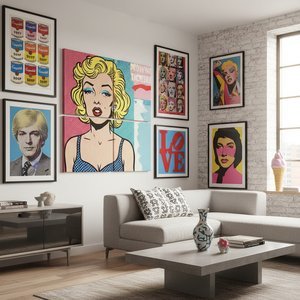
Pop art is an art movement that emerged in the United Kingdom and the United States during the mid- to late 1950s. The movement presented a challenge to traditions of fine art by including imagery from popular and mass culture, such as advertising, c...
Before Roy Lichtenstein’s explosive arrival on the art scene, the landscape was dominated by Abstract Expressionism – a movement steeped in subjective emotion and spontaneous gesture. Artists like Jackson Pollock and Mark Rothko sought to convey universal truths through non-representational forms, prioritizing the act of painting itself over any discernible subject matter. This emphasis on the internal world, however, left many feeling alienated from the canvas. A subtle but growing undercurrent of dissatisfaction began to emerge, a yearning for art that reflected the burgeoning consumer culture and the everyday realities of postwar America. Artists like Jasper Johns and Robert Rauschenberg tentatively introduced recognizable imagery – flags, maps, newspaper clippings – into their work, hinting at a shift in focus. These pioneers laid the groundwork for Pop Art’s eventual embrace of popular iconography, questioning the very definition of ‘high art’ and challenging the established hierarchy of subject matter. They paved the way for an artist who would take this rebellion to its most visually striking conclusion.
From Abstract Expressionism to Comic Book Panels: Lichtenstein's Early Evolution
Roy Lichtenstein’s artistic journey wasn’t a sudden leap into Pop aesthetics. Initially trained in traditional techniques at Parsons School of Design and Ohio State University, he explored various styles throughout the 1950s, including Cubism and Abstract Expressionism. He possessed a strong technical foundation, mastering representational drawing before deliberately abandoning it for the seemingly ‘crude’ aesthetic of comic books. This wasn't merely stylistic mimicry; it was a conscious rejection of the prevailing artistic dogma. Lichtenstein found himself increasingly drawn to the graphic clarity and bold simplicity of commercial art – advertisements, packaging, and particularly, comic strips. He recognized in these forms a potent visual language that resonated with the zeitgeist, reflecting a society saturated with mass media imagery. Early works from this period demonstrate a fascinating tension between his academic training and his burgeoning fascination with popular culture, foreshadowing the iconic style he would soon develop.
Ben-Day Dots & the Mechanical Aesthetic: Deconstructing the Image
 Whaam!
Experience Roy Lichtenstein’s ‘Whaam!’ – a defining Pop Art masterpiece! Bold comic-style, Ben-Day dots & commentary on war. Iconic artwork for collectors & interiors.
The defining characteristic of Lichtenstein’s work – the Ben-Day dot – wasn't simply a visual flourish; it was a deliberate attempt to deconstruct the illusion of depth and authenticity in art. These tiny, evenly spaced dots, originally used in commercial printing to create tonal variations, became synonymous with his style. By meticulously hand-painting these dots onto canvas (a process ironically labor-intensive for an aesthetic that mimicked mechanical reproduction), Lichtenstein exposed the underlying structure of mass-produced imagery. He wasn’t merely *representing* a comic book panel; he was recreating its very method of production, highlighting the artificiality inherent in all forms of representation. This technique also served to flatten the image, eliminating traditional notions of perspective and creating a distinctly graphic quality. The effect is both visually arresting and intellectually provocative, forcing viewers to confront the relationship between art, commerce, and technology. Whaam!, with its dramatic depiction of aerial combat, exemplifies this approach, transforming a fleeting moment into a static, stylized icon.
War, Romance, and Consumer Culture: Recurring Themes in Lichtenstein’s Oeuvre
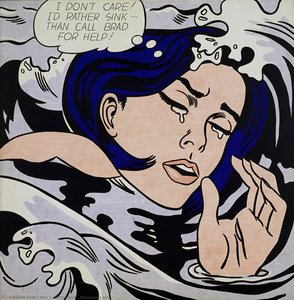 Drowning girl
Explore Roy Lichtenstein’s ‘Drowning Girl’! A vibrant Pop Art masterpiece featuring melodrama & Ben-Day dots. Own a piece of art history – perfect for collectors & interiors.
While often celebrated for his comic-inspired imagery, Lichtenstein's work wasn’t simply about replicating popular forms. Beneath the bright colors and bold lines lay a subtle but incisive commentary on American society. Recurring themes of war, romance, and consumerism permeated his oeuvre. Paintings like Blam! and other depictions of wartime scenarios weren’t glorifications of conflict; they were ironic examinations of its sensationalized portrayal in popular media. Similarly, his portrayals of idealized women – often caught in moments of melodrama, as seen in Drowning Girl – critiqued the stereotypical representations prevalent in comics and advertising. These works weren’t endorsements of these themes; they were explorations of their cultural impact, forcing viewers to question the values and assumptions embedded within them. His appropriation of commercial imagery wasn't about celebrating consumerism but rather about dissecting its pervasive influence on everyday life.
Lichtenstein's Impact and Enduring Influence on Contemporary Art
Roy Lichtenstein’s impact on contemporary art is undeniable. He, alongside Andy Warhol, fundamentally altered the course of artistic expression, challenging traditional notions of authorship, originality, and subject matter. His work paved the way for a new generation of artists who embraced appropriation, irony, and the blurring of boundaries between ‘high’ and ‘low’ culture. The influence of his Ben-Day dot technique can be seen in countless works across various disciplines – from graphic design to fashion to advertising. He demonstrated that art could be found not just in museums and galleries but also in the everyday objects that surrounded us, democratizing the artistic experience and expanding the definition of what constituted ‘art.’ His legacy continues to inspire artists today, prompting ongoing conversations about the role of art in a consumer-driven society.
Collecting Lichtenstein: Value, Authenticity, and Investment Considerations
Acquiring a Roy Lichtenstein artwork is not merely purchasing a beautiful object; it’s investing in a significant piece of art history. His works consistently command high prices at auction, with Masterpiece, sold for $165 million in 2017, representing the pinnacle of his market value. However, navigating the Lichtenstein market requires careful consideration. Authenticity is paramount, given the prevalence of reproductions and imitations. Provenance – the documented history of ownership – is crucial, as is a thorough examination of the work’s technique and materials. Consulting with reputable art appraisers and galleries is essential before making any investment. Beyond financial considerations, collecting Lichtenstein offers an opportunity to engage with a truly iconic artist whose work continues to resonate with contemporary audiences. At OriginalUniqueArt.com, we offer high-quality reproductions of Lichtenstein’s masterpieces, allowing art enthusiasts to experience his vision firsthand and appreciate the enduring power of Pop Art.