Hudson River School
Moonlight - Piazza Vecchia (Thomas Cole)
Thomas Cole (1801–1848) maakte Moonlight - Piazza Vecchia. Het behoort tot de Hudson River School-stroming. Het is gemaakt van Oil On Canvas.
- Oil On Canvas

 Voorvertoning

 Met de hand geschilderd olieverfwerk
 Verstuur
 Delen
 Informatieblad


 Download
 Vergelijkbare items
 Röntgenonderzoek
 Diavoorstelling
 Vraag & antwoord

 Statistieken
Moonlight - Piazza Vecchia, in het kort
- Titel
- Moonlight - Piazza Vecchia
- Kunstenaar
- Thomas Cole (1801–1848)
- Geboren in [jaar]
- Bolton, Verenigd Koninkrijk
- Medium
- Oil On Canvas
- Beweging
- Hudson River School
- Periode
- 19th Century
- Onderwerp
- moonlight, bridge, buildings, clock, river, person
Wat stelt Moonlight - Piazza Vecchia voor?
Identification of Moonlight - Piazza Vecchia
Moonlight - Piazza Vecchia is an oil painting by Thomas Cole. The artist, born in 1801 in Bolton, United Kingdom, moved to the United States in 1818. He eventually settled in Catskill, New York, where he remained until his death on February 11, 1848.
The scene captures a cityscape under a moonlit atmosphere. A bridge overlooks a body of water, appearing as either a river or an ocean. In the foreground, two buildings flank the composition, with a clock hanging from a wall near the center. A solitary figure stands near the bridge, observing the nocturnal view. The moonlight casts a soft glow across the architecture and the water, establishing a serene mood.
The Composition and Visual Elements
The nocturnal cityscape is organized around a central bridge that spans a body of water, appearing as either a river or an ocean. In the foreground, the composition is framed by two buildings positioned on the left and right sides. Near the center of the image, a clock hangs from a wall, providing a focal point amidst the architectural details. A solitary figure stands near the bridge, appearing to observe the view or move through the urban space.
Atmospheric light defines the scene. Moonlight casts a soft glow across the environment, creating a serene and peaceful mood. This illumination interacts with the shadows of the buildings and the surface of the water to establish depth within the nocturnal setting. The interplay of light and shadow emphasizes the quietude of the city at night.
The Artistic Style of Thomas Cole
Working primarily with oil on canvas, Cole developed a technique characterized by a sophisticated use of light and shadow. He utilized this interplay to establish atmospheric depth and a sense of volume within his compositions. His approach frequently involved the placement of solitary structures or small figures against expansive, moody landscapes, a method that emphasizes the scale of the environment relative to human presence.
His brushwork demonstrates a keen ability to render the specific textures of the natural world. This attention to detail allows for a tactile quality in his depictions of wilderness and terrain. Through careful layering of pigments, he achieved a tonal richness that defines the visual weight of his subjects.
Related Works by Thomas Cole
Cole’s exploration of landscape and the passage of time is evident in several significant compositions. His 1836 work, The Oxbow, also known as The Connecticut River near Northampton, examines the tension between untamed nature and cultivated land. This same year saw the completion of The Course of Empire, a five-part series tracing the cyclical rise and fall of civilizations.
Other notable works include River in the Catskills, painted in 1843. These pieces reflect the artist's ongoing engagement with the American wilderness and the shifting relationship between the natural world and human presence.
Hoogwaardige afbeeldingen van Moonlight - Piazza Vecchia
Publiek domein: de kunstenaar is overleden in 1848.
Thomas Cole, Moonlight - Piazza Vecchia. Publiek domein
Vragen over Moonlight - Piazza Vecchia, beantwoord
Met welke techniek is "Moonlight - Piazza Vecchia" door Thomas Cole vervaardigd?
"Moonlight - Piazza Vecchia" is uitgevoerd in Oil On Canvas.
Wat stelt "Moonlight - Piazza Vecchia" voor?
"Moonlight - Piazza Vecchia" door Thomas Cole toont: moonlight, bridge, buildings, clock, river, person, cityscape, night.
Behoort "Moonlight - Piazza Vecchia" door Thomas Cole tot het publiek domein?
"Moonlight - Piazza Vecchia" door Thomas Cole valt onder bevindt zich in het publiek domein - de auteursrechten zijn verlopen. Deze status bepaalt hoe de afbeelding van het werk mag worden gereproduceerd.
Wie is de kunstenaar achter "Moonlight - Piazza Vecchia"?
De kunstenaar achter "Moonlight - Piazza Vecchia" is Thomas Cole. Het werk is gecatalogiseerd onder de naam van Thomas Cole.
Tot welke stijl behoort "Moonlight - Piazza Vecchia"?
De kunststroming die verbonden is aan "Moonlight - Piazza Vecchia" door Thomas Cole is Hudson River School. Deze classificatie plaatst het werk binnen een context van verwante kunstenaars en kunstwerken.
Behoort "Moonlight - Piazza Vecchia" van Thomas Cole tot het publiek domein, en zo ja, waarom?
De auteursrechtstatus van "Moonlight - Piazza Vecchia" - bevindt zich in het publiek domein - de auteursrechten zijn verlopen - is gebaseerd op het overlijden van de kunstenaar in 1848.
Wat deelt "Moonlight - Piazza Vecchia" met het overige oeuvre van Thomas Cole?
"Moonlight - Piazza Vecchia" behoort tot het Hudson River School-werk van Thomas Cole, waarvan de bekende thema's onder meer european old masters, hudson river school, romantic landscape, spiritual resonance, nature vs. civilization omvatten.
Hoe verhoudt het onderwerp van "Moonlight - Piazza Vecchia" zich tot de gebruikelijke thema's van Thomas Cole?
"Moonlight - Piazza Vecchia" verbeeldt moonlight, bridge, buildings, clock, river, person, cityscape, night, terwijl de bekende thema's van Thomas Cole european old masters, hudson river school, romantic landscape, spiritual resonance, nature vs. civilization zijn. Een vergelijking tussen beide laat zien hoe het werk zich verhoudt tot de gebruikelijke onderwerpen van de kunstenaar.
Over de kunstenaar, Thomas Cole

1801–1848, Verenigd Koninkrijk
Thomas Cole
Het Leven en de Kunst van Thomas Cole Geboren op 1 februari 1801 in Bolton le Moors, Lancashire, Engeland, begon het leven van Thomas Cole ver verwijderd van de landschappen die uiteindelijk zijn naam zouden definiëren. In 1818 emigreerde zijn familie naar de Verenigde Staten, op zoek naar een nieuw begin in een land van uitgestrekte, onontdekte territoria. In die vroege jaren was hij een man van vele ambachten; hij werkte als graveur en vond vanaf 1822 uiteindelijk stabiel werk als portretschilder. Hij was grotendeels autodidact en ontwikkelde zijn oog door observatie en het bestuderen van boeken, in plaats van door een formele academische opleiding.
Ook van Thomas Cole
 De Oxbow
 De droom van de architect1840
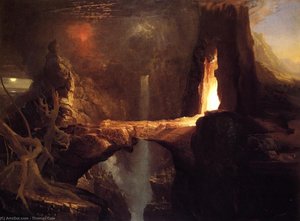 Verdrijving. Maan en Licht1828
 Een uitzicht op Florence vanuit San Miniato1837
Essays over Moonlight - Piazza Vecchia
 Masterpieces of the Wilderness: The Top 25 Thomas Cole ArtworksExplore the sublime Hudson River School through Thomas Cole's top 25 masterpieces. Discover the full collection online at OriginalUniqueArt…
 British artworks of the 1840s1840s British masterpieces by J. M. W. Turner and John Everett Millais. Shop museum-quality reproductions on OriginalUniqueArt.com.
 British artworks of the 1820sBritish Romanticism in the 1820s features the iconic works of J.M.W. Turner, John Constable, and William Blake. View the full collection at…