Cubism · 1914
Blue Lovers (Marc Chagall, 1914)
Marc Chagall (1887–1985) maakte Blue Lovers. Het dateert uit 1914. Het behoort tot de Cubism-stroming. Het is gemaakt van Oil. De afmetingen zijn 49 × 44 cm.
- 1914
- Oil
- 49 × 44 cm

 Voorvertoning

 Met de hand geschilderd olieverfwerk
 Verstuur
 Delen
 Informatieblad


 Download
 Vergelijkbare items
 Röntgenonderzoek
 Diavoorstelling
 Vraag & antwoord

 Statistieken
Blue Lovers, in het kort
- Titel
- Blue Lovers
- Kunstenaar
- Marc Chagall (1887–1985)
- Geboren in [jaar]
- Liozna, Wit-Rusland
- Datum
- 1914
- Medium
- Oil
- Afmetingen
- 49 × 44 cm
- Beweging
- Cubism
- Periode
- Modern
- Onderwerp
- love, embrace, blue sky, couple, gesture, surrealism
Wat stelt Blue Lovers voor?
Blue Lovers: A Symphony of Color and Emotion
Marc Chagall’s “Blue Lovers,” completed in 1914 during his formative years as a Cubist innovator, transcends mere visual representation; it embodies the very essence of romantic connection. Measuring 49 x 44 cm, this oil painting stands as a cornerstone of Cubism—a stylistic choice that Chagall skillfully employed to convey his profound personal vision and artistic exploration.
- Style: Cubism – Chagall’s embrace of this revolutionary movement distinguishes him from many contemporaries. Unlike Impressionists who sought to capture fleeting moments of light, Cubism dissected objects into geometric fragments, presenting multiple perspectives simultaneously—a technique that challenged conventional artistic norms and paved the way for Surrealist experimentation.
- Technique: Chagall’s masterful brushwork contributes significantly to the painting's emotive power. Thick impasto creates textural surfaces that capture the physicality of the figures and imbue them with palpable warmth. The artist meticulously blended blues—ranging from serene cerulean to deep indigo—to establish a dominant color palette symbolizing tranquility, timelessness, and transcendence.
The Significance of Blue
Chagall’s unwavering fascination with blue is documented throughout his oeuvre, reflecting his belief in its ability to evoke spiritual contemplation. As he famously stated, “Blue symbolizes a space devoid of mass and time,” mirroring the idealized realm where earthly constraints dissolve and lovers merge into one harmonious entity. This sentimentality resonates deeply with Chagall's own relationship with Bella Rosenfield—a tumultuous romance that fueled his artistic creativity until her passing in 1994.
Historical Context: Vitebsk’s Influence
The painting’s genesis occurred in Vitebsk, Belarus—a city brimming with cultural diversity shaped by Orthodox Christianity and Jewish traditions. Chagall's upbringing instilled within him a distinctive aesthetic sensibility characterized by fantastical imagery and vibrant hues—elements that would permeate his subsequent works. The depiction of the couple’s faces pressed together underscores the importance of intimacy and vulnerability in human experience, mirroring themes prevalent in Vitebsk folklore.
Symbolism: Gesture and Light
The painting's composition is meticulously crafted to convey a sense of movement and dynamism—a subtle tremor that captures the fleeting beauty of a moment shared. The couple’s gesture—a tender embrace—represents affection, devotion, and mutual support. Furthermore, Chagall skillfully utilizes light—primarily emanating from an unseen source—to illuminate the figures' faces and create an ethereal atmosphere, symbolizing enlightenment and spiritual illumination.
Legacy: A Masterpiece Preserved
"Blue Lovers" resides within The Museum Staatsgalerie Moderner Kunst (Munich, Germany), cementing Chagall’s place as one of the foremost artists of the 20th century. Alongside “Les yeux” by Maria H., this painting exemplifies Chagall's unparalleled ability to fuse stylistic innovation with heartfelt emotion—a testament to his enduring artistic legacy.
Hoogwaardige afbeeldingen van Blue Lovers
Auteursrechtelijk beschermd: deze bestanden zijn uitsluitend voor persoonlijk gebruik en vormen geen licentie voor herpublicatie.
Marc Chagall, Blue Lovers (1914).
Veelgestelde vragen over Blue Lovers
In welk jaar werd "Blue Lovers" door Marc Chagall gemaakt?
"Blue Lovers" dateert uit 1914. Deze datum plaatst het werk binnen de carrière van Marc Chagall en het betreffende tijdperk.
Met welke techniek is "Blue Lovers" door Marc Chagall vervaardigd?
"Blue Lovers" is uitgevoerd in Oil.
Wat zijn de afmetingen van het originele "Blue Lovers"?
Het originele werk "Blue Lovers" door Marc Chagall heeft de afmetingen 49 x 44 cm.
Wat wordt er afgebeeld in "Blue Lovers" door Marc Chagall?
"Blue Lovers" door Marc Chagall toont: love, embrace, blue sky, couple, gesture, surrealism, geometry.
Behoort "Blue Lovers" door Marc Chagall tot het publiek domein?
Wat betreft het auteursrecht valt "Blue Lovers" onder nog steeds auteursrechtelijk beschermd.
Wie is de kunstenaar achter "Blue Lovers"?
De kunstenaar achter "Blue Lovers" is Marc Chagall. Het werk is gecatalogiseerd onder de naam van Marc Chagall.
Bij welke kunststroming behoort "Blue Lovers" door Marc Chagall?
"Blue Lovers" is een werk uit de Cubism. De stroming geeft de artistieke traditie aan waartoe het werk behoort.
In welke periode van de carrière van Marc Chagall valt "Blue Lovers"?
"Blue Lovers" vertegenwoordigt de Early Period van Marc Chagall.
Hoe oud was Marc Chagall bij het creëren van "Blue Lovers" in 1914?
Toen "Blue Lovers" werd gemaakt in 1914, was Marc Chagall - geboren in 1887 - 27 jaar oud.
Over de kunstenaar, Marc Chagall
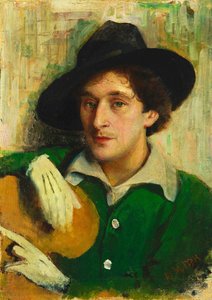
1887–1985, Wit-Rusland
Marc Chagall
Het Vroege Leven, Familie en Opleiding Marc Chagall kwam op 7 juli 1887 ter wereld in Vitebsk, in het Russische Rijk, geboren als Moishe Segal. Als eerste van negen kinderen in een bescheiden Joods gezin werd zijn leven gevormd door de ritmes van arbeid en kleinschalige handel. Zijn vader, Khatskel Segal, werkte als haringenpijper in een pakhuis, terwijl zijn moeder, Feïga-Ita Tchernina, een kleine kruidenierij runde. Deze vroege jaren zijn diep geworteld in de specifieke texturen van een provinciestad, waar de grenzen van zijn wereld werden bepaald door de behoeften van een groot huishouden en de rijke tradities van zijn gemeenschap.
Ook van Marc Chagall
 Ik en het Dorp1911
 Witte Kruisiging1938
 Het Verjaartje1915
 Over de stad1918
Essays over Blue Lovers
 Belarusian artworks of the 1950s1950s Belarusian art features masterpieces by Marc Chagall, including works like The Prophet. Find museum-quality reproductions on Original…
 Dreaming in Color: The 25 Most Iconic Masterpieces by Marc ChagallStep into the dreamlike world of Marc Chagall. Explore 25 iconic masterpieces, from vibrant surrealist tales to soulful folklore. Find insp…
 Belarusian artworks of the 1960sIconic Belarusian artworks of the 1960s, including masterpieces by Marc Chagall. Explore the full collection online at OriginalUniqueArt.co…