Realism · 1861
Catacombes De Paris (Gaspard-Félix Tournachon, 1861)
Gaspard-Félix Tournachon (1820–1910) maakte Catacombes De Paris. Het dateert uit 1861. Het behoort tot de Realism-stroming. Het is gemaakt van Photography.
- 1861
- Photography

 Met de hand geschilderd olieverfwerk
 Verstuur
 Delen
 Informatieblad


 Download
 Vergelijkbare items
 Diavoorstelling
 Vraag & antwoord

 Statistieken
Catacombes De Paris, in het kort
- Titel
- Catacombes De Paris
- Kunstenaar
- Gaspard-Félix Tournachon (1820–1910)
- Geboren in [jaar]
- rue Saint-Honoré, Frankrijk
- Datum
- 1861
- Medium
- Photography
- Beweging
- Realism
- Periode
- 19th Century
- Onderwerp
- skulls, bones, man, stone walls, monochrome, human remains
Wat stelt Catacombes De Paris voor?
Identification of Catacombes De Paris by Nadar
The photograph titled Catacombes De Paris was captured by the artist Nadar about 1861. It presents a chamber within the Paris Catacombs in Paris, France. Inside this subterranean space, stacks of human skulls and bones are arranged in rows. The image documents a quiet, organized architecture of remains.
This work represents one of the earliest examples of underground photography. The lens captures a realm of bone and shadow. It records the stillness of the ossuary through a stark, monochrome view. A heavy silence resides within the frame.
Composition and Visual Elements of the Work
A high-contrast monochrome palette defines this subterranean space, where light and shadow engage in a stark struggle. On the left side of the frame, a man stands as a silent observer, a visual anchor amidst the stillness. The darkness is not empty; it is a heavy presence that shrouds the periphery, pushing the eye toward the central arrangement of remains. Artificial light, likely cast from a lantern or flash, strikes the surfaces of the bones, carving them out of the gloom.
Geometry emerges from the organic chaos of the ossuary. Strong vertical lines rise from the stacks of bones and skulls, while horizontal lines define the orderly rows of the display. These intersecting paths create a rigid structure within the cramped chamber. Amidst these straight edges, circular shapes dominate the view, repeated endlessly through the numerous skulls that populate the scene. The textures shift from the smooth, pale surfaces of the crania to the rough, grainy quality of the stone walls. Every shadow holds a secret of the dark.
Technique and Photographic Materials Used
The darkness of the subterranean chamber required a calculated conquest of light. To pierce the shadows, the photographer employed artificial lighting, utilizing Bunsen batteries to provide a steady, controlled glow. Mannequins were positioned within the scene to assist in managing the illumination. This deliberate use of light allowed the camera and lens to capture the stark geometry of the bone stacks where natural light could not reach.
The image was captured through the wet collodion process, a method demanding immediate action and chemical precision. Light-sensitive chemicals, likely silver nitrate, were applied to the plates while they remained damp. These records were fixed onto glass or paper plates, preserving the textures of the skulls and the grain of the stone. Each exposure was a struggle against the damp, heavy air of the underground.
The resulting monochrome print holds the shadows in place. The chemical reaction binds the light to the surface, turning a fleeting moment of artificial brightness into a permanent, silent record. The light remains trapped in the silver.
Historical Context and Subject Matter
The image captures a subterranean reality beneath the streets of Paris, France. It documents a chamber filled with stacks of human skulls and bones, an ossuary that holds the remains of millions of Parisians. These bones were moved here from overcrowded cemeteries during the late 18th and early 19th centuries. The photograph, made about 1861, emerged during a period of rapid urbanization and social change within the city.
The subject matter provides a visual record of a unique and somewhat macabre location. It reveals the scale of the remains held within the dark, stone-walled passages. This work documents the infrastructure of the Parisian underground, a space that remained hidden from the public eye during the mid-nineteenth century. The stillness of the bones contrasts with the shifting, growing city above.
Related Works by the Artist Nadar
The shadows of the Parisian underground extend into other captures from 1861. In Égouts De Paris, the lens turns toward the city's sewer system. Here, the darkness is not filled with bone, but with the damp stone walls and flowing water of the subterranean tunnels. It is a study of the hidden veins beneath the streets, where light struggles against the heavy gloom of the masonry.
This work belongs to the movements of Realism and Pictorialism of the 19th Century. It shares a certain monochrome gravity with the catacombs, focusing on the functional, shadowed passages that exist far below the surface. The image captures a specific, gritty reality of the urban environment. It remains a quiet record of the infrastructure that remains out of sight.
Hoogwaardige afbeeldingen van Catacombes De Paris

Publiek domein: de kunstenaar is overleden in 1910.
Andere formaten, uitsneden en citatie →Gaspard-Félix Tournachon, Catacombes De Paris (1861). Publiek domein
Vragen over Catacombes De Paris, beantwoord
In welk jaar werd "Catacombes De Paris" door Gaspard-Félix Tournachon gemaakt?
"Catacombes De Paris" door Gaspard-Félix Tournachon werd gecreëerd in 1861.
Met welke techniek is "Catacombes De Paris" door Gaspard-Félix Tournachon vervaardigd?
Het medium van "Catacombes De Paris" door Gaspard-Félix Tournachon is Photography. Reproducties zijn bedoeld om de uitstraling van deze techniek weer te geven.
Wat stelt "Catacombes De Paris" voor?
"Catacombes De Paris" door Gaspard-Félix Tournachon toont: skulls, bones, man, stone walls, monochrome, human remains.
Behoort "Catacombes De Paris" door Gaspard-Félix Tournachon tot het publiek domein?
De auteursrechtelijke status van "Catacombes De Paris" door Gaspard-Félix Tournachon: het werk is bevindt zich in het publiek domein - de auteursrechten zijn verlopen. Dit bepaalt of reproducties van de afbeelding vrijelijk mogen worden gemaakt.
Wie is de kunstenaar achter "Catacombes De Paris"?
"Catacombes De Paris" is gemaakt door Gaspard-Félix Tournachon. De informatie op deze pagina beschrijft het originele werk van Gaspard-Félix Tournachon.
Tot welke stijl behoort "Catacombes De Paris"?
"Catacombes De Paris" door Gaspard-Félix Tournachon behoort tot de Realism-stroming. Deze stroming biedt de stilistische context van het werk.
In welke periode van de carrière van Gaspard-Félix Tournachon valt "Catacombes De Paris"?
"Catacombes De Paris" vertegenwoordigt de Mature Period van Gaspard-Félix Tournachon.
Op welke leeftijd maakte Gaspard-Félix Tournachon "Catacombes De Paris"?
Gaspard-Félix Tournachon maakte "Catacombes De Paris" op 41-jarige leeftijd. De kunstenaar werd geboren in 1820 en het werk dateert uit 1861.
Behoort "Catacombes De Paris" van Gaspard-Félix Tournachon tot het publiek domein, en zo ja, waarom?
"Catacombes De Paris" van Gaspard-Félix Tournachon is bevindt zich in het publiek domein - de auteursrechten zijn verlopen. De auteursrechten worden berekend vanaf het jaar van overlijden van de kunstenaar; Gaspard-Félix Tournachon is overleden in 1910.
Over de kunstenaar, Gaspard-Félix Tournachon
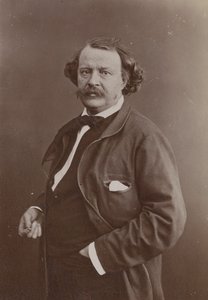
1820–1910, Frankrijk
Gaspard-Félix Tournachon
Félix Nadar: Een Pionier van de Fotografie Vroege Leven en Begin Geboren: Gaspard-Félix Tournachon op 5 april 1820 in Parijs (hoewel sommige bronnen Lyon suggereren). Zijn vader, Victor Tournachon, was een drukker en boekhandelaar. Hij studeerde aanvankelijk medicijnen, maar moest deze studie opgeven vanwege financiële moeilijkheden na de dood van zijn vader. Nadar, zoals hij later bekend zou worden, begon zijn carrière als karikaturist en romanschrijver, waarbij hij bijdroeg aan diverse kranten.
Over Gaspard-Félix Tournachon Bekende werken van Gaspard-Félix Tournachon
Ook van Gaspard-Félix Tournachon
 Alexandre Dumas père (1802-1870)1855
 Sarah Bernhardt1864
 [Sarah Bernhardt as the Empress Theodora in Sardou1889
 Paul and His Dog1865

Essays over Catacombes De Paris
 Beyond the Portrait: Félix Nadar & the Psychological Depths of 19th-Century PhotographyExplore the revolutionary photography of Félix Nadar – pioneer of portraiture, aerial imaging & psychological depth. Discover his iconic po…
 Dreams on Canvas: Understanding Automatist and Veristic SurrealismMaster the differences between Automatist and Veristic Surrealism. Explore the works of Dali and Miro to decode the dreamscape today.
 Top 25 Masterpieces by Laurent Fabre: A Journey Through Neo-Abstract GeometryImmerse yourself in the luminous world of Laurent Fabre. Explore 25 iconic Neo-Abstract masterpieces defined by geometric precision and chr…