AcademicArt
Blossoms (Émile Munier)
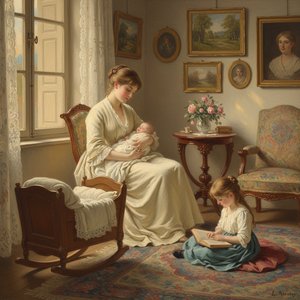
Émile Munier (1840–1895) maakte Blossoms. Het behoort tot de AcademicArt-stroming.

 Voorvertoning

 Met de hand geschilderd olieverfwerk
 Verstuur
 Delen
 Informatieblad


 Download
 Vergelijkbare items
 Röntgenonderzoek
 Diavoorstelling
 Vraag & antwoord

 Statistieken
Blossoms, in het kort
- Titel
- Blossoms
- Kunstenaar
- Émile Munier (1840–1895)
- Geboren in [jaar]
- Parijs, Frankrijk
- Beweging
- AcademicArt
- Onderwerp
- children and pets, pastoral scene”, “victorian era”, “bouguereau style”, “romantic painting”, “idealized beauty”
Hoogwaardige afbeeldingen van Blossoms
Publiek domein: de kunstenaar is overleden in 1895.
Émile Munier, Blossoms. Publiek domein
Vragen over Blossoms, beantwoord
Wat stelt "Blossoms" voor?
"Blossoms" door Émile Munier toont: children and pets, pastoral scene”, “victorian era”, “bouguereau style”, “romantic painting”, “idealized beauty”, “domestic bliss”.
Is de afbeelding van "Blossoms" door Émile Munier vrij van auteursrecht?
"Blossoms" door Émile Munier valt onder bevindt zich in het publiek domein - de auteursrechten zijn verlopen. Deze status bepaalt hoe de afbeelding van het werk mag worden gereproduceerd.
Wie is de kunstenaar achter "Blossoms"?
"Blossoms" is gemaakt door Émile Munier. De informatie op deze pagina beschrijft het originele werk van Émile Munier.
Bij welke kunststroming behoort "Blossoms" door Émile Munier?
"Blossoms" is een werk uit de AcademicArt. De stroming geeft de artistieke traditie aan waartoe het werk behoort.
In welke periode van de carrière van Émile Munier valt "Blossoms"?
Binnen de carrière van Émile Munier valt "Blossoms" in de Late Medieval. Deze fase helpt om het werk te vergelijken met andere werken van de kunstenaar.
Waarom heeft het kunstwerk "Blossoms" deze auteursrechtelijke status?
De auteursrechtstatus van "Blossoms" - bevindt zich in het publiek domein - de auteursrechten zijn verlopen - is gebaseerd op het overlijden van de kunstenaar in 1895.
Wat deelt "Blossoms" met het overige oeuvre van Émile Munier?
Binnen het oeuvre van Émile Munier past "Blossoms" binnen de AcademicArt-stijl, samen met de thema's van bouguereau's idealization, victorian domesticity", romantic pastoral scenes, moralizing sentimentality, academic tradition, childhood innocence, social harmony, genre painting focus.
Is "Blossoms" typerend voor het werk van Émile Munier?
Binnen de bekende thema's van Émile Munier - bouguereau's idealization, victorian domesticity", romantic pastoral scenes, moralizing sentimentality, academic tradition, childhood innocence, social harmony, genre painting focus - legt "Blossoms" een eigen focus op children and pets, pastoral scene”, “victorian era”, “bouguereau style”, “romantic painting”, “idealized beauty”, “domestic bliss”.
Over de kunstenaar, Émile Munier

1840–1895, Frankrijk
Émile Munier
Émile Munier: A Painter of Gentle Light and Timeless Innocence Émile Munier, born in the heart of Paris on June 2nd, 1840, is a figure whose artistic legacy quietly endures—a testament to his dedication to capturing the beauty of everyday life through a lens of refined academic technique and profound emotional sensitivity. His story isn’t one of dramatic upheaval or revolutionary innovation, but rather a gradual unfolding of talent nurtured within a family steeped in artistic tradition, shaped by the mentorship of a master, and ultimately defined by an unwavering commitment to portraying the tender moments of childhood and domestic harmony. His life was inextricably linked to the Gobelins Manufactory, where his father, Pierre François Munier, served as an artist upholsterer, and his mother, Marie Louise Carpentier, honed her skills in polishing cashmere cloth—a lineage that instilled in young Émile a deep appreciation for craftsmanship and visual beauty from the very beginning. Alongside his brothers, François and Florimond, he demonstrated an early aptitude for drawing, each producing self-portraits as teenagers – a subtle foreshadowing of the artistic path they would ultimately pursue.
Ook van Émile Munier
 A Tender Embrace1887
 the rescue1894
 Jesus
 Returning from the garden1875
Essays over Blossoms
 Blossoms of Time: A Historical & Aesthetic Exploration of Floral Painting Across CulturesExplore the rich history of floral painting! Discover symbolism, techniques & masterpieces from Van Huysum to O'Keeffe. Expert insights for…
 Émile Munier: Capturing 19th-Century French Life with Tender RealismDiscover Émile Munier's tender depictions of 19th-century French life. Explore his Realist style, charming paintings of children & pets, an…
 Mastering Abstraction: The Top 25 Iconic Artworks by Piet MondrianExplore 25 iconic Piet Mondrian masterpieces of Neoplasticism. Discover the full collection online at OriginalUniqueArt.com.