Aztec Empire
Flute (Azteekse Rijk)
Azteekse Rijk (1300–1521) maakte Flute. Het behoort tot de Aztec Empire-stroming. Het is gemaakt van Acrylic On Canvas. Het is te vinden in Metropolitan Museum of Art in New York, Verenigde Staten van Amerika.
- Acrylic On Canvas
- Metropolitan Museum of Art, New York

 Voorvertoning

 Met de hand geschilderd olieverfwerk
 Verstuur
 Delen
 Gids


 Download
 Vergelijkbare items
 Röntgenonderzoek
 Diavoorstelling
 Vraag & antwoord

 Statistieken
Flute: de essentie
- Titel
- Flute
- Kunstenaar
- Azteekse Rijk (1300–1521)
- Geboren in [jaar]
- Tenochtitlan, Mexico
- Medium
- Acrylic On Canvas
- Te zien in
- Metropolitan Museum of Art, New York, Verenigde Staten van Amerika
- Beweging
- Aztec Empire
- Onderwerp
- flute, aztec, ancient, culture, symbolism, mesoamerica
Wat stelt Flute voor?
The Echoing Voice of Stone: An Exploration of the Aztec Flute
Within the vast tapestry of Aztec artistry lies a deceptively simple instrument – the flute, often referred to as *uilacapitztli* (meaning “flute-head”). More than just a musical device, this clay vessel, meticulously crafted and imbued with symbolic resonance, offers a poignant window into the spiritual beliefs, artistic traditions, and cultural values of one of Mesoamerica’s most sophisticated civilizations. Recovered from archaeological sites across Mexico, these flutes – often adorned with depictions of animals, deities, or geometric patterns – are not merely relics of the past; they are tangible echoes of a vibrant society that flourished for centuries before succumbing to Spanish conquest.
The creation of an *uilacapitztli* was a deliberate and carefully considered process. Typically fashioned from unfired clay, these flutes were meticulously shaped by hand, reflecting a remarkable level of skill and artistry. The most common form is a cylindrical vessel with a distinctive bird-shaped head – the ‘head’ representing the feathered serpent Quetzalcoatl, a central deity associated with music, knowledge, and creation. Smaller versions, often resembling frogs or turtles, were also produced, suggesting their use in children's toys or as ritual objects for specific ceremonies. The intricate carvings that adorn these flutes – stylized representations of jaguars, serpents, birds, and geometric designs – are not merely decorative; they carry profound symbolic meaning, reflecting the Aztec worldview and their connection to the natural world.
A Symphony of Symbolism
The symbolism embedded within each *uilacapitztli* is a rich testament to Aztec cosmology. The bird-shaped head, prominently featured on many instruments, directly references Quetzalcoatl, whose association with music and the wind suggests a connection between sound, spirituality, and communication with the divine. Animal motifs – particularly jaguars and serpents – were frequently linked to powerful deities and represented concepts such as strength, fertility, and transformation. Geometric patterns, often repeating spirals or zigzags, may have symbolized cycles of time, cosmic order, or the interconnectedness of all things. The choice of animal or symbol likely depended on the specific purpose for which the flute was intended – whether for ceremonial use, entertainment, or even as a gift.
Furthermore, the clay itself held significance. Clay was considered a sacred material, representing earth and fertility—a fundamental element in Aztec beliefs. The act of shaping the clay into an instrument was therefore imbued with ritualistic importance, transforming a mundane substance into a conduit for spiritual expression. It’s believed that these flutes were not simply played; they were *sung* – their sounds carefully controlled to evoke specific emotions and connect with the spirit world.
A Legacy in Sound and Form
The *uilacapitztli* stands as a powerful reminder of the Aztec Empire’s artistic sophistication and its deep connection to spirituality. While much remains unknown about the precise melodies produced by these instruments, their enduring presence speaks volumes about the importance of music within Aztec society. These flutes were not merely objects; they were vessels for storytelling, ritual performance, and spiritual communion.
Today, high-quality reproductions of these ancient instruments are available, offering a unique opportunity to experience the beauty and artistry of Aztec craftsmanship. When selecting a reproduction, consider the materials used – authentic clay or durable ceramics that capture the texture and feel of the original. The level of detail in the carvings will also reflect the quality of the piece, ensuring it accurately represents the intricate symbolism of the ancient *uilacapitztli*. Owning such a reproduction is not simply acquiring an artifact; it’s embracing a tangible link to a remarkable civilization and allowing its resonant voice to echo through time.
In welk museum bevindt Flute zich?
Metropolitan Museum of Art
New York, Verenigde Staten van Amerika
Oorsprong en geschiedenis van het Metropolitan Museum of Art Het Metropolitan Museum of Art begon met een visie die werd gedeeld door een groep zakenlieden, financiers en vooraanstaande kunstenaars en denkers. Na de oprichting in 1870 zocht de instelling naar een permanente thuishaven om haar groeiende collectie onder te brengen. Voordat het museum zich op de huidige locatie vestigde, maakte het een korte periode door in het Douglas Mansion-landgoed aan West 14th Street.


Flute in hoge resolutie

Publiek domein: de kunstenaar is overleden in 1521.
Meer formaten, uitsneden & citatiegegevens →Azteekse Rijk, Flute, Metropolitan Museum of Art. Publiek domein
Een digitale expert controleert de kleuren aan de hand van het originele schilderij en retoucheert het bestand, trouw aan de penseelstreken van de kunstenaar.
Koop de afbeelding in hoge resolutieVragen over Flute
Waar komen de bezoekers van "Flute" door Azteekse Rijk vandaan?
Er bestaat een Statistieken-pagina voor "Flute". Deze brengt de maandelijkse bezoeken aan het kunstwerk en andere werken van de kunstenaar in kaart, met uitsplitsingen naar land en taal.
Aan welke kunstenaar wordt "Flute" toegeschreven?
"Flute" wordt toegeschreven aan Azteekse Rijk.
Onder welke pseudoniemen of andere namen is Azteekse Rijk bekend?
Azteekse Rijk staat ook bekend onder de namen Azteekse Kunst.
Wat voegt "Flute" door Azteekse Rijk toe aan een interieur?
Met zijn Calm karakter is "Flute" een aanrader voor de Living Room.
Welke afdrukinstellingen worden aanbevolen voor "Flute" door Azteekse Rijk?
Voor "Flute" is de aanbevolen afdrukinstelling een formaat van Medium en een Landscape oriëntatie.
Wat is de reden voor de auteursrechtelijke status van "Flute" door Azteekse Rijk?
"Flute" door Azteekse Rijk is bevindt zich in het publiek domein - de auteursrechten zijn verlopen. De auteursrechtelijke bescherming loopt vanaf het overlijden van de kunstenaar, dat plaatsvond in 1521.
Waar zou een reproductie van "Flute" door Azteekse Rijk opgehangen moeten worden?
Het Landscape-formaat van "Flute" door Azteekse Rijk wordt aanbevolen voor een Living Room. Formaat en ruimte samen bepalen de ideale plaatsing van een reproductie.
Kan "Flute" door Azteekse Rijk, onderdeel van de collectie van Metropolitan Museum of Art, op legale wijze worden gereproduceerd?
Het originele "Flute" bevindt zich in Metropolitan Museum of Art en het werk is bevindt zich in het publiek domein - de auteursrechten zijn verlopen.
Welk kleurenpalet wordt gebruikt in "Flute"?
De kleuren van "Flute" vormen een Pastels palet. Deze classificatie beschrijft de dominante kleurfamilies.
Over de kunstenaar, Azteekse Rijk

1300–1521, Mexico
Azteekse Rijk
De Echo's van Steen: Een Verkenning van de Kunst en Erfenis van het Azteekse Rijk De naam “Azteek” – afgeleid van het Nahuatl-woord ātl-ce-tlācati–tlān, wat "volk van vele vormen" betekent – roept beelden op van een uitgestrekt, complex rijk dat Mesoëmerica eeuwenlang domineerde. Meer dan alleen krijgers en veroveraars, waren de Azteken diepgaande kunstenaars die een verfijnde schoonheid weefden in elk aspect van hun leven – van monumentale architectuur tot delicaat verenwerk, van heilige rituelen tot alledaagse objecten. Hun kunst was niet louter decoratief; het was een levendige taal die religieuze overtuigingen, politieke macht, historische verhalen en sociale hiërarchieën communiceerde binnen een samenleving die zowel rigide gestructureerd als opmerkelijk innovatief was. De artistieke tradities van de Azteken, die in de vroege 14e eeuw ontstonden in Tenochtitlan, het hart van het Azteekse Rijk, waren diep geworteld in de nalatenschap van eerdere Meso-Amerikaanse beschavingen.
Ook van Azteekse Rijk
 Mosaic of a Double-headed Serpent1521
 Head from a Figure, Xochipilli Macuilxochitl1521
 Figure1521
 Serpent Labret met Articulated Tongue

Essays over Flute
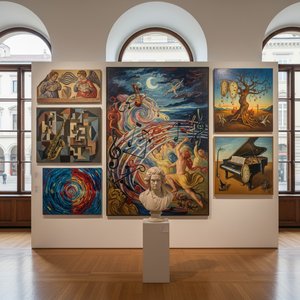 Harmonies on Canvas: Exploring the Visual Representation of Music in Art HistoryExplore the fascinating history of music's visual representation in art! From ancient symbolism to modern abstraction, discover how artists…
 Feathered Visions: A Historical & Artistic Exploration of Birds in PaintingExplore the rich history of birds in painting! Discover symbolism, artistic movements & master artists like Audubon. High-quality reproduct…
 25 Must-See Masterpieces at The Met: A Journey Through Art HistoryExplore 25 iconic treasures from The Met, from Pollock to Rembrandt. Discover museum-quality art on OriginalUniqueArt.com.