Art Nouveau Art Nouveau
(41) (Alphonse Mucha)
Alphonse Mucha (1860–1939) maakte (41). Het behoort tot de Art Nouveau Art Nouveau-stroming. Het is gemaakt van Acrylic On Canvas.
- Acrylic On Canvas

 Voorvertoning

 Met de hand geschilderd olieverfwerk
 Verstuur
 Delen
 Informatieblad


 Download
 Vergelijkbare items
 Röntgenonderzoek
 Diavoorstelling
 Vraag & antwoord

 Statistieken
(41), in het kort
- Titel
- (41)
- Kunstenaar
- Alphonse Mucha (1860–1939)
- Geboren in [jaar]
- Ivančice, Tsjechië
- Medium
- Acrylic On Canvas
- Beweging
- Art Nouveau Art Nouveau
- Onderwerp
- woman, hair, dress, baby, floral, organic
Wat stelt (41) voor?
Alphonse Mucha: The Enchanting Symbolism of Art Nouveau
Alphonse Maria Mucha stands as one of the most recognizable figures of Art Nouveau, an artistic movement that flourished between 1890 and 1910 across Europe. Born in Brno, Czech Republic, in 1860, Mucha rejected the rigid academic traditions of his time, forging a path toward a uniquely expressive style that captivated audiences and continues to inspire artists today.
Much’s artistic vision centered around capturing ethereal beauty—primarily through idealized depictions of women—often presented in flowing robes adorned with intricate floral motifs. Influenced by Impressionism and Symbolism, he skillfully blended these influences into his distinctive Art Nouveau aesthetic. Unlike the prevailing stylistic trends of his era, Mucha prioritized organic forms and graceful curves, mirroring the natural world’s rhythms and conveying a sense of movement.
His breakthrough came with collaborations on decorative posters for Parisian theaters and exhibitions. These commissions demanded meticulous attention to detail—particularly in the rendering of textures and colors—resulting in stunning visual experiences that cemented Mucha's reputation as a master craftsman. He employed techniques such as cloisonné enamel, gilding, and lithography to achieve unparalleled luminosity and vibrancy, pushing the boundaries of printmaking.
The Slavonic Uprising: A Fusion of Tradition and Innovation
Perhaps Mucha’s most ambitious project was “The Slavonic Uprising,” a monumental mural commissioned for Prague’s National Theatre. This artwork exemplifies Mucha's ability to synthesize disparate elements into a cohesive narrative—combining traditional Czech folklore with the dynamism of Art Nouveau principles.
The mural depicts a stylized battle scene, featuring figures draped in flowing robes reminiscent of Slavic princesses and warriors. Mucha skillfully utilized bold colors and sweeping lines to convey the urgency and grandeur of the uprising, capturing both its heroic spirit and its underlying melancholy. The intricate floral ornamentation—particularly around the central figures—underscores the movement’s preoccupation with nature and symbolizes resilience amidst adversity.
Symbolism Rooted in Myth and Folklore
Throughout Mucha's oeuvre, symbolism played a crucial role in conveying deeper meanings beyond mere visual representation. Recurring motifs—such as lilies, roses, and peacocks—carried associations rooted in Slavic mythology and Christian iconography. These symbols served to elevate the artwork’s emotional impact, inviting viewers to contemplate themes of heroism, sacrifice, and spiritual transcendence.
Consider “La Ribambelle des Gobelins,” a collaborative project with Piero Dorazio that explored the concept of collective creativity. Mucha's contribution—a stylized depiction of women—embodied the movement’s belief in the transformative power of art to inspire social change and celebrate human beauty.
A Legacy Enduring Through Reproduction
Today, Alphonse Mucha’s artwork continues to resonate with audiences worldwide. High-quality reproductions offer a captivating glimpse into his artistic genius—allowing collectors and interior designers alike to experience the enchantment of Art Nouveau firsthand. His enduring influence testifies to the power of visionary art to transcend time and inspire generations of artists.
Hoogwaardige afbeeldingen van (41)
Publiek domein: de kunstenaar is overleden in 1939.
Alphonse Mucha, (41). Publiek domein
Vragen over (41), beantwoord
Met welk medium is "(41)" door Alphonse Mucha uitgevoerd?
Het medium van "(41)" door Alphonse Mucha is Acrylic On Canvas. Reproducties zijn bedoeld om de uitstraling van deze techniek weer te geven.
Wat stelt "(41)" door Alphonse Mucha voor?
"(41)" door Alphonse Mucha toont: woman, hair, dress, baby, floral, organic, flowing lines, symmetry.
Is "(41)" vrij van auteursrecht?
De auteursrechtelijke status van "(41)" door Alphonse Mucha: het werk is bevindt zich in het publiek domein - de auteursrechten zijn verlopen. Dit bepaalt of reproducties van de afbeelding vrijelijk mogen worden gemaakt.
Wie heeft "(41)" gemaakt?
De kunstenaar achter "(41)" is Alphonse Mucha. Het werk is gecatalogiseerd onder de naam van Alphonse Mucha.
Tot welke stijl behoort "(41)"?
"(41)" is een werk uit de Art Nouveau Art Nouveau. De stroming geeft de artistieke traditie aan waartoe het werk behoort.
Tot welke periode in de carrière van Alphonse Mucha behoort "(41)"?
"(41)" vertegenwoordigt de Mature Period van Alphonse Mucha.
Waarom heeft het kunstwerk "(41)" deze auteursrechtelijke status?
"(41)" van Alphonse Mucha is bevindt zich in het publiek domein - de auteursrechten zijn verlopen. De auteursrechten worden berekend vanaf het jaar van overlijden van de kunstenaar; Alphonse Mucha is overleden in 1939.
Wat deelt "(41)" met het overige oeuvre van Alphonse Mucha?
"(41)" behoort tot het Art Nouveau Art Nouveau-werk van Alphonse Mucha, waarvan de bekende thema's onder meer renoir, moreau, czech motifs, modern art nouveau, idealized femininity omvatten.
Hoe verhoudt het onderwerp van "(41)" zich tot de gebruikelijke thema's van Alphonse Mucha?
"(41)" verbeeldt woman, hair, dress, baby, floral, organic, flowing lines, symmetry, terwijl de bekende thema's van Alphonse Mucha renoir, moreau, czech motifs, modern art nouveau, idealized femininity zijn. Een vergelijking tussen beide laat zien hoe het werk zich verhoudt tot de gebruikelijke onderwerpen van de kunstenaar.
Over de kunstenaar, Alphonse Mucha

1860–1939, Tsjechië
Alphonse Mucha
Early Life and Artistic Beginnings Alphonse Maria Mucha, geboren in 1860 in Ivanačice, een klein stadje in de zuidelijke Moravië (het huidige deel van Tsjechië), was al vroeg duidelijk dat hij een artistieke ziel bezat. Zijn talent voor tekenen ontdekte hij als kind, en hoewel zijn familie niet over de middelen beschikte om hem een formele opleiding te bieden, bleef hij tekenen met zijn linkerhand – een ongebruikelijke keuze die zijn unieke stijl zou bepalen. Deze vroege discipline en passie vormden de basis voor zijn latere successen. Zijn jeugd was gekleurd door de wisselvallige politieke omstandigheden van het Oostenrijk-Hongaarse rijk, waarin hij opgroeide, wat een diepe invloed had op zijn artistieke expressie.
Ook van Alphonse Mucha
 The Moon
 Nude
 The Apotheosis of the Slavs1926
 Stained-Glass Window in St. Vitus Cathedral
Essays over (41)
 Resilience and Heritage: A Curated Journey Through the Soul of Ukrainian Art HistoryExplore the profound legacy of Ukrainian art from Baroque grandeur to Repin's realism. Discover this rich cultural journey now.
 De Allure van Authenticiteit: Handgeschilderde Reproducties als Investering in Textuur, Diepte en Ambachtelijke WaardeOntdek handgeschilderde reproducties van museumkwaliteit. Investeer in ambachtelijk schilderwerk en breng de schoonheid van klassieke kunst…
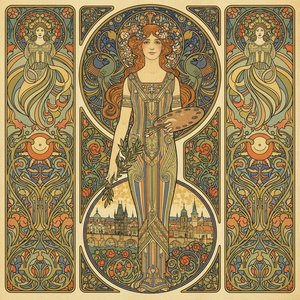 Alphonse Mucha: A Comprehensive Exploration of Art Nouveau's Master of Decorative SymbolismExplore the life & art of Alphonse Mucha, master of Art Nouveau! Discover his iconic posters, stunning illustrations, and the monumental Sl…