Portret van Red Grooms

De 40 beroemdste schilderijen van Red Grooms, elk uniek

Bijgewerkt in november 2026 · gerangschikt op basis van onze populariteitsscore (zoekopdrachten, bezoeken en bestellingen per kunstwerk) · 41 werken van Red Grooms in onze catalogus

Kortom

Self-portrait with extra large paper hat (1955) is het schilderij van Red Grooms dat de meeste aandacht trekt. Daarna gaat de blik naar Derain and Poiret (1998) en (Constantine) Guys (1972). Van de 41 werken van Red Grooms in onze catalogus zijn dit de 40 bekendste, elk een uniek origineel gepresenteerd met het jaar, het museum en de reden waarom het blijft voortbestaan.

geboren in 1937, Nashville Pop art Meeste werken: Metropolitan Museum of Art

Top 10 schilderijen van Red Grooms, door de ogen van de galerie

2
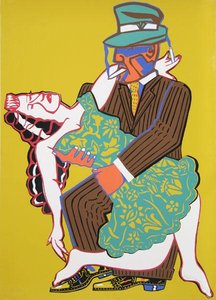
Derain and Poiret (1998) door Red Grooms

Derain and Poiret

1998 · Oil On Canvas · Metropolitan Museum of Art, New York

The work known as Derain and Poiret emerges from the creative mind of Red Grooms, an artist whose origins trace back to Nashville, Tennessee, in 1937. In this piece, the artist captures a specific moment of visual inquiry, bringing together names and ideas through a unique lens. The piece dates to 1998, a time when the artist's hand was already deeply engaged with the textures of modern existence.

De beroemde schilderijen van Red Grooms, nummer 11 tot 40

De onderwerpen die de aandacht van Red Grooms troffen

De vier onderwerpen die het meest voorkomen in deze originelen, elk met zijn mooiste voorbeeld.

De musea waar de originele werken van Red Grooms worden bewaard

Het museum met de meeste schilderijen op deze pagina.

Museum Stad Werken van Red Grooms Schilderijen uit deze lijst
Metropolitan Museum of Art, New YorkMetropolitan Museum of Art New York 1 Derain and Poiret

Red Grooms door de decennia heen: elk een uniek origineel

Werken per decennium

Kies een decennium om het origineel te zien dat dit tijdperk definieert.

Schilderijen van Red Grooms: vragen voor de galerie

Wat is het bekendste werk van Red Grooms?Onthul het antwoord

Self-portrait with extra large paper hat (1955). Derain and Poiret (1998) en (Constantine) Guys (1972) volgen.

Op welke leeftijd creëerde Red Grooms Self-portrait with extra large paper hat?Onthul het antwoord

18 jaar oud: Self-portrait with extra large paper hat dateert uit 1955, en Red Grooms werd geboren in 1937.

Welke tien schilderijen van Red Grooms zijn het meest bekend?Onthul het antwoord

Self-portrait with extra large paper hat, Derain and Poiret, (Constantine) Guys, Blewy, Baudelaire, Degas, Wounded Bird, Goal Posts, Charlie Chaplin en Lumberjack. De bovenstaande ranglijst vermeldt het jaar en het museum van elk werk.

Hoeveel werken van Red Grooms zijn er bekend?Onthul het antwoord

Onze catalogus bevat 41 werken van Red Grooms, daterend van 1955 tot 2017.

Waar kunnen de beroemdste originelen van Red Grooms worden bekeken?Onthul het antwoord

Voornamelijk in Metropolitan Museum of Art (New York). De bovenstaande museumtabel bevat een volledig overzicht.

In welke periode creëerde Red Grooms de bekendste schilderijen?Onthul het antwoord

In 1980s: 9 van de 40 werken op deze pagina werden toen gemaakt, waaronder Goal Posts.

Welk beroemd schilderij van Red Grooms is de vroegste, en welke de laatste?Onthul het antwoord

Op deze pagina is het vroegste Self-portrait with extra large paper hat (1955) en het laatste The Strand (2017).

Bij welke stroming behoort het werk van Red Grooms?Onthul het antwoord

Pop art, te oordelen aan de originelen op deze pagina.

Red Grooms: een portret van de kunstenaar

A Life Painted in Motion: The World of Red Grooms

Born Charles Rogers Grooms in Nashville, Tennessee, in 1937, the artist known as Red Grooms has spent a lifetime translating the vibrant energy and often chaotic beauty of modern life into a uniquely personal visual language. From his early days absorbing the sights and sounds of mid-century America to his groundbreaking experiments with multimedia installations, Grooms’ work is characterized by an irrepressible spirit of playfulness and a keen eye for social commentary. The nickname “Red,” bestowed upon him during his time as a dishwasher in Provincetown while studying with Hans Hofmann, stuck—a fitting moniker for an artist whose palette would forever be defined by bold, saturated hues. His father’s profession as a coppersmith may have subtly influenced Grooms' later inclination towards assemblage and construction, fostering an appreciation for the tactile qualities of materials and the art of building form from disparate parts.

From Happenings to ‘Sculpto-Pictoramas’: Forging a New Artistic Path

Grooms’ artistic journey was anything but conventional. After initial studies at the Art Institute of Chicago and Peabody College, he gravitated towards the burgeoning avant-garde scene in New York City, immersing himself in the experimental atmosphere of the New School for Social Research and the Hans Hofmann School. It was a period defined by collaboration and innovation—a rejection of traditional artistic boundaries. He quickly became involved with “happenings,” those ephemeral performance events that blurred the lines between art and life, working alongside figures like Allan Kaprow, Claes Oldenburg, and Jim Dine. These experiences were formative, instilling in Grooms a desire to create immersive artworks that actively engaged the viewer. This impulse led him to co-found City Gallery in New York, providing a platform for emerging artists pushing the boundaries of artistic expression. His early films, such as “Shoo” and “The Big Sneeze,” further demonstrated his willingness to experiment with different media and challenge conventional notions of artmaking. But it was the development of his signature ‘sculpto-pictoramas’ that truly cemented his reputation as a visionary artist. These large-scale, walk-through installations—like *City of Chicago* (1967) and *Ruckus Manhattan* (1975)—were not merely representations of urban environments; they were vibrant, chaotic recreations, teeming with life and brimming with satirical detail. These works often incorporated elements of popular culture, including advertisements, comic strips, and Hollywood imagery, creating a layered commentary on American society.

Influences and Artistic Kinships

While firmly rooted in the Pop Art movement of his time, Grooms’ artistic lineage extends far beyond Warhol and Lichtenstein. He openly acknowledges a debt to earlier masters of social satire—artists like William Hogarth and Honoré Daumier, whose works offered biting critiques of their respective societies through visual storytelling. He also admired Marcel Duchamp's willingness to challenge the very definition of art, embracing an openness that resonated with Grooms’ own experimental spirit. His work shares a comic sensibility with Bob and Ray, reflecting a shared ability to find humor in the mundane absurdities of everyday life. However, Grooms wasn’t simply mimicking these influences; he was synthesizing them into something entirely new—a distinctly American form of Pop Art that celebrated (and often gently mocked) the energy and contradictions of modern urban existence. He frequently incorporates stylistic nods to other artists as both homage and critique, demonstrating a deep understanding of art history and a playful disregard for artistic dogma. The influence of his father’s craft – the meticulous work of a coppersmith – is subtly reflected in the intricate detail and layered construction of many of his works.

A Legacy of Immersive Storytelling

Red Grooms’ impact on contemporary art is profound. He pioneered site-specific sculpture and installation art, creating immersive experiences that invited viewers to step inside his vibrant worlds. His work challenged the traditional passive role of the art spectator, fostering a sense of participation and encouraging audiences to actively engage with the artwork. Beyond the ‘sculpto-pictoramas,’ Grooms continued to explore diverse artistic avenues—from films and paintings to assemblages and carousel designs, such as the *Tennessee Fox Trot Carousel* commissioned for downtown Nashville in 1998. This commission exemplifies his ability to bring art into public spaces, making it accessible and engaging for a wider audience. His satirical commentary on consumerism, urban life, and societal conventions remains relevant today, offering a timeless reflection of the human condition. Red Grooms continues to live and work in New York City, constantly evolving his artistic practice and inspiring new generations of artists with his boundless creativity and unwavering commitment to pushing boundaries.

Early Life and Artistic Beginnings

Born Charles Rogers Grooms on June 7, 1937, in Nashville, Tennessee, Red Grooms’ early life was steeped in the traditions of the American South. His father, a skilled coppersmith, instilled in him an appreciation for craftsmanship and the beauty of working with materials. This hands-on experience would later inform his approach to sculpture and assemblage. Grooms initially studied at the Art Institute of Chicago and Peabody College before relocating to New York City in 1956 to pursue his artistic ambitions. He enrolled at the New School for Social Research, immersing himself in the experimental art scene of the time. A pivotal moment occurred during a summer study session at the Hans Hofmann School of Fine Arts in Provincetown, Massachusetts, where he earned the nickname “Red” from Dominic Falcone, a local gallery owner. This moniker stuck, becoming synonymous with his bold color palette and energetic style. His early artistic explorations encompassed figure studies and portraits, often utilizing inexpensive hardware-store enamels to create vibrant, accessible works.

Key Works and Recognition

Throughout his career, Red Grooms has produced a vast body of work encompassing paintings, prints, films, sculptures, and immersive installations. Some of his most notable achievements include *City of Chicago* (1967), a sprawling, multi-layered depiction of the Windy City; *Ruckus Manhattan* (1975), a chaotic celebration of New York’s urban sprawl; and *Hippodrome Hardware* (1972-73), a whimsical homage to the tools used in building his grandmother's house. His film *Shoo* (1960) is considered an early example of experimental animation, while *The Big Sneeze* (1964) showcased his talent for capturing fleeting moments of everyday life with humor and exaggeration. Grooms’ work has been exhibited extensively in museums and galleries around the world, earning him critical acclaim and a devoted following. He remains an active artist today, continuing to push the boundaries of contemporary art through his innovative and thought-provoking creations.