Portret van Nikolaj Ge

De 95 bekendste schilderijen van Nikolaj Ge, een selectie uit de galerie

Bijgewerkt in oktober 2026 · gerangschikt op basis van onze populariteitsscore (zoekopdrachten, bezoeken en bestellingen per kunstwerk) · 95 werken van Nikolaj Ge in onze catalogus

Kortom

Van alle originele werken die Nikolaj Ge heeft nagelaten, is Peter the Great Interrogating the Tsarevich Alexei Petrovich at Peterhof (1871) het bekendst, in de collectie van het Tretyakov Gallery, Moskou. Direct daarna volgen Christ and his disciples entered the Garden of Gethsemane (1888) en Harbingers of the Resurrection (1867). Onze catalogus bevat 95 werken van Nikolaj Ge; de galerie heeft de 95 meest bewonderde werken ter wereld bewaard, elk voorzien van de datum, het museum en het verhaal erachter.

1831 – 1894, Voronezj Realism Meeste werken: Tretyakov Gallery

De top 10 schilderijen van Nikolaj Ge: de selectie van de galerie

1
Peter the Great Interrogating the Tsarevich Alexei Petrovich at Peterhof (1871) door Nikolaj Ge

Peter the Great Interrogating the Tsarevich Alexei Petrovich at Peterhof

1871 · Oil On Canvas · Tretyakov Gallery, Moskou

The oil painting depicts a somber historical scene set within the interior of the Monplaisir Palace in Peterhof. The composition centers on two figures positioned on opposite sides of a large, ornate table. On the right, Peter I is seated in an upholstered chair trimmed with red velvet, leaning slightly forward with an authoritative gaze. On the left, Tsarevich Alexei Petrovich stands upright with a bowed head and a dejected…

2
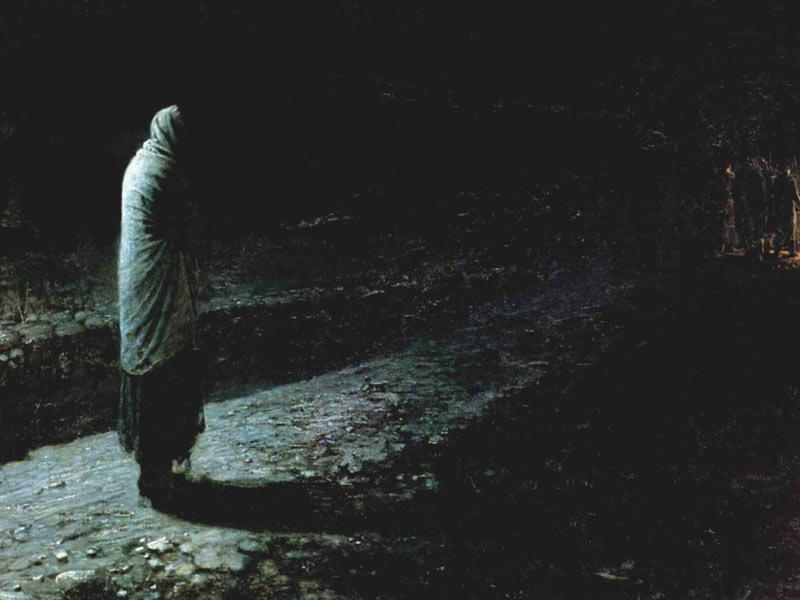
Christ and his disciples entered the Garden of Gethsemane (1888) door Nikolaj Ge

Christ and his disciples entered the Garden of Gethsemane

1888 · Oil On Canvas

Nikolai Ge’s Christ and his disciples entered the Garden of Gethsemane, painted about 1888, captures a pivotal moment from the New Testament. The religious subject matter focuses on the group of figures gathered in the garden. Christ stands prominently with outstretched arms, a gesture suggesting sacrifice and the acceptance of fate. Around him, the disciples are clustered in a solemn assembly. Their somber expressions convey a sense of anxiety and…

3
Harbingers of the Resurrection (1867) door Nikolaj Ge

Harbingers of the Resurrection

1867 · Oil

In the painting Harbingers of the Resurrection, created by Nikolai Ge about 1867, the central figure is Jesus Christ. He is positioned in the middle of the composition, flanked by two men. These two figures on either side of Christ appear to be angels or messengers. Each of these men holds a staff, an object that may symbolize their functions as protectors or guides. The presence of these figures establishes…

4
Portrait of Nikolai Nekrasov (1872) door Nikolaj Ge

Portrait of Nikolai Nekrasov

1872 · Oil On Canvas · Hermitage Museum, Sint-Petersburg

An elderly man sits within the heavy embrace of a patterned armchair. The fabric of his suit carries a palpable weight, rendered in deep blacks and muted earth tones that seem to absorb the surrounding light. His face, pale against the dark void of the background, holds a quiet melancholy. Light falls sharply across his forehead and eyes, catching the texture of skin and the silvered strands of facial hair.…

5
Leila and Khaji-Abrek (1852) door Nikolaj Ge

Leila and Khaji-Abrek

1852 · Oil

In the painting Leila and Khaji-Abrek by Nikolai Ge, two figures occupy the central space of the composition. Created about 1852, the work depicts a woman and a man in a specific physical arrangement. The woman is positioned kneeling on the ground, facing the man. He is situated before her, appearing as a soldier or a leader in stature and presence. Both individuals are dressed in traditional clothing that covers…

6
Bridge in Viko (1858) door Nikolaj Ge

Bridge in Viko

1858 · Oil On Paper

We are looking at Bridge in Viko, a work from 1858 by the Russian artist Nikolai Ge. This piece belongs to the Realism movement, a period where the focus shifted toward a more direct and unadorned representation of the world. It is a quiet study of landscape and structure, captured during a formative time in the artist's career.

7
Returning from the burial of Christ (1859) door Nikolaj Ge

Returning from the burial of Christ

1859 · Oil

In this quiet composition titled Returning from the burial of Christ, we encounter a profound moment of transition. The work is attributed to the Russian artist Nikolai Ge and dates to 1859. It captures a solemn procession of figures moving through a natural landscape, their presence marked by the heavy folds of their long robes. There is a stillness here that invites a closer look at the gravity of the…

8
Portrait of Leo Tolstoy (1884) door Nikolaj Ge

Portrait of Leo Tolstoy

1884 · Oil On Canvas · Tretyakov Gallery, Moskou

In the quiet, amber-hued atmosphere of a Moscow study, time seems to suspend itself within Nikolai Ge’s 1884 masterpiece, Portrait of Leo Tolstoy. This is not merely a depiction of a man at work; it is an intimate window into the very soul of Russian literature. The painting captures the legendary author seated at his desk, enveloped by the weight of his own profound thoughts. As he leans over his…

9
Portrait of Alexander Herzen (1867) door Nikolaj Ge

Portrait of Alexander Herzen

1867 · Oil On Canvas · Hermitage Museum, Sint-Petersburg

This oil painting is a somber and intense psychological portrait of an older man, presented as an oval-shaped bust-length figure. Set against a dark, indistinct background, the subject is illuminated by directional lighting coming from the upper left, which casts one side of his face and much of his clothing into deep shadow. This technique creates a sense of depth and three-dimensionality through dramatic chiaroscuro. The color palette is dominated…

De selectie van Nikolaj Ge gaat verder, van 11 tot 95

11Achilles and the body of Patroclus door Nikolaj GeAchilles and the body of PatroclusNational Art Museum of The Republic of Belarus 12Mary, sister of Lazarus, Greets Jesus (1863) door Nikolaj GeMary, sister of Lazarus, Greets Jesus1863 13Portrait of Russian baritone opera singer Gennady Kondratiev (1863) door Nikolaj GePortrait of Russian baritone opera singer Gennady Kondratiev1863 14Portrait of V.N.Rostovtseva (1861) door Nikolaj GePortrait of V.N.Rostovtseva1861 15Portrait of Joseph Daumang (1868) door Nikolaj GePortrait of Joseph Daumang1868 16Portrait of Princess Olga Volkonskaya (nee Kleinmichel) (1882) door Nikolaj GePortrait of Princess Olga Volkonskaya (nee Kleinmichel)1882 · Hermitage Museum 17Conscience, Judas (1891) door Nikolaj GeConscience, Judas1891 18Portrait of P.A. Kostichev (1892) door Nikolaj GePortrait of P.A. Kostichev1892 19Portrait of Yelena Likhachova (1892) door Nikolaj GePortrait of Yelena Likhachova1892 20Portrait of Yekaterina Ge, the Artist's Daughter-in-Law (1880) door Nikolaj GePortrait of Yekaterina Ge, the Artist's Daughter-in-Law1880 · Hermitage Museum 21Crucifixion door Nikolaj GeCrucifixion 22Portrait of Evdokiya Nikolaevna Kostycheva (1845) door Nikolaj GePortrait of Evdokiya Nikolaevna Kostycheva1845 23Portrait of Yakov Merkulov (1855) door Nikolaj GePortrait of Yakov Merkulov1855 24Portrait of Nikolay O.Ge, Artist's Father (1854) door Nikolaj GePortrait of Nikolay O.Ge, Artist's Father1854 25Frascati Clouds (1859) door Nikolaj GeFrascati Clouds1859 26The view from Santo Terenzo at Lerici by night (1862) door Nikolaj GeThe view from Santo Terenzo at Lerici by night1862 27Portrait of Piotr Zabela (1856) door Nikolaj GePortrait of Piotr Zabela1856 28Bay in Livorno. sunset (1862) door Nikolaj GeBay in Livorno. sunset1862 29Death of Imelda Lambertatstsi (1860) door Nikolaj GeDeath of Imelda Lambertatstsi1860 30Death of Virginia, Study (1857) door Nikolaj GeDeath of Virginia, Study1857 31Witch of Endor (1857) door Nikolaj GeWitch of Endor1857 32The destruction of the Temple in Jerusalem (1859) door Nikolaj GeThe destruction of the Temple in Jerusalem1859 33love of Vestal (1857) door Nikolaj Gelove of Vestal1857 34Portrait of the Artist's Wife Anna Ge (1858) door Nikolaj GePortrait of the Artist's Wife Anna Ge1858 · Kiev National Picture Gallery 35Portrait of Shestova with daughter (1859) door Nikolaj GePortrait of Shestova with daughter1859 36Death of Virginia, Study (1857) door Nikolaj GeDeath of Virginia, Study1857 37Vineyard at Vico (1858) door Nikolaj GeVineyard at Vico1858 38Death of Virginia, Study (1857) door Nikolaj GeDeath of Virginia, Study1857 39Livorno. Road to the Sea at Antiniano near Livorno (1862) door Nikolaj GeLivorno. Road to the Sea at Antiniano near Livorno1862 40Sorrento (1869) door Nikolaj GeSorrento1869 41Oaks in the mountains of Carrara (1868) door Nikolaj GeOaks in the mountains of Carrara1868 42Marble Saw in Carrara (1868) door Nikolaj GeMarble Saw in Carrara1868 43Loading marble (1868) door Nikolaj GeLoading marble1868 44Portrait of the Author Alexander Herzen (1867) door Nikolaj GePortrait of the Author Alexander Herzen1867 45The Transportation of Marble at Carrara (1868) door Nikolaj GeThe Transportation of Marble at Carrara1868 46Christ in front of Annas (1868) door Nikolaj GeChrist in front of Annas1868 47Portrait of an Unknown Woman in a blue blouse (1868) door Nikolaj GePortrait of an Unknown Woman in a blue blouse1868 48Christ in the synagogue (1868) door Nikolaj GeChrist in the synagogue1868 49Portrait of A.N.Pypin (1871) door Nikolaj GePortrait of A.N.Pypin1871 50Florence. The Cascina Park (1868) door Nikolaj GeFlorence. The Cascina Park1868 51Portrait of the Poet Nikolay Nekrasov (1872) door Nikolaj GePortrait of the Poet Nikolay Nekrasov1872 52Tsar Boris and the Queen Martha (1874) door Nikolaj GeTsar Boris and the Queen Martha1874 53Portrait of Alexei Antipowitsch Potechin (1876) door Nikolaj GePortrait of Alexei Antipowitsch Potechin1876 54Portrait of Anna Olsufyeva (1881) door Nikolaj GePortrait of Anna Olsufyeva1881 55An Old Peasant (1880) door Nikolaj GeAn Old Peasant1880 56Portrait of Adam Olsufyev (1881) door Nikolaj GePortrait of Adam Olsufyev1881 57On the Mount of Olives (1880) door Nikolaj GeOn the Mount of Olives1880 58Portrait of Natalia Petrunkevich (1892) door Nikolaj GePortrait of Natalia Petrunkevich1892 59Self-Portrait (1892) door Nikolaj GeSelf-Portrait1892 · Kiev National Picture Gallery 60Sophia Tolstaya (1886) door Nikolaj GeSophia Tolstaya1886 61Portrait of Maria Gabayeva (1886) door Nikolaj GePortrait of Maria Gabayeva1886 62Portrait of Tatyana Tolstaya, Leo Tolstoy's Daughter (1887) door Nikolaj GePortrait of Tatyana Tolstaya, Leo Tolstoy's Daughter1887 63Portrait of Nikolay Ge, the Artist's Grandson (1889) door Nikolaj GePortrait of Nikolay Ge, the Artist's Grandson1889 64Old Park (1893) door Nikolaj GeOld Park1893 65Crusifixion door Nikolaj GeCrusifixion 66Mother at the funeral of her child door Nikolaj GeMother at the funeral of her child 67Portrait of Barbara Kochubey door Nikolaj GePortrait of Barbara Kochubey 68Portrait of Olga Kostycheva door Nikolaj GePortrait of Olga Kostycheva 69Return of Tobias door Nikolaj GeReturn of Tobias 70Carrara door Nikolaj GeCarrara 71Judah door Nikolaj GeJudah 72The Temptation of Christ door Nikolaj GeThe Temptation of Christ 73Pushkin in the village Mihaylovskoye door Nikolaj GePushkin in the village Mihaylovskoye 74Ruslan and Lyudmila door Nikolaj GeRuslan and Lyudmila 75The road into the forest door Nikolaj GeThe road into the forest 76Bay in Livorno door Nikolaj GeBay in Livorno 77Boys at the beach. Study door Nikolaj GeBoys at the beach. Study 78Bay. Vyko door Nikolaj GeBay. Vyko 79Portrait of Historian M.Kostomarov door Nikolaj GePortrait of Historian M.Kostomarov 80Gorge in the mountains of Carrara door Nikolaj GeGorge in the mountains of Carrara 81Portrait of M.P.Svet door Nikolaj GePortrait of M.P.Svet 82Portrait of the Author Mikhail Saltykov-Shchedrin door Nikolaj GePortrait of the Author Mikhail Saltykov-Shchedrin 83Christ Head door Nikolaj GeChrist HeadKiev National Picture Gallery 84Portrait of the Ukrainian boy door Nikolaj GePortrait of the Ukrainian boy 85The head of John the Apostle door Nikolaj GeThe head of John the Apostle 86Katerina Ivanovna Zabello door Nikolaj GeKaterina Ivanovna Zabello 87Portrait of Maria Tolstaya, Leo Tolstoy's Daughter door Nikolaj GePortrait of Maria Tolstaya, Leo Tolstoy's Daughter 88Portrait of M.V. Alekhin door Nikolaj GePortrait of M.V. Alekhin 89Christand Robber door Nikolaj GeChristand Robber 90Peter I interrogates Tsarevich Alexei door Nikolaj GePeter I interrogates Tsarevich Alexei 91The Judgment of King Solomon door Nikolaj GeThe Judgment of King Solomon 92Last Supper (1863) door Nikolaj GeLast Supper1863 · Staats Russisch Museum 93What is Truth. Christ and Pilate (1890) door Nikolaj GeWhat is Truth. Christ and Pilate1890 · Tretyakov Gallery 94Golgotha (1893) door Nikolaj GeGolgotha1893 · Tretyakov Gallery 95The Judgment of the Sanhedrin (1892) door Nikolaj GeThe Judgment of the Sanhedrin1892 · Tretyakov Gallery

De beroemde schilderijen van Nikolaj Ge, periode voor periode

De onderwerpen die de aandacht van Nikolaj Ge troffen

De vier onderwerpen die het meest voorkomen in deze originelen, elk met zijn mooiste voorbeeld.

De musea waar de originele werken van Nikolaj Ge worden bewaard

De 5 musea met de meeste schilderijen op deze pagina.

Museum Stad Werken van Nikolaj Ge Schilderijen uit deze lijst
Tretyakov Gallery, MoskouTretyakov Gallery Moskou 5 Peter the Great Interrogating the Tsarevich Alexei Petrovich at Peterhof, Portrait of Leo Tolstoy, What is Truth. Christ and Pilate
Hermitage Museum, Sint-PetersburgHermitage Museum Sint-Petersburg 4 Portrait of Nikolai Nekrasov, Portrait of Alexander Herzen, Portrait of Princess Olga Volkonskaya (nee Kleinmichel)
Kiev National Picture Gallery, KyivKiev National Picture Gallery Kyiv 3 Portrait of the Artist's Wife Anna Ge, Self-Portrait, Christ Head
National Art Museum of The Republic of Belarus, MinskNational Art Museum of The Republic of Belarus Minsk 1 Achilles and the body of Patroclus
Staats Russisch Museum, Sint-PetersburgStaats Russisch Museum Sint-Petersburg 1 Last Supper

Nikolaj Ge decennium voor decennium: het origineel dat elk tijdperk definieert

Werken per decennium

Kies een decennium om het origineel te zien dat dit tijdperk definieert.

Vragen van verzamelaars over de schilderijen van Nikolaj Ge

Waar is Nikolaj Ge het meest bekend om?Onthul het antwoord

Peter the Great Interrogating the Tsarevich Alexei Petrovich at Peterhof (1871), Tretyakov Gallery, Moskou. Christ and his disciples entered the Garden of Gethsemane (1888) en Harbingers of the Resurrection (1867) volgen.

Hoe oud was Nikolaj Ge toen Peter the Great Interrogating the Tsarevich Alexei Petrovich at Peterhof werd gemaakt?Onthul het antwoord

40 jaar oud: Peter the Great Interrogating the Tsarevich Alexei Petrovich at Peterhof dateert uit 1871, en Nikolaj Ge werd geboren in 1831.

Wat zijn de tien beroemdste schilderijen van Nikolaj Ge?Onthul het antwoord

Peter the Great Interrogating the Tsarevich Alexei Petrovich at Peterhof, Christ and his disciples entered the Garden of Gethsemane, Harbingers of the Resurrection, Portrait of Nikolai Nekrasov, Leila and Khaji-Abrek, Bridge in Viko, Returning from the burial of Christ, Portrait of Leo Tolstoy, Portrait of Alexander Herzen en Catherine II at the Coffin of Empress Elizabeth. De bovenstaande ranglijst vermeldt het jaar en het museum van elk werk.

Hoeveel schilderijen heeft Nikolaj Ge nagelaten?Onthul het antwoord

Onze catalogus bevat 95 werken van Nikolaj Ge, daterend van 1845 tot 1893.

In welke musea hangen de meesterwerken van Nikolaj Ge?Onthul het antwoord

Voornamelijk in Tretyakov Gallery (Moskou), Hermitage Museum (Sint-Petersburg) en Kiev National Picture Gallery (Kyiv). De bovenstaande museumtabel bevat een volledig overzicht.

In welke jaren schilderde Nikolaj Ge de beroemdste werken?Onthul het antwoord

In 1860s: 21 van de 95 werken op deze pagina werden toen gemaakt, waaronder Harbingers of the Resurrection.

Wat zijn de eerste en de laatste beroemde originelen van Nikolaj Ge?Onthul het antwoord

Op deze pagina is het vroegste Portrait of Evdokiya Nikolaevna Kostycheva (1845) en het laatste Old Park (1893).

Welke onderwerpen koos Nikolaj Ge het vaakst?Onthul het antwoord

Portraits (25), Men (18) en Women (11), verspreid over de 95 werken op deze pagina.

Welke techniek gebruikte Nikolaj Ge het meest?Onthul het antwoord

Oil On Canvas, voor 7 van de 95 werken op deze pagina.

Bij welke kunststroming behoort Nikolaj Ge?Onthul het antwoord

Realism, te oordelen aan de originelen op deze pagina.

Welke werken van Nikolaj Ge hangen in het Tretyakov Gallery?Onthul het antwoord

Peter the Great Interrogating the Tsarevich Alexei Petrovich at Peterhof, Portrait of Leo Tolstoy en What is Truth. Christ and Pilate: het Tretyakov Gallery, Moskou herbergt 5 van de werken op deze pagina.

Nikolaj Ge: leven en werk

Nikolai Ge: Een Pionier van Realisme en Symboliek in de Russische Kunst

Nikolai Nikolaevich Ge (1831-1894) was een onmiskenbare figuur in de Russische kunstgeschiedenis, een schilder wiens werk zich onderscheidt door een unieke combinatie van realistische details met diepe filosofische reflecties. Geboren in Voronezh, Rusland, als onderdeel van een familie met Franse roots, werd zijn leven gekenmerkt door intellectuele bezigheden en een onwrikbare toewijding aan de kunst. Hoewel aanvankelijk bestemd voor een carrière in de wetenschap – hij studeerde fysica en wiskunde aan de Universiteit van Kiev en Sint Petersburg – maakte Ge in 1850 een radicale omslag en begon zich te verdiepen in schilderkunst aan de Academie der Kunst in Sint Petersburg. Deze beslissing zou niet alleen zijn eigen lot bepalen, maar ook een significante bijdrage leveren aan de evoluerende kunstscene van Rusland.

Vroege Opleiding en Invloeden

Ge’s opleiding aan de Academie der Kunst werd geleid door de meester schilder Pyotr Basin. Tijdens zijn vroege jaren was hij diep beïnvloed door Karl Bryullov, een prominente Russische academische schilder. Deze invloed manifesteerde zich in Ge’s vroege werken, die getekend waren door een beheersing van academische techniek, maar tegelijkertijd hintten naar de diepere filosofische verkenningen die zijn latere carrière zouden kenmerken. Een beurs die hij na zijn afstuderen ontving, stelde hem in staat om Europa te verkennen – hij reisde door Duitsland, Zwitserland en Frankrijk – wat zijn artistieke horizon aanzienlijk verbreden heeft.

Een bijzonder belangrijke invloed was Alexander Andreyevich Ivanov, wiens werk hij in Rome ontmoette. Ivanov’s stijl en thematische keuzes vormden een krachtige basis voor Ge’s toekomstige visie. De werken van Ivanov, met name “The Appearance of Christ before the People,” inspireerden Ge om verder te kijken dan de oppervlakkige representatie van het onderwerp en dieper in de menselijke conditie te duiken.

Pioniersgebruik van Fotografie en Controversiële Werken

Ge’s meest bekende werk, “The Last Supper” (1861), markeert een baanbrekende stap in de Russische kunst. In plaats van traditionele modellen te gebruiken, gebruikte hij een foto van Aleksandr Ivanovich Herzen door Sergei Lvovich Levitsky als basis voor het beeld van Christus. Deze beslissing was controversieel en leidde tot kritiek op Ge’s artistieke keuzes, maar tegelijkertijd toonde het zijn bereidheid om nieuwe technieken te verkennen en de grenzen van de kunst uit te dagen.

De schildering werd gezien als een provocatie door sommigen die beweerden dat het materialisme en nihilisme bevorderde. De combinatie van realistische details met een fotografische basis was ongebruikelijk voor zijn tijd en leidde tot discussies over de rol van de kunstenaar in de moderne wereld. Ondanks de controverse werd “The Last Supper” echter zeer gewaardeerd en leidde het tot Ge’s benoeming als professor aan de Academie der Kunst in 1863.

Historische Schilderingen en de Invloed van Tolstoy

Na zijn benoeming aan de Academie richtte Ge zich op historische thema's, wat resulteerde in werken zoals “Peter the Great Interrogates Tsarevich Alexei at Peterhof” (1871). Deze schildering toonde zijn vermogen om complexe historische gebeurtenissen te vertellen met een gevoel voor drama en detail. Tegelijkertijd ontwikkelde Ge een diepe vriendschap met Leo Tolstoy, wiens filosofie hem beïnvloedde in zijn latere artistieke keuzes. De nadruk op menselijke waardigheid en de kritiek op sociale onrechtvaardigheden, kenmerken van Tolstoys denken, weerspiegelden zich in Ge’s werk.

Religieuze Thema's en Filosofische Verstrengeling

In de jaren ’80 keerde Ge terug naar religieuze thema’s, maar zijn interpretaties werden vaak bekritiseerd omdat ze meer leken op de ideeën van Ernest Renan dan op traditionele Bijbelverhalen. Werken zoals “Quid Est Veritas? Christ and Pilate” (1890) werden censuurbed en ondanks dit werd Ge toegewijd aan het verkennen van diepgaande vragen over geloof, waarheid en de menselijke conditie.

Erfgoed en Herontdekking

Na zijn dood bleven veel van Ge’s werken in de schaduw. Ze werden door Beatrice de Vattville, een Zwitserse benefactrice, overgedragen, maar verdwenen na haar overlijden in 1952. Pas in 1974 werden tekeningen van Ge herontdekt in tweedehands winkels in Zwitserland. Deze ontdekking leidde tot een herwaardering van zijn werk en uiteindelijk tot de terugkeer van een aanzienlijke collectie naar Rusland in 2011, waar ze nu te zien zijn in de Tretyakov Gallery.

Nikolai Ge’s artistieke nalatenschap is in recente decennia opnieuw beoordeeld. Zijn baanbrekende gebruik van fotografie, zijn verkenning van complexe filosofische thema's en zijn toewijding aan het portretteren van de mensheid met zowel realisme als diepte resoneren nog steeds met het publiek.