Kortom
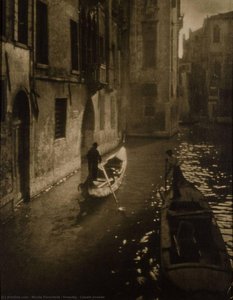
Van alle originele werken die Nicola Perscheid heeft nagelaten, is Venedig - Canale Grande (1929) de bekendste. Direct daarna volgen The Reaper (1901) en Heimwärts (1901). Onze catalogus bevat 5 werken van Nicola Perscheid; de galerie heeft de 5 meest bewonderde werken ter wereld bewaard, elk voorzien van de datum, het museum en het verhaal erachter.
De top 10 schilderijen van Nicola Perscheid: de selectie van de galerie
The Reaper
Nicola Perscheid's "The Reaper," painted in 1901, isn’t merely a depiction of rural labor; it’s a profound meditation on time, mortality, and the enduring connection between humanity and the land. This evocative monochrome image, now housed within the State Art Collections of Dresden, immediately draws the viewer into a world steeped in quiet intensity – a world where the rhythmic cycle of harvest is inextricably linked to the inevitable passage…
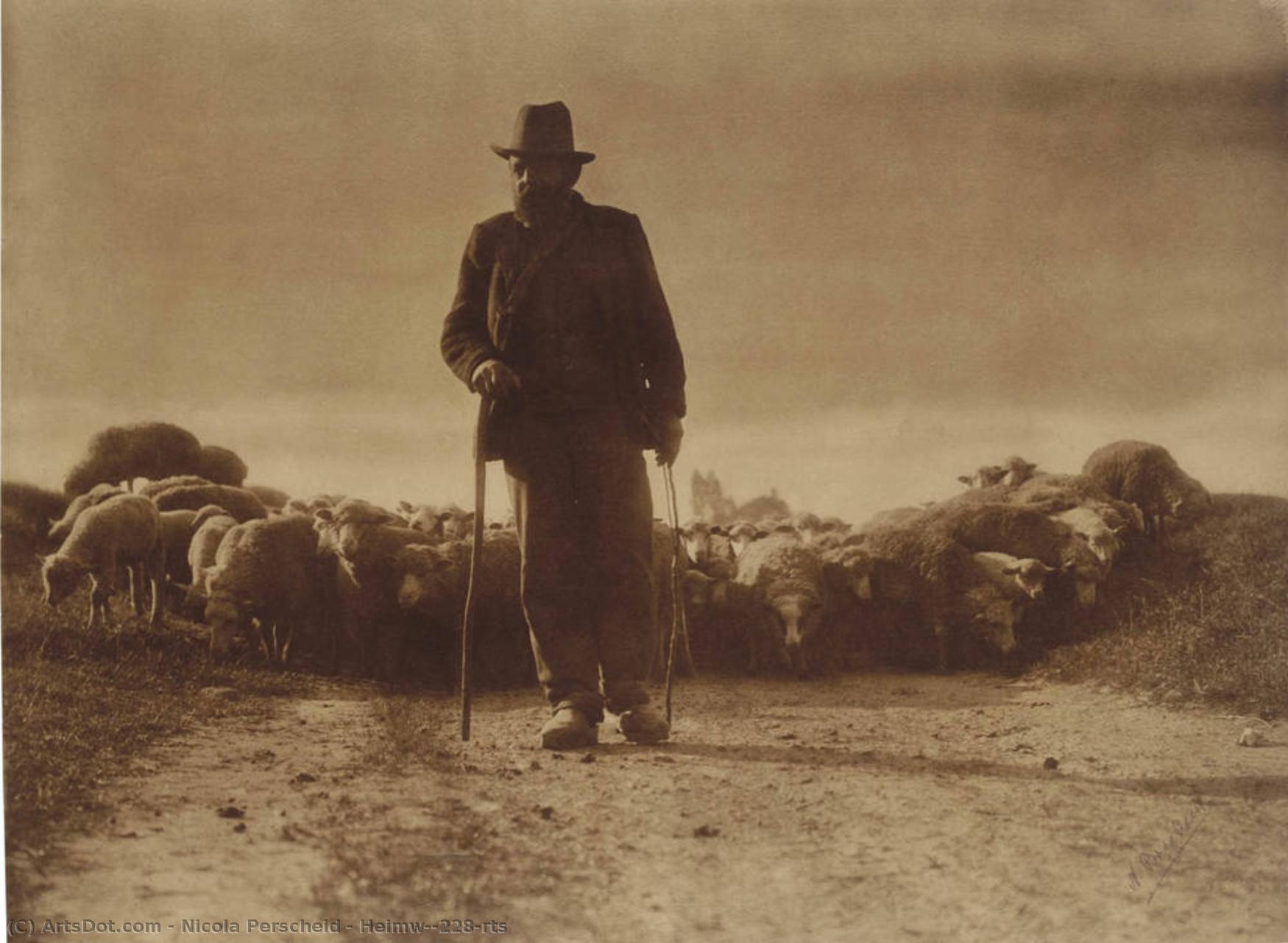
Heimwärts
The photograph Heimwärts was captured by Nicola Perscheid in 1901. It presents a quiet study of rural life, focusing on the rhythmic movement of a shepherd and his flock. The scene is frozen in a sepia-toned stillness, a moment caught in the soft light of an overcast day.
Arnold Schönberg
The opening of Nicola Perscheid’s studio at Bellevuestraße 6a, right near the Choralion hall (Bellevuestraße 4) where the world premiere of Pierrot lunaire, op. 21 took place in October 1912, was a major event in the press: “A magnificent space in colossal dimensions! No skylight! Smooth, green walls […] On the opposite wall facing the courtyard is an enormous window slanted inwards almost as wide as the wall, of the…
De onderwerpen die de aandacht van Nicola Perscheid troffen
De vier onderwerpen die het meest voorkomen in deze originelen, elk met zijn mooiste voorbeeld.
Landscape 2 werken
De musea waar de originele werken van Nicola Perscheid worden bewaard
De 2 musea met de meeste schilderijen op deze pagina.
| Museum | Stad | Werken van Nicola Perscheid | Schilderijen uit deze lijst |
|---|---|---|---|
| Dresden | 2 | The Reaper, Heimwärts | |
| Wenen | 1 | Arnold Schönberg |
Nicola Perscheid decennium voor decennium: het origineel dat elk tijdperk definieert
Werken per decennium
Kies een decennium om het origineel te zien dat dit tijdperk definieert.
The Reaper
Nicola Perscheid's "The Reaper," painted in 1901, isn’t merely a depiction of rural labor; it’s a profound meditation on time, mortality, and the enduring connection between humanity and the land. This evocative monochrome image, now housed within the State Art Collections of Dresden, immediately draws the viewer into a world steeped in quiet intensity – a world where the rhythmic cycle of harvest is inextricably linked to the inevitable passage…
Arnold Schönberg
The opening of Nicola Perscheid’s studio at Bellevuestraße 6a, right near the Choralion hall (Bellevuestraße 4) where the world premiere of Pierrot lunaire, op. 21 took place in October 1912, was a major event in the press: “A magnificent space in colossal dimensions! No skylight! Smooth, green walls […] On the opposite wall facing the courtyard is an enormous window slanted inwards almost as wide as the wall, of the…
Vragen van verzamelaars over de schilderijen van Nicola Perscheid
Waar is Nicola Perscheid het meest bekend om?Onthul het antwoord
Venedig - Canale Grande (1929). The Reaper (1901) en Heimwärts (1901) volgen.
Hoe oud was Nicola Perscheid toen Venedig - Canale Grande werd gemaakt?Onthul het antwoord
65 jaar oud: Venedig - Canale Grande dateert uit 1929, en Nicola Perscheid werd geboren in 1864.
Hoeveel schilderijen heeft Nicola Perscheid nagelaten?Onthul het antwoord
Onze catalogus bevat 5 werken van Nicola Perscheid, daterend van 1901 tot 1929.
In welke musea hangen de meesterwerken van Nicola Perscheid?Onthul het antwoord
Voornamelijk in Staatliche Kunstsammlungen Dresden (Dresden) en Arnold Schönberg Center (Wenen). De bovenstaande museumtabel bevat een volledig overzicht.
In welke jaren schilderde Nicola Perscheid de beroemdste werken?Onthul het antwoord
In 1900s: 2 van de 5 werken op deze pagina werden toen gemaakt, waaronder The Reaper.
Wat zijn de eerste en de laatste beroemde originelen van Nicola Perscheid?Onthul het antwoord
Op deze pagina is het vroegste The Reaper (1901) en het laatste Venedig - Canale Grande (1929).
Welke werken van Nicola Perscheid hangen in het Staatliche Kunstsammlungen Dresden?Onthul het antwoord
The Reaper en Heimwärts: het Staatliche Kunstsammlungen Dresden, Dresden herbergt 2 van de werken op deze pagina.
Nicola Perscheid: leven en werk
Nicola Perscheid: Pioneer of Artistic Portraiture and the Soft Focus Lens
Nicola Perscheid (3 December 1864 – 12 May 1930) stands as a singular figure in early 20th-century German photography, celebrated primarily for his masterful artistic portraits imbued with an ethereal quality achieved through innovative techniques. Born in Moselweiß near Koblenz, he embarked on a lifelong pursuit of visual storytelling, honing his craft across Europe – Saarbrücken, Trier, Colmar, Nice, Vienna and Budapest – demonstrating remarkable adaptability and dedication to his profession. His formative years instilled within him a deep appreciation for observation and meticulous detail, qualities that would subsequently define his artistic vision.- Early Life & Training: Perscheid’s formal education focused on classical studies, providing him with a foundational understanding of aesthetics and composition. However, it was his apprenticeship as a photographer under Wilhelm Schüle in Koblenz that truly ignited his passion for the medium and established him upon a path toward artistic expression.
- The Perscheid Lens: A Breakthrough in Portrait Photography: Perhaps Perscheid’s most enduring legacy rests on his invention of the “Perscheid lens,” a revolutionary soft focus apparatus specifically designed for large format portraiture. This ingenious device prioritized capturing subtle nuances of emotion and expression, rejecting the harsh realities of conventional photographic processes. It allowed photographers to achieve an unprecedented level of artistic control over image texture and tonal range.
Artistic Vision & Portrait Style
Perscheid’s approach to portraiture transcended mere documentation; he sought to convey the inner life of his subjects, prioritizing mood and atmosphere alongside precise likeness. Influenced by Impressionism and Symbolism – movements that championed subjective experience and evocative imagery – Perscheid skillfully employed lighting techniques and compositional choices to heighten emotional impact. His portraits are characterized by a contemplative stillness, reflecting a profound understanding of human psychology and an unwavering commitment to artistic integrity. He meticulously crafted images that captured not just appearance but also spirit.- Notable Works: Among his impressive oeuvre are captivating pieces such as ‘Dame Mit Japanischem Schirm’ (1925), where he expertly utilized platinum printing to produce a stunning black and white portrait brimming with texture and an otherworldly luminescence. Similarly, his depiction of Arnold Schönberg showcases the artist's ability to convey complex emotions through carefully considered framing and tonal gradation.
- Technique & Aesthetic Considerations: Perscheid’s dedication to artistic excellence extended beyond lens innovation; he embraced meticulous printing processes—particularly platinum printing—to maximize image depth and luminosity. This technique allowed him to achieve a remarkable level of tonal subtlety, mirroring the artist's desire to capture the essence of his subjects with profound sensitivity.