Portret van Ludovico Carracci

De 64 beroemdste schilderijen van Ludovico Carracci, elk uniek

Bijgewerkt in oktober 2026 · gerangschikt op basis van onze populariteitsscore (zoekopdrachten, bezoeken en bestellingen per kunstwerk) · 67 werken van Ludovico Carracci in onze catalogus

Kortom

The Dream of Saint Catherine of Alexandria (1593) is het schilderij van Ludovico Carracci dat de meeste aandacht trekt; het origineel bevindt zich in het National Gallery of Art, Washington. Daarna gaat de blik naar Madonna and Child with Saints (1607) en The Lamentation (1582). Van de 67 werken van Ludovico Carracci in onze catalogus zijn dit de 64 bekendste, elk een uniek origineel gepresenteerd met het jaar, het museum en de reden waarom het blijft voortbestaan.

1555 – 1619, Bologna Baroque Meeste werken: Bayerische Staatsgemäldesammlungen

Top 10 schilderijen van Ludovico Carracci, door de ogen van de galerie

1
The Dream of Saint Catherine of Alexandria (1593) door Ludovico Carracci

The Dream of Saint Catherine of Alexandria

1593 · Oil On Canvas · National Gallery of Art, Washington

To gaze upon this depiction of The Dream of Saint Catherine of Alexandria is to step directly into the heart of Baroque devotion. It is an artwork that does not merely hang on a wall; it envelops the viewer in a palpable atmosphere of sacred serenity and profound familial love. The composition immediately draws the eye into a pyramidal embrace, centering the Virgin Mary with the infant Jesus at its…

2
Madonna and Child with Saints (1607) door Ludovico Carracci

Madonna and Child with Saints

1607 · Oil On Copper · Metropolitan Museum of Art, New York

To gaze upon this depiction of the Madonna and Child with Saints is to step directly into the heart of Bologna's artistic fervor during the early seventeenth century. Ludovico Carracci, a master whose hand guided art through a period of profound transition, has gifted us a scene that is both deeply devotional and exquisitely sophisticated. The composition immediately draws the eye into a moment suspended between earthly celebration and heavenly…

3
The Lamentation (1582) door Ludovico Carracci

The Lamentation

1582 · Oil On Canvas · Metropolitan Museum of Art, New York

To stand before The Lamentation by Ludovico Carracci is to be enveloped in an atmosphere so thick with palpable sorrow that it feels almost breathable. This is not the polished, idealized grief often depicted in later art; rather, it is a raw, visceral outpouring of human emotion captured at its most agonizing peak. The scene presents a profound tableau of loss, centering on figures whose poses and expressions reject classical…

4
The Dream of Saint Catherine of Alexandria (detail) (1593) door Ludovico Carracci

The Dream of Saint Catherine of Alexandria (detail)

1593 · Oil On Canvas · National Gallery of Art, Washington

To gaze upon this detail from Ludovico Carracci’s The Dream of Saint Catherine of Alexandria is to step directly into the heart of the Bolognese Baroque—a moment where profound spirituality met breathtaking artistic realism. The scene unfolds with an almost palpable sense of devotion, capturing a sacred narrative rich with human emotion and divine mystery. At its core, we find Mary cradling the infant Jesus, their forms rendered with a…

5
An Angel Frees the Souls of Purgatory (1610) door Ludovico Carracci

An Angel Frees the Souls of Purgatory

1610 · Oil · Vaticaanse Pinacoteca, Vaticaanstad

Completed in 1610, this work reflects the religious fervor of the Counter-Reformation. As the Catholic Church sought to reaffirm its doctrines against Protestant critiques, artists in Bologna moved away from the artificiality of Mannerism toward a more visceral, emotive naturalism. This piece likely originated as a sketch for an altarpiece within the Carracci workshop. It captures a pivotal theological moment: the transition of souls from the state of purification to…

6
The Trinity with the Dead Christ (1590) door Ludovico Carracci

The Trinity with the Dead Christ

1590 · Oil On Canvas · Vaticaanse Pinacoteca, Vaticaanstad

In this work from around 1590, we find ourselves witnessing a heavy, quiet moment of transition. The composition is built upon a pyramidal structure, drawing the eye upward toward the limp, lifeless body of Christ. He rests upon a draped cloth, marked by the imprint of Veronica, a detail that anchors the scene in a tradition of compassion. There is a palpable sense of weight here, as the physical reality…

7
The Transfiguration (1590) door Ludovico Carracci

The Transfiguration

1590 · Oil On Canvas · Scottish National Gallery, Edinburgh

The air seems to thicken with a sudden, celestial weight as Jesus Christ stands at the center of this unfolding miracle. He is not a distant figure of stone, but a presence felt in the very movement of his outstretched arms. Light does not merely strike his form; it seems to emanate from within him, carving his silhouette against a world caught in a moment of profound spiritual upheaval. Around…

8
Saint Francis of Assisi in the Portiuncula (1601) door Ludovico Carracci

Saint Francis of Assisi in the Portiuncula

1601 · Oil · Museo del Prado, Madrid

The air in the Portiuncula feels heavy, thick with the scent of damp earth and the weight of a profound, sudden silence. Below, in the dimness of the earthly realm, Saint Francis of Assisi kneels. He is a figure of deep humility, his body pressed toward the ground in a gesture of total surrender. His arms cross over his chest, a physical manifestation of a soul caught in a moment…

9
The Vision of Saint Francis (1602) door Ludovico Carracci

The Vision of Saint Francis

1602 · Oil On Canvas · Art Institute of Chicago, Chicago

The canvas splits into two distinct realms, divided by a diagonal surge of clouds. On the lower left, Saint Francis kneels in the heavy shadows of the earthly plane, his form solid and grounded. Above him, the darkness of the night is pierced by a sudden, divine light. The Virgin Mary and the infant Christ emerge from this celestial glow, surrounded by the soft, rounded shapes of cherubs. A moon…

10
The Agony in the Garden (1590) door Ludovico Carracci

The Agony in the Garden

1590 · Oil On Canvas · Museo del Prado, Madrid

The Agony in the Garden emerges from the shadows of history as a profound oil on canvas by Ludovico Carracci. This specific work, known in collections as Prado P00074, captures a moment of intense spiritual weight. The paint clings to the fabric, holding the tension of a scene that feels as though it is unfolding right before our eyes. It is a work that breathes with the heavy atmosphere of…

De beroemde schilderijen van Ludovico Carracci, nummer 11 tot 64

11The Vision of St Jerome (1594) door Ludovico CarracciThe Vision of St Jerome1594 · Statens Museum for Kunst 12Bacchus and Ariadne (1591) door Ludovico CarracciBacchus and Ariadne1591 13Portrait of a Widow (1585) door Ludovico CarracciPortrait of a Widow1585 · Dayton Art Institute 14St Sebastian (1590) door Ludovico CarracciSt Sebastian1590 · Fitzwilliam Museum 15Portrait of a Young Man (1583) door Ludovico CarracciPortrait of a Young Man1583 · Capitoolse Musea 16Saint Francis in Meditation (1580) door Ludovico CarracciSaint Francis in Meditation1580 · Dulwich Picture Gallery 17Sacrifice of Isaac (1586) door Ludovico CarracciSacrifice of Isaac1586 18Holy Family (1600) door Ludovico CarracciHoly Family1600 · Slovak National Gallery 19Annunciation (1603) door Ludovico CarracciAnnunciation1603 · Musei di Strada Nuova 20Allegory of Providence (1604) door Ludovico CarracciAllegory of Providence1604 · Capitoolse Musea 21Singing angels (1605) door Ludovico CarracciSinging angels1605 · Museo Cerralbo 22Hercules and the Hydra (1594) door Ludovico CarracciHercules and the Hydra1594 23The Adoration of the Shepherds (1613) door Ludovico CarracciThe Adoration of the Shepherds1613 24Three angels visiting Abraham (1610) door Ludovico CarracciThree angels visiting Abraham1610 · Pinacoteca Nazionale di Bologna 25The Stories of Jason (detail) (1584) door Ludovico CarracciThe Stories of Jason (detail)1584 · Palazzo Fava 26The Virgin Appearing to St Hyacinth (1594) door Ludovico CarracciThe Virgin Appearing to St Hyacinth1594 · Louvre 27Ludovico ) (1555) door Ludovico CarracciLudovico )1555 28Male Nude (Hercules ?) (1588) door Ludovico CarracciMale Nude (Hercules ?)1588 · Kunstpalast 29The Agony in the Garden (1590) door Ludovico CarracciThe Agony in the Garden1590 · National Gallery 30The Marriage of the Virgin (1590) door Ludovico CarracciThe Marriage of the Virgin1590 · National Gallery 31Portrait of Carlo Alberto Rati Opizzoni in Armour (1597) door Ludovico CarracciPortrait of Carlo Alberto Rati Opizzoni in Armour1597 32Christ in the Wilderness, Served by Angels (1608) door Ludovico CarracciChrist in the Wilderness, Served by Angels1608 · Gemäldegalerie 33The Martyrdom of St Margaret (1616) door Ludovico CarracciThe Martyrdom of St Margaret1616 34Susannah and the Elders (1616) door Ludovico CarracciSusannah and the Elders1616 35Annunciation (1616) door Ludovico CarracciAnnunciation1616 · Kunstpalast 36The Denial of Saint Peter (1616) door Ludovico CarracciThe Denial of Saint Peter1616 · Metropolitan Museum of Art 37Bargellini Madonna (1588) door Ludovico CarracciBargellini Madonna1588 · Pinacoteca Nazionale 38Saint Francis door Ludovico CarracciSaint FrancisBayerische Staatsgemäldesammlungen 39Presentation in the Temple (1605) door Ludovico CarracciPresentation in the Temple1605 · Thyssen-Bornemisza Museum 40Preaching of John the Baptist door Ludovico CarracciPreaching of John the BaptistBayerische Staatsgemäldesammlungen 41Portrait of a Young Man door Ludovico CarracciPortrait of a Young ManBayerische Staatsgemäldesammlungen 42Saint Francis Seraphic door Ludovico CarracciSaint Francis SeraphicBayerische Staatsgemäldesammlungen 43Entombment of Christ door Ludovico CarracciEntombment of ChristBayerische Staatsgemäldesammlungen 44The Agony in the Garden of Gethsemane door Ludovico CarracciThe Agony in the Garden of Gethsemane 45St. John the Baptist at the Fontain door Ludovico CarracciSt. John the Baptist at the FontainMusée Fesch 46Saint Mary Magdalene door Ludovico CarracciSaint Mary MagdaleneNational Museum of Fine Arts 47Le martyre de saint Pierre et saint Paul door Ludovico CarracciLe martyre de saint Pierre et saint Paul 48LE BAPTEME DE JESUS door Ludovico CarracciLE BAPTEME DE JESUSMusée des Beaux-Arts de Lyon 49The Baptism of Christ door Ludovico CarracciThe Baptism of ChristBayerische Staatsgemäldesammlungen 50Christ Served by Angels in the Wilderness (1608) door Ludovico CarracciChrist Served by Angels in the Wilderness1608 · Staatliche Museen zu Berlin 51The Vision of Saint Francis of Assisi, Ludovico Carracci, 1583 - 1585 (1585) door Ludovico CarracciThe Vision of Saint Francis of Assisi, Ludovico Carracci, 1583 - 15851585 52Maria troonend met het Kind, St Johannes de Doper, de Archangel Michael, St Franciscus, St Lucia, St Joseph (1616) door Ludovico CarracciMaria troonend met het Kind, St Johannes de Doper, de Archangel Michael, St Franciscus, St Lucia, St Joseph1616 · Royal Łazienki Museum 53L'apparition de la Vierge et de l'enfant Jésus à saint Hyacinthe door Ludovico CarracciL'apparition de la Vierge et de l'enfant Jésus à saint HyacintheLouvre 54Antonio Landscape with Bathers door Ludovico CarracciAntonio Landscape with Bathers 55The Vision of Saint Francis door Ludovico CarracciThe Vision of Saint Francis 56L'Adoration des bergers La Nativité de Jésus Christ door Ludovico CarracciL'Adoration des bergers La Nativité de Jésus Christ 57The Marriage of the Virgin door Ludovico CarracciThe Marriage of the Virgin 58The Assumption of the Virgin door Ludovico CarracciThe Assumption of the Virgin 59Orlando Delivering Olympia from the Sea Monster door Ludovico CarracciOrlando Delivering Olympia from the Sea MonsterNational Trust 60La Vierge à l'enfant door Ludovico CarracciLa Vierge à l'enfantLouvre 61St. Sebastian Thrown into the Cloaca Maxima (1612) door Ludovico CarracciSt. Sebastian Thrown into the Cloaca Maxima1612 · J. Paul Getty Museum 62Chess players (1590) door Ludovico CarracciChess players1590 · Gemäldegalerie 63The Funeral of the Virgin Mary (1605) door Ludovico CarracciThe Funeral of the Virgin Mary1605 · Galleria Nazionale 64La Flagellation door Ludovico CarracciLa FlagellationMusée de la Chartreuse de Douai

De beroemde schilderijen van Ludovico Carracci, periode voor periode

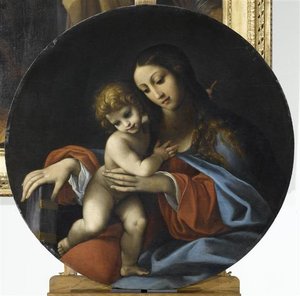
De onderwerpen die de aandacht van Ludovico Carracci troffen

De vier onderwerpen die het meest voorkomen in deze originelen, elk met zijn mooiste voorbeeld.

De musea waar de originele werken van Ludovico Carracci worden bewaard

De 8 musea met de meeste schilderijen op deze pagina.

Museum Stad Werken van Ludovico Carracci Schilderijen uit deze lijst
Bayerische Staatsgemäldesammlungen, MünchenBayerische Staatsgemäldesammlungen München 6 Saint Francis, Preaching of John the Baptist, Portrait of a Young Man
Metropolitan Museum of Art, New YorkMetropolitan Museum of Art New York 3 Madonna and Child with Saints, The Lamentation, The Denial of Saint Peter
Louvre, ParijsLouvre Parijs 3 The Virgin Appearing to St Hyacinth, L'apparition de la Vierge et de l'enfant Jésus à saint Hyacinthe, La Vierge à l'enfant
National Gallery of Art, WashingtonNational Gallery of Art Washington 2 The Dream of Saint Catherine of Alexandria, The Dream of Saint Catherine of Alexandria (detail)
Vaticaanse Pinacoteca, VaticaanstadVaticaanse Pinacoteca Vaticaanstad 2 An Angel Frees the Souls of Purgatory, The Trinity with the Dead Christ
Museo del Prado, MadridMuseo del Prado Madrid 2 Saint Francis of Assisi in the Portiuncula, The Agony in the Garden
Capitoolse Musea, RomeCapitoolse Musea Rome 2 Portrait of a Young Man, Allegory of Providence
Kunstpalast, DüsseldorfKunstpalast Düsseldorf 2 Male Nude (Hercules ?), Annunciation

Ludovico Carracci door de decennia heen: elk een uniek origineel

Werken per decennium

Kies een decennium om het origineel te zien dat dit tijdperk definieert.

Schilderijen van Ludovico Carracci: vragen voor de galerie

Wat is het bekendste werk van Ludovico Carracci?Onthul het antwoord

The Dream of Saint Catherine of Alexandria (1593), National Gallery of Art, Washington. Madonna and Child with Saints (1607) en The Lamentation (1582) volgen.

Op welke leeftijd creëerde Ludovico Carracci The Dream of Saint Catherine of Alexandria?Onthul het antwoord

38 jaar oud: The Dream of Saint Catherine of Alexandria dateert uit 1593, en Ludovico Carracci werd geboren in 1555.

Welke tien schilderijen van Ludovico Carracci zijn het meest bekend?Onthul het antwoord

The Dream of Saint Catherine of Alexandria, Madonna and Child with Saints, The Lamentation, The Dream of Saint Catherine of Alexandria (detail), An Angel Frees the Souls of Purgatory, The Trinity with the Dead Christ, The Transfiguration, Saint Francis of Assisi in the Portiuncula, The Vision of Saint Francis en The Agony in the Garden. De bovenstaande ranglijst vermeldt het jaar en het museum van elk werk.

Hoeveel werken van Ludovico Carracci zijn er bekend?Onthul het antwoord

Onze catalogus bevat 67 werken van Ludovico Carracci, daterend van 1580 tot 1616.

Waar kunnen de beroemdste originelen van Ludovico Carracci worden bekeken?Onthul het antwoord

Voornamelijk in Bayerische Staatsgemäldesammlungen (München), Metropolitan Museum of Art (New York) en Louvre (Parijs). De bovenstaande museumtabel bevat een volledig overzicht.

In welke periode creëerde Ludovico Carracci de bekendste schilderijen?Onthul het antwoord

In 1590s: 14 van de 64 werken op deze pagina werden toen gemaakt, waaronder The Dream of Saint Catherine of Alexandria.

Welk beroemd schilderij van Ludovico Carracci is de vroegste, en welke de laatste?Onthul het antwoord

Op deze pagina is het vroegste Saint Francis in Meditation (1580) en het laatste The Martyrdom of St Margaret (1616).

Welke onderwerpen had Ludovico Carracci de voorkeur?Onthul het antwoord

Man (11), Angels (8) en Virgin mary (6), verspreid over de 64 werken op deze pagina.

Met welke materialen schilderde Ludovico Carracci het meest?Onthul het antwoord

Oil On Canvas, voor 21 van de 64 werken op deze pagina.

Bij welke stroming behoort het werk van Ludovico Carracci?Onthul het antwoord

Baroque, te oordelen aan de originelen op deze pagina.

Welke originele werken van Ludovico Carracci kan ik zien in het Bayerische Staatsgemäldesammlungen?Onthul het antwoord

Saint Francis, Preaching of John the Baptist en Portrait of a Young Man: het Bayerische Staatsgemäldesammlungen, München herbergt 6 van de werken op deze pagina.

Ludovico Carracci: een portret van de kunstenaar

De Architect van de Bolognese Barok

In het levendige, intellectuele hart van Bologna, een stad waar de Renaissance-traditie de ontluikende geest van een nieuw tijdperk ontmoette, kwam Ludovico Carracci naar voren als een transformerende kracht in de Europese kunst. Geboren in 1555, was zijn leven onlosmakelijk verbonden met de fundamenten van de Bolognese School. Als onderdeel van de illustere familie Carracci, samen met zijn neven Annibale en Agostino, nam Ludovico niet slechts deel aan een artistieke beweging; hij hielp bij het ontwerpen van de overgang van de gestileerde, vaak kunstmatige elegantie van het Maniërisme naar het diepe, emotionele naturalisme van de Barok. Zijn vroege jaren werden gevormd in het atelier van zijn vader, Prospero Carracci, een omgeving die diende als een smeltkroes voor experimenten en een toevluchtsoord voor de studie van disegno—de minutieuze observatie van vorm en anatomie die een kenmerk van zijn nalatenschap zou worden.

Terwijl zijn neven vaak naar roem zochten aan de grote hoven van Rome, bleef Ludovico diep geworteld in zijn geboortestad Bologna. Deze standvastige verbondenheid stelde hem in staat een uniek artistiek toevluchtsoord te creëren door het runnen van een academie die een baken werd voor de volgende generatie meesters, waaronder Guido Reni en Domenichino. Zijn werk vertegenwoordigt een meesterlijke synthese van historische invloeden; hij putte uit de goddelijke genade van Rafaël, de zachte luminositeit van Correggio en het rijke kleurgebruik van Titiaan, maar hij injecteerde deze klassieke elementen met een nieuwe, dramatische vitaliteit. Door de uitgerekte en vaak gespannen poses van laat-maniëristische schilders zoals Parmigianino te verwerpen, omarmde Ludovico een meer viscerale realiteit, waarbij hij krachtige gebaren en een flikkerend, atmosferisch licht gebruikte om de zielen van zijn toeschouwers te raken.

Licht, Schaduw en Spirituele Intensiteit

Het ware genie van Ludovico Carracci ligt in zijn vermogen om chiaroscuro—het dramatische samenspel van licht en schaduw—te manipuleren als een kanaal voor spirituele contemplatie. Zijn doeken zijn zelden louter afbeeldingen van bijbelse gebeurtenissen; het zijn meeslepende ervaringen die bedoeld zijn om religieuze vurigheid op te wekken. In werken zoals Een engel bevrijdt de zielen uit het vagevuur, kan men getuige zijn van hoe zijn gebruik van licht een scène niet simpelweg verlicht, maar actief deelneemt aan het narratief, waarbij figuren uit de duisternis worden gehouwen om momenten van goddelijke medelijden en genade te benadrukken. Deze techniek, die doet denken aan het opkomende naturalisme van Caravaggio, stelde hem in staat zelfs de meest heilige onderwerpen te doordrenken met een tastbare, menselijke emotie.

Zijn meesterschap strekte zich uit over verschillende media, van de monumentale schaal van fresco's tot de delicate precisie van etsen en prenten. Of hij nu de serene heiligheid van de Presentatie in de Tempel vastlegde of de gespierde, heroïische spanning in zijn Mannelijke Naakt (Hercules?), er loopt een consistente draad van emotionele diepgang door zijn gehele oeuvre. Zijn religieuze schilderijen, zoals de Bargellini Madonna, tonen een vermogen om complexe groepen heiligen en engelen te organiseren in harmonieuze maar dynamische composities, waarbij elke plooi van de draperie en elke kanteling van een hoofd bijdraagt aan een groter gevoel van hemelse beweging.

Een Blijvende Nalatenschap in de Italiaanse Canon

Het historische belang van Ludovico Carracci kan niet worden overschat. Hij was een sleutelfiguur die hielp de Italiaanse kunst te revitaliseren op een moment dat deze het risico liep te stagneren onder het gewicht van haar eigen formalistische tradities. Door een stijl te verdedigen die prioriteit gaf aan emotionele waarheid en naturalistische observatie, leverde hij het blauwdruk voor de meest gevierde prestaties van het Baroktijdperk. Zijn invloed straalde vanuit Bologna naar buiten, vormde de esthetische taal van een groot deel van Europa en legde de basis voor het klassieke naturalisme dat de 17e eeuw zou domineren.

Wanneer we reflecteren op zijn leven en werk, zien we een kunstenaar die erin slaagde twee werelden te overbruggen: de gestructureerde perfectie van de Renaissance en de dramatische, theatrale energie van de Barok. Zijn vermogen om de intellectuele strengheid van disegno te verenigen met een diep gevoel voor colore en emotionele resonantie verzekert zijn plaats als een van de meest vitale schilders van zijn tijd. Door zijn toewijding aan zijn ambacht en zijn betrokkenheid bij de spirituele kracht van de kunst, liet Ludovico Carracci een onuitwisbare indruk achter op de geschiedenis van de westerse schilderkunst, waarmee hij ons eraan herinnert dat ware schoonheid ligt in het snijvlak van technische beheersing en het menselijke hart.