Portret van Józef Brandt

De 85 beroemdste schilderijen van Józef Brandt, elk uniek

Bijgewerkt in november 2026 · gerangschikt op basis van onze populariteitsscore (zoekopdrachten, bezoeken en bestellingen per kunstwerk) · 87 werken van Józef Brandt in onze catalogus

Kortom

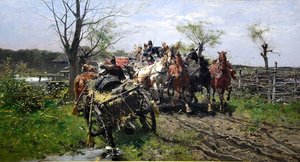
Jews were leading the horses on the market (1865) is het schilderij van Józef Brandt dat de meeste aandacht trekt; het origineel bevindt zich in het Nationaal Museum in Warschau, Warschau. Daarna gaat de blik naar Farewell (1867) en Defense of a manor (Bar Confederates). (1875). Van de 87 werken van Józef Brandt in onze catalogus zijn dit de 85 bekendste, elk een uniek origineel gepresenteerd met het jaar, het museum en de reden waarom het blijft voortbestaan.

1841 – 1915, Szczebrzeszyn Romanticism Meeste werken: Nationaal Museum in Warschau

Top 10 schilderijen van Józef Brandt, door de ogen van de galerie

2
Farewell (1867) door Józef Brandt

Farewell

1867 · Oil

In this 1867 oil painting, a somber scene of separation unfolds within a rural setting. The composition is divided by a sharp contrast between light and shadow. On the right, a dark, shadowed foreground contains a woman dressed in traditional folk attire. She stands near a wooden structure, her gaze directed toward the left side of the canvas. To the left, a group of men and horses are positioned under…

3
Defense of a manor (Bar Confederates). (1875) door Józef Brandt

Defense of a manor (Bar Confederates).

1875 · Oil On Canvas · Nationaal Museum in Warschau, Warschau

A chaotic military engagement unfolds within a desolate, snow-covered landscape. Figures move through deep, uneven drifts toward a wooden fortification, their forms cutting through the heavy, wintry atmosphere. The composition relies on energetic, diagonal lines to convey the tension of the movement, particularly in the strained postures of the men and the sloping, snow-laden roofs of the structures. Muted tones of white, gray, and dark brown dominate the scene, punctuated…

4
Courtship (1874) door Józef Brandt

Courtship

1874 · Oil On Canvas · Nationaal Museum in Warschau, Warschau

Józef Brandt’s Courtship, created about 1874, presents a social encounter set within a rustic, rural courtyard. The composition utilizes a diagonal arrangement to direct the viewer's gaze from the horses positioned in the foreground toward the human figures situated in the midground. A man wearing ornate attire, possibly military or folk in style, approaches a woman standing within a doorway. This interaction establishes a narrative of courtship through their proximity…

5
Cossack on Horseback (1881) door Józef Brandt

Cossack on Horseback

1881 · Oil On Canvas

In "Cossack on Horseback" by Józef Brandt, we find ourselves observing a solitary figure set against a vast, open landscape. The rider, a Cossack, is mounted upon a deep chestnut brown horse with a dark mane. Positioned slightly to the left of the center, the rider commands the space, creating a sense of quiet presence within the immense environment. He is dressed in a traditional military uniform, rendered in shades…

6
Lisowczycy - Archery Shooting (1885) door Józef Brandt

Lisowczycy - Archery Shooting

1885 · Oil On Canvas

A sudden surge of muscle and hoofbeat breaks the stillness of the field. The Lisowczycy cavalrymen move in a sharp, diagonal rush, their horses galloping from left to right with a heavy, rhythmic momentum. There is a tension in the air, held tight by the curve of a drawn bow. The riders are caught in a singular moment of focus, their bodies leaning into the wind of their own speed.…

7
Chat with Young Washerwomen (1882) door Józef Brandt

Chat with Young Washerwomen

1882 · Oil On Canvas

Chat with Young Washerwomen by Józef Brandt depicts a rural scene from about 1882. In the foreground, a group of washerwomen is gathered together. The subject matter focuses on the daily labor of common people. This group occupies the lower portion of the canvas, positioned near the viewer's eye-level perspective.

8
Fair in Balta, Podolia region (1885) door Józef Brandt

Fair in Balta, Podolia region

1885 · Oil On Panel · Nationaal Museum in Warschau, Warschau

The oil painting titled Fair in Balta, Podolia region was executed by the artist Józef Brandt. Created in 1885, this work depicts a scene centered on the daily life of a rural market. The setting is located in the Podolia region, a territory situated in the west-central and southwestern parts of Ukraine and northeastern Moldova.

9
Portrait of the painter Zenon Łęski (1900) door Józef Brandt

Portrait of the painter Zenon Łęski

1900 · Oil On Canvas

The artwork is the Portrait of the painter Zenon Łęski, a work executed by the artist Józef Brandt. This oil painting depicts Zenon Łęski, who was a student of Józef Brandt. The subject of the portrait is the painter himself, captured in a bust-length composition. The relationship between the artist and the sitter is established through their shared history in the Munich art circles, where Łęski studied under the guidance…

10
Keeping watch (1902) door Józef Brandt

Keeping watch

1902 · Oil · Nationaal Museum in Warschau, Warschau

A lone rider moves through a landscape that feels heavy with the weight of an overcast sky. The air seems thick, damp with the breath of a muted, grey heavens that press down upon the rolling hills. Beneath the horse's hooves, the grass is a textured sea of ochre and deep green, rendered with thick, visible strokes that suggest the unevenness of the earth. The chestnut horse carries its rider…

De beroemde schilderijen van Józef Brandt, nummer 11 tot 85

11The Capture Of A Caucasian Chief door Józef BrandtThe Capture Of A Caucasian ChiefNationaal Museum in Warschau 12Zaporizhians door Józef BrandtZaporizhians 13Leaving Vienna door Józef BrandtLeaving Vienna 14Horsemen in the woods, sketch (1876) door Józef BrandtHorsemen in the woods, sketch1876 · Nationaal Museum in Warschau 15The steppe farm (1876) door Józef BrandtThe steppe farm1876 · Polish Museum 16Defense of a manor (Bar Confederates) (1875) door Józef BrandtDefense of a manor (Bar Confederates)1875 17Prayer in the steppe (Our Lady of Pochayiv) (1890) door Józef BrandtPrayer in the steppe (Our Lady of Pochayiv)1890 · Nationaal Museum in Warschau 18Departure from Wilanów of John III Sobieski and Marysieńka (1887) door Józef BrandtDeparture from Wilanów of John III Sobieski and Marysieńka1887 · Nationaal Museum in Warschau 19Backyard (1898) door Józef BrandtBackyard1898 · Nationaal Museum in Warschau 20Farmyards (1898) door Józef BrandtFarmyards1898 · Nationaal Museum in Warschau 21Sketch for “Our Lady of Armenia” (1893) door Józef BrandtSketch for “Our Lady of Armenia”1893 · Nationaal Museum in Warschau 22Hunt (1900) door Józef BrandtHunt1900 · The Polish Museum in Rapperswil 23Portrait of Artur Potocki [?] door Józef BrandtPortrait of Artur Potocki [?]Nationaal Museum in Warschau 24Ein Siegeslied door Józef BrandtEin Siegeslied 25Schlittenfahrt Zur Zeit Des Königs Sobieski door Józef BrandtSchlittenfahrt Zur Zeit Des Königs Sobieski 26Ein Gefecht door Józef BrandtEin Gefecht 27Aufbruch Zur Jagd door Józef BrandtAufbruch Zur Jagd 28A Steppe Stud door Józef BrandtA Steppe Stud 29Militia At The Ford door Józef BrandtMilitia At The Ford 30Odbicie Jasyru door Józef BrandtOdbicie Jasyru 31Wyjazd Z Wilanowa Jana Iii Sobieskiego door Józef BrandtWyjazd Z Wilanowa Jana Iii Sobieskiego 32Czarniecki Na Tarancie door Józef BrandtCzarniecki Na Tarancie 33Fair in Białka (1885) door Józef BrandtFair in Białka1885 34Call to arms (1880) door Józef BrandtCall to arms1880 · Nationaal Museum in Warschau 35Zaporizhian Camp (1880) door Józef BrandtZaporizhian Camp1880 · Nationaal Museum in Warschau 36Cossacks Fording door Józef BrandtCossacks Fording 37After The Battle door Józef BrandtAfter The Battle 38On The Move door Józef BrandtOn The Move 39On Reconnaissance door Józef BrandtOn ReconnaissanceWalters Art Museum 40Battle Of Chocimem door Józef BrandtBattle Of Chocimem 41Cossacks At Play door Józef BrandtCossacks At Play 42The Flight door Józef BrandtThe Flight 43Czarniecki Under Koldynga door Józef BrandtCzarniecki Under Koldynga 44Bunczuczny door Józef BrandtBunczuczny 45The Oriental Market door Józef BrandtThe Oriental Market 46Jarmark Na Podolu door Józef BrandtJarmark Na Podolu 47Cossack Watchman door Józef BrandtCossack Watchman 48Haymaking door Józef BrandtHaymaking 49Bryczka Tatarska door Józef BrandtBryczka Tatarska 50Battle Of Vienna door Józef BrandtBattle Of Vienna 51The Caravan door Józef BrandtThe Caravan 52Prayer In The Steppe door Józef BrandtPrayer In The Steppe 53Speeding Chariot door Józef BrandtSpeeding Chariot 54A Cavalry Assault door Józef BrandtA Cavalry Assault 55Halt In A Small Town door Józef BrandtHalt In A Small Town 56Chorazy Królewski door Józef BrandtChorazy Królewski 57Attack Of The Cavalry door Józef BrandtAttack Of The Cavalry 58Konfederacja Barska door Józef BrandtKonfederacja Barska 59Signature Of The Polish Painter door Józef BrandtSignature Of The Polish Painter 60Do Widzenia door Józef BrandtDo Widzenia 61Hussar door Józef BrandtHussar 62Meeting On The Bridge door Józef BrandtMeeting On The BridgeNationaal Museum in Krakau 63Battle Over The Turkish Banner door Józef BrandtBattle Over The Turkish BannerNationaal Museum in Krakau 64Song Of The Cossack Victors door Józef BrandtSong Of The Cossack Victors 65Skladanie Sztandarow door Józef BrandtSkladanie Sztandarow 66Cossack And A Girl At The Well door Józef BrandtCossack And A Girl At The Well 67Before Lisowczycy Gospoda door Józef BrandtBefore Lisowczycy Gospoda 68A Cavalry Skirmish On The Outskirts Of A Town door Józef BrandtA Cavalry Skirmish On The Outskirts Of A Town 69The March Of Swedes For Kiejdany door Józef BrandtThe March Of Swedes For Kiejdany 70Horse door Józef BrandtHorse 71Towarzysz Pancerny door Józef BrandtTowarzysz Pancerny 72Horses Bolted door Józef BrandtHorses Bolted 73Battle Against Tatars door Józef BrandtBattle Against Tatars 74On The Move door Józef BrandtOn The Move 75Pospolite Ruszenie U Brodu door Józef BrandtPospolite Ruszenie U Brodu 76Chwytanie Konia Na Arkan door Józef BrandtChwytanie Konia Na Arkan 77The Runaway Cart door Józef BrandtThe Runaway Cart 78Untitled (AQQPKU) door Józef BrandtUntitled (AQQPKU) 79Battle of Khotyn (1621) (1867) door Józef BrandtBattle of Khotyn (1621)1867 · Nationaal Museum in Warschau 80Czarniecki at Kolding (1870) door Józef BrandtCzarniecki at Kolding1870 · Nationaal Museum in Warschau 81Dangerous crossing (1909) door Józef BrandtDangerous crossing1909 · Silesian Museum in Katowice 82Recapture of prisoners (1878) door Józef BrandtRecapture of prisoners1878 · Nationaal Museum in Warschau 83On the Dniester River (1875) door Józef BrandtOn the Dniester River1875 · Nationaal Museum in Krakau 84Portrait Of The Painter Józef Brandt door Józef BrandtPortrait Of The Painter Józef BrandtNationaal Museum in Warschau 85Cossacks door Józef BrandtCossacksNational Museum in Wrocław

De onderwerpen die de aandacht van Józef Brandt troffen

De vier onderwerpen die het meest voorkomen in deze originelen, elk met zijn mooiste voorbeeld.

De musea waar de originele werken van Józef Brandt worden bewaard

De 7 musea met de meeste schilderijen op deze pagina.

Museum Stad Werken van Józef Brandt Schilderijen uit deze lijst
Nationaal Museum in Warschau, WarschauNationaal Museum in Warschau Warschau 19 Jews were leading the horses on the market, Defense of a manor (Bar Confederates)., Courtship
Nationaal Museum in Krakau, KrakauNationaal Museum in Krakau Krakau 3 Meeting On The Bridge, Battle Over The Turkish Banner, On the Dniester River
Polish Museum, Rapperswil-sur-RippePolish Museum Rapperswil-sur-Rippe 1 The steppe farm
The Polish Museum in Rapperswil, Rapperswil-sur-RippeThe Polish Museum in Rapperswil Rapperswil-sur-Rippe 1 Hunt
Walters Art Museum, BaltimoreWalters Art Museum Baltimore 1 On Reconnaissance
Silesian Museum in Katowice, KatowiceSilesian Museum in Katowice Katowice 1 Dangerous crossing
National Museum in Wrocław, WrocławNational Museum in Wrocław Wrocław 1 Cossacks

Józef Brandt door de decennia heen: elk een uniek origineel

Werken per decennium

Kies een decennium om het origineel te zien dat dit tijdperk definieert.

Schilderijen van Józef Brandt: vragen voor de galerie

Wat is het bekendste werk van Józef Brandt?Onthul het antwoord

Jews were leading the horses on the market (1865), Nationaal Museum in Warschau, Warschau. Farewell (1867) en Defense of a manor (Bar Confederates). (1875) volgen.

Op welke leeftijd creëerde Józef Brandt Jews were leading the horses on the market?Onthul het antwoord

24 jaar oud: Jews were leading the horses on the market dateert uit 1865, en Józef Brandt werd geboren in 1841.

Welke tien schilderijen van Józef Brandt zijn het meest bekend?Onthul het antwoord

Jews were leading the horses on the market, Farewell, Defense of a manor (Bar Confederates)., Courtship, Cossack on Horseback, Lisowczycy - Archery Shooting, Chat with Young Washerwomen, Fair in Balta, Podolia region, Portrait of the painter Zenon Łęski en Keeping watch. De bovenstaande ranglijst vermeldt het jaar en het museum van elk werk.

Hoeveel werken van Józef Brandt zijn er bekend?Onthul het antwoord

Onze catalogus bevat 87 werken van Józef Brandt, daterend van 1865 tot 1909.

Waar kunnen de beroemdste originelen van Józef Brandt worden bekeken?Onthul het antwoord

Voornamelijk in Nationaal Museum in Warschau (Warschau), Nationaal Museum in Krakau (Krakau) en Polish Museum (Rapperswil-sur-Rippe). De bovenstaande museumtabel bevat een volledig overzicht.

In welke periode creëerde Józef Brandt de bekendste schilderijen?Onthul het antwoord

In 1870s: 8 van de 85 werken op deze pagina werden toen gemaakt, waaronder Defense of a manor (Bar Confederates)..

Welk beroemd schilderij van Józef Brandt is de vroegste, en welke de laatste?Onthul het antwoord

Op deze pagina is het vroegste Jews were leading the horses on the market (1865) en het laatste Dangerous crossing (1909).

Welke onderwerpen had Józef Brandt de voorkeur?Onthul het antwoord

Horse (7), Sky (6) en Wars (6), verspreid over de 85 werken op deze pagina.

Met welke materialen schilderde Józef Brandt het meest?Onthul het antwoord

Oil On Canvas, voor 7 van de 85 werken op deze pagina.

Bij welke stroming behoort het werk van Józef Brandt?Onthul het antwoord

Romanticism, te oordelen aan de originelen op deze pagina.

Welke originele werken van Józef Brandt kan ik zien in het Nationaal Museum in Warschau?Onthul het antwoord

Jews were leading the horses on the market, Defense of a manor (Bar Confederates). en Courtship: het Nationaal Museum in Warschau, Warschau herbergt 19 van de werken op deze pagina.

Józef Brandt: een portret van de kunstenaar

Een leven doordrenkt van Poolse moed: De wereld van Józef von Brandt

Józef von Brandt, geboren in het kleine Poolse stadje Szczebrzeszyn in 1841 en overleden in Radom in 1915, was meer dan slechts een schilder; hij was een chroniqueur van de geest van een natie. Zijn canvassen ademen met het drama van de veldslagen uit de 17e eeuw, de levendige energie van het Kozakkenleven en een onwankelbare toewijding aan de Poolse geschiedenis en culturele identiteit. De artistieke reis van Brandt begon niet in een atelier, maar in de klaslokalen van de school van J.N. Leszczynski en het Edeleninstituut in Warschau, een pad dat schijnbaar bestemd was voor de ingenieurswetenschappen toen hij in 1858 naar Parijs vertrok om aan de Ecole centrale te studeren. Het lot – of misschien een scherp oog voor talent – greep echter in via Juliusz Kossak, die Brandts ware roeping herkende en hem wegstuurde van de blauwdrukken, richting penselen en pigmenten. Dit cruciale moment heroriënteerde zijn leven naar een artistieke zoektocht die het verleden van Polen voor de eeuwigheid zou vereeuwigen.

Van München naar Meesterschap: De Vorming van een Historisch Schilder

De verhuizing naar München in 1863 bleek een transformatief moment in zijn leven. Onder de begeleiding van Franz Adam en Karl Piloty aan de Academie voor Schone Kunsten verfijnde Brandt zijn vaardigheden en absorbeerde hij technieken die de handelsmerken van zijn unieke stijl zouden worden. Hij leerde niet simpelweg schilderen; hij leerde de geschiedenis visueel te vertellen. De invloed van Theodor Horschelt, een specialist in veldslagen die het Russische leger had vergezeld, verfijnde zijn begrip van het militaire leven en de compositie verder. Tegen 1867 had Brandt zijn eigen atelier gevestigd, waarmee hij een centrale figuur werd binnen de bloeiende Poolse kunstgemeenschap in München – een toevluchtsoord voor kunstenaars die door politieke onrust waren verdreven. Hij werd al snel een mentor voor vele ambitieuze Poolse schilders en stimuleerde een gevoel van nationale trots door middel van de kunst. Zijn vroege werken, hoewel nog conventioneel, legden de fundering voor de dramatische en emotioneel geladen scènes die zijn carrière zouden definiëren.

De Essentie van de 17e-eeuwse Poolse Wereld: Thema's en Technieken

De schilderijen van Józef Brandt zijn niet louter afbeeldingen van veldslagen; het zijn meeslepende ervaringen. Hij richtte zijn onvermoeibare aandacht op het militaire leven van de 17e eeuw, een tijdperk dat doordrenkt is van Poolse glorie en bittere conflicten. Toch beperkte hij zich niet enkel tot de kunst van de oorlogvoering. Ook scènes uit het Poolse boerenleven vonden hun weg naar zijn canvassen, waarmee hij een venster opende naar het dagelijks bestaan dat de basis vormde voor de heroïsche verhalen van de natie. Zijn meest gevierde werken draaien om de hussars, die iconische gevleugelde cavaleristen, en de woeste Kozakkenkrijgers, met uiterst minutieuze precisie weergegeven in hun gedetailleerde uniformen en dynamische houdingen. Brandt bezat het uitzonderlijke vermogen om beweging en energie te vangen, waardoor hij een gevoel van onmiddellijkheid aan zijn grootschalige composities verleende. Hij combineerde meesterlijk realisme met symbolische diepgang, waarbij hij kleur, licht en schaduw gebruikte om emotie op te roepen en historische betekenis over te brengen. Hoewel hij de academische standaarden via zijn atelierwerk strikt naleefde, ondernam hij ook veldstudies in Polen en Oekraïne, wat de authenticiteit van zijn landschappen en figuren waarborgde.

Opmerkelijke Werken en een Blijvende Erfenis

Verschillende schilderijen staan als monumenten voor de artistieke beheersing van Józef Brandt. De Slag bij Wenen is een meeslepend panorama van conflict, dat de intensiteit en de chaos van dit cruciale historische moment met ongekende kracht vastlegt. Jan Karol Chodkiewicz tijdens de Slag bij Chotyn illustreert zijn talent om individuele heldenmoed te verweven in een grotere militaire context. En dan is er De Poolse Hussar, wellicht zijn meest iconische werk, dat de geest van Poolse dapperheid en nationale trots belichaamt. Deze werken, samen met andere meesterwerken zoals Zaporozhian Camp en Call to Arms, zijn meer dan louter historische verslagen; het zijn krachtige manifesten over identiteit, moed en veerkracht. Vandaag de dag sieren de werken van Brandt de muren van prestigieuze instellingen, zoals het Nationaal Museum in Warschau en het Museum Pomorskie in Danzig (Gdansk), waar ze dienen als blijvende herinneringen aan het rijke culturele erfgoed van Polen. Zijn nalatenschap reikt echter verder dan de museumzalen; door reproducties die beschikbaar zijn via platforms zoals OriginalUniqueArt.com en OriginalUniqueArt.com, krijgt een breder publiek de kans om de grootsheid en de emotionele diepgang van zijn meesterwerken te ervaren. Józef Brandt blijft een spilfiguur in de Poolse kunstgeschiedenis, gevierd om zijn vermogen om historische gebeurtenissen te transformeren tot meeslepende visuele verhalen die tot op de dag van vandaag resoneren bij het publiek.