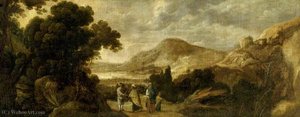
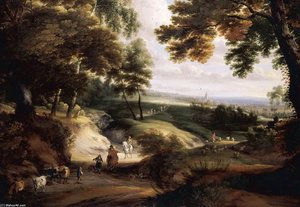
Portret van Jacob D'Arthois

De 57 beroemdste schilderijen van Jacob D'Arthois, elk uniek

Bijgewerkt in november 2026 · gerangschikt op basis van onze populariteitsscore (zoekopdrachten, bezoeken en bestellingen per kunstwerk) · 59 werken van Jacob D'Arthois in onze catalogus

Kortom

Family Group in a Landscape (1645) is het schilderij van Jacob D'Arthois dat de meeste aandacht trekt; het origineel bevindt zich in het Metropolitan Museum of Art, New York. Daarna gaat de blik naar Extensive forest landscape with St. Stanisław Kostka (1665) en The Ford in the Forest (1660). Van de 59 werken van Jacob D'Arthois in onze catalogus zijn dit de 57 bekendste, elk een uniek origineel gepresenteerd met het jaar, het museum en de reden waarom het blijft voortbestaan.

1613 – 1686, Brussel Baroque Meeste werken: Bayerische Staatsgemäldesammlungen

Top 10 schilderijen van Jacob D'Arthois, door de ogen van de galerie

1
Family Group in a Landscape (1645) door Jacob D'Arthois

Family Group in a Landscape

1645 · Oil On Canvas · Metropolitan Museum of Art, New York

A man stands with an arm outstretched, his finger tracing a line toward the distant horizon. Beside him, a woman and three children form a silent, structured group against the wildness of the Belgian countryside. The light falls from the upper left, catching the heavy folds of their period clothing and the pale skin of their faces. They are anchored by the dark, heavy mass of a sprawling tree on…

2
Extensive forest landscape with St. Stanisław Kostka (1665) door Jacob D'Arthois

Extensive forest landscape with St. Stanisław Kostka

1665 · Oil On Canvas · Kunsthistorisches Museum, Wenen

The canvas presents a dense, large-scale forest landscape characterized by an asymmetrical arrangement of ancient trees. On the left, massive trunks with textured, craggy bark dominate the foreground, their sprawling canopies extending toward the center. These dark, heavy forms create a natural frame for the interior of the woods. A winding path or clearing cuts through the mid-ground, leading the eye toward a small group of figures positioned on the…

3
The Ford in the Forest (1660) door Jacob D'Arthois

The Ford in the Forest

1660 · Oil On Canvas · Bayerische Staatsgemäldesammlungen, München

The air feels heavy with the scent of damp earth and ancient bark as the eye moves through a dense, dark frame of towering trees. These massive, irregular trunks act as a natural curtain, pulling the viewer into a secluded world where light and shadow perform a quiet dance. In the center of this woodland sanctuary, a shallow stream cuts through the terrain, creating a ford where life moves at…

4
Landscape with Entrance to a Forrest (1650) door Jacob D'Arthois

Landscape with Entrance to a Forrest

1650 · Oil On Canvas · Städel Museum, Frankfurt

A natural archway of heavy, textured bark frames the view. On the left and right, massive trees reach upward, their limbs twisting like slow-moving currents. These foreground sentinels cast long, cooling shadows across the earth, creating a dark vignette that pushes the eye toward a luminous center. Through this organic gateway, a pale blue sky peeks through a canopy of soft white clouds. The light arrives from the upper left,…

5
Extensive forest landscape with St. Francis Borgia (1665) door Jacob D'Arthois

Extensive forest landscape with St. Francis Borgia

1665 · Oil On Canvas · Kunsthistorisches Museum, Wenen

Step into the quietude of this expansive woodland. Jacques d'Arthois invites us into a vast, untamed wilderness where the scale of nature dwarfs the human presence. The composition is framed by heavy, detailed trees on the left and right, creating a natural vignette that draws the eye toward a luminous center. Deep forest greens and earthy ochre tones dominate the foliage, while the sky breaks through the canopy in pale…

6
Landscape with Stag Hunt (1649) door Jacob D'Arthois

Landscape with Stag Hunt

1649 · Oil On Canvas · Bayerische Staatsgemäldesammlungen, München

The scene unfolds within Landscape with Stag Hunt, a work that captures a moment of intense pursuit amidst the wild. Jacques D' Arthois, the hand behind this composition, breathes life into the rugged terrain through his precise rendering of the natural world. Born in Brussels, Belgium, in 1613, the artist brings a deep familiarity with the wooded landscapes of his homeland to this 1649 creation. The hunt moves through a…

7
Landscape (1682) door Jacob D'Arthois

Landscape

1682 · Oil On Canvas · Hermitage Museum, Sint-Petersburg

The composition is anchored by a dense, dark mass of trees occupying the left and central portions of the frame. These vertical elements create a sense of enclosure, casting much of the woodland into deep shadow. To the left, a sunlit rocky cliffside features a small, cascading waterfall that introduces movement into the otherwise still scene. In the lower foreground, a group of small figures and an animal gather near…

8
Landscape with a Herd (1630) door Jacob D'Arthois

Landscape with a Herd

1630 · Oil On Canvas · Hermitage Museum, Sint-Petersburg

In the heart of the Flemish Baroque era, Jacques d'Arthois captured a world where nature and pastoral life exist in a state of eternal, quiet grace. His masterpiece, Landscape with a Herd, is far more than a mere depiction of the countryside; it is an immersive window into a meticulously crafted vision of rural serenity. Painted between 1630 and 1650, this evocative oil on canvas invites the viewer to step…

9
Landscape with a herd (1665) door Jacob D'Arthois

Landscape with a herd

1665 · Oil On Canvas · Kunsthistorisches Museum, Wenen

In this 1630 oil on canvas, we find ourselves standing at the edge of a dense, shadowed woodland. The composition uses a repoussoir technique, where the dark, detailed bark of the foreground trees frames the view, drawing the eye inward toward a luminous, central valley. Sunlight breaks through a heavy, cloud-swept sky, casting a soft light upon the rolling hills and the distant, misty horizon. It is a scene of…

10
Landscape with waterfall (1638) door Jacob D'Arthois

Landscape with waterfall

1638 · Oil On Canvas

The scene is a vertical landscape dominated by a rugged, rocky terrain on the left side. A waterfall descends through this stone formation, creating white foam as the water moves downward. To the right and above the falls, dense trees with detailed foliage extend toward the top edge of the frame. The mid-ground features a sloping terrain that descends toward a distant, low-lying horizon. This horizon line suggests a wide…

De beroemde schilderijen van Jacob D'Arthois, nummer 11 tot 57

11Path to the Lake (1650) door Jacob D'ArthoisPath to the Lake1650 · Slovak National Gallery 12Deer Hunt (1649) door Jacob D'ArthoisDeer Hunt1649 · Bayerische Staatsgemäldesammlungen 13Falconry (1649) door Jacob D'ArthoisFalconry1649 · Bayerische Staatsgemäldesammlungen 14Landscape with Staffage (1649) door Jacob D'ArthoisLandscape with Staffage1649 · Bayerische Staatsgemäldesammlungen 15A Bay (1649) door Jacob D'ArthoisA Bay1649 · Bayerische Staatsgemäldesammlungen 16Forest Path (1649) door Jacob D'ArthoisForest Path1649 · Bayerische Staatsgemäldesammlungen 17Forest Edge (1649) door Jacob D'ArthoisForest Edge1649 · Bayerische Staatsgemäldesammlungen 18Wilderness Landscape with Waterfall (1649) door Jacob D'ArthoisWilderness Landscape with Waterfall1649 · Bayerische Staatsgemäldesammlungen 19Landscape with Trees and Water (1649) door Jacob D'ArthoisLandscape with Trees and Water1649 · Bayerische Staatsgemäldesammlungen 20Landscape with Trees (1649) door Jacob D'ArthoisLandscape with Trees1649 · Bayerische Staatsgemäldesammlungen 21Sunken Road in a Wood (1658) door Jacob D'ArthoisSunken Road in a Wood1658 · National Museum of Art, Architecture and Design 22Woodland Scene (1653) door Jacob D'ArthoisWoodland Scene1653 · National Museum of Art, Architecture and Design 23Landscape near Brussels (1654) door Jacob D'ArthoisLandscape near Brussels1654 · Hermitage Museum 24Wooded landscape with hunters and travellers (1657) door Jacob D'ArthoisWooded landscape with hunters and travellers1657 · Groninger Museum 25Wooded Landscape with Hunters (1657) door Jacob D'ArthoisWooded Landscape with Hunters1657 · Statens Museum for Kunst 26View taken in Brabant with figures and animals (1660) door Jacob D'ArthoisView taken in Brabant with figures and animals1660 · Musée des Beaux-Arts de Quimper 27Mountain pass with soldiers attacking peasants (1657) door Jacob D'ArthoisMountain pass with soldiers attacking peasants1657 · Staatliche Kunsthalle Karlsruhe 28Rudolf von Habsburg Handing over his Horse to a Priest (1650) door Jacob D'ArthoisRudolf von Habsburg Handing over his Horse to a Priest1650 29Landscape (1665) door Jacob D'ArthoisLandscape1665 · Groeningemuseum 30Landscape with a Group of Trees at the Shore of a Lake, Three Riders on the Road in the Foreground (1667) door Jacob D'ArthoisLandscape with a Group of Trees at the Shore of a Lake, Three Riders on the Road in the Foreground1667 · Städel Museum 31Waters with Planted Dykes (1660) door Jacob D'ArthoisWaters with Planted Dykes1660 · Bayerische Staatsgemäldesammlungen 32Cavaliers Halting on a Road in a Landscape door Jacob D'ArthoisCavaliers Halting on a Road in a LandscapeCalke Abbey 33Landscape with a River and Figures door Jacob D'ArthoisLandscape with a River and Figures 34Wooded Landscape door Jacob D'ArthoisWooded Landscape 35Edge of a Wood door Jacob D'ArthoisEdge of a WoodLouvre 36Landscape with Shepherd door Jacob D'ArthoisLandscape with ShepherdResidenzgalerie Salzburg 37Pond at the edge of a wood door Jacob D'ArthoisPond at the edge of a woodPalais des Beaux-Arts de Lille 38Landscape with Peasants Repelling Latona door Jacob D'ArthoisLandscape with Peasants Repelling LatonaMusée des Beaux-Arts 39Landscape: Woodland with Lake and Figures door Jacob D'ArthoisLandscape: Woodland with Lake and FiguresAuckland Art Gallery Toi o Tāmaki 40The Sonian forest with figures door Jacob D'ArthoisThe Sonian forest with figuresMuseum voor Schone Kunsten Gent 41Landscape door Jacob D'ArthoisLandscapeKoninklijk Museum voor Schone Kunsten Antwerpen 42Road through a Forest door Jacob D'ArthoisRoad through a ForestMuseum of Fine Arts 43Landscape with a Rider in Red door Jacob D'ArthoisLandscape with a Rider in RedNationalmuseum 44View of the woods of Soignies and the ponds of the Rood Klooster door Jacob D'ArthoisView of the woods of Soignies and the ponds of the Rood Klooster 45Landscape with a Huntsman door Jacob D'ArthoisLandscape with a Huntsman 46Hunting party door Jacob D'ArthoisHunting party 47A wooded landscape door Jacob D'ArthoisA wooded landscape 48Peasants at the Edge of a Forest door Jacob D'ArthoisPeasants at the Edge of a Forest 49Landscape with a Hunting Party door Jacob D'ArthoisLandscape with a Hunting PartyPetworth House 50Landscape with a River and Horsemen door Jacob D'ArthoisLandscape with a River and Horsemen 51Landscape, Riverbank with Figures door Jacob D'ArthoisLandscape, Riverbank with Figures 52Landscape with Figures door Jacob D'ArthoisLandscape with Figures 53Flemish landscape door Jacob D'ArthoisFlemish landscape 54Woody Landscape with Gypsies Telling a Gentleman's Fortune door Jacob D'ArthoisWoody Landscape with Gypsies Telling a Gentleman's Fortune 55Wooded Landscape door Jacob D'ArthoisWooded Landscape 56A rocky cove with fisherfolk on the shore, an artist sketching in the foreground door Jacob D'ArthoisA rocky cove with fisherfolk on the shore, an artist sketching in the foreground 57An Extensive Wooded Landscape with Travellers on a Path door Jacob D'ArthoisAn Extensive Wooded Landscape with Travellers on a Path

De onderwerpen die de aandacht van Jacob D'Arthois troffen

De vier onderwerpen die het meest voorkomen in deze originelen, elk met zijn mooiste voorbeeld.

De musea waar de originele werken van Jacob D'Arthois worden bewaard

De 8 musea met de meeste schilderijen op deze pagina.

Museum Stad Werken van Jacob D'Arthois Schilderijen uit deze lijst
Bayerische Staatsgemäldesammlungen, MünchenBayerische Staatsgemäldesammlungen München 12 The Ford in the Forest, Landscape with Stag Hunt, Deer Hunt
Kunsthistorisches Museum, WenenKunsthistorisches Museum Wenen 3 Extensive forest landscape with St. Stanisław Kostka, Extensive forest landscape with St. Francis Borgia, Landscape with a herd
Hermitage Museum, Sint-PetersburgHermitage Museum Sint-Petersburg 3 Landscape, Landscape with a Herd, Landscape near Brussels
Städel Museum, FrankfurtStädel Museum Frankfurt 2 Landscape with Entrance to a Forrest, Landscape with a Group of Trees at the Shore of a Lake, Three Riders on the Road in the Foreground
National Museum of Art, Architecture and Design, OsloNational Museum of Art, Architecture and Design Oslo 2 Sunken Road in a Wood, Woodland Scene
Metropolitan Museum of Art, New YorkMetropolitan Museum of Art New York 1 Family Group in a Landscape
Slovak National Gallery, BratislavaSlovak National Gallery Bratislava 1 Path to the Lake
Groninger Museum, GroningenGroninger Museum Groningen 1 Wooded landscape with hunters and travellers

Jacob D'Arthois door de decennia heen: elk een uniek origineel

Werken per decennium

Kies een decennium om het origineel te zien dat dit tijdperk definieert.

Schilderijen van Jacob D'Arthois: vragen voor de galerie

Wat is het bekendste werk van Jacob D'Arthois?Onthul het antwoord

Family Group in a Landscape (1645), Metropolitan Museum of Art, New York. Extensive forest landscape with St. Stanisław Kostka (1665) en The Ford in the Forest (1660) volgen.

Op welke leeftijd creëerde Jacob D'Arthois Family Group in a Landscape?Onthul het antwoord

32 jaar oud: Family Group in a Landscape dateert uit 1645, en Jacob D'Arthois werd geboren in 1613.

Welke tien schilderijen van Jacob D'Arthois zijn het meest bekend?Onthul het antwoord

Family Group in a Landscape, Extensive forest landscape with St. Stanisław Kostka, The Ford in the Forest, Landscape with Entrance to a Forrest, Extensive forest landscape with St. Francis Borgia, Landscape with Stag Hunt, Landscape, Landscape with a Herd, Landscape with a herd en Landscape with waterfall. De bovenstaande ranglijst vermeldt het jaar en het museum van elk werk.

Hoeveel werken van Jacob D'Arthois zijn er bekend?Onthul het antwoord

Onze catalogus bevat 59 werken van Jacob D'Arthois, daterend van 1630 tot 1682.

Waar kunnen de beroemdste originelen van Jacob D'Arthois worden bekeken?Onthul het antwoord

Voornamelijk in Bayerische Staatsgemäldesammlungen (München), Kunsthistorisches Museum (Wenen) en Hermitage Museum (Sint-Petersburg). De bovenstaande museumtabel bevat een volledig overzicht.

In welke periode creëerde Jacob D'Arthois de bekendste schilderijen?Onthul het antwoord

In 1640s: 11 van de 57 werken op deze pagina werden toen gemaakt, waaronder Family Group in a Landscape.

Welk beroemd schilderij van Jacob D'Arthois is de vroegste, en welke de laatste?Onthul het antwoord

Op deze pagina is het vroegste Landscape with a Herd (1630) en het laatste Landscape (1682).

Welke onderwerpen had Jacob D'Arthois de voorkeur?Onthul het antwoord

Landscape (32), Sky (27) en Forest (27), verspreid over de 57 werken op deze pagina.

Met welke materialen schilderde Jacob D'Arthois het meest?Onthul het antwoord

Oil On Canvas, voor 26 van de 57 werken op deze pagina.

Bij welke stroming behoort het werk van Jacob D'Arthois?Onthul het antwoord

Baroque, te oordelen aan de originelen op deze pagina.

Welke originele werken van Jacob D'Arthois kan ik zien in het Bayerische Staatsgemäldesammlungen?Onthul het antwoord

The Ford in the Forest, Landscape with Stag Hunt en Deer Hunt: het Bayerische Staatsgemäldesammlungen, München herbergt 12 van de werken op deze pagina.

Jacob D'Arthois: een portret van de kunstenaar

Een Meester uit Brussel van Bosrijke Taferelen: Het Leven en de Kunst van Jacques d’Arthois

Jacques d'Arthois, geboren in Brussel in 1613, kwam op in een bloeiende periode voor de Vlaamse kunst—een tijdperk waarin de landschapsschilderkunst gestaag aan belang won naast de gevestigde tradities van de portretkunst en de genrestukken. Hoewel hij wellicht niet zo wereldberoemd werd als sommige van zijn tijdgenoten, wist d’Arthois een unieke niche voor zichzelf te creëren met zijn minutieus gedetailleerde afbeeldingen van bosrijke landschappen, bevolkt door figuren die zich bezighielden met het dagelijks leven of pastorale bezigheden. Zijn carrière ontvouwde zich tegen de achtergrond van politieke en religieuze onrust, maar het lukte hem om een consistente stijl te cultiveren die resoneren met opdrachtgevers die zochten naar zowel schoonheid als sereniteit in hun omgeving. Na zijn leertijd bij Jan Mertens in 1625 blijven de details van zijn vroege opleiding enigszins mysterieus; het is echter overduidelijk dat d'Arthois al snel een affiniteit ontwikkelde voor het weergeven van de natuurlijke wereld met een opmerkelijke precisie. In 1634 trad hij toe tot het Sint-Lucasgilde in Brussel, wat een formele erkenning van zijn artistieke talenten betekende en hem vestigde als een professioneel schilder binnen de bloeiende kunstgemeenschap van de stad.

De Tapissier en het Pastorale Ideaal

D'Arthois wijdde zich niet uitsluitend aan de schilderkunst op het ezel; hij boekte ook aanzienlijk succes als ontwerper van wandtapijten, waarbij hij in 1655 de prestigieuze status van erkend kartonontwerper voor de stad Brussel verwierf. Deze dubbelrol is van groot belang, omdat het een venster biedt op zijn brede artistieke sensitiviteit—zijn vermogen om composities moeiteloos van het ene medium naar het andere te vertalen en zijn diepgaande begrip van decoratieve principes. Het ontwerpen van wandtapijten vereiste een helderheid in vorm en narratief die ongetwijfeld een stempel drukte op zijn schilderijen; het moedigde hem aan om scènes te creëren die zowel visueel meeslepend als gemakkelijk interpreteerbaar waren. Zijn landschappen roepen vaak een gevoel van geïdealiseerde harmonie op, een weerspiegeling van het pastorale ideaal dat zo dominant was in de 17e-eeuwse kunst—een diep verlangen naar een eenvoudiger, deugdzamer bestaan, stevig geworteld in de natuur. De bossen rondom Brussel dienden als zijn voornaamste bron van inspiratie, en hij legde ze dikwijls vast met een scherp oog voor atmosferische effecten en de subtiele dans van licht en schaduw. Om zijn composities tot leven te wekken, werden er vaak figuren aan toegevoegd door andere meesters, in het bijzonder David Teniers de Jonge en Gonzales Coques. Deze samenwerkingen resulteerden in meesterwerken die zowel de landschappelijke expertise van d'Arthois als het talent van de figuratieve schilders om de scènes te bezielen, in volle glorie lieten zien.

Invloeden en Artistieke Ontwikkeling

Het traceren van de invloeden op de stijl van d’Arthois onthult een complex samenspel van artistieke tradities. Zijn vroege werken tonen een duidelijke schuld aan Lodewijk de Vadder, een andere prominente Brusselse landschapsschilder wiens composities vaak vergelijkbare beboste decors en figuurgroeperingen bevatten. Toch ontwikkelde d’Arthois geleidelijk zijn eigen, kenmerkende stem, die werd gekenmerkt door een grotere nadruk op detail en een verfijnder gevoel voor atmosferisch perspectief. Ook de invloed van Denis van Alsloot is waarneembaar in zijn vroege schilderijen, met name in de weergave van bomen en gebladerte. Naarmate hij volwassen werd, begon d’Arthois te experimenteren met landschappen van grotere omvang, als reactie op de groeiende vraag naar decoratieve werken die kerken en abdijen konden verfraaien. Deze ambitieuze composities vereisten een geavanceerd begrip van ruimtelijke ordening en een meesterschap over kleur en toon. Hoewel het documentaire bewijs beperkt is, wordt vermoed dat Cornelis Huysmans rond 1650 tijd heeft doorgebracht in het atelier van d’Arthois, al blijft de omvang van zijn invloed onzeker.

Een nalatenschap van imitatie en historische betekenis

Jacques d’Arthois genoot tijdens zijn leven een succesvolle carrière, waarbij hij opdrachten verwierf van zowel particuliere mecenassen als religieuze instellingen. Zijn welstand werd weerspiegeld in het bezit van verschillende huizen, waaronder een woning in het Zoniënwoud—een tastbaar bewijs van zijn welvaart en zijn diepe verbondenheid met de natuurlijke wereld die hij zo vaak met zoveel passie vastlegde. Hoewel hij later in zijn leven te maken kreeg met financiële moeilijkheden, bleef zijn artistieke reputatie onverwoestbaar. De invloed van zijn penseelstreek reikte veel verder dan de muren van Brussel; dit blijkt uit de aanwezigheid van leerlingen die zijn stijl nauwgezet nabootsten en zijn esthetische principes door de hele regio verspreidden. Hoewel er geen werken definitief zijn ondertekend door zijn broer Nicolaes of zijn zoon Jan Baptist, bestaat de overtuiging dat veel schilderijen die aan Jacques d’Arthois worden toegeschreven, in werkelijkheid door deze familieleden zijn vervaardigd. Deze ambiguïteit onderstreept de complexe uitdagingen die inherent zijn aan het toeschrijven van zeventiende-eeuwse Vlaamse landschappen, maar het benadrukt tegelijkertijd de blijvende aantrekkingskracht van de stijl van d'Arthois—een stijl die generaties lang door andere landschapsschilders werd nagevolgd en geïmiteerd. Zijn werkelijke bijdrage aan de kunstgeschiedenis ligt niet in radicale vernieuwing, maar in de meesterlijke uitvoering van een geliefd genre en zijn unieke vermogen om de schoonheid en de serene rust van het Belgische platteland te vangen. Hij vormt een vitale schakel in de ontwikkeling van de Vlaamse landschapsschilderkunst, waarbij hij de brug sloeg tussen de oudere tradities en de meer verfijnde benaderingen die in de daaropvolgende eeuwen zouden opkomen.