Portret van Filippo De Pisis

Schilderijen van Filippo De Pisis: De 60 bekendste, door de ogen van een galerie

Bijgewerkt in oktober 2026 · gerangschikt op basis van onze populariteitsscore (zoekopdrachten, bezoeken en bestellingen per kunstwerk) · 61 werken van Filippo De Pisis in onze catalogus

Kortom

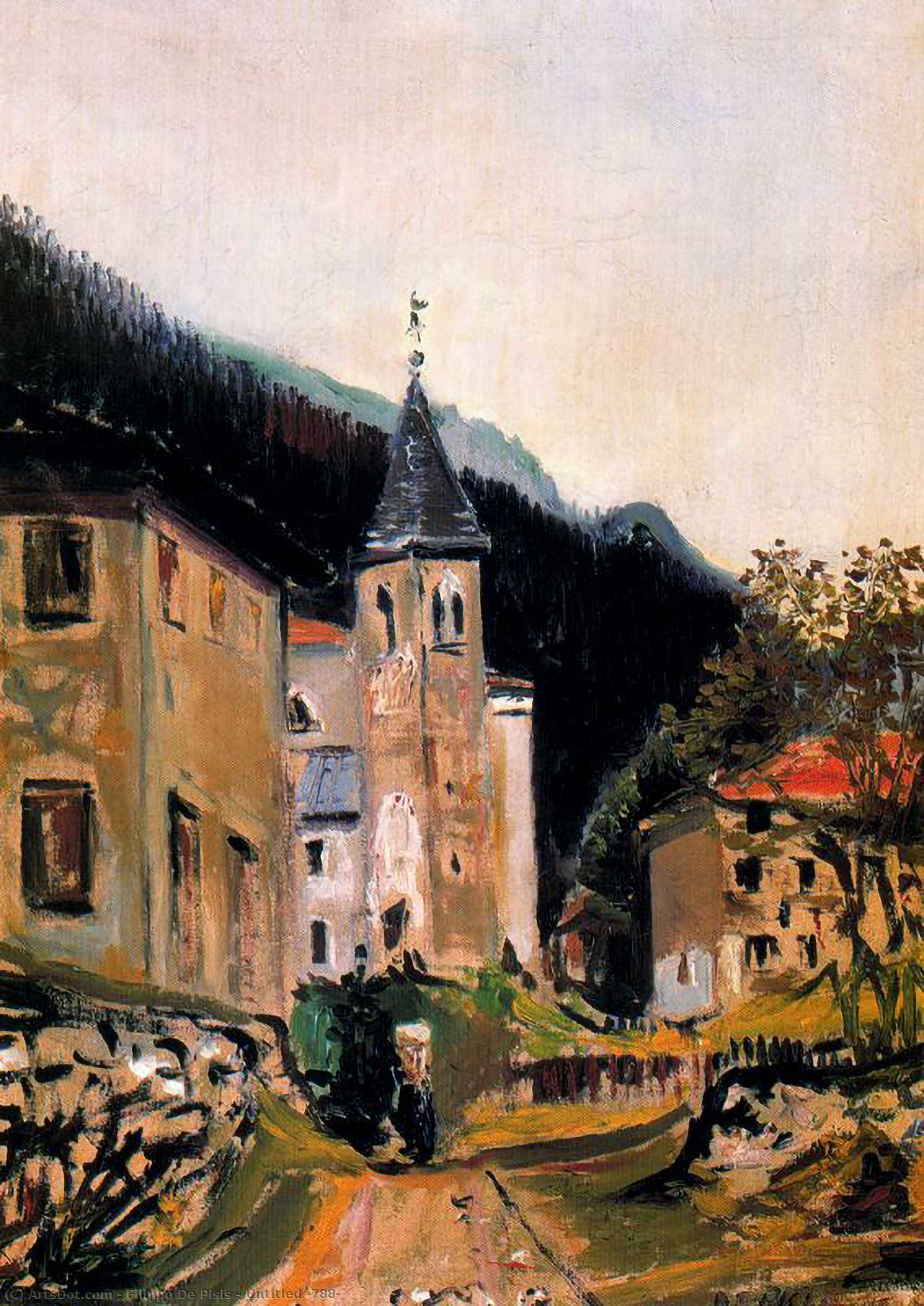
In het oog van de galerie is het beroemdste schilderij van Filippo De Pisis Untitled (839). Untitled (529) en Untitled (788) maken het trio compleet dat elk oog herkent. Van de 61 werken van Filippo De Pisis in onze catalogus presenteert de galerie hieronder de 60 bekendste werken, elk een origineel met de jaartal, het museum en wat het uniek maakt.

1896 – 1956, Ferrara Impressionism Meeste werken: Galleria d'Arte Moderna Achille Forti

De top 10 schilderijen van Filippo De Pisis in de galerie

1
Untitled (839) door Filippo De Pisis

Untitled (839)

Oil On Canvas

In this work, we find ourselves drifting through a quiet, atmospheric moment in Venice, Italy. The Basilica di Santa Maria della Salute dominates the composition, yet it does not demand attention through rigid lines or heavy outlines. Instead, the structure emerges from a haze of cool blues and purples, its domes catching a diffused light that feels as though it might shift at any second. The scene is one of…

2
Untitled (529) door Filippo De Pisis

Untitled (529)

Oil On Canvas

A man in a white shirt and trousers moves through a dream, caught in a dance pose that defies the stillness of the objects around him. He is partially obscured by a rectangular frame, a boundary that separates the viewer from this fleeting gesture. At the center, a vase overflows with flowers, their petals rendered in thick, impasto strokes that catch the light. Below this arrangement, a single red fruit…

7
Still life with Mushrooms (1934) door Filippo De Pisis

Still life with Mushrooms

In the quiet intimacy of Filippo de Pisis’s Still Life with Mushrooms, we are invited into a world where the mundane is elevated to the level of poetry. Created in 1934, this exquisite composition serves as a masterclass in the art of the fleeting moment. The painting captures a scattered collection of mushrooms, their organic forms resting with a delicate randomness across the canvas. Some lie solitary on the ground,…

Schilderijen van Filippo De Pisis, gerangschikt van 11 tot 60

De onderwerpen die de aandacht van Filippo De Pisis troffen

De vier onderwerpen die het meest voorkomen in deze originelen, elk met zijn mooiste voorbeeld.

De musea waar de originele werken van Filippo De Pisis worden bewaard

De 2 musea met de meeste schilderijen op deze pagina.

Museum Stad Werken van Filippo De Pisis Schilderijen uit deze lijst
Galleria d'Arte Moderna Achille Forti, VeronaGalleria d'Arte Moderna Achille Forti Verona 2 Still life with Mushrooms, Strawberries. Still Life
Art Gallery of New South Wales, SydneyArt Gallery of New South Wales Sydney 1 Flowers

Filippo De Pisis, de kenmerkende schilderijen van elk jaar

Ongeveer tien jaar, van 1930 tot 1939, waren genoeg voor Filippo De Pisis: de galerie loopt er jaar voor jaar doorheen, een beroemd origineel na het andere.

Werken per jaar

Selecteer een jaar om de originele werken te bekijken.

Schilderijen van Filippo De Pisis: de galerie geeft antwoord

Welk schilderij van Filippo De Pisis is het beroemdste van allemaal?Onthul het antwoord

Untitled (839). Untitled (529) en Untitled (788) volgen.

Wat zijn de top 10 schilderijen van Filippo De Pisis?Onthul het antwoord

Untitled (839), Untitled (529), Untitled (788), Flowers, Untitled (620), Untitled (313), Still life with Mushrooms, Untitled (805), Untitled (699) en Untitled (586). De bovenstaande ranglijst vermeldt het jaar en het museum van elk werk.

Hoeveel werken heeft Filippo De Pisis gemaakt?Onthul het antwoord

Onze catalogus bevat 61 werken van Filippo De Pisis, daterend van 1930 tot 1939.

Waar hangen de beroemdste originele werken van Filippo De Pisis?Onthul het antwoord

Voornamelijk in Galleria d'Arte Moderna Achille Forti (Verona) en Art Gallery of New South Wales (Sydney). De bovenstaande museumtabel bevat een volledig overzicht.

Wat zijn de vroegste en laatste beroemde werken van Filippo De Pisis?Onthul het antwoord

Op deze pagina is het vroegste Still Life with Shell (1930) en het laatste Strawberries. Still Life (1939).

Welke onderwerpen keerde Filippo De Pisis het vaakst naar terug?Onthul het antwoord

Still life (6), Italian art (6) en Flowers (2), verspreid over de 60 werken op deze pagina.

In welk medium werkte Filippo De Pisis het meest?Onthul het antwoord

Oil On Canvas, voor 2 van de 60 werken op deze pagina.

Bij welke stroming wordt Filippo De Pisis gerekend?Onthul het antwoord

Impressionism en Post-impressionism, te oordelen aan de originelen op deze pagina.

Welke originelen van Filippo De Pisis zijn in de collectie van het Galleria d'Arte Moderna Achille Forti?Onthul het antwoord

Still life with Mushrooms en Strawberries. Still Life: het Galleria d'Arte Moderna Achille Forti, Verona herbergt 2 van de werken op deze pagina.

Filippo De Pisis: de kunstenaar

The Poet of the Fleeting Moment

Born Luigi Filippo Tibertelli in the historic Italian city of Ferrara, Filippo De Pisis was an artist who refused to be confined by a single medium. To understand his canvas, one must first understand his soul as a poet; he viewed the world through a lens of literary sensitivity, where every shadow and light flicker held a narrative weight. His early years in Italy were marked by a profound intellectual curiosity, studying literature and philosophy in Bologna. It was here that he encountered the haunting, dreamlike visions of Giorgio De Chirico, an encounter that would plant the seeds of Metaphysical influence within his burgeoning style. This duality—the precision of a scholar and the wandering eye of a flâneur—defined his approach to art, allowing him to capture not just the physical reality of a subject, but its emotional resonance.

His journey was one of constant movement across the great cultural capitals of Europe. Moving to Rome in 1919 and later settling in Paris in 1925, De Pisis immersed himself in the vibrant, avant-garde pulse of the interwar period. In Paris, his brushwork began to shed its more rigid, metaphysical origins, absorbing the light and movement of French Impressionism. He moved within the same circles as Georges Braque and André Derain, and his style evolved into something uniquely his own: a technique often described as pittura a zancapi mosca—a "fly-wing" style of painting characterized by rapid, fragmented, and nervous brushstrokes. This method allowed him to achieve an airy, almost mirage-like quality, where objects seemed to vibrate with life before dissolving back into the atmosphere.

A Symphony of Light and Melancholy

The heart of De Pisis’s oeuvre lies in his ability to find the eternal within the ephemeral. He possessed a singular talent for elevating the mundane—a simple arrangement of mushrooms, a bowl of strawberries, or a vase of foxgloves—into profound meditations on existence. His still lifes are never merely static arrangements; they are imbued with what he called "pathetic pleasure-pain," a bittersweet recognition of beauty's fleeting nature. Through muted pastel hues and a masterful command of Venetian light, he created compositions where the boundaries between objects and their surroundings blur, suggesting a deep, spiritual interconnectedness between all things.

His fascination with Venice provided much of his most luminous subject matter. The city’s architectural grandeur and its misty, maritime atmosphere served as the perfect stage for his expressive explorations. Whether depicting the rhythmic movement of a seascape or the quiet intimacy of a street scene, De Pisis utilized a broken brushstroke technique that captured the very essence of light hitting water or stone. This period of his work represents a pinnacle of Italian Post-Impressionism, where the artist’s technical skill met an almost obsessive devotion to capturing the "secret spirit" of the moment.

Legacy of the Cosmopolitan Visionary

Despite the disruptions of World War II and his eventual return to Italy, De Pisis never lost the cosmopolitan spirit that had defined his youth. His life was famously eccentric, marked by a dandyish lifestyle and an insatiable appetite for the beauty found in the smallest details—even claiming that a discarded feather on a street could spark a masterpiece. This radical openness to the world ensured that his work remained perpetually fresh, avoiding the stagnation that often plagues established masters.

Today, the significance of Filippo De Pisis rests in his unique position as a bridge between the structured metaphysical movements of the early 20th century and the more spontaneous, emotive expressions of later decades. His legacy is found in:

  • The fusion of poetry and painting: Proving that visual art can be as lyrical and metaphorically rich as the written word.
  • Mastery of atmosphere: Redefining how light and texture can convey complex psychological states like nostalgia and longing.
  • The elevation of the everyday: Transforming simple still lifes into profound explorations of beauty, decay, and the passage of time.

He remains a celebrated figure in the annals of Italian art, remembered not just as a painter of scenes, but as a chronicler of the ephemeral soul.