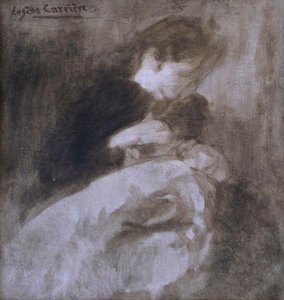
Portret van Eugène Carrière

De 100 beroemdste schilderijen van Eugène Carrière, elk uniek

Bijgewerkt in oktober 2026 · gerangschikt op basis van onze populariteitsscore (zoekopdrachten, bezoeken en bestellingen per kunstwerk) · 249 werken van Eugène Carrière in onze catalogus

Kortom

Portrait of Pablo Casals (1903) is het schilderij van Eugène Carrière dat de meeste aandacht trekt; het origineel bevindt zich in het Vil·la Casals-Museu Pau Casals, El Vendrell. Daarna gaat de blik naar Nelly Carrière (1903) en Le Docteur Léon Gorodiche et sa famille Portrait de famille (titre ancien). Van de 249 werken van Eugène Carrière in onze catalogus zijn dit de 100 bekendste, elk een uniek origineel gepresenteerd met het jaar, het museum en de reden waarom het blijft voortbestaan.

1849 – 1906, Gournay-sur-Marne Symbolism Meeste werken: Petit Palais

Top 10 schilderijen van Eugène Carrière, door de ogen van de galerie

1
Portrait of Pablo Casals (1903) door Eugène Carrière

Portrait of Pablo Casals

1903 · Oil On Canvas · Vil·la Casals-Museu Pau Casals, El Vendrell

Eugène Anatole Carrière’s “Portrait of Pablo Casals,” painted in 1903, is more than just a likeness; it's an intensely felt meditation on contemplation and the weight of artistic experience. This oil on canvas work, currently residing within the Vil·la Casals-Museu Pau Casals in El Vendrell, Spain, offers a rare glimpse into the mind of a man lost in thought – Pablo Casals himself, the renowned cellist – through Carrière’s masterful…

2
Nelly Carrière (1903) door Eugène Carrière

Nelly Carrière

1903 · Oil On Canvas

The air in the room feels heavy and still, thick with the scent of oil paint and the soft, diffused light of a late afternoon. Nelly Carrière sits before us, her presence a gentle weight in the center of the frame. She does not demand attention through movement or bright color; instead, she draws the eye inward through a profound, quiet stillness. Her head tilts slightly, a subtle asymmetry that…

3
Le Docteur Léon Gorodiche et sa famille Portrait de famille (titre ancien) door Eugène Carrière

Le Docteur Léon Gorodiche et sa famille Portrait de famille (titre ancien)

Oil

The canvas presents Le Docteur Léon Gorodiche et sa famille Portrait de famille (titre ancien), a work that brings the presence of Léon Gorodiche into the immediate view. This portrait captures a family moment, pulling the viewer into a quiet, domestic scene. The artist, Eugène Carrière, breathes life into the subjects, rendering them with a sense of profound intimacy. One can almost feel the stillness of the room as the…

4
Portrait of Madame Aline Ménard-Dorian (1905) door Eugène Carrière

Portrait of Madame Aline Ménard-Dorian

1905 · Oil On Canvas · Petit Palais, Parijs

The Portrait of Madame Aline Ménard-Dorian is a somber and ethereal portrait of a woman, characterized by a dreamlike, atmospheric quality and a monochromatic, low-key tonal range. The composition features a single female figure, positioned slightly off-center, appearing to emerge from a dark, nebulous background. The color palette is highly restricted, consisting almost entirely of sepia, umber, cream, and deep browns, creating a sense of antiquity and melancholy.

5
Arsène Carriere (1900) door Eugène Carrière

Arsène Carriere

1900 · Oil On Canvas · National Gallery of Art, Washington

Every brushstroke seeks to reach past the skin and into the essence of human experience. The way the light catches the white fabric of the dress against the darker, murky background creates a focal point that is both intimate and profound. This is not a mere depiction of a child, but an exploration of the raw, unvarnished emotions that exist in the earliest stages of life. The work carries a…

6
Femme nue couchée door Eugène Carrière

Femme nue couchée

Oil On Canvas

The composition is centered around the woman's body, which lies diagonally across the canvas in a horizontal format. Her pose is relaxed; one arm is raised above her head while the other rests near her side. A draped fabric partially covers her lower body, creating organic, flowing shapes that follow the curves of her form. To the right of the figure, a small table holds a glass of wine and…

7
Portrait du Dr. Léon Gorodiche Portrait du Dr. X door Eugène Carrière

Portrait du Dr. Léon Gorodiche Portrait du Dr. X

Oil On Canvas

Portrait du Dr. Léon Gorodiche Portrait du Dr. X is a work by the French artist Eugène Carrière. The subject is a man, identified as either Dr. Léon Gorodiche or an individual referred to as Dr. X. Carrière focuses on capturing the sitter's likeness and his psychological state through a muted and somewhat melancholic style.

8
Portrait of a Lady with a Dog (1885) door Eugène Carrière

Portrait of a Lady with a Dog

1885 · Oil On Canvas · Art Institute of Chicago, Chicago

A Study in Shadow and Stillness Portrait of a Lady with a Dog emerges from a dark, indistinct background like a memory surfacing through fog. The composition holds a seated woman, positioned slightly off-center, her form anchored by the small weight of a dog resting in her lap. A soft light source strikes her face, neck, and shoulder, pulling these features from the surrounding gloom. The palette is strictly grayscale,…

10
Self-Portrait (1893) door Eugène Carrière

Self-Portrait

1893 · Oil On Canvas

A man stares directly from the canvas, his gaze fixed and unyielding. Through a veil of hazy brushwork, his features emerge from a dense, monochromatic atmosphere of umber and grey. This 1893 oil on canvas presents a face defined by more than mere anatomy; it is a study of presence through absence. The subject, wearing glasses that catch a faint, spectral light, possesses a mustache and a beard that seem…

De beroemde schilderijen van Eugène Carrière, nummer 11 tot 100

11The Sleep (1890) door Eugène CarrièreThe Sleep1890 · Städel Museum 12Self-Portrait (1893) door Eugène CarrièreSelf-Portrait1893 · Metropolitan Museum of Art 13Tête de bébé (1878) door Eugène CarrièreTête de bébé1878 · The Hunterian Museum and Art Gallery 14Portrait of Edmond de Goncourt (1822-1896), writer (1880) door Eugène CarrièrePortrait of Edmond de Goncourt (1822-1896), writer1880 · Musée Carnavalet 15Portrait of Auguste Blanqui (1805-1881), Politician (1880) door Eugène CarrièrePortrait of Auguste Blanqui (1805-1881), Politician1880 · Musée Carnavalet 16Portrait of a Man (1879) door Eugène CarrièrePortrait of a Man1879 · Museum of Fine Arts 17Little d'Artagnan (1882) door Eugène CarrièreLittle d'Artagnan1882 18Sketch for the Salon of Sciences of the Hôtel de Ville de Paris: Physics - Chemistry (1890) door Eugène CarrièreSketch for the Salon of Sciences of the Hôtel de Ville de Paris: Physics - Chemistry1890 · Petit Palais 19Sketch for the Salon of Sciences of the Hôtel de Ville de Paris: Magnetism - Mechanics (1890) door Eugène CarrièreSketch for the Salon of Sciences of the Hôtel de Ville de Paris: Magnetism - Mechanics1890 · Petit Palais 20Sketch for the Salon of Sciences of the Hôtel de Ville de Paris: Mathematics - Mineralogy (1890) door Eugène CarrièreSketch for the Salon of Sciences of the Hôtel de Ville de Paris: Mathematics - Mineralogy1890 · Petit Palais 21Woman Sewing (1892) door Eugène CarrièreWoman Sewing1892 · Rhode Island School of Design Museum of Art 22Armand Berton (1891) door Eugène CarrièreArmand Berton1891 · Cleveland Museum of Art 23Portrait of Paul Gauguin (1891) door Eugène CarrièrePortrait of Paul Gauguin1891 · Yale University Art Gallery 24Self-portrait, Eugène Carrière (1887) door Eugène CarrièreSelf-portrait, Eugène Carrière1887 · Museum voor Schone Kunsten Gent 25Paul Verlaine (1891) door Eugène CarrièrePaul Verlaine1891 · Museum of Fine Arts 26Maternity (1892) door Eugène CarrièreMaternity1892 27Portrait of Gustave Geffroy (1891) door Eugène CarrièrePortrait of Gustave Geffroy1891 · Musée Toulouse-Lautrec 28Maternity (1888) door Eugène CarrièreMaternity1888 · National Museum Cardiff 29The Tin Mug (1888) door Eugène CarrièreThe Tin Mug1888 · National Museum Cardiff 30Meditation (1893) door Eugène CarrièreMeditation1893 · Ohara Museum of Art 31The Ages of Life: Young Mothers (1898) door Eugène CarrièreThe Ages of Life: Young Mothers1898 · Petit Palais 32Sketch for the Mairie du 12ème: Youth (1897) door Eugène CarrièreSketch for the Mairie du 12ème: Youth1897 · Petit Palais 33Sketch for the Mairie du 12ème: The Old Men (1897) door Eugène CarrièreSketch for the Mairie du 12ème: The Old Men1897 · Petit Palais 34Reading. (1894) door Eugène CarrièreReading.1894 · The National Museum in Poznań 35Portrait of a Lady (1894) door Eugène CarrièrePortrait of a Lady1894 · Nationaal Museum voor Schone Kunsten van Cuba 36A Family (1893) door Eugène CarrièreA Family1893 · National Museum of Art, Architecture and Design 37Two Women (1895) door Eugène CarrièreTwo Women1895 · Minneapolis Institute of Art 38Portrait of a Woman (Madame Keyser (?)) (1897) door Eugène CarrièrePortrait of a Woman (Madame Keyser (?))1897 · Los Angeles County Museum of Art 39Gabriel Séailles et sa fille (1893) door Eugène CarrièreGabriel Séailles et sa fille1893 · Musée d'Art Moderne et Contemporain de Strasbourg 40Maternity (Suffering) (1897) door Eugène CarrièreMaternity (Suffering)1897 · National Museum Cardiff 41Abandoned Fantine (1903) door Eugène CarrièreAbandoned Fantine1903 · Musée Victor Hugo 42Portrait of Anatole France (1844-1924), writer (1900) door Eugène CarrièrePortrait of Anatole France (1844-1924), writer1900 · Musée Carnavalet 43The Contemplator (1901) door Eugène CarrièreThe Contemplator1901 · Cleveland Museum of Art 44Madame Case (1900) door Eugène CarrièreMadame Case1900 · Cleveland Museum of Art 45Portrait of Elsa Koeberlé (1903) door Eugène CarrièrePortrait of Elsa Koeberlé1903 · Musée d'Art Moderne et Contemporain de Strasbourg 46Bust of a Young Girl (1903) door Eugène CarrièreBust of a Young Girl1903 · Harvard Art Museums 47Méditation (1900) door Eugène CarrièreMéditation1900 · Musée d'Art Moderne et Contemporain de Strasbourg 48Woman Leaning on a Table (1890) door Eugène CarrièreWoman Leaning on a Table1890 · Hermitage Museum 49L'enfant à la soupière door Eugène CarrièreL'enfant à la soupière 50Maternity (1880) door Eugène CarrièreMaternity1880 · Hill-Stead Museum 51The Pianist (1900) door Eugène CarrièreThe Pianist1900 · Bristol Museum - Art Gallery 52Portrait of Pauline Ménard-Dorian (1890) door Eugène CarrièrePortrait of Pauline Ménard-Dorian1890 · Petit Palais 53Roger Marx door Eugène CarrièreRoger Marx 54The First Communion (1896) door Eugène CarrièreThe First Communion1896 · Metropolitan Museum of Art 55Still Life (1875) door Eugène CarrièreStill Life1875 · Art Institute of Chicago 56Sketch for the Salon des Sciences of the Hôtel de Ville de Paris: Nude Woman from Behind, Spandrel Figure (1890) door Eugène CarrièreSketch for the Salon des Sciences of the Hôtel de Ville de Paris: Nude Woman from Behind, Spandrel Figure1890 · Petit Palais 57Sketch for the Salon of Sciences of the Hôtel de Ville de Paris: Geography - Geology (1890) door Eugène CarrièreSketch for the Salon of Sciences of the Hôtel de Ville de Paris: Geography - Geology1890 · Petit Palais 58Sketch for the Salon of Sciences of the Hôtel de Ville de Paris: Mathematics and Mineralogy (1890) door Eugène CarrièreSketch for the Salon of Sciences of the Hôtel de Ville de Paris: Mathematics and Mineralogy1890 · Petit Palais 59Sketch for the Salon of Sciences of the Hôtel de Ville de Paris: Botany - Medicine (1889) door Eugène CarrièreSketch for the Salon of Sciences of the Hôtel de Ville de Paris: Botany - Medicine1889 · Petit Palais 60Head of a Child (1891) door Eugène CarrièreHead of a Child1891 · National Gallery 61Winding Wool (Les Dévideuses) (1887) door Eugène CarrièreWinding Wool (Les Dévideuses)1887 · National Gallery 62Female figure (1901) door Eugène CarrièreFemale figure1901 · Vil·la Casals-Museu Pau Casals 63The Footbath (1890) door Eugène CarrièreThe Footbath1890 · National Museum Cardiff 64Mother and Child (1890) door Eugène CarrièreMother and Child1890 · National Museum Cardiff 65Landscape in the Orne (1901) door Eugène CarrièreLandscape in the Orne1901 · Rhode Island School of Design Museum of Art 66Head of a Woman (1900) door Eugène CarrièreHead of a Woman1900 · York Art Gallery 67Interior with a Vase (1896) door Eugène CarrièreInterior with a Vase1896 · Städel Museum 68Woman looking door Eugène CarrièreWoman lookingNational Museum of Fine Arts 69Artist at His Easel (L'Artiste à son Chevalet) door Eugène CarrièreArtist at His Easel (L'Artiste à son Chevalet)Indianapolis Museum of Art 70Portrait of a Lady. Study door Eugène CarrièrePortrait of a Lady. StudyNationalmuseum 71Porträt der Mme Arthur Fontaine door Eugène CarrièrePorträt der Mme Arthur FontaineMusée Toulouse-Lautrec 72violin-player door Eugène Carrièreviolin-player 73Head of a Young Girl door Eugène CarrièreHead of a Young Girl 74Portrait d'Henri Rochefort door Eugène CarrièrePortrait d'Henri Rochefort 75Portrait of a Man door Eugène CarrièrePortrait of a Man 76Portrait de femme (Lisbeth) (titre factice) door Eugène CarrièrePortrait de femme (Lisbeth) (titre factice) 77Marguerite Carrière door Eugène CarrièreMarguerite Carrière 78Maternité door Eugène CarrièreMaternité 79Child With A Doll door Eugène CarrièreChild With A Doll 80Femme coupant un tissu door Eugène CarrièreFemme coupant un tissu 81Sealmaiden door Eugène CarrièreSealmaiden 82Le Reveil, Le Baiser A La Mere door Eugène CarrièreLe Reveil, Le Baiser A La Mere 83Maternité (femme et enfant) door Eugène CarrièreMaternité (femme et enfant) 84Souvenir de Lourdes door Eugène CarrièreSouvenir de LourdesAshmolean Museum 85Portrait d'enfant door Eugène CarrièrePortrait d'enfant 86Portrait de Melle Lucienne Bréval door Eugène CarrièrePortrait de Melle Lucienne Bréval 87L'homme et sa destinée door Eugène CarrièreL'homme et sa destinée 88La chemise enlevée door Eugène CarrièreLa chemise enlevée 89Le baiser du soir door Eugène CarrièreLe baiser du soir 90Le fondeur door Eugène CarrièreLe fondeurMusée des Beaux-Arts de Nancy 91Famille Chausson en grisaille door Eugène CarrièreFamille Chausson en grisaille 92Intimité La grande soeur (autre titre) door Eugène CarrièreIntimité La grande soeur (autre titre)Bayerische Staatsgemäldesammlungen 93Scène d'enterrement médiéval door Eugène CarrièreScène d'enterrement médiéval 94Madame Eugène Carrière en méditation door Eugène CarrièreMadame Eugène Carrière en méditation 95Portrait de René Carrière dessinant door Eugène CarrièrePortrait de René Carrière dessinant 96La famille du peintre door Eugène CarrièreLa famille du peintre 97Sortie d'Eglise door Eugène CarrièreSortie d'Eglise 98Pas pressé de faire connaissance door Eugène CarrièrePas pressé de faire connaissance 99Femme dans un intérieur door Eugène CarrièreFemme dans un intérieur 100Femme assise en buste, les mains croisées door Eugène CarrièreFemme assise en buste, les mains croisées

De beroemde schilderijen van Eugène Carrière, periode voor periode

De onderwerpen die de aandacht van Eugène Carrière troffen

De vier onderwerpen die het meest voorkomen in deze originelen, elk met zijn mooiste voorbeeld.

De musea waar de originele werken van Eugène Carrière worden bewaard

De 8 musea met de meeste schilderijen op deze pagina.

Museum Stad Werken van Eugène Carrière Schilderijen uit deze lijst
Petit Palais, ParijsPetit Palais Parijs 12 Portrait of Madame Aline Ménard-Dorian, Sketch for the Salon of Sciences of the Hôtel de Ville de Paris: Physics - Chemistry, Sketch for the Salon of Sciences of the Hôtel de Ville de Paris: Magnetism - Mechanics
National Museum Cardiff, CardiffNational Museum Cardiff Cardiff 6 Maternity, The Tin Mug, Maternity (Suffering)
Musée d'Art Moderne et Contemporain de Strasbourg, StraatsburgMusée d'Art Moderne et Contemporain de Strasbourg Straatsburg 6 Gabriel Séailles et sa fille, Portrait of Elsa Koeberlé, Méditation
Musée Carnavalet, ParijsMusée Carnavalet Parijs 3 Portrait of Edmond de Goncourt (1822-1896), writer, Portrait of Auguste Blanqui (1805-1881), Politician, Portrait of Anatole France (1844-1924), writer
Cleveland Museum of Art, ClevelandCleveland Museum of Art Cleveland 3 Armand Berton, The Contemplator, Madame Case
Art Institute of Chicago, ChicagoArt Institute of Chicago Chicago 3 Portrait of a Lady with a Dog, Still Life
Metropolitan Museum of Art, New YorkMetropolitan Museum of Art New York 3 Self-Portrait, The First Communion
National Gallery, LondenNational Gallery Londen 3 Head of a Child, Winding Wool (Les Dévideuses)

Eugène Carrière door de decennia heen: elk een uniek origineel

Werken per decennium

Kies een decennium om het origineel te zien dat dit tijdperk definieert.

Schilderijen van Eugène Carrière: vragen voor de galerie

Wat is het bekendste werk van Eugène Carrière?Onthul het antwoord

Portrait of Pablo Casals (1903), Vil·la Casals-Museu Pau Casals, El Vendrell. Nelly Carrière (1903) en Le Docteur Léon Gorodiche et sa famille Portrait de famille (titre ancien) volgen.

Op welke leeftijd creëerde Eugène Carrière Portrait of Pablo Casals?Onthul het antwoord

54 jaar oud: Portrait of Pablo Casals dateert uit 1903, en Eugène Carrière werd geboren in 1849.

Welke tien schilderijen van Eugène Carrière zijn het meest bekend?Onthul het antwoord

Portrait of Pablo Casals, Nelly Carrière, Le Docteur Léon Gorodiche et sa famille Portrait de famille (titre ancien), Portrait of Madame Aline Ménard-Dorian, Arsène Carriere, Femme nue couchée, Portrait du Dr. Léon Gorodiche Portrait du Dr. X, Portrait of a Lady with a Dog, The Artist with his Wife and their Son Jean-René en Self-Portrait. De bovenstaande ranglijst vermeldt het jaar en het museum van elk werk.

Hoeveel werken van Eugène Carrière zijn er bekend?Onthul het antwoord

Onze catalogus bevat 249 werken van Eugène Carrière, daterend van 1875 tot 1905.

Waar kunnen de beroemdste originelen van Eugène Carrière worden bekeken?Onthul het antwoord

Voornamelijk in Petit Palais (Parijs), National Museum Cardiff (Cardiff) en Musée d'Art Moderne et Contemporain de Strasbourg (Straatsburg). De bovenstaande museumtabel bevat een volledig overzicht.

In welke periode creëerde Eugène Carrière de bekendste schilderijen?Onthul het antwoord

In 1890s: 34 van de 100 werken op deze pagina werden toen gemaakt, waaronder The Artist with his Wife and their Son Jean-René.

Welk beroemd schilderij van Eugène Carrière is de vroegste, en welke de laatste?Onthul het antwoord

Op deze pagina is het vroegste Still Life (1875) en het laatste Portrait of Madame Aline Ménard-Dorian (1905).

Welke onderwerpen had Eugène Carrière de voorkeur?Onthul het antwoord

Woman (10), Portrait (9) en Domestic scene (8), verspreid over de 100 werken op deze pagina.

Met welke materialen schilderde Eugène Carrière het meest?Onthul het antwoord

Oil On Canvas, voor 19 van de 100 werken op deze pagina.

Bij welke stroming behoort het werk van Eugène Carrière?Onthul het antwoord

Symbolism, te oordelen aan de originelen op deze pagina.

Welke originele werken van Eugène Carrière kan ik zien in het Petit Palais?Onthul het antwoord

Portrait of Madame Aline Ménard-Dorian, Sketch for the Salon of Sciences of the Hôtel de Ville de Paris: Physics - Chemistry en Sketch for the Salon of Sciences of the Hôtel de Ville de Paris: Magnetism - Mechanics: het Petit Palais, Parijs herbergt 12 van de werken op deze pagina.

Eugène Carrière: een portret van de kunstenaar

Vroege jaren, familie en opleiding

Op 16 januari 1849 kwam Eugène Carrière ter wereld in Gournay-sur-Marne, in de Seine-Saint-Denis. Als achtste van maar liefst negen kinderen van een verzekeringsagent groeide hij op in een gezin dat de basis zou vormen voor zijn latere levensvisie. Zijn vroege jaren werden doorgebracht in Straatsburg, de plek waar de fundamenten van zijn technische vaardigheid werden gelegd. Zijn eerste stappen in de kunstwereld maakte hij aan de Ecole Municipale de Dessin, waar hij via een leerlingplaats in de commerciële lithografie zijn eerste ambachtelijke discipline leerde.

In 1868 zou zijn levenspad een cruciale wending maken. Terwijl hij kortstondig werkzaam was als lithograaf, veranderde een bezoek aan Parijs alles wat hij wist. De unieke atmosfeer van de stad en de overweldigende kunstwereld riepen een roeping op die een heel ander pad vereiste. Hij besloot dat hij kunstenaar wilde worden, een besluit dat hem naar de prestigieuze École des Beaux-Arts in Parijs zou leiden. Onder de deskundige begeleiding van Cabanel verfijnde hij zijn discipline en bewoog hij zich weg van de commerciële precisie van de lithografie, richting de diepgaande complexiteit van de schone kunsten.

Techniek en Artistieke Stijl

Het canvas van Eugène Carrière is vaak ondergedompeld in een dichte, mistige bruine atmosfeer. Hij beweegt zich weg van het vluchtige licht van zijn tijdgenoten en kiest in plaats daarvan voor een ingetogen palet dat de psychologische diepgang verheft boven de loutere visuele sensatie. Zijn werk ontleedt de werkelijkheid door middel van een monochroom clair-obscur, waarbij tinten van bruin en grijs de compositie domineren. Deze benadering streeft ernaar de buitenwereld weg te strippen, om zo de spirituele resonanties en de innerlijke gemoedstoestanden te bereiken die verborgen liggen onder het oppervlak van het onderwerp.

Zijn wijze van schilderen is tactiel en doelbewust. Hij hanteert een schilderkunstige techniek waarbij hij vaak de grattage-methode gebruikt—het schrapen van het pigment met de steel van een penseel om textuur en licht te creëren. Deze fysieke manipulatie van het medium draagt bij aan de etherische, droomachtige kwaliteit van zijn beeldtaal. De resulterende oppervlakken stellen niet louter een scène voor; ze proberen de essentie van de menselijke ervaring op te roepen door het samenspel van licht en schaduw.

Belangrijke werken en opmerkelijke schilderijen

Door zijn meest herkenbare onderwerpen verschuift de focus naar het huiselijke en het spirituele. In 1885 schilderde hij in Parijs Het Zieke Kind, een werk dat tegenwoordig in het Musée d’Orsay te bewonderen is. Tegen 1890 bereikte zijn fascinatie voor moederlijke thema's een hoogtepunt met Moederschap, een compositie waarin een vrouw haar zuigeling wiegt in een zacht, etherisch licht. Deze periode bracht ook de creatie voort van zijn portret van Paul Verlaine in Luxemburg uit 1891, volgend op een eerdere versie die in 1890 in Parijs werd geschilderd. Deze werken benadrukken de psychologische diepgang van de geportretteerden door middel van een ingetogen, monochrome atmosfeer.

Naarmate zijn carrière vorderde, werd zijn vermogen om contemplatie door middel van vorm vast te leggen steeds prominenter. In 1896 voltooide hij De Eerste Communie, een werk dat zijn talent illustreert om verstilde, spirituele momenten weer te geven. Later, in 1903, richtte hij zijn aandacht op de beroemde cellist in zijn Portret van Pablo Casals. Dit schilderij fungeert als een meditatie over de zwaarte van de artistieke ervaring, waarbij hij een diepgaand monochroom palet van bruintinten gebruikt om een gevoel van plechtigheid te creëren.

Cirkel, Associaties en Leerlingen

Eugène Carrière beweegt zich door de intellectuele stromingen van het fin-de-siècle Parijs, verankerd door diepe vriendschappen met de meest significante makers van die tijd. Hij onderhoudt een nauwe band met de beeldhouwer Auguste Rodin. Deze verbinding plaatst hem in het hart van een voortdurend veranderend artistiek landschap. Zijn invloed reikt zelfs tot in de literaire wereld, waar hij associaties onderhoudt met vooraanstaande schrijvers zoals Paul Verlaine, Stéphane Mallarmé en Charles Morice. Deze relaties overbruggen de kloof tussen het visuele en het geschreven woord, waardoor zijn werk diep geworteld raakt in de bredere symbolistische beweging.

Zijn institutionele aanwezigheid is eveneens indrukwekkend. Als oprichter van de Société Nationale des Beaux-Arts helpt hij de structuren van de Franse kunstwereld vorm te geven. Hij verstevigt deze invloed verder door zijn betrokkenheid bij de Salon d’Automne, waar hij uiteindelijk diende als erevoorzitter. Deze rollen plaatsen hem in het centrum van grote tentoonstellingen en organisatorische verschuivingen binnen de Franse kunst. Buiten de salons om vormt hij de volgende generatie schilders door zijn onderwijs aan de Académie de La Palette. Zijn pedagogische invloed werkt voort via zijn leerlingen, waaronder Charles Edmond Kayser.

Nalatenschap en invloed op de moderne kunst

De schaduw van de monochrome esthetiek van Eugène Carrière reikt tot diep in de fundamentele verschuivingen van de twintigste-eeuwse kunst. Zijn voorkeur voor een ingetogen, bruinachtig palet en een mistige, droomachtige atmosfeer liet een duidelijk spoor na in de evolutie van het modernisme. In het bijzonder zijn sporen van zijn unieke stijl terug te vinden in het werk van Pablo Picasso, met name tijdens de Blauwe Periode van de kunstenaar. Deze verbinding suggereert dat de verkenning van Eugène Carrière van psychologische diepgang door middel van kleurontbering de weg heeft vrijgemaakt voor de emotionele intensiteit die in latere stromingen werd gevonden.

Het einde van zijn leven kwam met een stille, persoonlijke intensiteit. Hij overleed op 27 maart 1906 aan keelkanker. Zijn laatste momenten werden gekenmerkt door een kort, ontroerend gebod dat door zijn kinderen werd vastgelegd: "Aimez-vous avec frénésie." Dit afscheid, "Heb elkaar wild lief," blijft de laatste noot van een carrière die volledig in het teken stond van het "schilderen van de ziel."