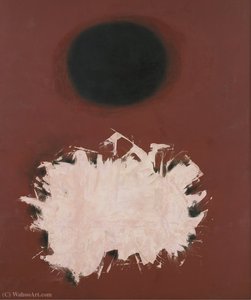
Adolph Gottlieb: de kunstenaar
A Pioneer of Abstract Expressionism: The Life and Art of Adolph Gottlieb
Adolph Gottlieb, born in New York City on March 14, 1903, emerged as a pivotal figure in the burgeoning landscape of American Abstract Expressionism. His journey was one of constant exploration—a relentless pursuit to distill universal human experiences into a visual language that resonated with both ancient symbolism and modern anxieties. Growing up as the son of Jewish immigrants, Gottlieb’s early life instilled within him a sensitivity to cultural displacement and the search for meaning in a rapidly changing world, themes that would profoundly shape his artistic vision. He received foundational training at the Art Students League and Parsons The New School for Design, but it was his subsequent travels through Europe during the 1920s that truly ignited his aesthetic sensibilities. Immersing himself in the art and philosophies of Germany and France, he absorbed influences from Constructivism and Surrealism, laying the groundwork for his future innovations.
Early Influences and Artistic Formation
Gottlieb’s initial artistic inclinations leaned toward representational painting—particularly landscapes—drawing inspiration from Impressionist masters like Claude Monet and William-Adolphe Bouguereau. However, he quickly recognized the limitations of depicting reality faithfully and sought a more expressive approach. His formative years were marked by intellectual curiosity and engagement with philosophical ideas, fostering an appreciation for symbolism and mythology that would become central to his artistic worldview. The impact of European avant-garde movements—particularly Surrealism—was undeniable; Gottlieb experimented with dreamlike imagery and subconscious associations, anticipating the stylistic developments of Abstract Expressionism.
The Founding of “The Ten” and Collaborative Exploration
A crucial step in Gottlieb’s artistic trajectory was his involvement with “The Ten,” a collective of artists who championed American originality within the international art scene during the mid-1930s. Alongside Mark Rothko, John D. Graham, Franz Kline, Barnett Newman, Helen Frankenthaler, Willem de Kooning, Philip Guston, Lester Thomson and Ivan Zakish, Gottlieb fostered a spirit of experimentation and challenged prevailing artistic conventions. This collaborative effort provided invaluable support during the Great Depression and solidified his commitment to pushing boundaries—a characteristic that would define his entire career. The Federal Art Project offered him considerable resources for his creative endeavors.
Arizona Landscapes and Proto-Pictographs
His relocation to Arizona in 1937-1938 proved transformative, profoundly influencing Gottlieb’s artistic style. Surrounded by the stark beauty of the desert landscape—the mesas, canyons, and cacti—he experienced a visceral connection with primal forces and ancient Native American cultures. This encounter sparked an interest in tribal art and symbolism, foreshadowing the development of his iconic *Pictographs*. These paintings, begun in 1940, represent Gottlieb’s breakthrough into abstraction, characterized by rectangular fields filled with stylized glyphs—symbols reminiscent of hieroglyphs or tribal markings—that evoke a sense of mystery and universality.
The Pictographs Series: Universal Symbolism
The *Pictographs* series stands as Gottlieb's most recognizable achievement, embodying his artistic vision. He deliberately drew inspiration from diverse sources—classical mythology, Amerindian art, African motifs—creating a compelling dialogue between modernity and ancient traditions. The glyphs themselves weren’t merely decorative elements; they were attempts to capture the essence of primal symbolism—a quest for meaning beyond visual representation. Gottlieb's exploration of universal themes—myth, ritual, human experience—continues to resonate with audiences today. He sought to express emotions and ideas that transcend language and cultural boundaries.
Legacy and Recognition
Throughout his prolific career, Gottlieb exhibited extensively in the United States and Europe, garnering critical acclaim for his distinctive style and unwavering dedication to artistic innovation. His work is now housed in major museums worldwide—including MoMA and Tate Modern—a testament to its enduring significance and influence on subsequent generations of artists. Gottlieb received numerous awards and accolades recognizing his contribution to American art history. He remains a celebrated figure, remembered not only for his groundbreaking paintings but also for his unwavering belief in the transformative power of art as a vehicle for exploring fundamental questions about human existence. His legacy endures as an inspiration for artists striving to express profound ideas through visual language—a reminder that true artistic achievement lies in confronting complexity and embracing ambiguity.