Wang Yuanqi portretas

22 garsiausių Wang Yuanqi paveikių rinkinys: galerijos išboru

Atnaujinta lapkritis 2026 · pagal mūsų populiarumumo koeficientą (paieškos, lankytojai ir užsakymai kiekvienam kūriniui) · 22 Wang Yuanqi darbai mūsų kataloge

Trumpai tariant

Iš visų originalų, kuriuos paliko Wang Yuanqi, garsiausias yra Landscape for Zhanting (1710). Tiesiog už jų seka Wangchuan Villa (1711) ir Landscape (1678). Mūsų kataloge yra 22 darbų autoriaus Wang Yuanqi; galerija išsaugojo 22 labiausiai pasaulyje žyminiausių kūrinių – kiekvienas jų pateikiamas su datos, muziejaus ir istorijos aprašymu.

1642 – 1715, Taicang Literati painting Daugiausia darbų: Metropolitano meno muziejus

Wang Yuanqi geriausios 10 paveikslų: galerijos pasirinkimas

1
Landscape for Zhanting (1710) aut. Wang Yuanqi

Landscape for Zhanting

1710 · Ink

In Landscape for Zhanting, the artist Wang Yuanqi presents a vast mountain range that stretches across the entire width of the silk. Snow-capped peaks rise against the sky, their white summits catching the light amidst the rugged terrain. These mountains form a heavy, continuous boundary that defines the horizon. The scale of the landscape creates a sense of immense depth, pulling the eye through layers of stone and mist.
2
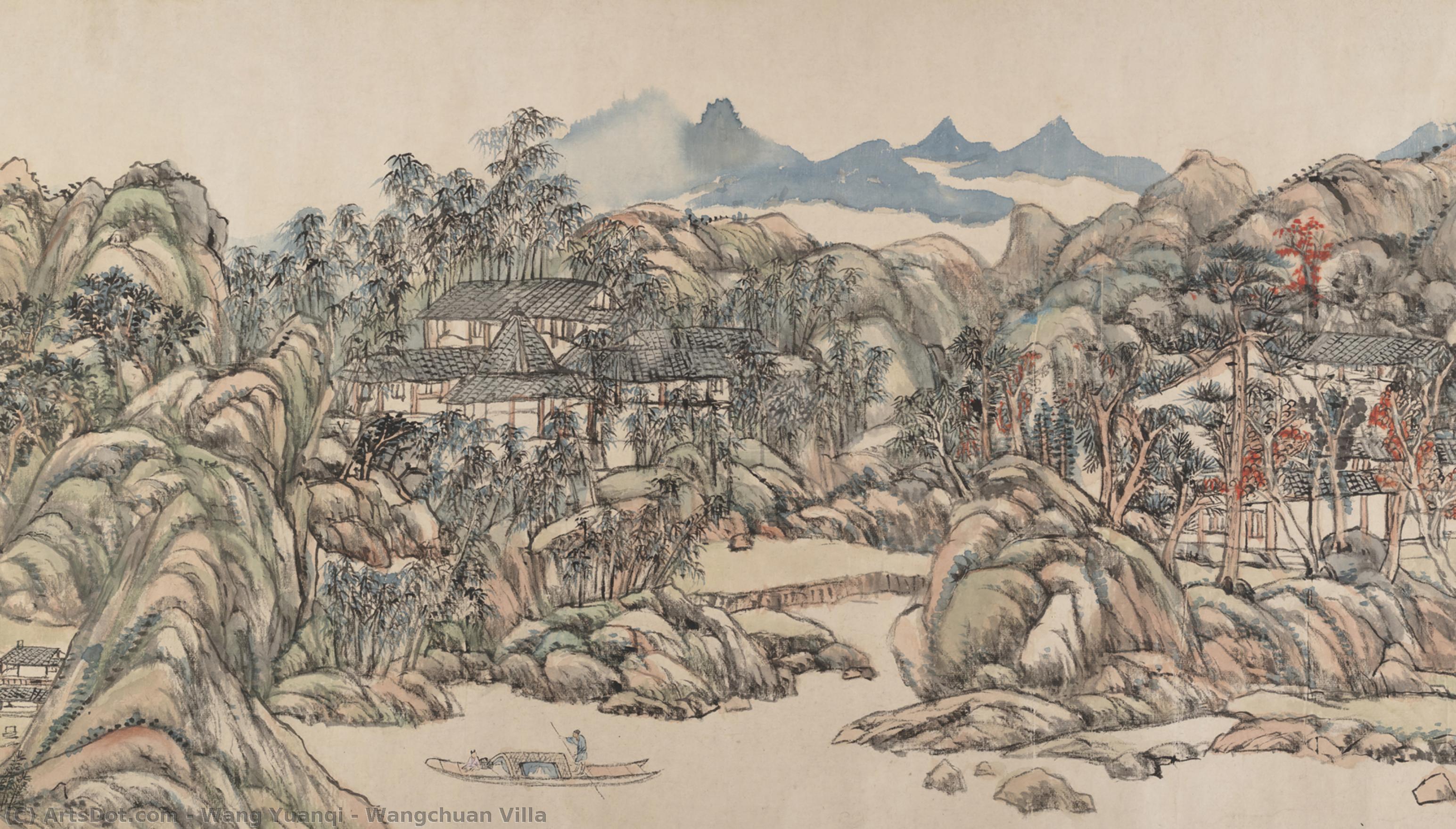
Wangchuan Villa (1711) aut. Wang Yuanqi

Wangchuan Villa

1711 · Ink On Paper · Metropolitano meno muziejus, Niujorkas

The handscroll titled Wangchuan Villa emerges from the brush of Wang Yuanqi, a painter who shaped the landscape traditions of the Qing Dynasty. Born in 1642 in Taicang, Jiangsu province, China, Wang Yuanqi carries the weight of a profound artistic lineage. He moves through the world of ink and color as a leading figure of the Orthodox School. His hand brings life to this specific vision of a mountain community,…

3
Landscape (1678) aut. Wang Yuanqi

Landscape

1678 · Ink On Paper · Art Institute of Chicago, Čikagos

In this vertical and expansive work, Wang Yuanqi organizes a vast, mountainous terrain through a high-distance perspective. The composition directs the eye from foreground rocky outcrops and trees upward through a series of receding mountain ridges. These paths lead toward distant, misty peaks that dissolve into the upper reaches of the frame. Small architectural structures are nestled among the cliffs, providing a sense of scale to the winding paths and…

4
Mountainous Landscape after Wang Meng (1678) aut. Wang Yuanqi

Mountainous Landscape after Wang Meng

1678 · Ink On Paper · Art Institute of Chicago, Čikagos

In Mountainous Landscape after Wang Meng, Wang Yuanqi organizes the vertical space into a series of ascending movements. The composition begins at the base with a detailed foreground of rocky outcrops and tangled trees. From this rugged foundation, the eye travels upward through a sequence of receding mountain ridges. These layers of stone and earth climb toward a towering, central peak that anchors the entire scene. This peak reaches into…

5
Free Spirits Among Streams and Mountains (1684) aut. Wang Yuanqi

Free Spirits Among Streams and Mountains

1684 · Ink On Paper · Walters Art Museum, Baltimore

In 1684, Wang Yuanqi captured a classic depiction of nature in Free Spirits Among Streams and Mountains. The ink settles upon the surface to trace a landscape of rolling peaks and dense groves. Water flows through the composition, a calm body reflecting the stillness of the surrounding terrain. It is a vision of the natural world where the mountains do not merely exist but breathe through the mist.

6
清 王原祁 倣吳鎮山水圖 軸 Landscape after Wu Zhen (1695) aut. Wang Yuanqi

清 王原祁 倣吳鎮山水圖 軸 Landscape after Wu Zhen

1695 · Ink On Paper · Metropolitano meno muziejus, Niujorkas

Created in 1695, this hanging scroll reflects the rigorous traditions of the Qing dynasty. Wang Yuanqi, a central figure of the Orthodox School, looks backward to the Yuan dynasty to move forward. Here, the influence of Wu Zhen is palpable, particularly in the way the landscape is constructed through rhythmic, textured movements. The composition centers on a lofty mountain range, its peaks dusted with snow, rising above a verdant landscape…

7
Landscape for Zhanting (1710) aut. Wang Yuanqi

Landscape for Zhanting

1710 · Ink On Paper · Metropolitano meno muziejus, Niujorkas

The vertical composition of Landscape for Zhanting is dominated by a central mountain mass that rises through the upper half of the scroll. This geological formation is surrounded by undulating hills, rocky outcrops, and clusters of pine trees. The terrain is rendered in a monochromatic palette, utilizing varying shades of ink wash from deep charcoal to pale grey against a light beige substrate. Through the application of cun texture strokes,…

8
Landscape after Ni Zan (1707) aut. Wang Yuanqi

Landscape after Ni Zan

1707 · Ink On Paper · Cleveland Museum of Art, Klevlandas

The landscape unfolds before us through the brush of Wang Yuanqi, a painter who lived from 1642 to 1715. In this work, titled Landscape after Ni Zan, the artist reaches back through the centuries to find inspiration in the spirit of the Yuan dynasty. Created in 1707, the painting captures a quiet, scholarly seclusion that feels as present now as it did when the ink first met the silk. It…

10
Landscape after Huang Gongwang (1701) aut. Wang Yuanqi

Landscape after Huang Gongwang

1701 · Ink · Art Institute of Chicago, Čikagos

A vertical expanse of mist holds the mountains in a soft, grey grip. The scene unfolds in layers, guiding the eye from the textured foreground through quiet settlements toward peaks that dissolve into the pale sky. It is a world of monochrome, where the only color is the varying depth of black ink on a light substrate. The air feels heavy with moisture, as if a sudden rain has just…

Wang Yuanqi darba rinkinys tęsiamas, nuo 11 iki 22

žymios Wang Yuanqi tapiojamos, pagal laikotarpį

Temos, kurios domino Wang Yuanqi

Ketverios temos, dažniausiai pasikrausto originaluose, kiekvienos su savo puikiausiu pavyzdžiu.

Muziejai, kuriuose saugomi Wang Yuanqi originalūs darbai

8 muziejai, kuriuose saugoma daugiausia šioje pusėje esamų paveikslų.

Muzejaus Miestas Wang Yuanqi darbai Šiojo sąrašo paveikslai
Metropolitano meno muziejus, NiujorkasMetropolitano meno muziejus Niujorkas 7 Wangchuan Villa, 清 王原祁 倣吳鎮山水圖 軸 Landscape after Wu Zhen, Landscape for Zhanting
Art Institute of Chicago, ČikagosArt Institute of Chicago Čikagos 3 Landscape, Mountainous Landscape after Wang Meng, Landscape after Huang Gongwang
Cleveland Museum of Art, KlevlandasCleveland Museum of Art Klevlandas 2 Landscape after Ni Zan, Green Peaks under Clear Sky: After Huang Gongwang
Yale University Art Gallery, Niū HevenasYale University Art Gallery Niū Hevenas 2 Landscape in the Style of Huang Gongwang, Landscape
Walters Art Museum, BaltimoreWalters Art Museum Baltimore 1 Free Spirits Among Streams and Mountains
Detroito meno institutas, DetroitasDetroito meno institutas Detroitas 1 Mountain and River Landscape
The Palace Museum, PekinasThe Palace Museum Pekinas 1 Wang Yuanqi's Thatched Cottage Ten Records
Nacionalinė Viktorijos galerija, MelburnasNacionalinė Viktorijos galerija Melburnas 1 The Fuchun Mountians

Wang Yuanqi dešimtmetėms po dešimtmetės: originalus kūrinys, apibūdinantis kiekvieną iš jų

Darbai pagal dešimtmečius

Pasirinkite dešimtmetį, kad pamatytėte jį apibrėžusį originalą.

Kolekcjonerų klausimai apie Wang Yuanqi paveikslus

Kuriu darbu Wang Yuanqi yra labiausiai garsus?Atsakymas

Landscape for Zhanting (1710). Toliausiai eina Wangchuan Villa (1711) ir Landscape (1678).

Kokia buvo Wang Yuanqi amžius, kai buvo sukurtas Landscape for Zhanting?Atsakymas

68 metų amžiaus: Landscape for Zhanting sukurta 1710 m. Nr. Wang Yuanqi gimė 1642.

Kokie yra 10 garsiausių Wang Yuanqi paveikslų?Atsakymas

Landscape for Zhanting, Wangchuan Villa, Landscape, Mountainous Landscape after Wang Meng, Free Spirits Among Streams and Mountains, 清 王原祁 倣吳鎮山水圖 軸 Landscape after Wu Zhen, Landscape for Zhanting, Landscape after Ni Zan, Green Peaks under Clear Sky: After Huang Gongwang ir Landscape after Huang Gongwang. Viršuje esančioje reitingo sąraše nurodyta kiekvieno kūrinio metis ir muziejus.

Kiek paveikslų paliko Wang Yuanqi?Atsakymas

Mūsų kataloge yra 22 Wang Yuanqi darbų, skirtų laikotarpiui nuo 1678 iki 1712.

Kuriuose muziejuose eksponuojami Wang Yuanqi šedevrai?Atsakymas

Daugiausia – Metropolitano meno muziejus (Niujorkas), Art Institute of Chicago (Čikagos) ir Cleveland Museum of Art (Klevlandas). Viršuje esančiame muziejų sąraše yra visi jie.

Kuriomis metais Wang Yuanqi tapo savo garsiausius kūrinius?Atsakymas

1700s laikotarpiu: 5 iš 22 šioje pusėje esančių darbų buvo sukurtos tada, iš jų Landscape after Ni Zan.

Kokie yra pirmasis ir paskutinis garsieji Wang Yuanqi originalūs darbai?Atsakymas

Šioje pusėje seniausias darbas yra Landscape (1678), o naujausias – Landscape in the Style of Huang Gongwang (1712).

Kurią temą Wang Yuanqi rinkosi dažniausiai?Atsakymas

Mountains (12), Trees (11) ir River (7) iš 22 šioje pusėje esamų darbų.

Kurią techniką Wang Yuanqi naudojo dažniausiai?Atsakymas

Ink On Paper, iš 22 šios puslapio darbų – 9.

Kelią meno kryptį priklauso Wang Yuanqi?Atsakymas

Literati painting, vadovaujantis šios puslapio originalais kūriniais.

Kurių Wang Yuanqi darbai eksponuojami Metropolitano meno muziejus?Atsakymas

Wangchuan Villa, 清 王原祁 倣吳鎮山水圖 軸 Landscape after Wu Zhen ir Landscape for Zhanting: Metropolitano meno muziejus, Niujorkas kolekcijoje yra 7 šioje pusėje esančių darbų.

Wang Yuanqi: gyvenimas ir kūryba

Wang Yuanqi: A Master of Qing Dynasty Landscape

Early Life and Education

  • Wang Yuanqi (王原祁) was born in 1642 in Taicang, Jiangsu province, China.
  • He came from a family with a strong artistic tradition; his grandfather, Wang Shimin, was a renowned painter of the early Qing dynasty.
  • Yuanqi received rigorous training in painting from his grandfather, laying the foundation for his future artistic endeavors.
  • His style name was 'Mao-ching' and his sobriquet was 'Lu-t’ai'.

Career as a Court Official

  • Wang Yuanqi rose to prominence as a court official during the Qing dynasty, beginning shortly after its establishment in 1644.
  • He served with distinction and was eventually appointed curator of the imperial collection under the Kangxi Emperor.
  • This position granted him access to a vast array of artworks, further enriching his artistic knowledge and influencing his style.
  • He remained a court official throughout his long career, balancing administrative duties with his passion for painting until his death in 1715 at age 73.

Artistic Style and Influences

  • Wang Yuanqi is considered one of the “Six Masters of the early Qing period,” also known as the ‘Four Wangs, a Wu and a Yun’.
  • He was a leading figure in the 'Orthodox School' (正统派) of Chinese landscape painting.
  • His landscapes drew inspiration from Yuan dynasty artists who moved away from the highly realistic depictions favored during the Northern Song period.
  • A key influence on his work was Huang Gongwang, particularly in the use of dry brush strokes, ink washes, and a sophisticated approach to color.
  • He skillfully integrated color patterns into his compositions, complementing abstract designs with rhythmic color flows.

Major Works and Achievements

  • Notable works include Landscape in the Style of Huang Gongwang (1711), currently held in Singapore’s Asian Civilisations Museum.
  • His rendition of Wang Wei's eighth-century hand scroll, The Wang River Villa, is housed in the Metropolitan Museum of Art, New York City.
  • Other significant paintings include “The Fuchun Mountains”, “Landscape for Zhanting” and numerous landscapes after the Four Great Yuan Masters.
  • He excelled at recreating the styles of earlier masters while imbuing his works with a unique personal touch.

Historical Significance

  • Wang Yuanqi played a crucial role in shaping the development of Chinese landscape painting during the Qing dynasty.
  • His adherence to and refinement of the Orthodox School established a standard for generations of artists.
  • He helped preserve and promote traditional artistic values while also demonstrating innovative techniques in composition and color usage.
  • His work continues to be celebrated for its technical mastery, aesthetic beauty, and historical importance within the context of Chinese art history.