Pjeras Polis Prudonas portretas

100 garsiausių Pjeras Polis Prudonas paveikių – kiekvienas yra unikalus

Atnaujinta lapkritis 2026 · pagal mūsų populiarumumo koeficientą (paieškos, lankytojai ir užsakymai kiekvienam kūriniui) · 207 Pjeras Polis Prudonas darbai mūsų kataloge

Trumpai tariant

Portrait of the Empress Josephine (1805) yra Pjeras Polis Prudonas paveikslas, kuriuo gausiausia žmonių žavisi. Po to akmuo patenka į Venus Bathing (1810) ir Untitled (D2X835) (1817). Iš 207 Pjeras Polis Prudonas darbų mūsų kataloge šios 100 yra garsiausios – kiekvienas yra unikali originali dai̇lia, pateikta su jos metais, muziejumi ir priežastimi, kodėl ji išlieka per amžius.

1758 – 1823, Kliuni Neo-classicism Daugiausia darbų: Wallace Collection

10 geriausių Pjeras Polis Prudonas paveikslų: galerijos akimais

1
Portrait of the Empress Josephine (1805) aut. Pjeras Polis Prudonas

Portrait of the Empress Josephine

1805 · Oil On Canvas

The Portrait of the Empress Josephine by Pierre-Paul Prud'hon presents a quiet, intimate moment captured in 1805. The subject of this work is Josephine Bonaparte, the first wife of Napoleon Bonaparte. Rather than appearing in the rigid splendor of the imperial court, she is seen here in a more private, natural setting. She sits upon the mossy rocks of the gardens at Malmaison, a place deeply connected to her own…

2
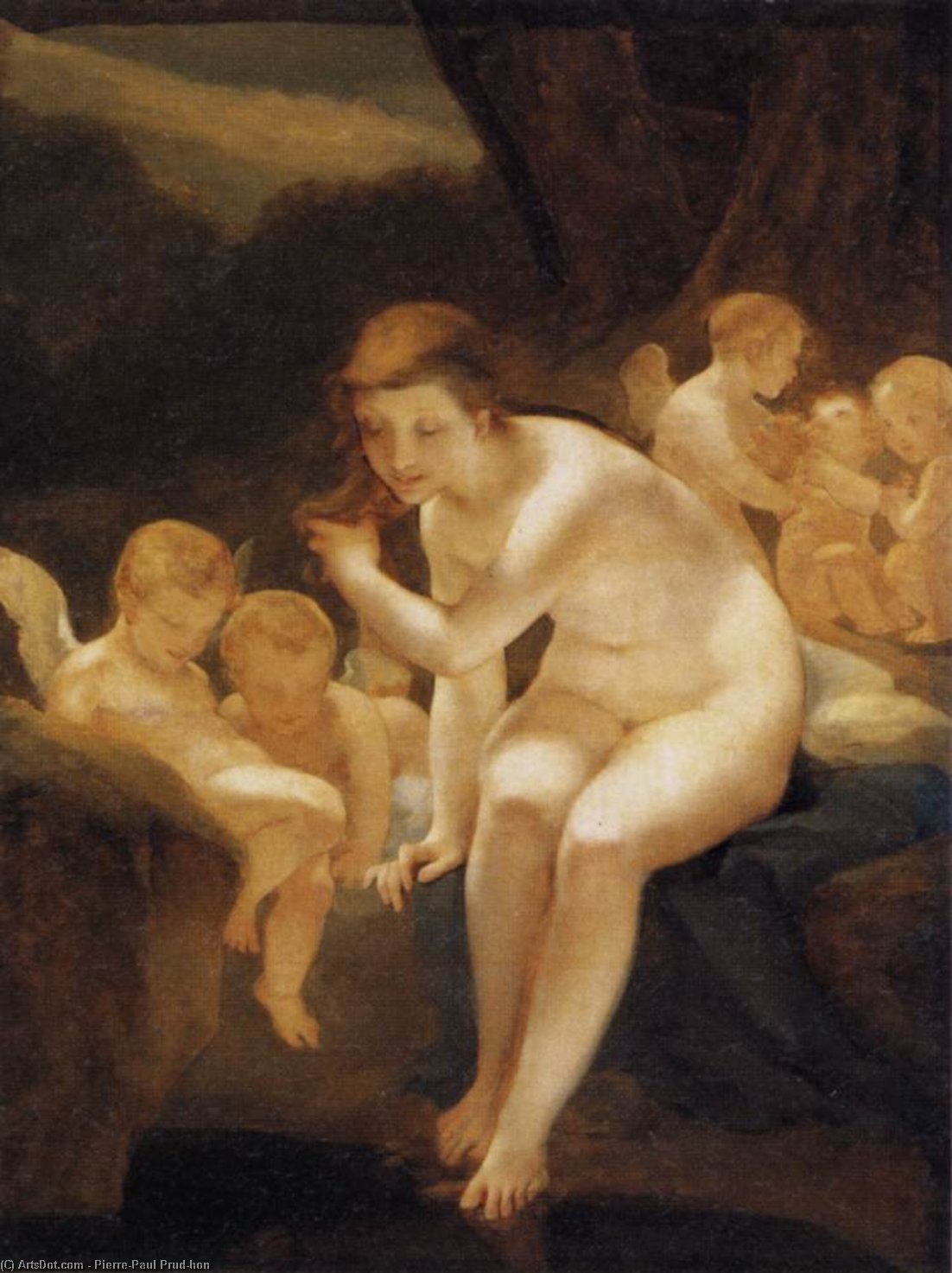
Venus Bathing (1810) aut. Pjeras Polis Prudonas

Venus Bathing

1810 · Acrylic On Canvas · Liuvro muziejus, Paryžius

Pierre-Paul Prud’hon's “Venus Bathing” stands as a cornerstone of Neoclassical art, embodying the era’s pursuit of idealized beauty and rational order. Painted in 1810 during a period marked by significant artistic upheaval—the waning influence of Rococo giving way to Romantic fervor—this monumental oil on canvas (134 x 103 cm) resides within the hallowed halls of the Musée du Louvre, Paris, ensuring its enduring legacy.

3
Untitled (D2X835) (1817) aut. Pjeras Polis Prudonas

Untitled (D2X835)

1817 · Acrylic On Canvas · Metropolitano meno muziejus, Niujorkas

Pierre-Paul Prud’hon’s “Untitled (D2X835),” painted in 1817, offers a captivating glimpse into the world of Parisian society during the early 19th century. More than just a simple portrait, it's a carefully constructed tableau vivant—a staged scene brimming with subtle social commentary and an exquisite mastery of chiaroscuro, a technique that defines Prud’hon’s distinctive style. The painting depicts a gentleman in formal attire – a dark suit, top hat, and crisp…

4
Puppies (1795) aut. Pjeras Polis Prudonas

Puppies

1795 · Oil · Wallace Collection, Londonas

The air in the room feels warm and still, filled with the soft scent of oil paint and the gentle breathing of young life. A seated child, draped in a luminous yellow dress that catches the light from an unseen window to the upper right, leans into a moment of pure connection. Beside them, another child stands, arms cradling a cluster of puppies. The scene is intimate, a private fragment…

5
The Glorification of the government of Burgundy (1786) aut. Pjeras Polis Prudonas

The Glorification of the government of Burgundy

1786 · Oil

The heavens open in a dramatic display of divine authority, casting a celestial light upon the earthly realm below. High above the clouds, angels descend through a luminous sky, their forms caught in a moment of eternal motion. Some of these heavenly beings carry swords and shields, their presence signaling a power that transcends the mortal plane. Amidst this swirling movement, small cherubs drift through the air, adding a sense…

6
Drawing of Female Nude with charcoal and chalk (1800) aut. Pjeras Polis Prudonas

Drawing of Female Nude with charcoal and chalk

1800 · Charcoal

A single figure occupies the space, a woman caught in a moment of quiet contemplation. She sits with her hand pressed against her head, her gaze turned upward toward an unseen source of light. The charcoal and chalk trace the soft contours of her skin, building a body through the delicate interplay of shadow and highlight. There is a stillness here, a pause in breath that feels heavy and intimate.…

7
The Zephyr (1814) aut. Pjeras Polis Prudonas

The Zephyr

1814 · Oil · Wallace Collection, Londonas

The Zephyr is an oil sketch by Pierre-Paul Prud'hon, a work that captures a sense of mythological grace through its delicate handling of form. Created around 1814, this piece reflects the artist's ability to navigate the transition between Neoclassicism and Romanticism. The subject, often interpreted as a personification of the wind, is rendered with a lightness that suggests movement even within the stillness of the oil medium.

8
Louis Antoine de Saint Just (1793) aut. Pjeras Polis Prudonas

Louis Antoine de Saint Just

1793 · Oil · Museum De Waag, Deventera

In the turbulent landscape of 1793, amidst the fervor and shadows of the French Revolution, Pierre-Paul Prud'hon captured more than just a likeness; he captured an era. His portrait of Louis Antoine de Saint Just serves as a profound window into a moment of intense political and personal transformation. The subject, a man whose name was synonymous with the radical shifts of the Reign of Terror, is presented not through…

9
Abundance (1823) aut. Pjeras Polis Prudonas

Abundance

1823 · Oil · Condé muziejus, Šantili

In the painting Abundance, Pierre-Paul Prud'hon presents two human figures positioned in a close, intimate arrangement. Created about 1823, the work focuses on the interaction between these two subjects against a dark, indistinct background. The figures appear to be engaged in either a shared task or an embrace, though their exact movements remain partially obscured by the shadows. The composition centers on this physical proximity, placing the viewer in immediate…

10
Une Famille dans la désolation (A Grief-Stricken Family) (1821) aut. Pjeras Polis Prudonas

Une Famille dans la désolation (A Grief-Stricken Family)

1821 · Oil On Canvas · Yale University Art Gallery, Niū Hevenas

In this 1821 oil on canvas, we find ourselves drawn into a quiet, heavy moment of human suffering. The composition centers on a family bound together by a profound sense of loss, their bodies slumped in a way that speaks of exhaustion and despair. A man and a woman sit at the heart of the group, surrounded by children, creating an intimate, tight arrangement that emphasizes their collective grief. The…

žinomi Pjeras Polis Prudonas paveikslai, nuo 11 iki 100 numerio

11Dr. Thomas Dagoumer (1762-1833/1835) (1819) aut. Pjeras Polis PrudonasDr. Thomas Dagoumer (1762-1833/1835)1819 · Fogg Museum 12Innocence Choosing Between Love and Riches (1804) aut. Pjeras Polis PrudonasInnocence Choosing Between Love and Riches1804 · Art Institute of Chicago 13Wisdom and Truth Descending to Earth (1758) aut. Pjeras Polis PrudonasWisdom and Truth Descending to Earth1758 · Bavarijos valstybinės paveikslų kolekcijos 14The Preparations of War or The Preparations of Love (1790) aut. Pjeras Polis PrudonasThe Preparations of War or The Preparations of Love1790 · Musée Cognacq-Jay 15The Cruel Laughs at the Tears He Makes Fall (1794) aut. Pjeras Polis PrudonasThe Cruel Laughs at the Tears He Makes Fall1794 16Monument to Pope Clement XIV by Canova (1787) aut. Pjeras Polis PrudonasMonument to Pope Clement XIV by Canova1787 17Portrait of sculptor Nicolas Bornier (1788) aut. Pjeras Polis PrudonasPortrait of sculptor Nicolas Bornier1788 · Musée des Beaux-Arts de Dijon 18Minerva Illuminating the Genii of the Arts and Sciences (1800) aut. Pjeras Polis PrudonasMinerva Illuminating the Genii of the Arts and Sciences1800 19The Genius of Peace (1800) aut. Pjeras Polis PrudonasThe Genius of Peace1800 20Young Naiad Ravished by Loves (1800) aut. Pjeras Polis PrudonasYoung Naiad Ravished by Loves1800 21Diana Imploring Jupiter Not to Subject Her to the Laws of Hymen (1802) aut. Pjeras Polis PrudonasDiana Imploring Jupiter Not to Subject Her to the Laws of Hymen1802 22Minerva (1797) aut. Pjeras Polis PrudonasMinerva1797 23Apollo (1797) aut. Pjeras Polis PrudonasApollo1797 24Plutus (1797) aut. Pjeras Polis PrudonasPlutus1797 25Pan (1797) aut. Pjeras Polis PrudonasPan1797 26Time (1797) aut. Pjeras Polis PrudonasTime1797 27Old Age (1797) aut. Pjeras Polis PrudonasOld Age1797 28Two Winged Horses (1797) aut. Pjeras Polis PrudonasTwo Winged Horses1797 29Mnemosyne (1797) aut. Pjeras Polis PrudonasMnemosyne1797 30The Folly (1797) aut. Pjeras Polis PrudonasThe Folly1797 31Mercury (1797) aut. Pjeras Polis PrudonasMercury1797 32Bacchus (1797) aut. Pjeras Polis PrudonasBacchus1797 33Portrait of an Unknown Person (1800) aut. Pjeras Polis PrudonasPortrait of an Unknown Person1800 · Carnavalet muziejus 34Diana begs Jupiter not to subject her to the hymen (1803) aut. Pjeras Polis PrudonasDiana begs Jupiter not to subject her to the hymen1803 35Portrait of Marguerite Duffour, wife of sculptor Nicolas Bornier (1796) aut. Pjeras Polis PrudonasPortrait of Marguerite Duffour, wife of sculptor Nicolas Bornier1796 36Male Nude Grasping his Wrists (1800) aut. Pjeras Polis PrudonasMale Nude Grasping his Wrists1800 37Seated Male Nude (1800) aut. Pjeras Polis PrudonasSeated Male Nude1800 38Female Nude from Behind (1800) aut. Pjeras Polis PrudonasFemale Nude from Behind1800 39Standing Female Nude (1800) aut. Pjeras Polis PrudonasStanding Female Nude1800 40Male Nude Raising his Arm (1800) aut. Pjeras Polis PrudonasMale Nude Raising his Arm1800 41Seated Female Nude by a Fountain (1800) aut. Pjeras Polis PrudonasSeated Female Nude by a Fountain1800 42Female Nude Reclining (1800) aut. Pjeras Polis PrudonasFemale Nude Reclining1800 43Female Nude Leaning (1800) aut. Pjeras Polis PrudonasFemale Nude Leaning1800 44Daphnis and Chloe (1802) aut. Pjeras Polis PrudonasDaphnis and Chloe1802 45Female Nude Bound (1800) aut. Pjeras Polis PrudonasFemale Nude Bound1800 46Male Nude Turning (1800) aut. Pjeras Polis PrudonasMale Nude Turning1800 47Male Nude Pointing (1800) aut. Pjeras Polis PrudonasMale Nude Pointing1800 48Female Nude Raising her Arm (1800) aut. Pjeras Polis PrudonasFemale Nude Raising her Arm1800 49The Source (1801) aut. Pjeras Polis PrudonasThe Source1801 50Drawing of Female Nude with charcoal and chalk (1800) aut. Pjeras Polis PrudonasDrawing of Female Nude with charcoal and chalk1800 51Portrait of Georges Anthony (1796) aut. Pjeras Polis PrudonasPortrait of Georges Anthony1796 · Musée des Beaux-Arts de Dijon 52Drawing of Female Nude with charcoal and chalk (1800) aut. Pjeras Polis PrudonasDrawing of Female Nude with charcoal and chalk1800 53Drawing of Female Nude with charcoal and chalk (1800) aut. Pjeras Polis PrudonasDrawing of Female Nude with charcoal and chalk1800 54Arts, Wealth, Pleasure and Philosophy: Wealth (1800) aut. Pjeras Polis PrudonasArts, Wealth, Pleasure and Philosophy: Wealth1800 55Drawing of Female Nude with charcoal and chalk (1800) aut. Pjeras Polis PrudonasDrawing of Female Nude with charcoal and chalk1800 56Arts, Wealth, Pleasure and Philosophy: Philosophy (1800) aut. Pjeras Polis PrudonasArts, Wealth, Pleasure and Philosophy: Philosophy1800 57Monsieur Vallet (1812) aut. Pjeras Polis PrudonasMonsieur Vallet1812 58Minerva Leading the Genius of the Arts to Immortality (1812) aut. Pjeras Polis PrudonasMinerva Leading the Genius of the Arts to Immortality1812 59Meeting of Napoleon I and Francis II of Austria, December 4, 1805 (1809) aut. Pjeras Polis PrudonasMeeting of Napoleon I and Francis II of Austria, December 4, 18051809 · Opera House 60Victory and Peace (1807) aut. Pjeras Polis PrudonasVictory and Peace1807 · Carnavalet muziejus 61The Empress Josephine (1807) aut. Pjeras Polis PrudonasThe Empress Josephine1807 · Wallace Collection 62Seated Woman Plucking a Flower (1810) aut. Pjeras Polis PrudonasSeated Woman Plucking a Flower1810 · Rhode Island School of Design Museum of Art 63Charles Maurice de Talleyrand Périgord (1754–1838), Prince de Bénévent (1807) aut. Pjeras Polis PrudonasCharles Maurice de Talleyrand Périgord (1754–1838), Prince de Bénévent1807 · Carnavalet muziejus 64Study for 'Minerva leading the Genius of the Arts into Immortality' (1813) aut. Pjeras Polis PrudonasStudy for 'Minerva leading the Genius of the Arts into Immortality'1813 · Fitzwilliam Museum 65Young Zephyrus balancing above water (1814) aut. Pjeras Polis PrudonasYoung Zephyrus balancing above water1814 · Musée des Beaux-Arts de Dijon 66Abundance (1812) aut. Pjeras Polis PrudonasAbundance1812 · Museum of Fine Arts 67Venus Bathing (1814) aut. Pjeras Polis PrudonasVenus Bathing1814 · Fine Arts Museums of San Francisco 68Josephine Bonaparte (study) (1805) aut. Pjeras Polis PrudonasJosephine Bonaparte (study)1805 69Madame Jarre (1821) aut. Pjeras Polis PrudonasMadame Jarre1821 70The Dream of Happiness (sketch) (1818) aut. Pjeras Polis PrudonasThe Dream of Happiness (sketch)1818 71The Assumption of the Virgin (1817) aut. Pjeras Polis PrudonasThe Assumption of the Virgin1817 · Wallace Collection 72Flora and Zephyr (1820) aut. Pjeras Polis PrudonasFlora and Zephyr1820 · National Museum in Wrocław 73Gian Battista Sommariva (1815) aut. Pjeras Polis PrudonasGian Battista Sommariva1815 74Arnauld de Beaufort (1818) aut. Pjeras Polis PrudonasArnauld de Beaufort1818 · Saint Louis Art Museum 75The Happy Mother (1810) aut. Pjeras Polis PrudonasThe Happy Mother1810 · Wallace Collection 76Portrait of a Young Man (1874) aut. Pjeras Polis PrudonasPortrait of a Young Man1874 77Crucifixion (1822) aut. Pjeras Polis PrudonasCrucifixion1822 · Liuvro muziejus 78Marquis de Lafayette (1820) aut. Pjeras Polis PrudonasMarquis de Lafayette1820 · National Portrait Gallery 79Homage to Beauty (1808) aut. Pjeras Polis PrudonasHomage to Beauty1808 · Condé muziejus 80The King of Rome in the form of sleeping Cupid (1811) aut. Pjeras Polis PrudonasThe King of Rome in the form of sleeping Cupid1811 · Museo Glauco Lombardi 81Arts, Wealth, Pleasure and Philosophy (1800) aut. Pjeras Polis PrudonasArts, Wealth, Pleasure and Philosophy1800 · Musée Fabre 82Portrait of Charles Maurice de Talleyrand-Perigord aut. Pjeras Polis PrudonasPortrait of Charles Maurice de Talleyrand-Perigord 83Rutger Jan Schimmelpenninck with his Wife and Children (1801) aut. Pjeras Polis PrudonasRutger Jan Schimmelpenninck with his Wife and Children1801 · Rijksmuseum 84Venus and Cupid asleep, caressed and awakened by the Zephyrs (1806) aut. Pjeras Polis PrudonasVenus and Cupid asleep, caressed and awakened by the Zephyrs1806 · Condé muziejus 85David Johnston (1808) aut. Pjeras Polis PrudonasDavid Johnston1808 · National Gallery of Art 86French, prudhon) (1758) aut. Pjeras Polis PrudonasFrench, prudhon)1758 87The First Kiss of Love (1795) aut. Pjeras Polis PrudonasThe First Kiss of Love1795 88Madame Copia (1792) aut. Pjeras Polis PrudonasMadame Copia1792 89The union of love and friendship (1793) aut. Pjeras Polis PrudonasThe union of love and friendship1793 90Nicolas Perchet (1795) aut. Pjeras Polis PrudonasNicolas Perchet1795 91Etienne Renon de Franois (1795) aut. Pjeras Polis PrudonasEtienne Renon de Franois1795 92Christ on the Cross. Mary Magdalene and the Virgin are at His feet (1800) aut. Pjeras Polis PrudonasChrist on the Cross. Mary Magdalene and the Virgin are at His feet1800 93Seated Female Nude (1800) aut. Pjeras Polis PrudonasSeated Female Nude1800 94Female Nude Raising her Arm (1800) aut. Pjeras Polis PrudonasFemale Nude Raising her Arm1800 95Drawing of Female Nude with charcoal and chalk (1800) aut. Pjeras Polis PrudonasDrawing of Female Nude with charcoal and chalk1800 96Portrait of Constance Mayer (1804) aut. Pjeras Polis PrudonasPortrait of Constance Mayer1804 97Arts, Wealth, Pleasure and Philosophy: Pleasure (1800) aut. Pjeras Polis PrudonasArts, Wealth, Pleasure and Philosophy: Pleasure1800 98Arts, Wealth, Pleasure and Philosophy: Arts (1800) aut. Pjeras Polis PrudonasArts, Wealth, Pleasure and Philosophy: Arts1800 99The wisdom and truth (1799) aut. Pjeras Polis PrudonasThe wisdom and truth1799 100Portrait of Josephine de Beauharnais (1800) aut. Pjeras Polis PrudonasPortrait of Josephine de Beauharnais1800

žymios Pjeras Polis Prudonas tapiojamos, pagal laikotarpį

Temos, kurios domino Pjeras Polis Prudonas

Ketverios temos, dažniausiai pasikrausto originaluose, kiekvienos su savo puikiausiu pavyzdžiu.

Muziejai, kuriuose saugomi Pjeras Polis Prudonas originalūs darbai

8 muziejai, kuriuose saugoma daugiausia šioje pusėje esamų paveikslų.

Muzejaus Miestas Pjeras Polis Prudonas darbai Šiojo sąrašo paveikslai
Wallace Collection, LondonasWallace Collection Londonas 6 Puppies, The Zephyr, The Empress Josephine
Condé muziejus, ŠantiliCondé muziejus Šantili 3 Abundance, Homage to Beauty, Venus and Cupid asleep, caressed and awakened by the Zephyrs
Musée des Beaux-Arts de Dijon, DijonasMusée des Beaux-Arts de Dijon Dijonas 3 Portrait of sculptor Nicolas Bornier, Portrait of Georges Anthony, Young Zephyrus balancing above water
Carnavalet muziejus, ParisCarnavalet muziejus Paris 3 Portrait of an Unknown Person, Victory and Peace, Charles Maurice de Talleyrand Périgord (1754–1838), Prince de Bénévent
Liuvro muziejus, ParyžiusLiuvro muziejus Paryžius 5 Venus Bathing, Crucifixion
Metropolitano meno muziejus, NiujorkasMetropolitano meno muziejus Niujorkas 2 Untitled (D2X835)
Rhode Island School of Design Museum of Art, ProvidenceRhode Island School of Design Museum of Art Providence 2 Seated Woman Plucking a Flower
Rijksmuseum, AmsterdamasRijksmuseum Amsterdamas 2 Rutger Jan Schimmelpenninck with his Wife and Children

Pjeras Polis Prudonas per dešimtmečius: vieniškas originalas kiekvienam

Darbai pagal dešimtmečius

Pasirinkite dešimtmetį, kad pamatytėte jį apibrėžusį originalą.

Pjeras Polis Prudonas tapų klausimai galerijai

Koks yra garsiausias Pjeras Polis Prudonas kūrinys?Atsakymas

Portrait of the Empress Josephine (1805). Toliausiai eina Venus Bathing (1810) ir Untitled (D2X835) (1817).

Kuriuo amžiaus atσταση Pjeras Polis Prudonas sukūrė Portrait of the Empress Josephine?Atsakymas

47 metų amžiaus: Portrait of the Empress Josephine sukurta 1805 m. Nr. Pjeras Polis Prudonas gimė 1758.

Kurios Pjeras Polis Prudonas dešimt paveikslų yra garsiausi?Atsakymas

Portrait of the Empress Josephine, Venus Bathing, Untitled (D2X835), Puppies, The Glorification of the government of Burgundy, Drawing of Female Nude with charcoal and chalk, The Zephyr, Louis Antoine de Saint Just, Abundance ir Une Famille dans la désolation (A Grief-Stricken Family). Viršuje esančioje reitingo sąraše nurodyta kiekvieno kūrinio metis ir muziejus.

Kiek žinoma Pjeras Polis Prudonas darbų?Atsakymas

Mūsų kataloge yra 207 Pjeras Polis Prudonas darbų, skirtų laikotarpiui nuo 1786 iki 1823.

Kur galima pamatyti garsiausių Pjeras Polis Prudonas originalų?Atsakymas

Daugiausia – Wallace Collection (Londonas), Condé muziejus (Šantili) ir Musée des Beaux-Arts de Dijon (Dijonas). Viršuje esančiame muziejų sąraše yra visi jie.

Kuriuo laikotarpiu Pjeras Polis Prudonas sukūrė savo žymiausias paveikslus?Atsakymas

1800s laikotarpiu: 47 iš 100 šioje pusėje esančių darbų buvo sukurtos tada, iš jų Portrait of the Empress Josephine.

Kuris iš garsių Pjeras Polis Prudonas paveikslų yra pirmasis, o kuris – paskutinis?Atsakymas

Šioje pusėje seniausias darbas yra The Glorification of the government of Burgundy (1786), o naujausias – Abundance (1823).

Kokia temos Pjeras Polis Prudonas mėgavosi?Atsakymas

Woman (38), Man (32) ir Nude (18) iš 100 šioje pusėje esamų darbų.

Kuriomis medžiagomis Pjeras Polis Prudonas tapė dažniausiai?Atsakymas

Oil On Canvas, iš 100 šios puslapio darbų – 28.

Kelią meno kryžkelę priklauso Pjeras Polis Prudonas kūryba?Atsakymas

Neo-classicism ir Romanticism, vadovaujantis šios puslapio originalais kūriniais.

Kurius Pjeras Polis Prudonas originalius galėčiau pamatyti Wallace Collection?Atsakymas

Puppies, The Zephyr ir The Empress Josephine: Wallace Collection, Londonas kolekcijoje yra 5 šioje pusėje esančių darbų.

Pjeras Polis Prudonas: meno kūrinys – autoportretas

Pierre-Paul Prud'hon: Tarp Neoklasicizmo ir Romantizmo Vizijos

Prancūzų dailininkas Pierre-Paul Prud’hon (1758–1823) – tai įspūdinga figūra Prancūzijos meno istorijoje, sklandžiai perėjęs nuo Neoklasicizmo griežtumo prie Romantizmo aistringos ekspresyvumo. Gimęs Cluny miestelyje, Saône-et-Loire regione, Prud’hon gyvenimas ir kūryba atspindi XIX amžiaus pradžios Europos meno pokyčius. Jis žinomas ne tik alegorinėmis tapybomis, bet ir portretais, kuriuose demonstruoja meistrišką šviesos šešėlių valdymą (chiaroscuro) bei realizmą, sugebėjusį užburti žiūrovus ir įkvėpti vėlesnių kartų menininkus.

Ankstyvieji Metai ir Formavimasis

Prud’hon savo pirmuosius meno pamokimus gavo Prancūzijos provincijoje. 1774 metais jis sulaukė municipalinio stipendijos, leidusi studijuoti École de Dessin Dijone – tai buvo svarbus žingsnis link formalaus meno išsilavinimo. Netrukus, 1784 metais, dailininkas keliavo į Romą, kur pasinėrė į klasikinio meno tyrinėjimą. Ypač didelį įspūdį jam padarė Canova ir Correggio darbai. Šis laikotarpis turėjo gilų poveikį ankstyvajam jo stiliui, suteikdamas elegancijos ir idealizuotos formos jausmą, būdingą Neoklasicizmui. Tačiau net ir tuomet Prud’hon rodė polinkį į subtilius emocinius niuansus, kurie vėliau taps jo kūrybos vizitine kortele.

Karjera Revoliucijos Metu ir Karališkosios Apsaugos Palankumas

Prud’hon išgarsėjo Prancūzijos revoliucijos metais. Jis sukūrė įspūdingas vignetes, knygų iliustracijas bei alegorines tapybas, atliepiančias respublikonų idealus. Jo talentą pastebėjo Napoleonas Bonapartas, kuris pavedė jam nutapyti portretus Žozefinai de Boharnė ir Marijos Luizai d’Autriche. Ypač įsimintas Žozefinos portretas, kuriame ji nebuvo vaizduojama kaip imperatorienė, o kaip kerinti moteris – tai sukėlė daug spekuliacijų apie galimą romanišką santykį tarp dailininko ir buvusios karalienės. Prud’hon sugebėjo puikiai derinti to meto besikeičiančias meno tendencijas, į savo darbus įtraukdamas tiek Neoklasicizmo elementus, tiek Romantizmo užuominų. Nors jis išlaikė klasikinį kompozicijos pagrindą ir formą, jo tapybose atsirado emocinio gilumo ir dramatiškos šviesotės, pranašaujančios Romantizmo judėjimą.

Pagrindiniai Darbai ir Meno Palikimas

Prud’hon paliko po savęs daugybę reikšmingų darbų. Madame Georges Anthony and Her Two Sons (1796) – tai ankstyvas pavyzdys jo portretinės tapybos įgūdžių, demonstruojantis rafinuotą eleganciją. The Soul Breaking the Links Holding it to the Earth – galingas alegorinis kūrinys, parodantis jo gebėjimą perteikti sudėtingus jausmus simboline kalba. The Dream of Happiness – liūdnas apmąstymas apie žmogaus siekius ir troškimus. Crucifixion (1822), užsakyta St Etienne’o katedrai Metze, o dabar saugoma Louvro muziejuje, laikomas vienu iš jo svarbiausių pasiekimų. Justice and Divine Vengeance Pursuing Crime – monumentalus šedevras, pranašaujantis Géricault’o *The Raft of the Medusa* dramatiškumą.

Įtaka ir Istorinė Reikšmė

Prud’hon turėjo didelį poveikį vėlesnės kartos prancūzų menininkams. Jo meistriškas šviesos šešėlių valdymas, gebėjimas portretuose perteikti psichologinį gilumą bei Neoklasicizmo ir Romantizmo stilių sintezė padarė jį labai gerbiamu meno pasaulyje. Menininkai, tokie kaip Théodore Géricault ir Eugène Delacroix, pripažino jo įtaką, semdamiesi įkvėpimo iš jo dramatiškos kompozicijos ir emocinio ekspresyvumo. Stendhalis, Millet’as ir Baudelaire’as taip pat atpažino Prud’hon meno vertę, dar labiau sustiprindami jo vietą prancūzų kultūros istorijoje. Jo kūryba – tai subtilus perėjimas nuo racionalaus Neoklasicizmo prie aistringo Romantizmo, palikęs neišdildomą pėdsaką Europos meno istorijoje.