Nadežda Petrović portretas

10 garsiausių Nadežda Petrović paveikių – kiekvienas yra unikalus

Atnaujinta lapkritis 2026 · pagal mūsų populiarumumo koeficientą (paieškos, lankytojai ir užsakymai kiekvienam kūriniui) · 10 Nadežda Petrović darbai mūsų kataloge

Trumpai tariant

Old Fountain in Prizren (1913) yra viena矚 most žiūrėlių pritraukiančių Nadežda Petrović tapierių; originalas saugomas Serbijos muziejai, Belgradas. Po to akmuo patenka į Gračanica Monastery (1913) ir Lady with a White Parasol (1910). Iš 10 Nadežda Petrović darbų mūsų kataloge šios 10 yra garsiausios – kiekvienas yra unikali originali dai̇lia, pateikta su jos metais, muziejumi ir priežastimi, kodėl ji išlieka per amžius.

1873 – 1915, Čačak Expressionism Daugiausia darbų: Serbijos muziejai

10 geriausių Nadežda Petrović paveikslų: galerijos akimais

2
Gračanica Monastery (1913) aut. Nadežda Petrović

Gračanica Monastery

1913 · Oil · Serbijos muziejai, Belgradas

The monastery rises from the earth like a prayer carved in pigment. Its walls carry a warm, pinkish hue that catches the light, softening the heavy stone into something almost organic. Two towers stand on the left, one reaching slightly higher than its companion, while three domes crown the structure against a sky of blue and drifting clouds. The architecture is a heavy, rhythmic presence of windows and domes, anchored…

3
Lady with a White Parasol (1910) aut. Nadežda Petrović

Lady with a White Parasol

1910 · Oil On Canvas

Lady with a White Parasol by Nadežda Petrović depicts a woman positioned in the foreground of an outdoor setting. The subject is dressed in a light-colored gown and a hat, holding a white parasol. She is surrounded by dense foliage and greenery. Behind the figure, a wooden fence is visible amidst the plants. The composition places the woman as the central focus, with the organic shapes of the garden filling…

4
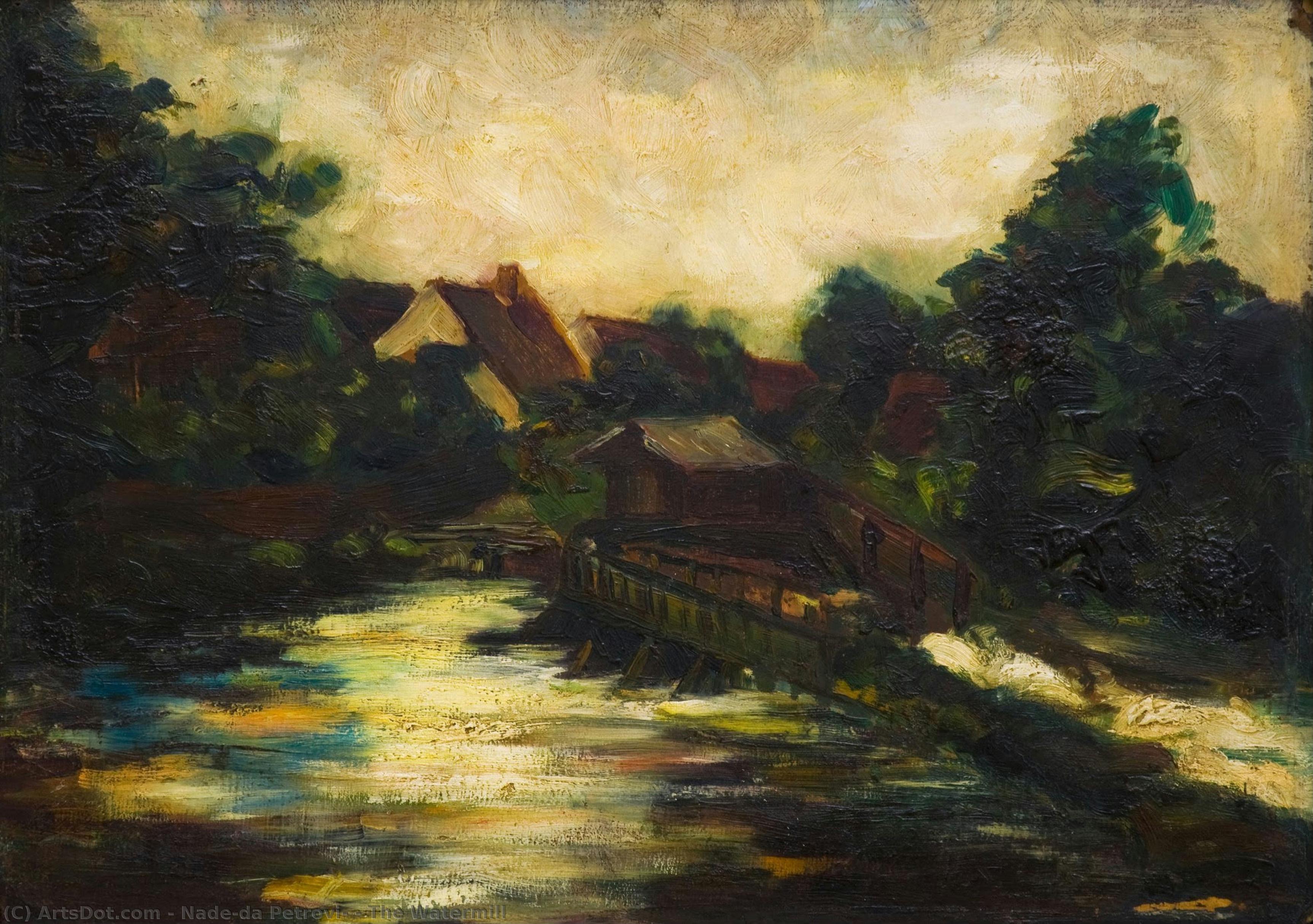
The Watermill (1901) aut. Nadežda Petrović

The Watermill

1901 · Painting · Serbijos muziejai, Belgradas

In this 1901 work, we find ourselves in the midst of the artist's Munich period. The scene is a quiet, monochromatic study of a Bavarian landscape, centered upon a watermill. A large building, likely a house, sits adjacent to the mill, anchoring the composition. In the background, a bridge spans the distance, while trees frame the edges of the view. The presence of two figures—one standing near the center and…

8
Ksenija Atanasijević (1912) aut. Nadežda Petrović

Ksenija Atanasijević

Nadežda’s most famous painting in the collection was painted in winter 1912, upon her return from Paris. Ksenija Atanasijević came to the Petrović house in Ratarska Street (Belgrade) to visit Nadežda and there she posed for the artist in the snow wearing a large black hat that Nadežda had just brought from Paris for her sister, Mica. Ksenija Atanasijević (1894–1981), a professor at the Belgrade Faculty of Philosophy, studied classical…

9
Sea, GNP (1910) aut. Nadežda Petrović

Sea, GNP

1910 · Oil On Canvas · Serbijos muziejai, Belgradas

In the turbulent dance of Sea, GNP, we encounter the visceral energy of the natural world as captured by the legendary Serbian visionary, Nadežda Petrović. Painted in 1910, this work serves as a breathtaking window into a moment where the ocean’s untamed force meets the stability of the shore. The canvas vibrates with the movement of crashing waves, rendered with a sense of urgency that suggests the artist was not…

Temos, kurios domino Nadežda Petrović

Ketverios temos, dažniausiai pasikrausto originaluose, kiekvienos su savo puikiausiu pavyzdžiu.

Muziejai, kuriuose saugomi Nadežda Petrović originalūs darbai

3 muziejai, kuriuose saugoma daugiausia šioje pusėje esamų paveikslų.

Muzejaus Miestas Nadežda Petrović darbai Šiojo sąrašo paveikslai
Serbijos muziejai, BelgradasSerbijos muziejai Belgradas 6 Old Fountain in Prizren, Gračanica Monastery, The Watermill
The Pavle Beljanski Memorial Collection, Novi SadThe Pavle Beljanski Memorial Collection Novi Sad 2 Belgrade Suburb, Ksenija Atanasijević
Museum of Contemporary Art, BelgradasMuseum of Contemporary Art Belgradas 1 Bois de Boulogne

Nadežda Petrović darbai per metus: kiekvieno unikalūs originalūs kūriniai

Tarp pirmosios ir paskutinės čia rodomos Nadežda Petrović originalių datų skirtas 14 metų skirtumas, 1900 ir 1913: kiekvieni metai nurodyti žemiau.

Darbai pagal metus

Pasirinkite metus, kad pamatytumėte originalus darbus.

Nadežda Petrović tapų klausimai galerijai

Koks yra garsiausias Nadežda Petrović kūrinys?Atsakymas

Old Fountain in Prizren (1913), Serbijos muziejai, Belgradas. Toliau seka Gračanica Monastery (1913) ir Lady with a White Parasol (1910).

Kuriuo amžiaus atσταση Nadežda Petrović sukūrė Old Fountain in Prizren?Atsakymas

40 metų amžiaus: Old Fountain in Prizren sukurta 1913 m. Nr. Nadežda Petrović gimė 1873.

Kurios Nadežda Petrović dešimt paveikslų yra garsiausi?Atsakymas

Old Fountain in Prizren, Gračanica Monastery, Lady with a White Parasol, The Watermill, Bavarian with a Hat, Belgrade Suburb, Bois de Boulogne, Ksenija Atanasijević, Sea, GNP ir Bird, GNP. Viršuje esančioje reitingo sąraše nurodyta kiekvieno kūrinio metis ir muziejus.

Kiek žinoma Nadežda Petrović darbų?Atsakymas

Mūsų kataloge yra 10 Nadežda Petrović darbų, skirtų laikotarpiui nuo 1900 iki 1913.

Kur galima pamatyti garsiausių Nadežda Petrović originalų?Atsakymas

Daugiausia – Serbijos muziejai (Belgradas), The Pavle Beljanski Memorial Collection (Novi Sad) ir Museum of Contemporary Art (Belgradas). Viršuje esančiame muziejų sąraše yra visi jie.

Kuriuo laikotarpiu Nadežda Petrović sukūrė savo žymiausias paveikslus?Atsakymas

1910 laikotarpiu: 2 iš 10 šioje pusėje esančių darbų buvo sukurtos tada, iš jų Lady with a White Parasol.

Kuris iš garsių Nadežda Petrović paveikslų yra pirmasis, o kuris – paskutinis?Atsakymas

Šioje pusėje seniausias darbas yra Bavarian with a Hat (1900), o naujausias – Old Fountain in Prizren (1913).

Kokia temos Nadežda Petrović mėgavosi?Atsakymas

People (2) ir Portrait (2) iš 10 šioje pusėje esamų darbų.

Kuriomis medžiagomis Nadežda Petrović tapė dažniausiai?Atsakymas

Oil On Canvas, iš 10 šios puslapio darbų – 3.

Kelią meno kryžkelę priklauso Nadežda Petrović kūryba?Atsakymas

Expressionism, vadovaujantis šios puslapio originalais kūriniais.

Kurius Nadežda Petrović originalius galėčiau pamatyti Serbijos muziejai?Atsakymas

Old Fountain in Prizren, Gračanica Monastery ir The Watermill: Serbijos muziejai, Belgradas kolekcijoje yra 6 šioje pusėje esančių darbų.

Nadežda Petrović: meno kūrinys – autoportretas

Nadežda Petrović (1873–1915): Serbia’s Expressionist Visionary

Nadežda Petrović (Serbian Cyrillic: Надежда Петровић; 11/12 October 1873 – 3 April 1915) was a Serbian painter and one of the women war photography pioneers in the region. Considered Serbia’s most famous expressionist and fauvist, she was the most important Serbian female painter of the period. Born in Čačak, Serbia, Petrović moved to Belgrade in her youth and attended the women's school of higher education there. Graduating in 1891, she taught there for a period beginning in 1893 before moving to Munich to study with Slovenian artist Anton Ažbe. Between 1901 and 1912, she exhibited her work in many cities throughout Europe. Her artistic journey culminated in a tragically premature death during World War I, leaving behind an indelible mark on Serbian art history.

Early Life and Education

Nadežda Petrović was born into a family of intellectuals—her father Dimitrije Petrović was a professor of mathematics and her mother Mileva Petrović was a teacher—providing her with a privileged upbringing steeped in culture and artistic appreciation. Growing up in Čačak, she experienced the hardships of Serbian life under Austro-Hungarian rule, fostering resilience and shaping her worldview. Recognizing her talent for art early on, her parents encouraged her pursuit of education beyond the conventional roles expected of women at the time. She excelled academically, earning a degree from Belgrade’s Women's School of Higher Education in 1891, marking a pivotal moment in her life and establishing her foundation for artistic endeavors. Her subsequent teaching position allowed her to nurture young minds and disseminate knowledge—a testament to her dedication and commitment to education.

Munich and Artistic Influences

Petrović’s relocation to Munich in 1901 proved transformative, exposing her to the burgeoning avant-garde movements of Expressionism and Fauvism. Studying under Anton Ažbe, a Slovenian artist who championed innovative techniques and stylistic experimentation, she absorbed influences from artists like Edvard Munch and Henri Matisse. These encounters ignited her creative spirit and propelled her artistic style toward bold color palettes, distorted forms, and emotionally charged compositions—characteristics that would define her oeuvre. The Munich environment fostered intellectual discourse and challenged established artistic conventions, encouraging Petrović to forge her own distinctive path as an artist.

Artistic Style and Notable Works

Petrović’s artistic style is characterized by Expressionism and Fauvism, movements that prioritized emotional intensity over realistic representation. Her paintings frequently employed vibrant hues—particularly crimson—and exaggerated brushstrokes to convey profound feelings and capture the essence of her subjects. Among her most celebrated works are “Ksenija Atanasijević,” a portrait imbued with melancholic beauty and psychological depth, and “Gračanica Monastery,” which exemplifies her masterful use of color and texture to depict Serbian Orthodox spirituality. These paintings stand as enduring symbols of Serbian artistic heritage and continue to inspire admiration for Petrović’s visionary approach to art. Furthermore, she contributed significantly to the preservation of Serbian cultural identity through her depictions of sacred sites and historical narratives.

War Photography and Humanitarian Service

Beyond her painting achievements, Nadežda Petrović demonstrated remarkable courage and compassion by volunteering as a nurse during the Balkan Wars (1912–1913) and subsequently during World War I. Driven by an unwavering commitment to humanitarian service, she tirelessly cared for wounded soldiers—often under perilous conditions—risking her own safety for the benefit of others. Her dedication earned her recognition from Serbian authorities and cemented her reputation as a selfless advocate for human dignity. Petrović’s bravery was honored with a Medal for Bravery and an Order of the Red Cross, acknowledging her extraordinary contribution to alleviating suffering during wartime.

Legacy and Recognition

Nadežda Petrović's legacy extends beyond her artistic output; she remains a symbol of Serbian resilience, creativity, and humanitarian spirit. Her paintings are housed in prominent museums across Serbia, including the National Museum of Serbia and the Pavle Beljanski Memorial Collection, ensuring that her artistic vision continues to resonate with audiences today. Moreover, her work is available for purchase as prints or hand-painted replicas on OriginalUniqueArt.com, allowing enthusiasts worldwide to experience the beauty and emotional power of her masterpieces. Petrović’s pioneering role as a woman artist in Serbia—and as a war photographer—serves as an inspiration for future generations striving to honor artistic excellence alongside social responsibility.