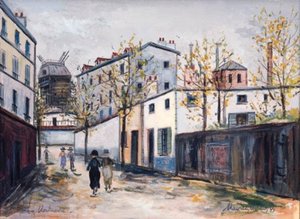
Maurice Utrillo portretas

Maurice Utrillo tapiai: 100 garsiausi πίναšiai, galerijos akimis

Atnaujinta lapkritis 2026 · pagal mūsų populiarumumo koeficientą (paieškos, lankytojai ir užsakymai kiekvienam kūriniui) · 691 Maurice Utrillo darbai mūsų kataloge

Trumpai tariant

Galerijos akimais, garsiausias Maurice Utrillo paveikslas yra montmartre (1930). Church of Saint Jean Baptiste le Perreux on the Marne (1938) ir Three mills montmartre under the snow užbaia trio, kurį atpažįsta kiekvienas ž)/\ Iš 691 Maurice Utrillo darbų mūsų kataloge, galerija žemiau pristato 100 garsiausius – kiekvienas yra originalus, su nurodytu metais, muziejumi bei unikaliu aprašymu.

1883 – 1955, Paryžius Post-impressionism Daugiausia darbų: Statens Museum For Kunst

10 geriausių galerijos Maurice Utrillo paveikslų

1
montmartre (1930) aut. Maurice Utrillo

montmartre

1930 · Watercolor

The watercolor titled montmartre was created by the artist Maurice Utrillo in 1930. This work captures a specific street within the Montmartre district, a famous hill located in Paris, France. The scene focuses on the urban architecture and the movement of people navigating the thoroughfare.

3
Three mills montmartre under the snow aut. Maurice Utrillo

Three mills montmartre under the snow

Oil

In the quiet, wintry atmosphere of Three mills montmartre under the snow, the artist Maurice Utrillo captures a specific, frozen moment on the hill of Montmartre. The scene unfolds as if the viewer is standing upon the rue Lepic, looking out toward the skyline. Three windmills dominate the view, their silhouettes rising against the pale, snowy landscape. These structures—the Blute-Fin, the Radet, and the Debray, also known as Poivre—anchor the…

4
Pontoise, Rue De L'éperon and Rue De La Coutellerie aut. Maurice Utrillo

Pontoise, Rue De L'éperon and Rue De La Coutellerie

Acrylic On Canvas

The world of Maurice Utrillo (1883-1955) is one defined by intimacy, a profound connection to the very bones of Paris – specifically, the weathered streets and humble buildings of Montmartre. Unlike many of his contemporaries who sought grand vistas or fashionable subjects, Utrillo relentlessly pursued the overlooked, the forgotten corners of his beloved district. His paintings aren’t merely depictions; they are emotional echoes, imbued with a quiet melancholy and an…

5
Rue du Chevalier de la Barre, Les coupoles du Sacré-Cœur et le clocher de Saint-Pierre de Montmartre aut. Maurice Utrillo

Rue du Chevalier de la Barre, Les coupoles du Sacré-Cœur et le clocher de Saint-Pierre de Montmartre

Oil

The scene unfolds in the Rue du Chevalier de la Barre, Les coupoles du Sacré-Cœur et le clocher de Saint-Pierre de Montmartre, a work by Maurice Utrillo. This painting captures a specific, atmospheric moment within the Montmartre district of Paris. The view focuses on the intersection of monumental architecture and the quiet, everyday urban life that pulses through the narrow streets. It is a moment frozen in time, where the…

6
flowers (1946) aut. Maurice Utrillo

flowers

1946 · Oil On Canvas

The light settles softly upon a wooden table, catching the edge of a vase that holds a sudden burst of life. Red and white flowers lean toward one another, their petals heavy with color against a backdrop that feels almost dreamlike and indistinct. There is a stillness here, the kind found in a sunlit corner of a Parisian room where the world outside ceases to matter. The arrangement rests firmly…

7
Moulin in Sannois under snow aut. Maurice Utrillo

Moulin in Sannois under snow

Oil On Canvas

Moulin in Sannois under snow is a work by the French painter Maurice Utrillo. The artist, born in 1883, emerged from the 18th arrondissement of Paris, France. His life, which spanned until 1955, was deeply rooted in the urban textures of his birthplace.

9
church at deuil (1912) aut. Maurice Utrillo

church at deuil

1912 · Oil On Canvas

The oil on canvas painting titled church at deuil was created by the French artist Maurice Utrillo. This work is dated 1912. The subject of the piece is the Church of Deuil, located in France. The artist, Maurice Utrillo, was born in the 18th arrondissement of Paris, France, in 1883.

10
place pigalle (1910) aut. Maurice Utrillo

place pigalle

1910 · Oil

In this work, titled place pigalle, we encounter a specific moment captured by Maurice Utrillo in 1910. The painting offers a view of a city street, centered around a large white building that dominates the background. A fountain sits before this structure, providing a focal point within the urban scene. Scattered figures move through the space, some positioned in the foreground and others receding into the distance, creating a sense…

Maurice Utrillo tapiai, rangos nuo 11 iki 100

11The pink house in Montmartre aut. Maurice UtrilloThe pink house in Montmartre 12le Maquis de Montmartre Sous la Neige aut. Maurice Utrillole Maquis de Montmartre Sous la Neige 13sacre coeur de montmartre rue du chevalier de la barre a montmartre (1935) aut. Maurice Utrillosacre coeur de montmartre rue du chevalier de la barre a montmartre1935 14Abbey of St. Denis (1908) aut. Maurice UtrilloAbbey of St. Denis1908 · The Phillips Collection 15Basilica di Saint Denis (1909) aut. Maurice UtrilloBasilica di Saint Denis1909 16church at st hilaire (1911) aut. Maurice Utrillochurch at st hilaire1911 17Terrains _ vendre _Gentilly (1922) aut. Maurice UtrilloTerrains _ vendre _Gentilly1922 18paysage _ saint bernard (1924) aut. Maurice Utrillopaysage _ saint bernard1924 19The Cottin Passage aut. Maurice UtrilloThe Cottin Passage 20The castle of Chasseneuil, Charente aut. Maurice UtrilloThe castle of Chasseneuil, Charente 21Gabrielle la belle, montmartre aut. Maurice UtrilloGabrielle la belle, montmartre 22The Public Square at Tertre (1911) aut. Maurice UtrilloThe Public Square at Tertre1911 · Milwaukee Art Museum 23Sacré-Coeur De Montmartre And Rue Sainte-Rustique aut. Maurice UtrilloSacré-Coeur De Montmartre And Rue Sainte-Rustique 24Rue de l'Abreuvoir, Montmartre aut. Maurice UtrilloRue de l'Abreuvoir, Montmartre 25rue des abbesses aut. Maurice Utrillorue des abbesses 26The Rue Norvins at Montmartre 2 aut. Maurice UtrilloThe Rue Norvins at Montmartre 2 27Sacré-Coeur De Montmartre And Rue Norvins aut. Maurice UtrilloSacré-Coeur De Montmartre And Rue Norvins 28The Sacré Coeur, Montmartre aut. Maurice UtrilloThe Sacré Coeur, Montmartre 29Hospice of saint vincent de paul aut. Maurice UtrilloHospice of saint vincent de paul 30The Bridges of Toulouse aut. Maurice UtrilloThe Bridges of Toulouse 31Rue Saint-Vincent and the Lapin Agile (1917) aut. Maurice UtrilloRue Saint-Vincent and the Lapin Agile1917 32Street in Stains aut. Maurice UtrilloStreet in Stains 33Church of Bessines (Haute Vienne) aut. Maurice UtrilloChurch of Bessines (Haute Vienne) 34Church of Saint-Pierre de Montmartre and the Sacré-Coeur aut. Maurice UtrilloChurch of Saint-Pierre de Montmartre and the Sacré-Coeur 35Sacre Coeur De Montmartre And Square Saint-Pierre aut. Maurice UtrilloSacre Coeur De Montmartre And Square Saint-Pierre 36House on the Isle of Ouessant, Brittany aut. Maurice UtrilloHouse on the Isle of Ouessant, Brittany 37Montmartre 2 aut. Maurice UtrilloMontmartre 2 38Church of Bessines aut. Maurice UtrilloChurch of Bessines 39Village street in the snow in Sannois aut. Maurice UtrilloVillage street in the snow in Sannois 40Church of saint peter and the sacred heart of montmartre aut. Maurice UtrilloChurch of saint peter and the sacred heart of montmartre 41Rue du Mont-Cenis Montmartre and the house of Berlioz aut. Maurice UtrilloRue du Mont-Cenis Montmartre and the house of Berlioz 42The squre Abbesses in the Snow aut. Maurice UtrilloThe squre Abbesses in the Snow 43Mother Catherine's Restaurant in Montmartre aut. Maurice UtrilloMother Catherine's Restaurant in Montmartre 44Benches at Montmagny (Val-d'Oise) aut. Maurice UtrilloBenches at Montmagny (Val-d'Oise) 45Moutier street and square de la Mairie aut. Maurice UtrilloMoutier street and square de la Mairie 46Old Houses at Fourqueux (1900) aut. Maurice UtrilloOld Houses at Fourqueux1900 · Statens Museum For Kunst 47Row of Houses at Pierrefitte (1905) aut. Maurice UtrilloRow of Houses at Pierrefitte1905 · National Gallery of Art 48La Butte Pinson aut. Maurice UtrilloLa Butte Pinson 49Street in Sannois (1910) aut. Maurice UtrilloStreet in Sannois1910 · Antverpio karališkasis gražiųjų menų muziejus 50Rue du Mont-Cenis (1911) aut. Maurice UtrilloRue du Mont-Cenis1911 51The Red Wall, Boulevard de la Chapelle (1910) aut. Maurice UtrilloThe Red Wall, Boulevard de la Chapelle1910 · Cincinnati Art Museum 52La Place du Tertre (1910) aut. Maurice UtrilloLa Place du Tertre1910 · Scottish National Gallery of Modern Art 53Place du Tertre (1911) aut. Maurice UtrilloPlace du Tertre1911 · The Phillips Collection 54Rue de L'Abreuvoir, Montmartre (1911) aut. Maurice UtrilloRue de L'Abreuvoir, Montmartre1911 · Statens Museum For Kunst 55Street in Paris (1910) aut. Maurice UtrilloStreet in Paris1910 · Statens Museum For Kunst 56Houses on the River Bank (1910) aut. Maurice UtrilloHouses on the River Bank1910 · Statens Museum For Kunst 57Paris Seen from Square Saint-Pierre (1908) aut. Maurice UtrilloParis Seen from Square Saint-Pierre1908 · Statens Museum For Kunst 58Church at St Hilaire aut. Maurice UtrilloChurch at St Hilaire 59Street In Montmartre 2 aut. Maurice UtrilloStreet In Montmartre 2 60Le Moulin De La Galette 11 aut. Maurice UtrilloLe Moulin De La Galette 11 61Le Moulin de la Galette at Montmartre aut. Maurice UtrilloLe Moulin de la Galette at Montmartre 62Rue Saint-Vincent aut. Maurice UtrilloRue Saint-Vincent 63The Cortot street aut. Maurice UtrilloThe Cortot street 64A Street in a Suburb of Paris 1 aut. Maurice UtrilloA Street in a Suburb of Paris 1 65Street in Montmartre 5 aut. Maurice UtrilloStreet in Montmartre 5 66Ecouen (Seine et Oise) aut. Maurice UtrilloEcouen (Seine et Oise) 67View of Montmarte aut. Maurice UtrilloView of Montmarte 68The Abreuvoir street aut. Maurice UtrilloThe Abreuvoir street 69Rue d'Orsel aut. Maurice UtrilloRue d'Orsel 70Rue Clovis in Paris aut. Maurice UtrilloRue Clovis in Paris 71The Basilica of Longpont aut. Maurice UtrilloThe Basilica of Longpont 72The Creil church aut. Maurice UtrilloThe Creil church 73Church of Simandre-les-Ormes aut. Maurice UtrilloChurch of Simandre-les-Ormes 74Church of Anse (Rhône) aut. Maurice UtrilloChurch of Anse (Rhône) 75Church of our lady of good hope aut. Maurice UtrilloChurch of our lady of good hope 76Le Moulin de la Galette, Montmartre, Paris aut. Maurice UtrilloLe Moulin de la Galette, Montmartre, Paris 77Street Scene aut. Maurice UtrilloStreet Scene 78Chapel of the Convent of the Carmelites in Paris aut. Maurice UtrilloChapel of the Convent of the Carmelites in Paris 79Rue du Chevalier-de-la-barre aut. Maurice UtrilloRue du Chevalier-de-la-barre 80Vue de pontoise aut. Maurice UtrilloVue de pontoise 81Church of Saint-Médard aut. Maurice UtrilloChurch of Saint-Médard 82Church of Chapaize - Saône-et-Loire aut. Maurice UtrilloChurch of Chapaize - Saône-et-Loire 83Rue Montmartre aut. Maurice UtrilloRue Montmartre 84Intersection in Sannois aut. Maurice UtrilloIntersection in Sannois 85Fortifications de Paris, Porte de Clichy aut. Maurice UtrilloFortifications de Paris, Porte de Clichy 86Church and street montmagny aut. Maurice UtrilloChurch and street montmagny 87Street In Montmartre 3 aut. Maurice UtrilloStreet In Montmartre 3 88Le Moulin De La Galette, Montmartre aut. Maurice UtrilloLe Moulin De La Galette, Montmartre 89The Norvins street in Montmartre aut. Maurice UtrilloThe Norvins street in Montmartre 90The Church of Auvers sur Oise aut. Maurice UtrilloThe Church of Auvers sur Oise 91Cabaret du Lapin Agile aut. Maurice UtrilloCabaret du Lapin Agile 92Rue Cortt, Montmartre aut. Maurice UtrilloRue Cortt, Montmartre 93Le Moulin De La Galette 9 aut. Maurice UtrilloLe Moulin De La Galette 9 94Birthplace of Joan of Arc in Domremy (Vosges) aut. Maurice UtrilloBirthplace of Joan of Arc in Domremy (Vosges) 95Mimi Pinson's House in Montmartre aut. Maurice UtrilloMimi Pinson's House in Montmartre 96Busy street in Ivry aut. Maurice UtrilloBusy street in Ivry 97Tertre Square at Montmartre aut. Maurice UtrilloTertre Square at Montmartre 98Factories In The Snow aut. Maurice UtrilloFactories In The Snow 99Sacré Coeur and the Rue Saint-Rustique aut. Maurice UtrilloSacré Coeur and the Rue Saint-Rustique 100Le Moulin de la Galette in the snow 1 aut. Maurice UtrilloLe Moulin de la Galette in the snow 1

žymios Maurice Utrillo tapiojamos, pagal laikotarpį

Temos, kurios domino Maurice Utrillo

Ketverios temos, dažniausiai pasikrausto originaluose, kiekvienos su savo puikiausiu pavyzdžiu.

Muziejai, kuriuose saugomi Maurice Utrillo originalūs darbai

7 muziejai, kuriuose saugoma daugiausia šioje pusėje esamų paveikslų.

Muzejaus Miestas Maurice Utrillo darbai Šiojo sąrašo paveikslai
Statens Museum For Kunst, KopenhagaStatens Museum For Kunst Kopenhaga 6 Old Houses at Fourqueux, Rue de L'Abreuvoir, Montmartre, Street in Paris
The Phillips Collection, VašingtonasThe Phillips Collection Vašingtonas 2 Abbey of St. Denis, Place du Tertre
National Gallery of Art, VašingtonasNational Gallery of Art Vašingtonas 2 Row of Houses at Pierrefitte
Antverpio karališkasis gražiųjų menų muziejus, AntverpysAntverpio karališkasis gražiųjų menų muziejus Antverpys 2 Street in Sannois
Milwaukee Art Museum, MilvaukiMilwaukee Art Museum Milvauki 1 The Public Square at Tertre
Cincinnati Art Museum, SinciatiatiCincinnati Art Museum Sinciatiati 1 The Red Wall, Boulevard de la Chapelle
Scottish National Gallery of Modern Art, EdinburghScottish National Gallery of Modern Art Edinburgh 1 La Place du Tertre

Maurice Utrillo, po vieno ikoninio paveikslio kiekvienam dešimtmenės laikotarpiui

Darbai pagal dešimtmečius

Pasirinkite dešimtmetį, kad pamatytėte jį apibrėžusį originalą.

Maurice Utrillo tapyiniai: galerijos atsakymai

Kuris Maurice Utrillo paveikslas yra pats garsiausias iš visų?Atsakymas

montmartre (1930). Toliausiai eina Church of Saint Jean Baptiste le Perreux on the Marne (1938) ir Three mills montmartre under the snow.

Kiek metų buvo Maurice Utrillo, kai sukūrė montmartre?Atsakymas

47 metų amžiaus: montmartre sukurta 1930 m. Nr. Maurice Utrillo gimė 1883.

Kuriose yra 10 geriausių Maurice Utrillo paveikslų?Atsakymas

montmartre, Church of Saint Jean Baptiste le Perreux on the Marne, Three mills montmartre under the snow, Pontoise, Rue De L'éperon and Rue De La Coutellerie, Rue du Chevalier de la Barre, Les coupoles du Sacré-Cœur et le clocher de Saint-Pierre de Montmartre, flowers, Moulin in Sannois under snow, Church of St. Nicolas du Chardonnet Under The Snow, church at deuil ir place pigalle. Viršuje esančioje reitingo sąraše nurodyta kiekvieno kūrinio metis ir muziejus.

Kiek kūrinių sukūrė Maurice Utrillo?Atsakymas

Mūsų kataloge yra 691 Maurice Utrillo darbų, skirtų laikotarpiui nuo 1900 iki 1946.

Kur kabinami garsiausi Maurice Utrillo originalūs darbai?Atsakymas

Daugiausia – Statens Museum For Kunst (Kopenhaga), The Phillips Collection (Vašingtonas) ir National Gallery of Art (Vašingtonas). Viršuje esančiame muziejų sąraše yra visi jie.

Kada Maurice Utrillo sukūrė savo garsiausias paveikslus?Atsakymas

1910s laikotarpiu: 13 iš 100 šioje pusėje esančių darbų buvo sukurtos tada, iš jų church at deuil.

Kokie yra ankstyviausi ir vėliausi garsieji Maurice Utrillo kūriniai?Atsakymas

Šioje pusėje seniausias darbas yra Old Houses at Fourqueux (1900), o naujausias – flowers (1946).

Kurią temą Maurice Utrillo kūrė dažniausiai?Atsakymas

France (24), Buildings (23) ir Street (16) iš 100 šioje pusėje esamų darbų.

Kurią techniką Maurice Utrillo naudojo dažniausiai?Atsakymas

Oil, iš 100 šios puslapio darbų – 13.

Su kokiu kierliu siejama Maurice Utrillo?Atsakymas

Post-impressionism, vadovaujantis šios puslapio originalais kūriniais.

Kurių Maurice Utrillo originalų turi Statens Museum For Kunst?Atsakymas

Old Houses at Fourqueux, Rue de L'Abreuvoir, Montmartre ir Street in Paris: Statens Museum For Kunst, Kopenhaga kolekcijoje yra 5 šioje pusėje esančių darbų.

Maurice Utrillo: menininkas

Early Life, Family and Training

Maurice Utrillo was born Maurice Valadon on 26 December 1883 in the Montmartre district of Paris, France. His arrival into the world was marked by a certain ambiguity, as his mother, Suzanne Valadon, never revealed the identity of his father. Suzanne was a woman of many lives, having transitioned from a circus acrobat to a sought-after artist's model. Growing up in the bohemian atmosphere of Montmartre, Maurice was surrounded by the creative energy of the neighborhood, yet his own path was shaped more by personal hardship than by formal instruction. He received no formal art school training, learning instead through the direct, unpolished guidance of his mother.

His youth was a difficult period defined by struggles with alcoholism and mental illness. As he faced bouts of illness and a growing sense of isolation, Suzanne encouraged him to take up painting. She saw it as a form of therapy, a way to find stability amidst his internal turbulence. Around 1904 to 1905, he began to paint under her watchful eye. This early period was less about academic technique and more about finding a way to navigate his own reality. The streets and buildings of his home district became his first teachers, providing a sense of structure when his personal life felt uncertain.

The White Period and Artistic Style

Around 1909, Utrillo entered a distinctive phase of his work known as the "White Period." During these years, his approach to the canvas became deeply physical. He often chose to work on cardboard rather than traditional canvas, a choice that influenced the weight and presence of his compositions. His technique involved a heavy impasto, where he applied paint with a thickness that gave the surface a tangible, sculptural quality. To achieve this, he mixed zinc white with plaster, creating textured layers that mimicked the very surfaces he sought to depict.

This method allowed him to capture the weathered walls and timeworn facades of the Montmartre streets he knew so well. His palette during this time was restrained, favoring muted tones of ochres, browns, and grays. These colors, combined with the chalky, cracked textures of the plaster, reflected the aging architecture of the district. He was not interested in the bright colors of a bustling city, but rather in the quiet, pale light that settled on the stone and mortar of the buildings.

Key Works and Subject Matter

Utrillo focused his gaze on the physical bones of the city, specializing in cityscapes and landscapes. His most frequent subjects were the houses and streets of the Montmartre district in Paris. He had a particular affinity for the quiet, weathered facades and the winding alleys that defined the neighborhood. Many of his paintings captured the Sacré-Coeur or various Parisian street scenes, often focusing on the way light hit the stone and plaster of the buildings.

He often returned to the same corners of his world, finding deep familiarity in the local landmarks. One such place was the Lapin Agile, a cabaret in Montmartre that served as a gathering point for many artists and writers. His work frequently depicted these social hubs and the surrounding architecture. As his health changed in later years, his perspective shifted. No longer able to wander the streets freely, he began to paint landscapes viewed from his windows, often using postcards or his own memory to reconstruct the scenes he could no longer reach.

  • Montmartre Street Corner or Lapin Agile (1936)

Later Years and Death

By the late 1920s, Utrillo had achieved a level of stability and respect that had long eluded him. In 1928, the French government awarded him the Cross of the Légion d'honneur, recognizing the unique way he had captured the spirit of the streets. His personal life also saw a significant change in 1935 when he married Lucie Valore. Following their marriage, the couple moved to Le Vésinet, a quiet area located just outside the edges of Paris.

As his health began to decline, his ability to paint changed. He could no longer work in the open air, so he turned his attention to the views from his windows. He often relied on postcards or his own memory to recreate the scenes of Montmartre that had defined his earlier years. Even in these later stages, his connection to the city remained a constant thread in his life.

His life came to an end on 5 November 1955. He passed away at the Hotel Splendid in Dax, France. Though his final years were spent away from the bustling center of the capital, his roots remained firmly planted in the district of his birth. He was eventually buried in the Cimetière Saint-Vincent in Montmartre.

Legacy and Influence

Utrillo remains a singular figure in the history of the School of Paris, largely because he was one of the few notable painters of Montmartre who was actually born and raised within the district. While many artists traveled to the neighborhood to find inspiration in its bohemian lifestyle, his work grew from a lived experience of its winding streets and weathered facades. His canvases offer an invaluable insight into the atmosphere of early 20th-century Paris, capturing a version of the city that was rapidly changing even as he painted it.

The reach of his work extends far beyond the hills of Montmartre. His paintings are held in numerous museums worldwide, ensuring that his specific vision of urban solitude remains accessible to those studying the era. His presence in major international collections, such as the Hermitage Museum and the Musée d'Orsay, confirms the lasting importance of his perspective on the built environment. He did not seek to paint grand historical events, but instead focused on the quiet, everyday reality of the streets and buildings that defined his home.

Where to See the Works Today

To experience the quiet, textured streets of Montmartre through his eyes, one can travel to several major institutions. In New York, his paintings are part of the collections at the Metropolitan Museum of Art and the Museum of Modern Art. These works offer a way to see the heavy impasto and the pale, chalky facades he favored, even when he was painting from memory in his later years.

In Europe, his presence is felt in many significant galleries. The Musée National d'Art Moderne and the Tate Museum both hold his pieces, preserving the specific atmosphere of the Parisian neighborhoods he loved. For a more intimate connection to the district that shaped him, his art is featured in the Musée de Montmartre, a place that feels deeply connected to the life he lived.

  • The Lapin Agile (1913)
  • Montmartre Street Corner or Lapin Agile (about 1936)