Jan Aselijns portretas

Jan Aselijns tapiai: 76 garsiausi πίναšiai, galerijos akimis

Atnaujinta spalis 2026 · pagal mūsų populiarumumo koeficientą (paieškos, lankytojai ir užsakymai kiekvienam kūriniui) · 84 Jan Aselijns darbai mūsų kataloge

Trumpai tariant

Galerijos akimais, garsiausias Jan Aselijns tapas yra Rūbiantis kswanas (1652), kurio originalas eksponuojamas Rijksmuseum, Amsterdamas. King Gustav Adolf II of Sweden in the Battle of Lutzen, 1632 (1634) ir Landscape with a Bridge in the Italian Countryside (1652) užbaia trio, kurį atpažįsta kiekvienas ž)/\ Iš 84 Jan Aselijns darbų mūsų kataloge, galerija žemiau pristato 76 garsiausius – kiekvienas yra originalus, su nurodytu metais, muziejumi bei unikaliu aprašymu.

1610 – 1652, Djepas Dutch golden age Daugiausia darbų: Rijksmuseum

10 geriausių galerijos Jan Aselijns paveikslų

1
Rūbiantis kswanas (1652) aut. Jan Aselijns

Rūbiantis kswanas

1652 · Aliejus ant drobės · Rijksmuseum, Amsterdamas

is an oil painting on canvas by the artist Jan Asselijn. Completed around 1650, the work captures a mute swan in a moment of fierce defense. The bird spreads its wings and hisses, guarding its nest against the approach of a dog. This struggle between the white plumage and the encroaching threat defines the central tension of the image.

2
King Gustav Adolf II of Sweden in the Battle of Lutzen, 1632 (1634) aut. Jan Aselijns

King Gustav Adolf II of Sweden in the Battle of Lutzen, 1632

1634 · Oil On Canvas · Statens Museum For Kunst, Kopenhaga

Jan Asselijn's “King Gustav Adolf II of Sweden in the Battle of Lutzen, 1632” isn’t merely a painting; it’s a visceral plunge into the heart of a pivotal moment in European history. Completed in 1634, this monumental work captures the chaotic fury and strategic brilliance of the Battle of Lutzen, fought on August 17th of that year, a clash that cemented Gustav Adolf II's reputation as a military genius and…

3
Landscape with a Bridge in the Italian Countryside (1652) aut. Jan Aselijns

Landscape with a Bridge in the Italian Countryside

1652 · Oil On Canvas · Cannon Hall Museum, Barnsley

A stone bridge with arched spans anchors this serene landscape, crossing a calm body of water that reflects the soft, overcast sky. To the left, a solitary figure sits upon a barrel, watching the quiet movement of the scene. On the right, the composition gathers around a horse and carriage; a person guides the animal toward the water's edge while another observer stands nearby. A dog occupies the foreground, grounding…

4
King Gustav Adolf II in the Battle of Lutzen on November 6,1632 (1632) aut. Jan Aselijns

King Gustav Adolf II in the Battle of Lutzen on November 6,1632

The air is thick with the scent of wet earth and sulfur. In the center of the chaos, King Gustav Adolf II of Sweden rides a horse through the fray, his sword a flash of cold light against the darkening sky. The Battle of Lutzen is not a quiet affair; it is a collision of muscle and metal. Soldiers on foot and mounted on horseback press against one another in…

5
Four Figures (1615) aut. Jan Aselijns

Four Figures

1615 · Oil · Groeningemuseum, Brugė

In Four Figures, Jan Asselijn organizes a group of men in period attire within a dimly lit, atmospheric setting. The composition centers on this cluster of figures, who are arranged in a loose, triangular formation. This structural choice draws the viewer's eye toward the middle of the group, where the subjects interact in a moment of quietude. One man is captured drinking from a vessel, while another stands holding a…

6
King Gustav Adolf II of Sweden, Battle near Lutzen 1632 (1635) aut. Jan Aselijns

King Gustav Adolf II of Sweden, Battle near Lutzen 1632

1635 · Oil On Panel · Gemäldegalerie, Berlynas

The artwork titled King Gustav Adolf II of Sweden, Battle near Lutzen 1632 is a work by the artist Jan Asselijn. Dated about 1635, this oil on panel painting belongs to the genre of military history. The subject matter focuses on the Battle of Lützen, a significant conflict from the Thirty Years' War. The scene captures the king amidst the movement of a large-scale military engagement.

7
The Tiber River with the Ponte Molle at Sunset (1650) aut. Jan Aselijns

The Tiber River with the Ponte Molle at Sunset

1650 · Oil · National Gallery of Art, Vašingtonas

The sun hangs low over the horizon, casting a sharp, golden light through the four massive stone arches of the Ponte Molle. This light slices through the atmosphere, painting the sky in a gradient that shifts from a warm, glowing amber on the right to a pale, tranquil aquamarine as the eye moves toward the left. The river below remains placid, reflecting the changing colors of the sky, while the…

8
Ruined Building with Shepherd and Sheep (1646) aut. Jan Aselijns

Ruined Building with Shepherd and Sheep

1646 · Oil On Panel

Ruined Building with Shepherd and Sheep is an artwork by Jan Asselijn. This piece belongs to the Dutch Golden Age and the Italianate landscape style of the Early Modern period. The subject matter focuses on a pastoral landscape that incorporates ruins and sheep. The composition integrates elements of nature, shepherds, and weathered stone structures within a single scene.

9
Italian Landscape (1638) aut. Jan Aselijns

Italian Landscape

1638 · Oil On Canvas · Statens Museum For Kunst, Kopenhaga

The artwork titled Italian Landscape is a painting by the Dutch Golden Age painter Jan Asselijn. Created in 1638, this work represents a specific period in the artist's career. Asselijn was born in Dieppe, France, around 1610, before his family relocated to Amsterdam. His development as a painter was shaped by the artistic environment of the Dutch Golden Age, a time when landscape painting was evolving toward more atmospheric depictions.

10
Fight against Robbers (1638) aut. Jan Aselijns

Fight against Robbers

1638 · Oil On Panel · Statens Museum For Kunst, Kopenhaga

A violent skirmish unfolds across a rugged, rocky landscape, captured in a dramatic monochrome palette. The composition relies on a sharp diagonal arrangement, pulling the eye from the foreground into a chaotic center-right where figures engage in combat. Mounted riders and infantrymen clash amidst dense foliage and spindly, skeletal trees. The atmosphere is heavy with mist and swirling smoke, creating a sense of tension and movement. Light filters through an…

Jan Aselijns tapiai, rangos nuo 11 iki 76

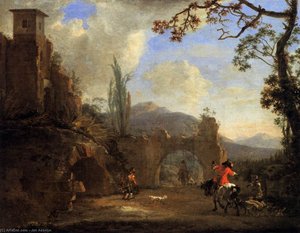
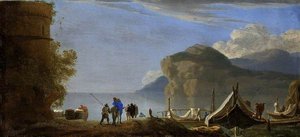
11Lion Hunting (1640) aut. Jan AselijnsLion Hunting1640 · Musée Fabre 12Italianate landscape with travellers by a stream with cattle (1652) aut. Jan AselijnsItalianate landscape with travellers by a stream with cattle1652 13Italian Landscape with a view from a Grotto (1639) aut. Jan AselijnsItalian Landscape with a view from a Grotto1639 · Nationalmuseum 14Landscape with Ruins and Hunting Party (1645) aut. Jan AselijnsLandscape with Ruins and Hunting Party1645 · Vienos dailės akademija 15PAYSAGE AVEC UN TROUPEAU TRAVERSANT UNE RIVIERE aut. Jan AselijnsPAYSAGE AVEC UN TROUPEAU TRAVERSANT UNE RIVIERELiuvro muziejus 16River Bank with Herdsmen (1650) aut. Jan AselijnsRiver Bank with Herdsmen1650 · Vienos dailės akademija 17Coastal Scene with Resting Riders (detail) (1652) aut. Jan AselijnsCoastal Scene with Resting Riders (detail)1652 · Vienos dailės akademija 18Imaginary Italian Landscape (1652) aut. Jan AselijnsImaginary Italian Landscape1652 · Mauritshuis Royal Picture Gallery 19Landscape with a Cowherd (1594) aut. Jan AselijnsLandscape with a Cowherd1594 20Italianate Landscape (1631) aut. Jan AselijnsItalianate Landscape1631 · Bavarijos valstybinės paveikslų kolekcijos 21Cavalry Engagement (1635) aut. Jan AselijnsCavalry Engagement1635 22Peasants by a River Bank (1639) aut. Jan AselijnsPeasants by a River Bank1639 · Yale University Art Gallery 23Mountain - landscape (1639) aut. Jan AselijnsMountain - landscape1639 24Riders Gallopping towards the Gates of the Fortress (1645) aut. Jan AselijnsRiders Gallopping towards the Gates of the Fortress1645 · Ermitažas 25Winter Landscape (1645) aut. Jan AselijnsWinter Landscape1645 · Ermitažas 26Nocturnal Crayfishing (1638) aut. Jan AselijnsNocturnal Crayfishing1638 · Statens Museum For Kunst 27Vesuvius Erupting at Nightfall (1638) aut. Jan AselijnsVesuvius Erupting at Nightfall1638 · Statens Museum For Kunst 28Head of an Ox (1647) aut. Jan AselijnsHead of an Ox1647 · Musée des Beaux-Arts 29Catching Crayfish (1645) aut. Jan AselijnsCatching Crayfish1645 · Muzeum Palacu Króla Jana Iii w Wilanowie 30Ford between High Cliffs (1644) aut. Jan AselijnsFord between High Cliffs1644 · Nacionalinė galerija Praha 31Peasants and Cattle beside a Tower (1646) aut. Jan AselijnsPeasants and Cattle beside a Tower1646 32Winter landscape with huntsmen on a bridge (1647) aut. Jan AselijnsWinter landscape with huntsmen on a bridge1647 · Fondation Custodia 33A rocky mountain valley with shepherds and cattle (1645) aut. Jan AselijnsA rocky mountain valley with shepherds and cattle1645 · Staatliche Kunsthalle Karlsruhe 34Italian Landscape (1640) aut. Jan AselijnsItalian Landscape1640 · Pushkinio valstybinis dailės muziejus 35Frozen Moat outside City Walls (1647) aut. Jan AselijnsFrozen Moat outside City Walls1647 · Worcester Art Museum 36Italianate Landscape with Drovers, Cattle and Sheep beside Ruins (1647) aut. Jan AselijnsItalianate Landscape with Drovers, Cattle and Sheep beside Ruins1647 · Fogg Museum of Art 37Italianate Landscape with a River and an Arched Bridge (1648) aut. Jan AselijnsItalianate Landscape with a River and an Arched Bridge1648 · Staatsgalerie Schleissheim 38Southern Landscape with Cattle near Ruins (1650) aut. Jan AselijnsSouthern Landscape with Cattle near Ruins1650 · National Museum in Wrocław 39View of the Solario Bridge on the Teverone (1650) aut. Jan AselijnsView of the Solario Bridge on the Teverone1650 40Head of a lowing Ox (1650) aut. Jan AselijnsHead of a lowing Ox1650 · Staatliches Museum Schwerin 41Italianate landscape with bridge near Tivoli (1649) aut. Jan AselijnsItalianate landscape with bridge near Tivoli1649 42River Landscape with the Fort Saint-Jean and the Chateau Pierre-Scize in Lyon (1650) aut. Jan AselijnsRiver Landscape with the Fort Saint-Jean and the Chateau Pierre-Scize in Lyon1650 · Yale University Art Gallery 43The restoration of the Diemerdijk or Muiderdijk near Amsterdam in 1651 (1651) aut. Jan AselijnsThe restoration of the Diemerdijk or Muiderdijk near Amsterdam in 16511651 · Gemäldegalerie 44Breach of a Dyke by Storm Surge on March 5 1651 (1651) aut. Jan AselijnsBreach of a Dyke by Storm Surge on March 5 16511651 · Gemäldegalerie 45The Breach of the Sint Anthonisdijk in 1651 (1652) aut. Jan AselijnsThe Breach of the Sint Anthonisdijk in 16511652 · Amsterdam Museum 46The Breach of the Saint Anthony’s Dike near Amsterdam, Jan Asselijn, 1651 (1651) aut. Jan AselijnsThe Breach of the Saint Anthony’s Dike near Amsterdam, Jan Asselijn, 16511651 47Drovers with Cattle under an Arch of the Colosseum in Rome, Jan Asselijn, 1640 - 1652 (1652) aut. Jan AselijnsDrovers with Cattle under an Arch of the Colosseum in Rome, Jan Asselijn, 1640 - 16521652 · Rijksmuseum 48A Mediterranean Coastal View with Shipping and Mariners by a Fort (1650) aut. Jan AselijnsA Mediterranean Coastal View with Shipping and Mariners by a Fort1650 49A Mediterranean Coastal View with Shipping and Mariners by a Fort (1650) aut. Jan AselijnsA Mediterranean Coastal View with Shipping and Mariners by a Fort1650 50River Landscape with the Church of Santi Giovanni e Paolo (1650) aut. Jan AselijnsRiver Landscape with the Church of Santi Giovanni e Paolo1650 51Landscape with a Drover (1649) aut. Jan AselijnsLandscape with a Drover1649 · Holburne Museum 52Landscape with a Bridge in the Italian Countryside (1652) aut. Jan AselijnsLandscape with a Bridge in the Italian Countryside1652 · Cannon Hall Museum 53Coastal Scene with Resting Riders (1652) aut. Jan AselijnsCoastal Scene with Resting Riders1652 · Vienos dailės akademija 54PAYSAGE AVEC UNE TOUR aut. Jan AselijnsPAYSAGE AVEC UNE TOURLiuvro muziejus 55RUINE ET CABANE DE BERGERS aut. Jan AselijnsRUINE ET CABANE DE BERGERSLiuvro muziejus 56LANDSCAPE WITH A DEPARTURE FOR A HUNT aut. Jan AselijnsLANDSCAPE WITH A DEPARTURE FOR A HUNT 57Muleteers beside an Italian Ruin (1650) aut. Jan AselijnsMuleteers beside an Italian Ruin1650 · Rijksmuseum 58Hangout in Italy (1620) aut. Jan AselijnsHangout in Italy1620 · Rijksmuseum 59Herders with Their Animals under an Arch of the Colosseum in Rome (1652) aut. Jan AselijnsHerders with Their Animals under an Arch of the Colosseum in Rome1652 · Rijksmuseum 60Hunting Company out of Rome (1652) aut. Jan AselijnsHunting Company out of Rome1652 · Rijksmuseum 61Beggars in front of a Roman Limekiln (1638) aut. Jan AselijnsBeggars in front of a Roman Limekiln1638 · Vienos dailės akademija 62Asselijn - (50Riverbank) aut. Jan AselijnsAsselijn - (50Riverbank) 63Asselijn ruin aut. Jan AselijnsAsselijn ruinRijksmuseum 64Italian Coast Scene aut. Jan AselijnsItalian Coast Scene 65Italian Landscape with Two Horsemen and Figures on a Road aut. Jan AselijnsItalian Landscape with Two Horsemen and Figures on a Road 66Italian Landscape with the Church of Sts. Giovanni e Paolo in Rome aut. Jan AselijnsItalian Landscape with the Church of Sts. Giovanni e Paolo in RomeSzépművészeti Múzeum 67Mountainous Landscape aut. Jan AselijnsMountainous Landscape 68A rocky river landscape with travellers in the foreground and ships beyond aut. Jan AselijnsA rocky river landscape with travellers in the foreground and ships beyond 69A Landscape with Peasants (also known as Landscape with Herdsmen Fording a River) aut. Jan AselijnsA Landscape with Peasants (also known as Landscape with Herdsmen Fording a River)Ascott House 70A Cavalier on Horseback Before a Landscape aut. Jan AselijnsA Cavalier on Horseback Before a Landscape 71Landscape with shepherds and their flock crossing the Ponte Acquoria near Tivoli aut. Jan AselijnsLandscape with shepherds and their flock crossing the Ponte Acquoria near Tivoli 72an italianate river landscape with herders on a path with their flock and donkeys, classical ruins on a hilltop beyond aut. Jan Aselijnsan italianate river landscape with herders on a path with their flock and donkeys, classical ruins on a hilltop beyondMinneapolis Institute of Art 73Italian Coast Scene aut. Jan AselijnsItalian Coast SceneFitzwilliam College 74Italian Landscape aut. Jan AselijnsItalian LandscapeFitzwilliam College 75Italian Landscape with the Ruins of a Roman Bridge and Aqueduct aut. Jan AselijnsItalian Landscape with the Ruins of a Roman Bridge and AqueductRijksmuseum 76Cavalry Attack at Sunset, Jan Asselijn, 1646 (1646) aut. Jan AselijnsCavalry Attack at Sunset, Jan Asselijn, 16461646 · Rijksmuseum

žymios Jan Aselijns tapiojamos, pagal laikotarpį

Temos, kurios domino Jan Aselijns

Ketverios temos, dažniausiai pasikrausto originaluose, kiekvienos su savo puikiausiu pavyzdžiu.

Muziejai, kuriuose saugomi Jan Aselijns originalūs darbai

8 muziejai, kuriuose saugoma daugiausia šioje pusėje esamų paveikslų.

Muzejaus Miestas Jan Aselijns darbai Šiojo sąrašo paveikslai
Rijksmuseum, AmsterdamasRijksmuseum Amsterdamas 9 Rūbiantis kswanas, Drovers with Cattle under an Arch of the Colosseum in Rome, Jan Asselijn, 1640 - 1652, Muleteers beside an Italian Ruin
Statens Museum For Kunst, KopenhagaStatens Museum For Kunst Kopenhaga 5 King Gustav Adolf II of Sweden in the Battle of Lutzen, 1632, Italian Landscape, Fight against Robbers
Vienos dailės akademija, VienaVienos dailės akademija Viena 5 Landscape with Ruins and Hunting Party, River Bank with Herdsmen, Coastal Scene with Resting Riders (detail)
Gemäldegalerie, BerlynasGemäldegalerie Berlynas 3 King Gustav Adolf II of Sweden, Battle near Lutzen 1632, The restoration of the Diemerdijk or Muiderdijk near Amsterdam in 1651, Breach of a Dyke by Storm Surge on March 5 1651
Liuvro muziejus, ParyžiusLiuvro muziejus Paryžius 3 PAYSAGE AVEC UN TROUPEAU TRAVERSANT UNE RIVIERE, PAYSAGE AVEC UNE TOUR, RUINE ET CABANE DE BERGERS
Cannon Hall Museum, BarnsleyCannon Hall Museum Barnsley 2 Landscape with a Bridge in the Italian Countryside, Landscape with a Bridge in the Italian Countryside
Yale University Art Gallery, Niū HevenasYale University Art Gallery Niū Hevenas 2 Peasants by a River Bank, River Landscape with the Fort Saint-Jean and the Chateau Pierre-Scize in Lyon
Ermitažas, Šv. PeterburgasErmitažas Šv. Peterburgas 2 Riders Gallopping towards the Gates of the Fortress, Winter Landscape

Jan Aselijns, po vieno ikoninio paveikslio kiekvienam dešimtmenės laikotarpiui

Darbai pagal dešimtmečius

Pasirinkite dešimtmetį, kad pamatytėte jį apibrėžusį originalą.

Jan Aselijns tapyiniai: galerijos atsakymai

Kuris Jan Aselijns paveikslas yra pats garsiausias iš visų?Atsakymas

Rūbiantis kswanas (1652), Rijksmuseum, Amsterdamas. Toliau seka King Gustav Adolf II of Sweden in the Battle of Lutzen, 1632 (1634) ir Landscape with a Bridge in the Italian Countryside (1652).

Kiek metų buvo Jan Aselijns, kai sukūrė Rūbiantis kswanas?Atsakymas

42 metų amžiaus: Rūbiantis kswanas sukurta 1652 m. Nr. Jan Aselijns gimė 1610.

Kuriose yra 10 geriausių Jan Aselijns paveikslų?Atsakymas

Rūbiantis kswanas, King Gustav Adolf II of Sweden in the Battle of Lutzen, 1632, Landscape with a Bridge in the Italian Countryside, King Gustav Adolf II in the Battle of Lutzen on November 6,1632, Four Figures, King Gustav Adolf II of Sweden, Battle near Lutzen 1632, The Tiber River with the Ponte Molle at Sunset, Ruined Building with Shepherd and Sheep, Italian Landscape ir Fight against Robbers. Viršuje esančioje reitingo sąraše nurodyta kiekvieno kūrinio metis ir muziejus.

Kiek kūrinių sukūrė Jan Aselijns?Atsakymas

Mūsų kataloge yra 84 Jan Aselijns darbų, skirtų laikotarpiui nuo 1620 iki 1652.

Kur kabinami garsiausi Jan Aselijns originalūs darbai?Atsakymas

Daugiausia – Rijksmuseum (Amsterdamas), Statens Museum For Kunst (Kopenhaga) ir Vienos dailės akademija (Viena). Viršuje esančiame muziejų sąraše yra visi jie.

Kada Jan Aselijns sukūrė savo garsiausias paveikslus?Atsakymas

1650s laikotarpiu: 24 iš 76 šioje pusėje esančių darbų buvo sukurtos tada, iš jų Rūbiantis kswanas.

Kokie yra ankstyviausi ir vėliausi garsieji Jan Aselijns kūriniai?Atsakymas

Šioje pusėje seniausias darbas yra Hangout in Italy (1620), o naujausias – Rūbiantis kswanas (1652).

Kurią temą Jan Aselijns kūrė dažniausiai?Atsakymas

Landscape (26), Ruins (7) ir Figures (6) iš 76 šioje pusėje esamų darbų.

Kurią techniką Jan Aselijns naudojo dažniausiai?Atsakymas

Oil On Canvas, iš 76 šios puslapio darbų – 12.

Su kokiu kierliu siejama Jan Aselijns?Atsakymas

Dutch golden age ir Baroque, vadovaujantis šios puslapio originalais kūriniais.

Kurių Jan Aselijns originalų turi Rijksmuseum?Atsakymas

Rūbiantis kswanas, Drovers with Cattle under an Arch of the Colosseum in Rome, Jan Asselijn, 1640 - 1652 ir Muleteers beside an Italian Ruin: Rijksmuseum, Amsterdamas kolekcijoje yra 9 šioje pusėje esančių darbų.

Jan Aselijns: menininkas

Gyvenimo Kelias, Nukaltas Peizažų Tapyboje: Jan Asselijn Pasaulis

Jan Asselijn (tikrasis vardas Jean Asselin), gimęs apie 1610 metus Prancūzijos uostamiestyje Diepe, gyveno laikais, kupinais religinių permainų ir meninės kūrybos paieškų. Jo šeima, hugenotai, bėgdami nuo persekiojimų, persikėlė į Amsterdamą 1621 metais – gyvybingą prekybos centrą, klestėjusiame Nyderlandų Aukso amžiuje. Šis persikraustymas buvo lemtingas jaunajam Jeanui, jis pasinėrė į pasaulį, kuriame peizažo tapyba sparčiai tobulėjo, peržengiant tradicinius vaizdus link atmosferiškų ir emocionaliai rezonuojančių scenų. Pradžioje jis mokėsi pas Jan Martszen jaunąjį, ugdydamas įgūdžius karinių scenų tapyboje, tačiau netrukus atrado tikrą savo pašaukimą – grožio ir dramos perteikimą gamtos peizažuose bei gyvūnijos paveiksluose. Ankstyvas susipažinimas su olandiška šviesa ir plačiais dangais tapo ryškiu jo kūrybos bruožumu, tačiau būtent kelionė į Italiją padėjo jam galutinai susiformuoti meninei vizijai.

Itališkas Apgaubimas Ir “Bentvueghels” Bendruomenė

Kaip ir daugelis ambicingų šiaurės Europos tapytojų, Asselijn ieškojo tobulumo Italijoje, tikslus atvykimo laikas nežinomas, tačiau manoma, kad tai įvyko po 1635 metų. Būtent ten jis visiškai pasinėrė į *itališkąjį* stilių – žanrą, kuriam būdingi saulės apšviesti vaizdai, klasikinės griuvėsiai ir pastorališkos scenos, kupinos romantikos. Jis prisijungė prie *Bentvueghels*, spalvingo Nyderlandų ir flamandų menininkų draugijos Romoje. Šie “Paukščiai”, kaip juos vadino, buvo žinomi dėl savo netradicinio elgesio, satyrinių pravardžių ir atsidavimo tapybai tiesiogiai gamtoje – atsisakydami studijų ribotumų. Šioje triukšmingoje bendruomenėje Asselijn gavo pravardę “Krabbetje” (mažasis krabas) dėl fizinės negalios, paveikusios jo ranką, tačiau jis klestėjo kūrybiškai. Jis įsisavino tokio menininko kaip Pieter van Laer (Bamboccio) įtaką, kurio romos valstiečių gyvenimo ir peizažų vaizdai giliai rezonavo su pačiu Asselijn besiformuojančiu stiliumi. Šis laikotarpis buvo lemiamas ugdant jo gebėjimą perteikti atmosferą, šviesą ir naratyvą kompozicijose.

Šviesos Įvaldymo Meno Ir Simbolizmo Raktiniai Darbai

Asselijn grįžo į Amsterdamą su tobulintu įgūdžiu ir savitu balsu. Jo paveikslus charakterizuoja aiškumas ir meistriškas šviesos valdymas – savybės, greitai pelniusios jam pripažinimą. Nors jis kūrė istorines ir karines scenas, būtent jo peizažai ir gyvūnų paveikslai išskyrė jį iš kitų. “Grasinamas Gulbė”, nutapytas keturiasdešimtaisiais metais, išlieka jo garsiausiu darbu. Tai daugiau nei tik paukščio gynimo vaizdas – šis paveikslas tapo galinga Nyderlandų nacionalinės atsparos prieš išorinius grėsmijus simbolika. Uoliai savo lizdą sauganti gulbė, agresyviai atbaidanti įsibrovėlius, rezonavo su tuo metu vyravusia nerimu ir buvo interpretuojama kaip alegorija Johano de Witt, žymaus Nyderlandų valstybės veikėjo. Įdomu tai, kad vėliau paveikslo savininkai ant drobės pridėjo simbolinius įrašus – “Olandija” prie vieno iš kiaušinių ir “Valstybės priešas” šalia grasinančio šuns – dar labiau sustiprindami jo politinį kontekstą. Kiti svarbūs darbai apima “Kavalerijos Ataka Saulėlydyje”, demonstruojantį ankstesnį karinių scenų tapybos mokymąsi su dramatišku įspūdžiu, ir kaimo gyvenimo vaizdus, tokius kaip “Ganai su Galvijais Po Koliziejaus Arka Romoje”, kurie puikiai derina itališkus peizažus su gyvūnų studijomis. “Švento Antono Užtvankos Prarūva Prie Amsterdamo” parodo jo gebėjimą užfiksuoti nacionalinės krizės akimirką, atspindintį nuolatinę vandens grėsmę ir Nyderlandų žemės įsisavinimo sudėtingumą.

Įtaka Ir Palikimas: Trūkstantis Įspūdis

Jan Asselijn poveikis apėjo ribas jo paties gausios kūrybos. Jį gerbė bendraamžiai, tokie kaip Rembrandt, kuris net sukūrė graviūras su menininku darbe – tačiau pastebima, kad šios graviūros užmaskuoja Asselijn rankas, galbūt jautriai pripažindami jo fizinę negalią. Jis taip pat buvo mentorius Frederik de Moucheron, kito žymaus Nyderlandų peizažisto, kuris toliau populiarino itališkąjį stilių. Asselijn novatoriškas požiūris į šviesą ir atmosferą turėjo įtakos kartai menininkų, keliant natūralizmo ir emocinio gilumo lygį peizažo tapyboje. Jo darbai dabar saugomi prestižiniuose rinkiniuose, tokiuose kaip Rijksmuseum Amsterdamas, užtikrinant jo palikimą kaip reikšmingą Nyderlandų Aukso amžiaus veikėją. Jis mirė gana jaunas, 1652 metais, tačiau paliko po save kūrinių rinkinį, kuris ir toliau žavi žiūrovus savo grožiu, drama ir subtiliais prasminiais sluoksniais.