Gustave Moreau portretas

100 garsiausių Gustave Moreau paveikių rinkinys: galerijos išboru

Atnaujinta spalis 2026 · pagal mūsų populiarumumo koeficientą (paieškos, lankytojai ir užsakymai kiekvienam kūriniui) · 535 Gustave Moreau darbai mūsų kataloge

Trumpai tariant

Iš visų originalų, kuriuos paliko Gustave Moreau, garsiausias yra Žalos išpažinimas (1876). Tiesiog už jų seka Feetonas (1878) ir Mairės, apie 1885 m.. Mūsų kataloge yra 535 darbų autoriaus Gustave Moreau; galerija išsaugojo 100 labiausiai pasaulyje žyminiausių kūrinių – kiekvienas jų pateikiamas su datos, muziejaus ir istorijos aprašymu.

1826 – 1898, Paryžius Simbolistinė tapyba Daugiausia darbų: Musėja Gustavo Moros

Gustave Moreau geriausios 10 paveikslų: galerijos pasirinkimas

1
Žalos išpažinimas (1876) aut. Gustave Moreau

Žalos išpažinimas

1876 · Aliejus ant drobės

Gustavo Moreau kūrinys „Aparekcija“ (1876) yra laiko nekaitantis šedevras, sujungiantis šventybę su sensualumu žavintiems simbolizmo meno išraiškai. Šis akvarelis, saugomas Orsėje (Musée d'Orsay), įamžina biblijinį momentą, kai Salome šoka priešais Herodą Antipasą, o jos viziją kietina nuтренkėlio Jono Krikštyto galvos vaizdas. Sudėtinga Moreau kompozicija ir šviesus paletės naudojimas sukuria kitokią, ne iš šio pasaulio atmosferą, kuri žavi žiūrovus net po šalio amžiaus.

2
Feetonas (1878) aut. Gustave Moreau

Feetonas

1878 · Aliejus ant drobės · Liuvro muziejus, Paryžius

1878 metais pabaigtas Gustave Moreau kūrinys „Feetonas“ yra kvapą gniaužiantis simbolizmo paveikslų pavyzdys – darbas, kuris peržengia paprasto vaizdinimo ribas ir nukelia į mitų, emocijų bei žmogaus būties gelmes. Šiuo metu prestižiniame Paryžiaus Louvro muziejuje esantis šis ešlinėms audinys darbas kviečia žiūrovus į dramatišką ir psichologiškai įkrautą pasakojimą.

3
Mairės, apie 1885 m. aut. Gustave Moreau

Mairės, apie 1885 m.

Aliejus ant drobės · Grand Palais, Paris

Vandenyno sielos odisėja Gustave Moreau tapytas apie 1885 metus kūrinys „Mairės, apie 1885 m.“ yra kur kas daugiau nei paprasta jūros fantazija; tai gilus perėjimas į simbolizmo judėjimo širdį. Pasikliaudami šiuos prabangius vandens žemės realmą, žiūrovai susiduria su trijų sirenių trio, kurios egzistencija peržengia paprasto mito ribas.Įkvėstas epinės Homeros Odsejos pasakų, Moreau peržiūri pavojingą Odisėja ir sirenių susitikimą ne kaip fizinę kovą, o kaip psichologinę meditaciją apie pagavą, troškulį ir…

4
Salome su Šv. Jono Krikštytojo galva (1876) aut. Gustave Moreau

Salome su Šv. Jono Krikštytojo galva

1876 · Akrilas ant drobės · Metropolitano meno muziejus, Niujorkas

Gustave Moreau 1876 metų alievinė paveikslas, Salome su Šv. Jono Krikštytojo galva, nėra triumfo spektaklis ar šiurpus vaizdas, o labiau intymi ir neruginanti psichologinės erdvės tyrimo istorija. Nors jo matmenys vos 22 x 12 cm ir jis sukurtas ant medžio, šis mažas drobė turi neįtikėtiną jėgą, šiuo metu žavinti žiūrovus Niujorko Metropolitenos meno muziejuje. Moreau mums nepateikia paties žudymo akimirkos nei Salome, besimėginės savo pergale; vietoj to jis pasiūlo laiko…

5
Jazonas ir Medėja (1865) aut. Gustave Moreau

Jazonas ir Medėja

1865 · Akrilas ant drobės · Liuvro muziejus, Paryžius

Gustave Moreau: Mitinio tamsumo vizija Moreau kūrinys „Jasonas ir Medėja“ nėra tiesiog graikų mitologijos vaizdinimas; tai pasinėrimas į karalystę, kurioje triumfuoja tamsa, prasukta nerimo gražumu. Šis monumentalus plėstinys, parašytas 1865 m., simbolizmo entuziazmo viršuje, peržengia paprastą pasakojimą ir siekia iškelti gilius psichologinius būsenas – baimę, trokimą ir galiausiai – neviltį – per itin meistriškai sukurtą vizualią kalbą. Moreau ambicija nebuvo atkurti Homerinės didybės, o išgauti jos esmę, sukoncentruotą emocijų paveikslėlį,…

6
Jupiteris ir Semele (1890) aut. Gustave Moreau

Jupiteris ir Semele

1890 · Aliejus ant drobės · Musėja Gustavo Moros, Paris

Oro tankis prisidauja sunkiu, elektriniu įtampu, kai riba tarp žemiškosios ir dieviškosios esybės pradeda tirpti. Šioje erdvėje Dievų karaliu Jupiteris sėdi ant masyvaus thrones, jo žvilgsnis užfiksuotas tiesiai į priekį su griežta, išsiskverdiu intensyvumu. Jis nėra tik mitinė figūra, bet budulys, spinduliuojantis siaurią, baisų švytėjimą. Ant jo dešinio viršumelio laužyta Semele, kurios kūnas pasiekė tikslų perėjimo momentą tarp gyvybės ir sunaikinimo. Jos rankos atitrauktos iš šoko, o kūnas atrodo besidaužantis…

7
The Daughters of Thespius (1853) aut. Gustave Moreau

The Daughters of Thespius

1853 · Oil On Canvas · Musėja Gustavo Moros, Paris

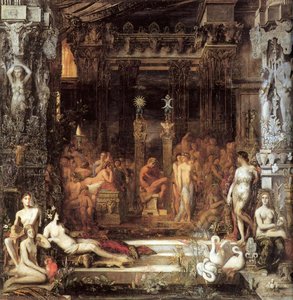
A Portal into the Mythic Dreamscape In the heart of nineteenth-century Paris, Gustave Moreau emerged not merely as a painter, but as a weaver of dreams, and nowhere is this more evident than in his monumental work, The Daughters of Thespius. Created in 1853, this breathtaking oil on canvas serves as an early testament to the artist's profound ability to conjure realms that exist at the intersection of reality and…

8
Jupiter and Semele (1895) aut. Gustave Moreau

Jupiter and Semele

1895 · Oil On Canvas

In the grand tapestry of nineteenth-century art, few threads shimmer with as much mystery and nocturnal beauty as Gustave Moreau’s Jupiter and Semele. Completed in 1895, this monumental canvas stands as a cornerstone of the Symbolist movement, embodying a profound fascination with dreamlike imagery and psychological exploration. The painting plunges viewers into a scene brimming with dramatic tension, capturing a pivotal moment from Greek mythology where the celestial and the…

9
Aparicija (1876) aut. Gustave Moreau

Aparicija

1876 · Aliejus ant drobės · Fogg Museum, Keimbridžas

Šiame alievoje ant pluošto kadro viršuje, centre, dominuoja švytanti, levituojanti galva. Jos aplinkuje skveria radianti, žvaigždės formos baltos šviesos aureola, kurios spinduliai skrieja per visą sceną. Po šia apobraikliu situota moteris su ilga, banguota ruda plaka, pasidavusi puikiai dekoruotai, pusiau nuogai aprangai. Jai dėvimą išsiunčytą atverną robe, karūną bei įvairiusias papuošalus. Jos dešinė ranka pasiekia link levituojantis figūros. Po moters kojomis ranguoja leopardas. Fone atsiduoduoja masyvios, korinto stiliaus kolonos ir…

10
Jakobas ir angelas (1876) aut. Gustave Moreau

Jakobas ir angelas

1876 · Aliejus ant drobės · Fogg Museum, Keimbridžas

The canvas captures a nocturnal struggle between the mortal Jacob and a divine presence. Set against a turbulent landscape under a pale moon, the composition centers on the physical tension of the wrestling match. To the left, an angelic figure is draped in intricate, jewel-like garments, her head framed by a multi-colored halo of radiating light. Opposite her, a muscular male figure strains with dynamic effort, his body contorted in…

Gustave Moreau darba rinkinys tęsiamas, nuo 11 iki 100

11Salome Dancing (1886) aut. Gustave MoreauSalome Dancing1886 · Musée d'Orsay 12Salomė kalėjime (1876) aut. Gustave MoreauSalomė kalėjime1876 · Nacionalinis Vakarų meno muziejus 13Salom Dancing before Herod (1876) aut. Gustave MoreauSalom Dancing before Herod1876 · Armand Hammer meno muziejus 14The Muses Leaving Their Father Apollo to go and Enlighten th aut. Gustave MoreauThe Muses Leaving Their Father Apollo to go and Enlighten thMusėja Gustavo Moros 15Hercules and the Lernaean Hydra (1876) aut. Gustave MoreauHercules and the Lernaean Hydra1876 · Musėja Gustavo Moros 16helene glorifiee aut. Gustave Moreauhelene glorifiee 17Pietė (1854) aut. Gustave MoreauPietė1854 · Städelsche Kunstinstitut Und Städtische Galerie 18Sainte Cécile et les Anges de la musique aut. Gustave MoreauSainte Cécile et les Anges de la musique 19The Triumph of Alexander the Great (1892) aut. Gustave MoreauThe Triumph of Alexander the Great1892 · Musėja Gustavo Moros 20Salome Dancing before Herod aut. Gustave MoreauSalome Dancing before HerodHammer Museum 21Sapfos mirtis (1850) aut. Gustave MoreauSapfos mirtis1850 · Musėja Gustavo Moros 22Jakobas ir angelas (1878) aut. Gustave MoreauJakobas ir angelas1878 · Musėja Gustavo Moros 23Les Argonautes aut. Gustave MoreauLes Argonautes 24The Death of Sappho (1872) aut. Gustave MoreauThe Death of Sappho1872 · Musée Municipal 25Pieta aut. Gustave MoreauPietaNacionalinis Vakarų meno muziejus 26Hercules and the Hydra (1876) aut. Gustave MoreauHercules and the Hydra1876 27The Suitors aut. Gustave MoreauThe SuitorsMusėja Gustavo Moros 28Prince Hamlet kill King Claudius aut. Gustave MoreauPrince Hamlet kill King Claudius 29La Toilette (1885) aut. Gustave MoreauLa Toilette1885 · Artizon Museum 30The Sphinx (1864) aut. Gustave MoreauThe Sphinx1864 31Jupiter et Sémélé aut. Gustave MoreauJupiter et Sémélé 32Ganymede (1886) aut. Gustave MoreauGanymede1886 33Uogulėta Salome (1875) aut. Gustave MoreauUogulėta Salome1875 · Musėja Gustavo Moros 34Saint Michael Vanquishing Satan (1882) aut. Gustave MoreauSaint Michael Vanquishing Satan1882 35La Vie de l'Humanité l'Age d'or, Adam Le soir. Le Sommeil aut. Gustave MoreauLa Vie de l'Humanité l'Age d'or, Adam Le soir. Le Sommeil 36Sappho (1893) aut. Gustave MoreauSappho1893 37Les Anges voyageurs ou Les voyageurs aut. Gustave MoreauLes Anges voyageurs ou Les voyageurs 38Saint George and the Dragon aut. Gustave MoreauSaint George and the Dragon 39Hercule et le Lion de Némée aut. Gustave MoreauHercule et le Lion de Némée 40The Birth of Venus aut. Gustave MoreauThe Birth of Venus 41Rape of Deianira (1850) aut. Gustave MoreauRape of Deianira1850 · Musėja Gustavo Moros 42Apollo Vanquishing the Serpent Python (1885) aut. Gustave MoreauApollo Vanquishing the Serpent Python1885 · Kanados Nacionalinė galerija 43Apollo and the Nine Muses aut. Gustave MoreauApollo and the Nine Muses 44Prometheus, Variant (1870) aut. Gustave MoreauPrometheus, Variant1870 · Musėja Gustavo Moros 45Naissance de Vénus aut. Gustave MoreauNaissance de Vénus 46Léda aut. Gustave MoreauLéda 47Salome with Column (1890) aut. Gustave MoreauSalome with Column1890 48Salome (1875) aut. Gustave MoreauSalome1875 · Musėja Gustavo Moros 49Jacob and the Angel aut. Gustave MoreauJacob and the Angel 50King David (1878) aut. Gustave MoreauKing David1878 · Musėja Gustavo Moros 51Pasiphaë (1880) aut. Gustave MoreauPasiphaë1880 · Musėja Gustavo Moros 52The Peacock complaining to Juno (1881) aut. Gustave MoreauThe Peacock complaining to Juno1881 53Salome Carrying the Head of John the Baptist on a Platter (1876) aut. Gustave MoreauSalome Carrying the Head of John the Baptist on a Platter1876 54La Vie de l'Humanité l'Age d'or, Adam Le Midi. L'Extase aut. Gustave MoreauLa Vie de l'Humanité l'Age d'or, Adam Le Midi. L'Extase 55Hercule et les filles de Thespius aut. Gustave MoreauHercule et les filles de Thespius 56St. Elisabeth of Hungary (The Miracle of the Roses) (1879) aut. Gustave MoreauSt. Elisabeth of Hungary (The Miracle of the Roses)1879 57L'enlèvement d'Europe ou Jupiter et Europe aut. Gustave MoreauL'enlèvement d'Europe ou Jupiter et EuropeMusėja Gustavo Moros 58Cleopatra (1887) aut. Gustave MoreauCleopatra1887 59Jacob et l'Ange aut. Gustave MoreauJacob et l'AngeMusėja Gustavo Moros 60The Pietà (1867) aut. Gustave MoreauThe Pietà1867 · Harvard Art Museums 61Salome in the Garden (1878) aut. Gustave MoreauSalome in the Garden1878 62Bethsabée aut. Gustave MoreauBethsabée 63Delilah (1896) aut. Gustave MoreauDelilah1896 · Museo de Arte de Ponce 64Diana bathing (1900) aut. Gustave MoreauDiana bathing1900 · Musėja Gustavo Moros 65Galatée aut. Gustave MoreauGalatée 66Death of Sappho (1870) aut. Gustave MoreauDeath of Sappho1870 67Moïse sauvé des eaux aut. Gustave MoreauMoïse sauvé des eauxMusėja Gustavo Moros 68Les Licornes aut. Gustave MoreauLes Licornes 69The Chimera (1867) aut. Gustave MoreauThe Chimera1867 · Fogg Art Museum 70Moses, in Sight of the Promised Land, Takes His Sandals Off (1854) aut. Gustave MoreauMoses, in Sight of the Promised Land, Takes His Sandals Off1854 · Musėja Gustavo Moros 71Lucretia and Tarquin (1850) aut. Gustave MoreauLucretia and Tarquin1850 · Musėja Gustavo Moros 72The childhood of Sixtus V. (1853) aut. Gustave MoreauThe childhood of Sixtus V.1853 · Musée d'Orsay 73Cléopâtre aut. Gustave MoreauCléopâtre 74Hercules and the Stymphalian Birds (1872) aut. Gustave MoreauHercules and the Stymphalian Birds1872 · Frances Lehman Loeb Art Center 75The Entombment (1867) aut. Gustave MoreauThe Entombment1867 · Harvard Art Museums 76Sémélé aut. Gustave MoreauSémélé 77Life of Humanity (1886) aut. Gustave MoreauLife of Humanity1886 · Musėja Gustavo Moros 78Evening and Sorrow (1882) aut. Gustave MoreauEvening and Sorrow1882 79La Vie de l'Humanité l'Age de fer, Caïn. Le Soir. La Mort aut. Gustave MoreauLa Vie de l'Humanité l'Age de fer, Caïn. Le Soir. La Mort 80A Saint in the Desert (1879) aut. Gustave MoreauA Saint in the Desert1879 · Petit Palais 81The Poet and the Siren aut. Gustave MoreauThe Poet and the Siren 82Françoise de Rimini aut. Gustave MoreauFrançoise de Rimini 83Ebauche pour Le Triomphe d'Alexandre le Grand aut. Gustave MoreauEbauche pour Le Triomphe d'Alexandre le Grand 84Saint Martin (1882) aut. Gustave MoreauSaint Martin1882 85Young Man and Death (1865) aut. Gustave MoreauYoung Man and Death1865 86The Magi (1860) aut. Gustave MoreauThe Magi1860 · Musėja Gustavo Moros 87Diomedes Devoured by His Horses (1865) aut. Gustave MoreauDiomedes Devoured by His Horses1865 · Detroito meno institutas 88untitled (6379) aut. Gustave Moreauuntitled (6379) 89Rose thé aut. Gustave MoreauRose thé 90Hercules and the Lernaean Hydra (1878) aut. Gustave MoreauHercules and the Lernaean Hydra1878 91Voices of Evening (1885) aut. Gustave MoreauVoices of Evening1885 · Musėja Gustavo Moros 92The Chimera (1867) aut. Gustave MoreauThe Chimera1867 93Dalila aut. Gustave MoreauDalila 94Venice (1885) aut. Gustave MoreauVenice1885 · Musėja Gustavo Moros 95Les Prétendants aut. Gustave MoreauLes Prétendants 96Poète persan aut. Gustave MoreauPoète persan 97Mystical Flower (1890) aut. Gustave MoreauMystical Flower1890 · Musėja Gustavo Moros 98Scottish Horseman (1854) aut. Gustave MoreauScottish Horseman1854 · Musėja Gustavo Moros 99The Poet and the Saint (1868) aut. Gustave MoreauThe Poet and the Saint1868 100Salome (Entering the Banquet Room) (1875) aut. Gustave MoreauSalome (Entering the Banquet Room)1875

žymios Gustave Moreau tapiojamos, pagal laikotarpį

Temos, kurios domino Gustave Moreau

Ketverios temos, dažniausiai pasikrausto originaluose, kiekvienos su savo puikiausiu pavyzdžiu.

Muziejai, kuriuose saugomi Gustave Moreau originalūs darbai

8 muziejai, kuriuose saugoma daugiausia šioje pusėje esamų paveikslų.

Muzejaus Miestas Gustave Moreau darbai Šiojo sąrašo paveikslai
Musėja Gustavo Moros, ParisMusėja Gustavo Moros Paris 85 Jupiteris ir Semele, The Daughters of Thespius, The Muses Leaving Their Father Apollo to go and Enlighten th
Musée d'Orsay, ParisMusée d'Orsay Paris 7 Salome Dancing, The childhood of Sixtus V.
Fogg Museum, KeimbridžasFogg Museum Keimbridžas 4 Aparicija, Jakobas ir angelas
Nacionalinis Vakarų meno muziejus, TokijasNacionalinis Vakarų meno muziejus Tokijas 3 Salomė kalėjime, Pieta
Harvard Art Museums, KembrižasHarvard Art Museums Kembrižas 3 The Pietà, The Entombment
Liuvro muziejus, ParyžiusLiuvro muziejus Paryžius 2 Feetonas, Jazonas ir Medėja
Metropolitano meno muziejus, NiujorkasMetropolitano meno muziejus Niujorkas 2 Salome su Šv. Jono Krikštytojo galva
Petit Palais, ParisPetit Palais Paris 2 A Saint in the Desert

Gustave Moreau dešimtmetėms po dešimtmetės: originalus kūrinys, apibūdinantis kiekvieną iš jų

Darbai pagal dešimtmečius

Pasirinkite dešimtmetį, kad pamatytėte jį apibrėžusį originalą.

Kolekcjonerų klausimai apie Gustave Moreau paveikslus

Kuriu darbu Gustave Moreau yra labiausiai garsus?Atsakymas

Žalos išpažinimas (1876). Toliausiai eina Feetonas (1878) ir Mairės, apie 1885 m..

Kokia buvo Gustave Moreau amžius, kai buvo sukurtas Žalos išpažinimas?Atsakymas

50 metų amžiaus: Žalos išpažinimas sukurta 1876 m. Nr. Gustave Moreau gimė 1826.

Kokie yra 10 garsiausių Gustave Moreau paveikslų?Atsakymas

Žalos išpažinimas, Feetonas, Mairės, apie 1885 m., Salome su Šv. Jono Krikštytojo galva, Jazonas ir Medėja, Jupiteris ir Semele, The Daughters of Thespius, Jupiter and Semele, Aparicija ir Jakobas ir angelas. Viršuje esančioje reitingo sąraše nurodyta kiekvieno kūrinio metis ir muziejus.

Kiek paveikslų paliko Gustave Moreau?Atsakymas

Mūsų kataloge yra 535 Gustave Moreau darbų, skirtų laikotarpiui nuo 1850 iki 1896.

Kuriuose muziejuose eksponuojami Gustave Moreau šedevrai?Atsakymas

Daugiausia – Musėja Gustavo Moros (Paris), Musée d'Orsay (Paris) ir Fogg Museum (Keimbridžas). Viršuje esančiame muziejų sąraše yra visi jie.

Kuriomis metais Gustave Moreau tapo savo garsiausius kūrinius?Atsakymas

1870s laikotarpiu: 23 iš 100 šioje pusėje esančių darbų buvo sukurtos tada, iš jų Žalos išpažinimas.

Kokie yra pirmasis ir paskutinis garsieji Gustave Moreau originalūs darbai?Atsakymas

Šioje pusėje seniausias darbas yra Sapfos mirtis (1850), o naujausias – Delilah (1896).

Kurią temą Gustave Moreau rinkosi dažniausiai?Atsakymas

Mythology (49), Religion (11) ir Woman (11) iš 100 šioje pusėje esamų darbų.

Kurią techniką Gustave Moreau naudojo dažniausiai?Atsakymas

Oil On Canvas, iš 100 šios puslapio darbų – 42.

Kelią meno kryptį priklauso Gustave Moreau?Atsakymas

Simbolistinė tapyba, vadovaujantis šios puslapio originalais kūriniais.

Kurių Gustave Moreau darbai eksponuojami Musėja Gustavo Moros?Atsakymas

Jupiteris ir Semele, The Daughters of Thespius ir The Muses Leaving Their Father Apollo to go and Enlighten th: Musėja Gustavo Moros, Paris kolekcijoje yra 26 šioje pusėje esančių darbų.

Gustave Moreau: gyvenimas ir kūryba

The Life and Art of Gustave Moreau

Gustave Moreau was a French artist who lived a life deeply connected to the streets of Paris. Born in the city on April 6, 1826, he spent his years navigating the shifting currents of the nineteenth century. He was a central figure in the Symbolist movement, a period that looked away from the literal world to find meaning in the unseen. His work was not a pursuit of mere imitation, but an attempt to give form to the internal landscape of the human psyche.

His output was immense. Throughout his life, he produced over 15,000 paintings, watercolors, and drawings. This vast collection reflects a man who was constantly translating myth and religion into a personal visual language. He worked with an intensity that saw him create a massive body of work before he passed away in Paris on April 18, 1898.

His art often focused on the heavy, psychological weight of ancient stories. Rather than simply illustrating a scene, he sought to capture the spiritual essence of his subjects. This approach made him a singular voice in a time when many of his peers were focused on the fleeting light of the natural world. His dedication to this inward exploration left behind a profound record of the human soul.

Early Life, Family and Training

Born into a bourgeois family in Paris, France, Gustave Moreau grew up in a household where structure and melody met. His father, Louis Jean Marie Moreau, worked as an architect and archivist, providing a sense of order and historical depth to their home. His mother, Adèle-Pauline Desmoutier, was a musician, and her influence added a rhythmic sensibility to the family's atmosphere. From a very young age, Gustave showed a natural talent for drawing, a gift that seemed to emerge almost instinctively as he explored the world around him.

His formal education began at Collège Rollin, which is known today as Collège-lycée Jacques-Decour. This early schooling provided the foundation for his later, more specialized studies. He eventually entered the École des Beaux-Arts, where he underwent rigorous academic training. It was here that he studied under figures such as François-Édouard Picot, learning the technical discipline required to master the classical traditions of his time.

Artistic Development and Italian Travels

By the 1850s, Moreau felt the pull of the past, a need to understand the foundations of the art he so deeply respected. This led him to Italy, a period that would fundamentally reshape his vision. He did not merely observe the works of the masters; he lived among them, spending his time making hundreds of copies and studies of Old Master paintings. These were not simple exercises for him. Through the act of replication, he sought to absorb the secrets of composition and the psychological depth found in the works of Michelangelo and Leonardo da Vinci. He studied their anatomy and their ability to capture the human spirit, absorbing their techniques to build his own visual language.

While the Italian masters provided a structural foundation, other influences added a layer of emotional intensity to his developing style. He found himself drawn to the dramatic use of color seen in the works of Eugène Delacroix. This fascination with how color could convey narrative and feeling became a cornerstone of his approach. He was not interested in the objective reality of the world around him, but rather in how light and pigment could express the internal movements of the soul. His time in Italy allowed him to synthesize these diverse influences, blending the classical precision of the Renaissance with a more modern, expressive use of color.

Technique and Symbolic Style

Moreau’s approach to the canvas was a slow, deliberate process. He favored a meticulous layering of paint, building up surfaces that possessed a heavy, physical presence. This method allowed him to create rich textures that seemed to hold light within them. To deepen the spiritual weight of his subjects, he often incorporated gold leaf, a choice that lent his scenes a Byzantine quality. He was less interested in the surface of the natural world and more focused on the expressive power of color and form to convey a specific mood or a hidden meaning.

His paintings are filled with a dense language of symbols. A serpent might appear to represent temptation, while jewels are used to signify earthly desires. These elements do not merely decorate the scene; they act as visual cues for the viewer to look toward the psychological or the spiritual. Through this intricate detail, he built a dreamlike atmosphere where the boundaries of reality felt thin. The figures in his work often seem to exist in a state of suspension, caught between the physical and the ethereal.

Notable Masterpieces and Works

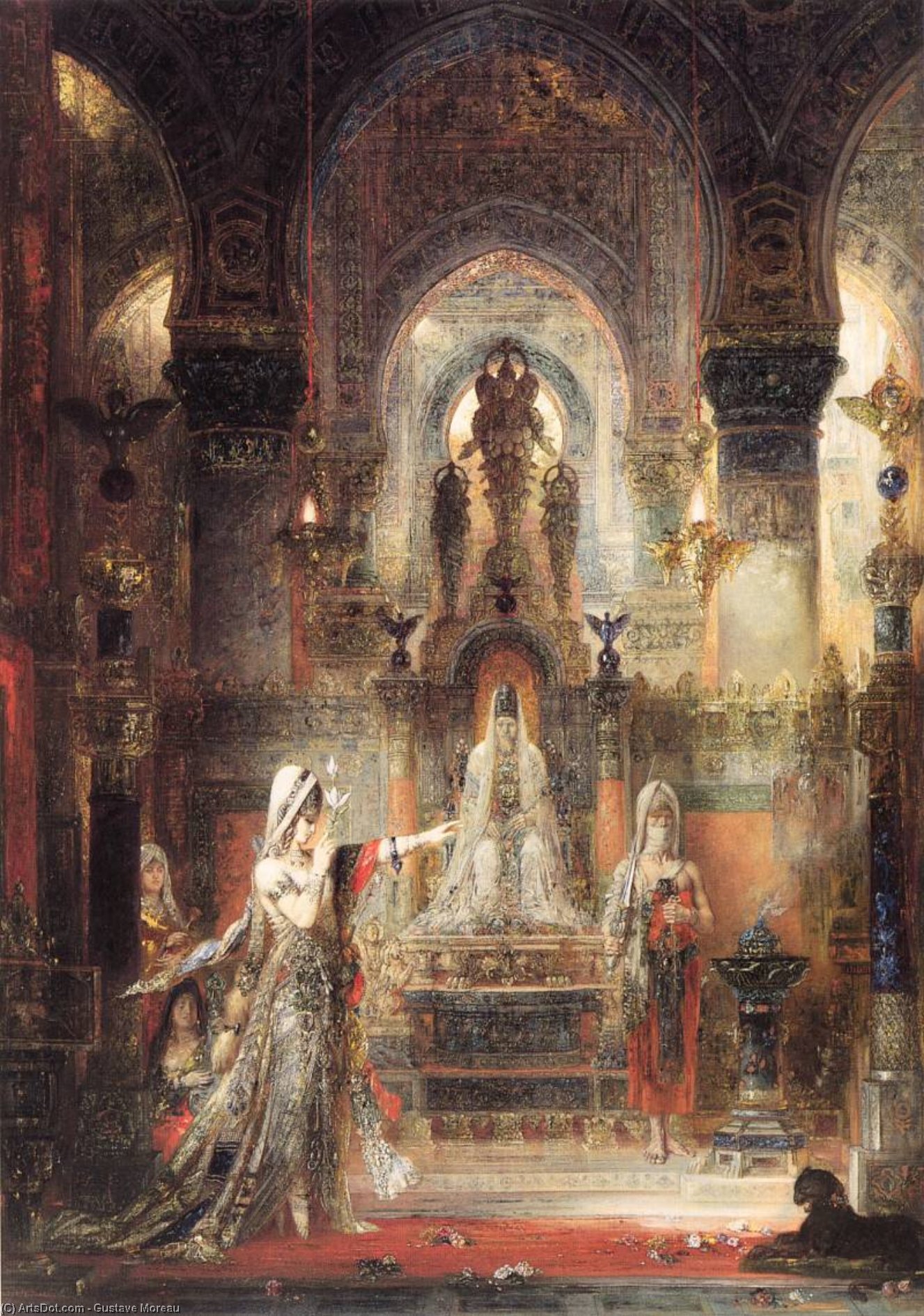
Many of Moreau's most recognized paintings emerged from his deep interest in the stories of antiquity and the Bible. In 1864, he exhibited Oedipus and the Sphinx, a work that helped establish his reputation. His fascination with the figure of Salome led to several different interpretations. One of his most famous works is Salome Dancing before Herod, which captures the tension of the biblical narrative through his unique, detailed approach. He also produced The Apparition between 1874 and 1876, a piece that highlights the strange, dreamlike atmosphere he often sought to create.

As his career progressed, his compositions grew in complexity. In 1885, he painted Voices of Evening, a watercolor that demonstrates his ability to use soft textures to convey a sense of spiritual quietude. Later in his life, in 1895, he completed Jupiter and Semele, a work that reflects the grand, mythological scale he favored. His canvases often felt less like windows into a real room and more like stages for the subconscious, where light and shadow worked together to suggest something beyond the physical world.

Circle, Pupils and Teaching

In his later years, Moreau moved from the quiet seclusion of his studio into the classroom. In 1893, he accepted a professorship at the École des Beaux-Arts, a position that allowed him to pass his ideas to a new generation of painters. He did not teach his students to merely mimic his hand or his specific way of applying paint. Instead, he encouraged them to look inward. He urged them to embrace their own imagination and to find their own unique modes of individual expression, pushing them to move beyond the rigid rules of the academy.

This emphasis on the internal life of the artist left a mark on many who sat in his lectures. Among those who studied under him was Henri Matisse, who would go on to reshape the landscape of modern art. Georges Rouault was another of his pupils, absorbing the lessons of symbolism and personal vision that Moreau championed. Through these students, his belief in the importance of the subconscious and the spiritual became a part of the broader evolution of French painting.

Legacy and Enduring Influence

By the 1890s, Moreau had become a central figure in the Symbolist movement. He did not seek the spotlight, yet his presence was felt deeply by those who followed him. His influence reached into the classrooms of the École des Beaux-Arts, where he encouraged his students to look inward and embrace their own imagination. This focus on individual expression helped pave the way for the modern art that would emerge in the decades following his death.

While his specific style was sometimes met with mixed reactions during his lifetime, his importance was recognized again in the latter half of the 20th century. This period saw a significant reevaluation of his work, as people looked past the surface to find the psychological depth he had spent his life exploring. He is now widely regarded as a precursor to modern art, a man who helped shift the focus of painting from the external world to the internal soul.

The Musée Gustave Moreau in Paris remains a place where his vision is preserved. The building itself, which he helped transform into a museum, keeps his memory alive in the very space where he lived and worked. It is a quiet place that holds the weight of his many years of study and creation.

Where to See the Works Today

To experience his art in the most intimate way, one can visit the Musée Gustave Moreau in Paris, France. This museum is housed in the very building that served as his home and studio. Walking through these spaces allows you to see the environment where he lived and worked, providing a direct connection to his daily life and creative process.

Beyond his personal residence, several major institutions hold his paintings. In Paris, the Louvre also maintains two of his works in its collection. For those traveling further, the Metropolitan Museum of Art in New York holds two more of his paintings, allowing his vision to reach audiences far beyond the streets of France.