Andrea Di Bartolo portretas

Andrea Di Bartolo tapiai: 28 garsiausi πίναšiai, galerijos akimis

Atnaujinta lapkritis 2026 · pagal mūsų populiarumumo koeficientą (paieškos, lankytojai ir užsakymai kiekvienam kūriniui) · 30 Andrea Di Bartolo darbai mūsų kataloge

Trumpai tariant

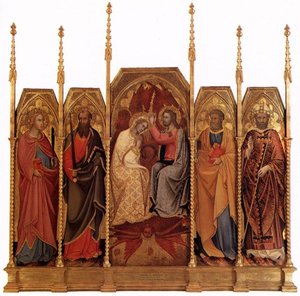
Galerijos akimais, garsiausias Andrea Di Bartolo tapas yra Coronation of the Virgin (1410), kurio originalas eksponuojamas Pinacoteca di Brera, Milanas. St. Jerome in the Wildrness (1515) ir The Presentation of the Virgin in the Temple (1400) užbaia trio, kurį atpažįsta kiekvienas ž)/\ Iš 30 Andrea Di Bartolo darbų mūsų kataloge, galerija žemiau pristato 28 garsiausius – kiekvienas yra originalus, su nurodytu metais, muziejumi bei unikaliu aprašymu.

1360 – 1428, Siena Sienese school Daugiausia darbų: National Gallery of Art

10 geriausių galerijos Andrea Di Bartolo paveikslų

1
Coronation of the Virgin (1410) aut. Andrea Di Bartolo

Coronation of the Virgin

1410 · Oil On Canvas · Pinacoteca di Brera, Milanas

To stand before this depiction of the Coronation of the Virgin is to be transported across the veil of time, into a realm where earthly grandeur meets divine glory. The scene unfolds with breathtaking solemnity and vibrant energy, capturing that singular moment when Mary, the Mother of God, is elevated to her heavenly throne. Andrea di Bartolo’s masterful hand guides our gaze through this sacred gathering, presenting not merely an…

2
St. Jerome in the Wildrness (1515) aut. Andrea Di Bartolo

St. Jerome in the Wildrness

1515 · Oil On Panel · The Bowes Museum, Barnard Castle

In the quiet, rugged expanse of a landscape that feels more European than Syrian, we encounter a moment of profound spiritual intensity. St. Jerome in the Wilderness is not merely a depiction of a saint; it is an immersive experience of penance and prayer. As the viewer’s eye meets the kneeling figure of St. Jerome, there is an immediate sense of the weight of devotion. The artist captures the saint…

3
The Presentation of the Virgin in the Temple (1400) aut. Andrea Di Bartolo

The Presentation of the Virgin in the Temple

1400 · Tempera On Panel · National Gallery of Art, Vašingtonas

The Presentation of the Virgin in the Temple by Andrea Di Bartolo captures a pivotal moment from the life of the Madonna. Created about 1400/1405, the work illustrates the young Virgin Mary taking leave of her parents, Anna and Joachim. This narrative is drawn from an apocryphal account attributed to the evangelist Matthew, rather than the canonical Gospels.

4
Madonna of Humility, The Blessing Christ, Two Angels, and a Donor [obverse] (1380) aut. Andrea Di Bartolo

Madonna of Humility, The Blessing Christ, Two Angels, and a Donor [obverse]

1380 · Tempera On Panel · National Gallery of Art, Vašingtonas

The late 14th-century Sienese School finds a profound expression in this tempera and gold leaf panel. Seated upon a patterned cushion, the Virgin Mary nurtures the infant Christ, a composition that emphasizes maternal intimacy within a rigid, hierarchical structure. The gold ground provides a non-naturalistic, divine backdrop, reflecting an omnipresent light that transcends earthly space. This portable altarpiece, dated to approximately 1380, utilizes a vertical arrangement to guide the viewer…

5
Christ on the Cross [reverse] (1380) aut. Andrea Di Bartolo

Christ on the Cross [reverse]

1380 · Tempera On Panel · National Gallery of Art, Vašingtonas

The viewer encounters Christ on the Cross [reverse], a work by Andrea Di Bartolo that dates to about 1380/1390. This panel functions as a simplified version of a portable diptych, a small and intimate object designed for private contemplation. While the obverse of such an icon typically presents a Madonna and Child, this specific side focuses entirely on the central figure of the Crucifixion. It is a quiet, solitary scene…

6
The Crucifixion (1400) aut. Andrea Di Bartolo

The Crucifixion

1400 · Tempera On Panel · Metropolitano meno muziejus, Niujorkas

In this panoramic composition, we find ourselves witnessing a profound moment of religious tragedy. The scene is crowded, filled with a dense assembly of mourners and soldiers that presses against the foreground, creating a sense of immediate, heavy presence. At the center, the figure of Christ is suspended on the cross, flanked by two thieves, while angels hover within the sky above. The composition is characteristic of the Sienese Gothic…

7
The Assumption of the Virgin with St. Thomas and Two Donors (Ser Palamedes and his Son Matthew) (1390) aut. Andrea Di Bartolo

The Assumption of the Virgin with St. Thomas and Two Donors (Ser Palamedes and his Son Matthew)

1390 · Tempera On Panel · Virginia Museum of Fine Arts, Ričmondas

The composition ascends vertically, guiding the eye from the earthly realm toward a divine summit. At the center of this spiritual movement, the Virgin Mary rises through layers of angelic figures, her presence framed by a background of gold leaf that eliminates earthly shadows. This Sienese Gothic approach creates a flattened, sacred space where light is even and pervasive. The figures are defined by rhythmic, organic shapes and the precise,…

8
Den hellige Blasius (1395) aut. Andrea Di Bartolo

Den hellige Blasius

1395 · Tempera On Panel · National Museum of Art, Architecture and Design, Oslo

The gaze meets Den hellige Blasius, a painting that holds a steady, sacred presence. This work by Andrea Di Bartolo brings a singular figure into view, presenting a religious scene or person through the lens of late medieval devotion. The subject, Saint Blasius, emerges from a background of gold, appearing as a quiet pillar of faith. Every line of the figure seems to carry the weight of a prayer, frozen…

9
The Crucifixion (1390) aut. Andrea Di Bartolo

The Crucifixion

1390 · Tempera On Panel · Nacionalinis muziejus Varšuvoje, Varšuva

The Crucifixion by Andrea Di Bartolo emerges from the shadows of the late fourteenth century, a solemn vision captured around 1400. This work places the viewer directly before the central event of Christian history, presenting the Crucifixion of Jesus Christ with a profound sense of spiritual weight. Every line and color choice works to anchor this sacred moment in a space that feels both otherworldly and deeply felt.

10
Saint Stephen (panel from the right pilaster of an altarpiece) (1397) aut. Andrea Di Bartolo

Saint Stephen (panel from the right pilaster of an altarpiece)

1397 · Tempera On Panel · Victoria and Albert Museum, Londonas

Saint Stephen (panel from the right pilaster of an altarpiece) is a work by Andrea Di Bartolo. This fragmentary panel originated as part of a series of superimposed figures from the right pilaster of an unidentified Italian altarpiece. The wood panel captures the first Christian martyr, Saint Stephen, in a moment of quiet, heavy presence. He is depicted with the symbols of his devotion and his end: a book held…

Andrea Di Bartolo tapiai, rangos nuo 11 iki 28

Temos, kurios domino Andrea Di Bartolo

Ketverios temos, dažniausiai pasikrausto originaluose, kiekvienos su savo puikiausiu pavyzdžiu.

Muziejai, kuriuose saugomi Andrea Di Bartolo originalūs darbai

8 muziejai, kuriuose saugoma daugiausia šioje pusėje esamų paveikslų.

Muzejaus Miestas Andrea Di Bartolo darbai Šiojo sąrašo paveikslai
National Gallery of Art, VašingtonasNational Gallery of Art Vašingtonas 5 The Presentation of the Virgin in the Temple, Madonna of Humility, The Blessing Christ, Two Angels, and a Donor [obverse], Christ on the Cross [reverse]
Musée du Petit Palais, AvinjonasMusée du Petit Palais Avinjonas 3 Saint Bishop, Saint Anthony Abbot, Saint Costanzo
Detroito meno institutas, DetroitasDetroito meno institutas Detroitas 2 Christ in Benediction, Madonna and Child
Pinacoteca di Brera, MilanasPinacoteca di Brera Milanas 1 Coronation of the Virgin
The Bowes Museum, Barnard CastleThe Bowes Museum Barnard Castle 1 St. Jerome in the Wildrness
Metropolitano meno muziejus, NiujorkasMetropolitano meno muziejus Niujorkas 1 The Crucifixion
Virginia Museum of Fine Arts, RičmondasVirginia Museum of Fine Arts Ričmondas 1 The Assumption of the Virgin with St. Thomas and Two Donors (Ser Palamedes and his Son Matthew)
National Museum of Art, Architecture and Design, OsloNational Museum of Art, Architecture and Design Oslo 1 Den hellige Blasius

Andrea Di Bartolo, po vieno ikoninio paveikslio kiekvienam dešimtmenės laikotarpiui

Darbai pagal dešimtmečius

Pasirinkite dešimtmetį, kad pamatytėte jį apibrėžusį originalą.

Andrea Di Bartolo tapyiniai: galerijos atsakymai

Kuris Andrea Di Bartolo paveikslas yra pats garsiausias iš visų?Atsakymas

Coronation of the Virgin (1410), Pinacoteca di Brera, Milanas. Toliau seka St. Jerome in the Wildrness (1515) ir The Presentation of the Virgin in the Temple (1400).

Kiek metų buvo Andrea Di Bartolo, kai sukūrė Coronation of the Virgin?Atsakymas

50 metų amžiaus: Coronation of the Virgin sukurta 1410 m. Nr. Andrea Di Bartolo gimė 1360.

Kuriose yra 10 geriausių Andrea Di Bartolo paveikslų?Atsakymas

Coronation of the Virgin, St. Jerome in the Wildrness, The Presentation of the Virgin in the Temple, Madonna of Humility, The Blessing Christ, Two Angels, and a Donor [obverse], Christ on the Cross [reverse], The Crucifixion, The Assumption of the Virgin with St. Thomas and Two Donors (Ser Palamedes and his Son Matthew), Den hellige Blasius, The Crucifixion ir Saint Stephen (panel from the right pilaster of an altarpiece). Viršuje esančioje reitingo sąraše nurodyta kiekvieno kūrinio metis ir muziejus.

Kiek kūrinių sukūrė Andrea Di Bartolo?Atsakymas

Mūsų kataloge yra 30 Andrea Di Bartolo darbų, skirtų laikotarpiui nuo 1380 iki 1424.

Kur kabinami garsiausi Andrea Di Bartolo originalūs darbai?Atsakymas

Daugiausia – National Gallery of Art (Vašingtonas), Musée du Petit Palais (Avinjonas) ir Detroito meno institutas (Detroitas). Viršuje esančiame muziejų sąraše yra visi jie.

Kada Andrea Di Bartolo sukūrė savo garsiausias paveikslus?Atsakymas

1400s laikotarpiu: 8 iš 28 šioje pusėje esančių darbų buvo sukurtos tada, iš jų The Presentation of the Virgin in the Temple.

Kokie yra ankstyviausi ir vėliausi garsieji Andrea Di Bartolo kūriniai?Atsakymas

Šioje pusėje seniausias darbas yra Madonna of Humility, The Blessing Christ, Two Angels, and a Donor [obverse] (1380), o naujausias – Madonna and Child (1424).

Kurią temą Andrea Di Bartolo kūrė dažniausiai?Atsakymas

Gold background (14), Woman (7) ir Child (6) iš 28 šioje pusėje esamų darbų.

Kurią techniką Andrea Di Bartolo naudojo dažniausiai?Atsakymas

Tempera On Panel, iš 28 šios puslapio darbų – 19.

Su kokiu kierliu siejama Andrea Di Bartolo?Atsakymas

Sienese school, vadovaujantis šios puslapio originalais kūriniais.

Kurių Andrea Di Bartolo originalų turi National Gallery of Art?Atsakymas

The Presentation of the Virgin in the Temple, Madonna of Humility, The Blessing Christ, Two Angels, and a Donor [obverse] ir Christ on the Cross [reverse]: National Gallery of Art, Vašingtonas kolekcijoje yra 5 šioje pusėje esančių darbų.

Andrea Di Bartolo: menininkas

Sienos atsidavimo palikimas

Gyvybingaiame Sienos mokyklos šerelyje Andrea Di Bartolo iškilo kaip meistras, kurio brushas perteikė gilią savo laikotarpio dvasinę intensyvumą. Kaip žinomo tapo Bartolo di Fredi sūnus ir mokinys, Andrea Di Bartolo kūrybinis kelias buvo glaudžiai įsiukurtas tėvo dirbtuvės tradicijomis. Prarandamos pirmosios jaunystės metų valandos skirtos prestižingiems užsakymams, kurie sklendė per šeimos studiją – tai buvo mokymosi laikotarpis, laidavęs pagrindus karjerai, apibūdinamai dvasine atsidavimu ir techniniu meistrišku.

Dirbdamas kartu su tokiais šviesos šalių luminarais kaip Luca di Tommè, jis prisidėjo prie svarbių bendruomeniškų darbų, įskaitant altarijos skliaidrą sienečių gildui Sienos katedroje, taip pažymėdamas savo pirmąjį užfiksuotą presence meno istorijos metraptslapiuose.

Andrea Di Bartolo meniškumas neapsiribojama vien tik paveiksluostėmis; jis buvo universalus kūrėjas, tarnavęs kaip tapininkas, vitražų dizaineris ir rankraščių iliustruotojas. Jo darbai dažnai užpildė atėmą tarp eteriškos gotikos tradicijos elegancijos ir besivystančio humanizmo, kuris galiausiai apibrėžė Renesansą. Religiniuose temuose galima atrasti kruopštų dėsių į detales ir gebėjimą kurti naratyvinę galybę. Ar tai būtų rami Šv. Jeronimo vienatvė dybare, ar dramatiška Prikryžieniaus įtampa, Andrea turėjo gebėjimą tvirtinanti savo kompozicijas per galingas struktūras, kurios veda žiūrovą į kontemplacijos būseną.

Šviesos ir naratyvo meistriškumas

Andrea Di Bartolo techninis meistriškumas labiausiai pasireiškia jo gebėjimą manipuliuoti šviesa ir tekstūra, siekiant sukeliamų emocijų. Jo darbus dažnai žymi luministinė kokybė, kur šešėlių ir šviesos žaismas atspindi vidinę savo pavožinių dvasinę kovą. Šventųjų figūrų vaizduose jaučiamas tankus svoris ir buvimo pojūtis; sunkios, ritmiškos kardinalų rūbų raidės ar delicate translucencija skliaidros yra atvaizduojamos tokia tikslybe, kad dieviškumas tampa lytiniu, tangliaus pojūčiu. Šis meistriškumas leido jam kurti darbus, kurie tarnavo kaip tylūs pamokai, pilni simbolinės kalbos, skirsčios įkvėpti tikrąjį tikėtojų pietybę.

Be asmeninio talento, Andrea Di Bartolo istorinė reikšmė slypi jo vaidmenėje besivelsekančiame Vidurinės ir Šiaurės Italijos krašte. Veikdamas XIV amžiaus pabaigoje ir XV amžiaus pradžioje, jis padėjo išlaikyti Sienos mokyklos prestižą per didelius transformacijos laikotarpius. Jo indėlis į altarijos skliaidras, vitražus ir iliustruotus rankraščius užtikrino, kad jo meninė vizija persisvaikytų per įvairius religinio gyvenimo aspektus Sienoje ir jos aplinkiniuose miestuose. Per savo atsidavimą tiek dekoratyviam savo amato sudėtingumui, tiek solemniai savo temų grožiui, Andrea Di Bartolo paliko neištrinčiam pėdsną Italijos vizualioji paveldos istorijoje.