


1


Atnaujinta spalis 2026 · pagal mūsų populiarumumo koeficientą (paieškos, lankytojai ir užsakymai kiekvienam kūriniui) · 36 Alan Davie darbai mūsų kataloge
Trumpai tariant
Galerijos akimais, garsiausias Alan Davie paveikslas yra Woman Arranging Flowers (1945). Untitled Abstract ir Self Portrait with Brushes (1937) užbaia trio, kurį atpažįsta kiekvienas ž)/\ Iš 36 Alan Davie darbų mūsų kataloge, galerija žemiau pristato 36 garsiausius – kiekvienas yra originalus, su nurodytu metais, muziejumi bei unikaliu aprašymu.


 Joe's Magic Lantern1961
12
 Joe's Lucky Dip1961
13
 Keep Your Fingers Crossed1961
14
 Hopi Studies No.32, Opus 0.11731991 · University of Hertfordshire
15
 Hopi Studies No.30 (Big Blue) (Opus O.1171)1991
16
 Homage to an Earth Goddess No.61992
17
 Symbols in a Landscape1994 · The Pier Arts Centre
18
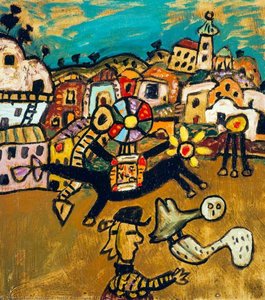 Village Witch (Opus O.1263)1994
19
 Magic Casket1997 · Scottish National Gallery of Modern Art
20
 Celtic Landscape (Dreamscape)1996 · The Pier Arts Centre
21
 Magic Landscape (Opus O.1337)1996
22
 The Alchemist's Mirror No.1 (Opus 1357)1997
23
 Cosmic Signals I2000
24
 Cosmic Signals No.72000
25
 The Golden Palace1999
26
 Magician's Mirror No.22000 · The Mercer Art Gallery
27
 Serpent's Idea of a Horse2000
28
 The Magician's Mirror No.3 (Opus 1450)2000
29
 Without Devices2004 · Pembroke College Oxford Jcr Art Collection
30
 Around and Around in the PinkKanados Nacionalinė galerija
31
 Kaleidoscope for a Parrot
32
 Prize for a Serpent
33
 Flowers on a TableThe Fleming Collection
34Prophet in a Tree, 1963Fitzwilliam College
35
 Double MonumentRobinson College
36
 Hallucination with Monster and Cock
8 muziejai, kuriuose saugoma daugiausia šioje pusėje esamų paveikslų.
| Muzejaus | Miestas | Alan Davie darbai | Šiojo sąrašo paveikslai |
|---|---|---|---|
 The Pier Arts Centre |
Stromness | 2 | Symbols in a Landscape, Celtic Landscape (Dreamscape) |
 University of Hertfordshire |
North Hatley | 1 | Hopi Studies No.32, Opus 0.1173 |
 Scottish National Gallery of Modern Art |
Edinburgas | 1 | Magic Casket |
 The Mercer Art Gallery |
Harrogate | 1 | Magician's Mirror No.2 |
 Pembroke College Oxford Jcr Art Collection |
Oxford | 1 | Without Devices |
 Kanados Nacionalinė galerija |
Otava | 1 | Around and Around in the Pink |
 The Fleming Collection |
London | 1 | Flowers on a Table |
 Fitzwilliam College |
Cambridge | 1 | Prophet in a Tree, 1963 |
Pasirinkite dešimtmetį, kad pamatytėte jį apibrėžusį originalą.
Woman Arranging Flowers (1945). Toliausiai eina Untitled Abstract ir Self Portrait with Brushes (1937).
25 metų amžiaus: Woman Arranging Flowers sukurta 1945 m. Nr. Alan Davie gimė 1920.
Woman Arranging Flowers, Untitled Abstract, Self Portrait with Brushes, The Saint, Entrance to a Paradise, Jingling Space, Ram Grip, Piggy Chain, Joy Bag No. 1 ir Entrance For A Red Temple No. 4. Viršuje esančioje reitingo sąraše nurodyta kiekvieno kūrinio metis ir muziejus.
Mūsų kataloge yra 36 Alan Davie darbų, skirtų laikotarpiui nuo 1937 iki 2004.
Daugiausia – The Pier Arts Centre (Stromness), University of Hertfordshire (North Hatley) ir Scottish National Gallery of Modern Art (Edinburgas). Viršuje esančiame muziejų sąraše yra visi jie.
1990s laikotarpiu: 10 iš 36 šioje pusėje esančių darbų buvo sukurtos tada, iš jų Hopi Studies No.32, Opus 0.1173.
Šioje pusėje seniausias darbas yra Self Portrait with Brushes (1937), o naujausias – Without Devices (2004).
Abstract expressionism, judging by the originals on this page.
Symbols in a Landscape ir Celtic Landscape (Dreamscape): The Pier Arts Centre, Stromness kolekcijoje yra 2 šioje pusėje esančių darbų.

