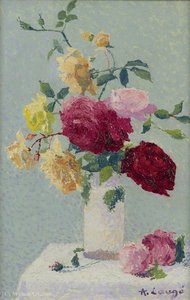
Achille Laugé portretas

57 garsiausių Achille Laugé paveikių rinkinys: galerijos išboru

Atnaujinta lapkritis 2026 · pagal mūsų populiarumumo koeficientą (paieškos, lankytojai ir užsakymai kiekvienam kūriniui) · 59 Achille Laugé darbai mūsų kataloge

Trumpai tariant

Iš visų originalų, kuriuos paliko Achille Laugé, garsiausias yra Les meules. Tiesiog už jų seka Almond Trees in Blossom near Cailhau, Aude (1934) ir The Road of Cailhau (1909). Mūsų kataloge yra 59 darbų autoriaus Achille Laugé; galerija išsaugojo 57 labiausiai pasaulyje žyminiausių kūrinių – kiekvienas jų pateikiamas su datos, muziejaus ir istorijos aprašymu.

1861 – 1944, Arzens Impressionism Daugiausia darbų: Musée des Beaux-Arts

Achille Laugé geriausios 10 paveikslų: galerijos pasirinkimas

1
Les meules aut. Achille Laugé

Les meules

Oil On Canvas

The scene depicts a sunlit field where several hay bales are scattered across the terrain. In the background, a hill rises against the horizon, suggesting a clear, bright day. Figures are positioned throughout the landscape, engaged in the manual task of tending to the hay. Some individuals appear in the foreground, while others are smaller in the distance, creating a sense of depth within the rural setting. The light falls…

3
The Road of Cailhau (1909) aut. Achille Laugé

The Road of Cailhau

1909 · Oil On Canvas

The air feels crisp as the eye follows the empty path winding through the landscape. It is 1909, and the world of Cailhau is caught in a moment of seasonal transition. Trees line the road, their branches heavy with leaves that have turned to deep reds, signaling the arrival of autumn. A solitary house sits nestled near the center of the scene, providing a sense of place and human presence…

4
Portrait de Madame Astre (1892) aut. Achille Laugé

Portrait de Madame Astre

1892 · Oil On Canvas · Musée des Beaux-Arts, Karkasonas

In this 1892 portrait, we encounter Madame Astre in a moment of profound stillness. She is presented in a full-length composition, her figure occupying the center of the frame with a poised, upright grace. The silhouette is defined by the structured tailoring of a high-collared, long-sleeved gown, a garment that speaks to a certain social standing and a preference for formal elegance. There is a quietude here that feels almost…

5
Portrait of a Woman (1896) aut. Achille Laugé

Portrait of a Woman

1896 · Oil On Canvas · Musée des Beaux-Arts, Karkasonas

A woman sits in profile, her gaze fixed on something just beyond the right edge of the frame. She is caught in a moment of stillness, her dark hair pulled back into a neat bun that reveals the soft curve of her neck and ear. The light, arriving from the front-left, brushes against her skin in a gentle wash, casting subtle shadows that define the contours of her face. There…

6
Portrait of Albert Sarraut (1898) aut. Achille Laugé

Portrait of Albert Sarraut

1898 · Oil · Musée des Beaux-Arts, Karkasonas

Portrait of Albert Sarraut by Achille Laugé presents a profile portrait of a man in a close-up bust view. The subject is positioned slightly off-center and faces toward the left of the frame. This composition focuses the viewer's attention on the contours of the face and the structure of the head. The depth of the piece is shallow, which keeps the focus strictly on the figure without any environmental distractions.

7
Portrait of a Woman (1900) aut. Achille Laugé

Portrait of a Woman

1900 · Oil On Canvas · Musée des Beaux-Arts, Karkasonas

In this 1896 oil on canvas, we encounter a young woman captured in a moment of profound stillness. She is positioned in a bust-length view, her body turned slightly toward the right while her gaze remains fixed forward, meeting the viewer with a serene, steady composure. The composition is classical, favoring a sense of dignity over dramatic movement. A dark garment provides a heavy, grounding contrast to the delicate white…

Achille Laugé darba rinkinys tęsiamas, nuo 11 iki 57

11Alrededores cailhau aut. Achille LaugéAlrededores cailhau 12The Atellier at Alet-les-Bains aut. Achille LaugéThe Atellier at Alet-les-Bains 13La route (The Road) (1893) aut. Achille LaugéLa route (The Road)1893 · Houston meno muziejus 14The willow alley (1896) aut. Achille LaugéThe willow alley1896 · Musée des Beaux-Arts 15Away with Broom (1900) aut. Achille LaugéAway with Broom1900 · Wallraf-Richartz-Museum 16Vase with Roses (1909) aut. Achille LaugéVase with Roses1909 · Wallraf-Richartz-Museum 17Route de Cailhavel, Almond Trees in Bloom (1911) aut. Achille LaugéRoute de Cailhavel, Almond Trees in Bloom1911 · musée Petiet de Limoux 18Cailhau (1909) aut. Achille LaugéCailhau1909 · Musée des Beaux-Arts 19Le relais (1909) aut. Achille LaugéLe relais1909 · Musée des Beaux-Arts 20Fleurs et poires (1909) aut. Achille LaugéFleurs et poires1909 · Musée des Beaux-Arts 21Fleurs et fruits 1910 - Achille Laugé (1910) aut. Achille LaugéFleurs et fruits 1910 - Achille Laugé1910 · Musée des Beaux-Arts 22The road to Cailhau (1910) aut. Achille LaugéThe road to Cailhau1910 · Musée des Beaux-Arts 23Le moulin de Gatimel (1932) aut. Achille LaugéLe moulin de Gatimel1932 · musée Petiet de Limoux 24Fruits aut. Achille LaugéFruitsmusée Petiet de Limoux 25Notre-Dame de Paris aut. Achille LaugéNotre-Dame de Parismusée Petiet de Limoux 26The Garonne In Toulouse aut. Achille LaugéThe Garonne In Toulouse 27Flowers, (1938) aut. Achille LaugéFlowers, (1938) 28Collioure, (1927) aut. Achille LaugéCollioure, (1927) 29The port aut. Achille LaugéThe port 30Almond Trees Blooming near Cailhau aut. Achille LaugéAlmond Trees Blooming near Cailhau 31Bouquet of Flowers, (1907) aut. Achille LaugéBouquet of Flowers, (1907) 32Vase of Roses aut. Achille LaugéVase of Roses 33Amendiers en Fleurs aut. Achille LaugéAmendiers en Fleursmusée Petiet de Limoux 34Vase with Roses, (1919) aut. Achille LaugéVase with Roses, (1919) 35View of Ginoles-les-Bains, (1936) aut. Achille LaugéView of Ginoles-les-Bains, (1936) 36The artist`s orchard aut. Achille LaugéThe artist`s orchard 37Bouquet of Roses in the Glass aut. Achille LaugéBouquet of Roses in the Glass 38On the Bank of the Lake aut. Achille LaugéOn the Bank of the Lake 39Vase of Roses, (1924) aut. Achille LaugéVase of Roses, (1924) 40Au Bord du Lac aut. Achille LaugéAu Bord du Lac 41Bouquet of Roses, (1918) aut. Achille LaugéBouquet of Roses, (1918) 42View of the Port of Collioure from the Point of Saint-Vincent (diptych), (1928) aut. Achille LaugéView of the Port of Collioure from the Point of Saint-Vincent (diptych), (1928) 43The Road Boarding by Almond-Trees in Bloom, (1934) aut. Achille LaugéThe Road Boarding by Almond-Trees in Bloom, (1934) 44Vase with Flowers aut. Achille LaugéVase with Flowers 45The Road Entering to Cailhau, (1922) aut. Achille LaugéThe Road Entering to Cailhau, (1922) 46The Road from Limoux to Alete-Les-Bains aut. Achille LaugéThe Road from Limoux to Alete-Les-Bains 47Vase with Roses, (1921) aut. Achille LaugéVase with Roses, (1921) 48The Road in the Outskirts of Cailhau, (1921) aut. Achille LaugéThe Road in the Outskirts of Cailhau, (1921) 49Road in Champagne, (1898) aut. Achille LaugéRoad in Champagne, (1898) 50The Road near Cailhau aut. Achille LaugéThe Road near Cailhau 51The Road with Almond Trees in Autumn, (1921) aut. Achille LaugéThe Road with Almond Trees in Autumn, (1921) 52Bouquet of Roses, (1922) aut. Achille LaugéBouquet of Roses, (1922) 53The Road near Genets aut. Achille LaugéThe Road near Genets 54Bouquet of Roses, (1905) aut. Achille LaugéBouquet of Roses, (1905) 55Etude de Chrysanthemes aut. Achille LaugéEtude de Chrysanthemes 56Study of Chrysanthemums aut. Achille LaugéStudy of Chrysanthemums 57The Road of Belveze near Revesible Station, (1918) aut. Achille LaugéThe Road of Belveze near Revesible Station, (1918)

Temos, kurios domino Achille Laugé

Ketverios temos, dažniausiai pasikrausto originaluose, kiekvienos su savo puikiausiu pavyzdžiu.

Muziejai, kuriuose saugomi Achille Laugé originalūs darbai

4 muziejai, kuriuose saugoma daugiausia šioje pusėje esamų paveikslų.

Muzejaus Miestas Achille Laugé darbai Šiojo sąrašo paveikslai
Musée des Beaux-Arts, KarkasonasMusée des Beaux-Arts Karkasonas 10 Portrait de Madame Astre, Portrait of a Woman, Portrait of Albert Sarraut
musée Petiet de Limoux, Limouxmusée Petiet de Limoux Limoux 5 Route de Cailhavel, Almond Trees in Bloom, Le moulin de Gatimel, Fruits
Wallraf-Richartz-Museum, KelnasWallraf-Richartz-Museum Kelnas 2 Away with Broom, Vase with Roses
Houston meno muziejus, HjustonasHouston meno muziejus Hjustonas 1 La route (The Road)

Achille Laugé dešimtmetėms po dešimtmetės: originalus kūrinys, apibūdinantis kiekvieną iš jų

Darbai pagal dešimtmečius

Pasirinkite dešimtmetį, kad pamatytėte jį apibrėžusį originalą.

Kolekcjonerų klausimai apie Achille Laugé paveikslus

Kuriu darbu Achille Laugé yra labiausiai garsus?Atsakymas

Les meules. Toliausiai eina Almond Trees in Blossom near Cailhau, Aude (1934) ir The Road of Cailhau (1909).

Kokie yra 10 garsiausių Achille Laugé paveikslų?Atsakymas

Les meules, Almond Trees in Blossom near Cailhau, Aude, The Road of Cailhau, Portrait de Madame Astre, Portrait of a Woman, Portrait of Albert Sarraut, Portrait of a Woman, La Route au Lieu-Dit l`Hort, Montpellier, View of the Port of Collioure from the Point of Saint-Vincent, (1928) ir A Road in Champagne near Cailhau, (1908). Viršuje esančioje reitingo sąraše nurodyta kiekvieno kūrinio metis ir muziejus.

Kiek paveikslų paliko Achille Laugé?Atsakymas

Mūsų kataloge yra 59 Achille Laugé darbų, skirtų laikotarpiui nuo 1892 iki 1934.

Kuriuose muziejuose eksponuojami Achille Laugé šedevrai?Atsakymas

Daugiausia – Musée des Beaux-Arts (Karkasonas), musée Petiet de Limoux (Limoux) ir Wallraf-Richartz-Museum (Kelnas). Viršuje esančiame muziejų sąraše yra visi jie.

Kuriomis metais Achille Laugé tapo savo garsiausius kūrinius?Atsakymas

1900s laikotarpiu: 7 iš 57 šioje pusėje esančių darbų buvo sukurtos tada, iš jų The Road of Cailhau.

Kokie yra pirmasis ir paskutinis garsieji Achille Laugé originalūs darbai?Atsakymas

Šioje pusėje seniausias darbas yra Portrait de Madame Astre (1892), o naujausias – Almond Trees in Blossom near Cailhau, Aude (1934).

Kurią temą Achille Laugé rinkosi dažniausiai?Atsakymas

Flowers (10), Roads (8) ir Vase (5) iš 57 šioje pusėje esamų darbų.

Kurią techniką Achille Laugé naudojo dažniausiai?Atsakymas

Oil On Canvas, iš 57 šios puslapio darbų – 7.

Kelią meno kryptį priklauso Achille Laugé?Atsakymas

Impressionism, vadovaujantis šios puslapio originalais kūriniais.

Kurių Achille Laugé darbai eksponuojami Musée des Beaux-Arts?Atsakymas

Portrait de Madame Astre, Portrait of a Woman ir Portrait of Albert Sarraut: Musée des Beaux-Arts, Karkasonas kolekcijoje yra 10 šioje pusėje esančių darbų.

Achille Laugé: gyvenimas ir kūryba

A Painter of Provençal Light: The Life and Art of Achille Lauge

Achille Lauge, born in 1861, was a French artist deeply connected to the landscapes of Provence. While not as widely celebrated as some of his Impressionist contemporaries, Lauge carved out a distinctive niche for himself with his sensitive depictions of the southern French countryside, particularly renowned for his almond blossom scenes and evocative rural vistas. His life, though relatively undocumented in grand biographical detail, was one dedicated to capturing the fleeting beauty of nature and the quiet rhythms of provincial life. He spent much of his career painting *en plein air*, immersing himself in the very environments he sought to portray on canvas. This dedication resulted in a body of work that offers a poignant glimpse into a specific time and place – a Provence largely untouched by the rapid industrialization sweeping across Europe during his lifetime. Lauge’s paintings are not merely representations of scenery; they are imbued with an emotional resonance, a sense of peace and tranquility that speaks to a deep appreciation for the natural world. He passed away in 1944, leaving behind a legacy of works that continue to charm and inspire those who seek solace in the beauty of the French landscape.

Early Influences and Artistic Development

The artistic influences on Achille Lauge are somewhat difficult to pinpoint with absolute certainty, as detailed records from his formative years remain scarce. However, it’s clear that he was deeply affected by the prevailing artistic currents of late 19th-century France. The Barbizon school, with its emphasis on direct observation and realistic depictions of nature, undoubtedly played a role in shaping his early style. Artists like Camille Corot and Jean-François Millet, who focused on rural life and landscapes, likely served as inspiration for Lauge’s subject matter and approach to painting. The burgeoning Impressionist movement also left its mark, though Lauge never fully embraced the radical techniques of Monet or Renoir. Instead, he developed a more restrained and lyrical style, characterized by soft brushwork, subtle color palettes, and a focus on atmospheric effects. His early works often feature darker tones and a greater emphasis on detail, gradually evolving towards the brighter, more luminous paintings that would become his signature style. He wasn’t interested in capturing the *moment* as much as he was in conveying the *feeling* of a place – the warmth of the sun, the scent of blossoms, the stillness of the countryside.

Themes and Motifs: Provence as Muse

Provence became not just Lauge’s home but his enduring muse. His paintings are overwhelmingly focused on the landscapes, villages, and rural scenes of this region in southern France. He was particularly drawn to the almond blossoms that blanketed the countryside each spring, transforming orchards into seas of white and pink. These blossoms appear repeatedly throughout his oeuvre, becoming a symbol of renewal, hope, and the ephemeral beauty of nature. Beyond the almond blossoms, Lauge frequently depicted winding roads leading through sun-drenched fields, rustic farmhouses nestled amongst rolling hills, and picturesque villages bathed in golden light. These are not grand, dramatic landscapes, but rather intimate glimpses into everyday life – a farmer tending his fields, children playing by the roadside, a cart laden with produce making its way to market. He also painted scenes of coastal Provence, capturing the rugged beauty of the Mediterranean coastline and the vibrant colors of the sea. His work offers a valuable record of rural life in Provence during a period of significant change, preserving a sense of authenticity and tranquility that is often missing from more ambitious or overtly stylized depictions of the region.

Technique and Style: A Lyrical Approach to Landscape

Achille Lauge’s technique was characterized by a delicate touch and a subtle use of color. He typically worked in oil on canvas, employing soft brushwork to create a sense of atmosphere and luminosity. Unlike the broken brushstrokes favored by many Impressionists, Lauge preferred to blend his colors more smoothly, creating a softer, more diffused effect. His palette was generally restrained, dominated by warm earth tones, muted greens, and delicate shades of pink and blue. He masterfully captured the quality of light in Provence, conveying the warmth of the sun and the subtle variations in color throughout the day. He wasn’t interested in precise detail or photographic realism; instead, he sought to capture the *essence* of a scene – its mood, its atmosphere, its emotional resonance. His paintings often have a slightly hazy quality, as if viewed through a dreamlike filter. This lyrical approach to landscape sets him apart from his contemporaries and contributes to the unique charm and appeal of his work.
  • Emphasis on *plein air* painting.
  • Soft brushwork and blended colors.
  • Restrained palette with warm earth tones.
  • Focus on atmospheric effects and light.

Historical Significance and Legacy

While Achille Lauge may not be a household name, his work holds significant historical value as a document of rural life in Provence during the late 19th and early 20th centuries. His paintings offer a glimpse into a way of life that was rapidly disappearing – a world of small farms, traditional villages, and close-knit communities. He provides an important counterpoint to more industrialized or urbanized depictions of France during this period. Today, his work is appreciated for its quiet beauty, its emotional resonance, and its sensitive portrayal of the natural world. His paintings are held in private collections around the world and continue to be exhibited in galleries and museums. Although he didn’t actively seek fame or recognition, Achille Lauge left behind a lasting legacy as a painter who captured the soul of Provence with grace, skill, and unwavering dedication. His art serves as a reminder of the enduring power of nature and the importance of preserving the beauty of our surroundings for future generations.