Theodoros Stamos portretas

Theodoros Stamos tapiai: 24 garsiausi πίναšiai, galerijos akimis

Atnaujinta lapkritis 2026 · pagal mūsų populiarumumo koeficientą (paieškos, lankytojai ir užsakymai kiekvienam kūriniui) · 32 Theodoros Stamos darbai mūsų kataloge

Trumpai tariant

Galerijos akimais, garsiausias Theodoros Stamos tapas yra Greek Myth (1947), kurio originalas eksponuojamas Izraelio muziejus, Jeruzalė. Lupine (1953) ir Gamboge Swamp (1956) užbaia trio, kurį atpažįsta kiekvienas ž)/\ Iš 32 Theodoros Stamos darbų mūsų kataloge, galerija žemiau pristato 24 garsiausius – kiekvienas yra originalus, su nurodytu metais, muziejumi bei unikaliu aprašymu.

1922 – 1997, Niujorkas Abstract expressionism Daugiausia darbų: The Phillips Collection

10 geriausių galerijos Theodoros Stamos paveikslų

3
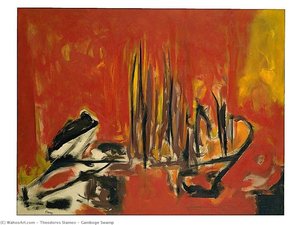
Gamboge Swamp (1956) aut. Theodoros Stamos

Gamboge Swamp

1956

The painting Gamboge Swamp by Theodoros Stamos is a masterpiece that showcases the artist's unique style and contribution to the Abstract Expressionism movement. Created in 1956, this oil on canvas piece measures 96 x 122 cm and is a testament to Stamos' skillful use of color and composition. Artist Background Theodoros Stamos was a Greek-American painter born in 1922 in New York City. He is one of the youngest painters…

4
Infinity Field: Lefkata Series (1980) aut. Theodoros Stamos

Infinity Field: Lefkata Series

1980 · Oil On Canvas · Parrish Art Museum, Water Mill

Theodoros Stamos invites the viewer into an abstract landscape where blue and red collide with startling intensity. The central square of deep navy, almost velvety, anchors the composition while a jagged, torn border of crimson ripples outward like a storm’s edge. Thin white lines cut through the chaos, offering fleeting moments of calm. Though devoid of recognizable forms, the painting speaks in hues and textures that echo the artist’s own…

6
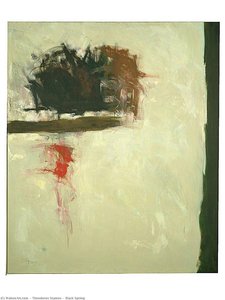
The Field (1952) aut. Theodoros Stamos

The Field

1952 · The Phillips Collection, Vašingtonas

The Field is a painting by Theodoros Stamos, executed in 1952. This work is held within the Phillips Collection. The piece belongs to a period in the artist's career where he moved toward the development of Color Field painting, utilizing layers of thin pigment to establish depth within expansive areas of color.

Theodoros Stamos tapiai, rangos nuo 11 iki 24

Muziejai, kuriuose saugomi Theodoros Stamos originalūs darbai

6 muziejai, kuriuose saugoma daugiausia šioje pusėje esamų paveikslų.

Muzejaus Miestas Theodoros Stamos darbai Šiojo sąrašo paveikslai
The Phillips Collection, VašingtonasThe Phillips Collection Vašingtonas 5 Lupine, The Field, The Sacrifice of Kronos, No. 2
Izraelio muziejus, JeruzalėIzraelio muziejus Jeruzalė 2 Greek Myth, The Geometrician
Parrish Art Museum, Water MillParrish Art Museum Water Mill 1 Infinity Field: Lefkata Series
Smithsonian American Art Museum, VašingtonasSmithsonian American Art Museum Vašingtonas 1 Untitled
Metropolitano meno muziejus, NiujorkasMetropolitano meno muziejus Niujorkas 1 Cheops Sun-Box Number 2
Bavarijos valstybinės paveikslų kolekcijos, MiunchasBavarijos valstybinės paveikslų kolekcijos Miunchas 1 Infinity Field Series No. 4

Theodoros Stamos, po vieno ikoninio paveikslio kiekvienam dešimtmenės laikotarpiui

Darbai pagal dešimtmečius

Pasirinkite dešimtmetį, kad pamatytėte jį apibrėžusį originalą.

Theodoros Stamos tapyiniai: galerijos atsakymai

Kuris Theodoros Stamos paveikslas yra pats garsiausias iš visų?Atsakymas

Greek Myth (1947), Izraelio muziejus, Jeruzalė. Toliau seka Lupine (1953) ir Gamboge Swamp (1956).

Kiek metų buvo Theodoros Stamos, kai sukūrė Greek Myth?Atsakymas

25 metų amžiaus: Greek Myth sukurta 1947 m. Nr. Theodoros Stamos gimė 1922.

Kuriose yra 10 geriausių Theodoros Stamos paveikslų?Atsakymas

Greek Myth, Lupine, Gamboge Swamp, Infinity Field: Lefkata Series, The Geometrician, The Field, The Sacrifice of Kronos, No. 2, World Tablet, Untitled ir Study for Hibernation. Viršuje esančioje reitingo sąraše nurodyta kiekvieno kūrinio metis ir muziejus.

Kiek kūrinių sukūrė Theodoros Stamos?Atsakymas

Mūsų kataloge yra 32 Theodoros Stamos darbų, skirtų laikotarpiui nuo 1945 iki 1980.

Kur kabinami garsiausi Theodoros Stamos originalūs darbai?Atsakymas

Daugiausia – The Phillips Collection (Vašingtonas), Izraelio muziejus (Jeruzalė) ir Parrish Art Museum (Water Mill). Viršuje esančiame muziejų sąraše yra visi jie.

Kada Theodoros Stamos sukūrė savo garsiausias paveikslus?Atsakymas

1940s laikotarpiu: 11 iš 24 šioje pusėje esančių darbų buvo sukurtos tada, iš jų Greek Myth.

Kokie yra ankstyviausi ir vėliausi garsieji Theodoros Stamos kūriniai?Atsakymas

Šioje pusėje seniausias darbas yra Untitled (1945), o naujausias – Infinity Field: Lefkata Series (1980).

Su kokiu kierliu siejama Theodoros Stamos?Atsakymas

Abstract expressionism, vadovaujantis šios puslapio originalais kūriniais.

Kurių Theodoros Stamos originalų turi The Phillips Collection?Atsakymas

Lupine, The Field ir The Sacrifice of Kronos, No. 2: The Phillips Collection, Vašingtonas kolekcijoje yra 5 šioje pusėje esančių darbų.

Theodoros Stamos: menininkas

A Life Immersed in Abstraction: The Journey of Theodoros Stamos

Theodoros Stamos, a pivotal figure in the evolution of American Abstract Expressionism, occupies a unique space within the canon of 20th-century art. Born on December 31, 1922, in New York City to Greek immigrant parents – his mother from Sparta, his father from Lefkada – Stamos’s artistic trajectory was shaped by both his heritage and the vibrant energy of a burgeoning American art scene. He wasn't merely *present* at the birth of Abstract Expressionism; he embodied its restless spirit of experimentation and its profound search for new visual languages. From humble beginnings, working various jobs to support his artistic pursuits – printer, florist, hat-blocker, book salesman – Stamos immersed himself in a world where art was not just creation but a vital force of cultural change. His early exposure to European avant-garde artists like Arshile Gorky and Fernand Léger through connections made during these formative years proved invaluable, seeding his artistic imagination with possibilities beyond the traditional. A scholarship to the American Artists School in 1936 marked a turning point, where he initially focused on sculpture before gravitating towards painting, a medium that would ultimately become his defining voice. The mentorship of Joseph Solman, a member of “The Ten,” was crucial, opening doors to the influential An American Place Gallery and the works of Arthur Dove and Georgia O’Keeffe – artists who profoundly impacted Stamos's early aesthetic development.

From Biomorphic Beginnings to Fields of Color

Stamos’s artistic journey wasn’t a sudden leap into abstraction but rather a gradual unfolding, marked by distinct phases of exploration. His earliest works, emerging in the 1940s, were characterized by muted earth tones and biomorphic imagery – forms suggestive of geological shapes or organic life. These paintings reflected an early fascination with natural history and a desire to tap into primal visual languages. This period laid the groundwork for his later explorations, demonstrating a sensitivity to form and texture that would remain central to his practice. Around 1950, Stamos embarked on the *Tea House Series*, a captivating body of work inspired by East Asian aesthetics. These paintings showcased softly defined geometric forms overlaid with dark calligraphic brushwork, creating an atmosphere of serene contemplation. This series revealed a willingness to embrace minimalism and explore the expressive potential of line and space. However, it was in the 1950s onwards that Stamos truly found his signature style: Color Field painting. Increasingly focused on reductive compositions, he employed layers of thin pigment to create depth within broad expanses of color. These weren’t simply paintings *of* color; they were immersive experiences *in* color, inviting viewers to lose themselves in the subtle nuances and emotional resonance of hue and tone. The culmination of this exploration arrived with the *Infinity Field Series*, beginning in 1971. Characterized by vast areas of color delineated by slim lines or shapes, these paintings evoked a meditative and expansive feeling, suggesting limitless space and boundless possibility. Within this series, the *Lefkada* sub-series held particular significance, drawing direct inspiration from his ancestral homeland and reflecting a deep connection to place and memory.

Influences and Affiliations: A Network of Artistic Exchange

Stamos’s artistic development wasn't solely an individual pursuit; it was deeply intertwined with the intellectual and creative currents of his time, shaped by key relationships and influences. His exposure to Alfred Stieglitz’s gallery fostered a profound appreciation for modern art and its radical potential. The works of Arthur Dove and Georgia O’Keeffe served as early touchstones, guiding his exploration of abstraction and organic form. Perhaps most significantly, Stamos forged close friendships with Barnett Newman and Mark Rothko, sharing a common interest in primitive imagery and the spiritual dimensions of art. These relationships were characterized by mutual support, critical dialogue, and a shared commitment to pushing the boundaries of artistic expression. The influence of East Asian aesthetics, particularly Zen Buddhism and calligraphy, is evident in his *Tea House Series*, demonstrating an openness to non-Western traditions and their minimalist principles. Furthermore, Stamos’s participation as one of “The Irascibles” – a group of Abstract Expressionist painters who publicly protested the Metropolitan Museum of Art's conservative policies towards American painting in 1950 – solidified his place within the movement and underscored his commitment to artistic independence. This act of defiance was not merely a political statement; it was a declaration of the importance of abstract art as a vital force in contemporary culture.

Legacy and Historical Significance: A Bridge Between Generations

Theodoros Stamos stands as a crucial link between the early pioneers and later developments within Abstract Expressionism. He wasn’t simply an imitator of his contemporaries; he forged his own distinct path, bridging the gap between biomorphic forms and expansive color field explorations. His work contributed significantly to the evolution of abstract art in America, demonstrating a continuous refinement of form and a deepening exploration of color's expressive power. Despite facing challenges later in life, including involvement in the Rothko estate controversy, Stamos’s artistic contributions continue to be celebrated for their subtle beauty and meditative qualities. He left an enduring impact on subsequent generations of artists through his dedicated teaching career at institutions like the Art Students League. His paintings are not merely objects to be viewed; they are invitations to experience a world beyond representation, a realm of pure sensation and emotional resonance. Stamos’s legacy lies in his ability to create works that are both intellectually rigorous and deeply moving – testaments to the power of abstraction to evoke profound human experiences. He remains a vital voice in the ongoing conversation about the nature of art and its capacity to transform our perception of the world.