Théodore Ralli portretas

25 garsiausių Théodore Ralli paveikių rinkinys: galerijos išboru

Atnaujinta lapkritis 2026 · pagal mūsų populiarumumo koeficientą (paieškos, lankytojai ir užsakymai kiekvienam kūriniui) · 26 Théodore Ralli darbai mūsų kataloge

Trumpai tariant

Iš visų originalų, kuriuos paliko Théodore Ralli, garsiausias yra Marionettes in the Harem (1881). Tiesiog už jų seka Eavesdropping (1880) ir The Kiss (1887). Mūsų kataloge yra 26 darbų autoriaus Théodore Ralli; galerija išsaugojo 25 labiausiai pasaulyje žyminiausių kūrinių – kiekvienas jų pateikiamas su datos, muziejaus ir istorijos aprašymu.

1852 – 1909, Constantinople Daugiausia darbų: Nacionalinė galerija

Théodore Ralli geriausios 10 paveikslų: galerijos pasirinkimas

1
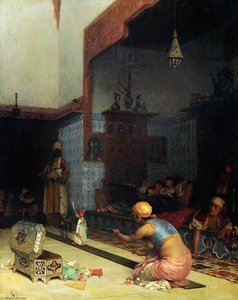
Marionettes in the Harem (1881) aut. Théodore Ralli

Marionettes in the Harem

1881 · Oil

The composition presents a crowded interior scene rendered in a black and white palette. Within this space, at least nine figures are positioned in various states of repose and activity. Some individuals sit upon chairs or couches, while others remain standing throughout the room. A woman is depicted kneeling on the floor next to a child, appearing to engage with dolls. The architectural setting is defined by a blue and…

2
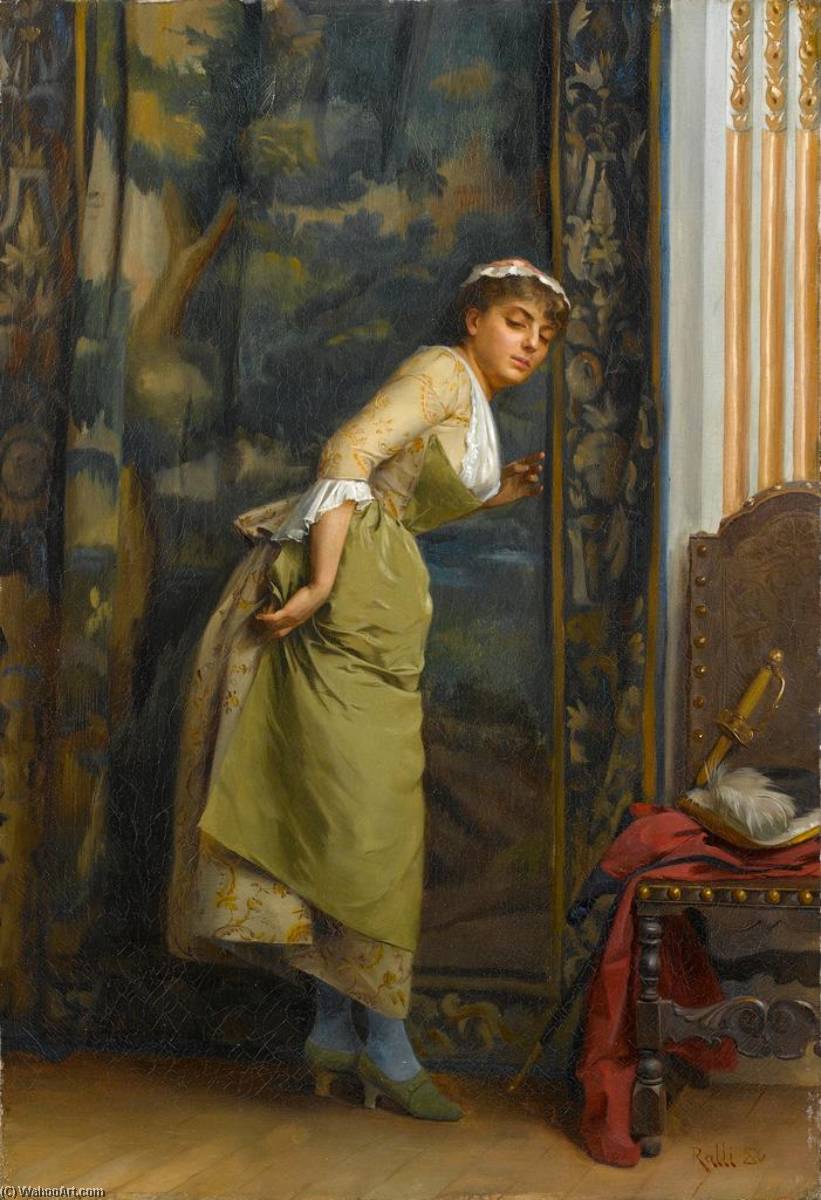
Eavesdropping (1880) aut. Théodore Ralli

Eavesdropping

1880 · Oil On Canvas

In this oil painting from about 1880, Théodore Ralli captures a quiet, private moment of introspection. A young woman occupies the center of the scene, her gaze fixed intently upon an ornate mirror. She sits within a richly decorated room, surrounded by heavy drapery and substantial furniture that suggests an aristocratic or historical setting. The atmosphere feels heavy with a sense of melancholy, as if the viewer has stumbled upon…

3
The Kiss (1887) aut. Théodore Ralli

The Kiss

1887 · Oil On Canvas

The intimate scene known as The Kiss emerges from the brush of Théodore Ralli, a painter who captures a profound moment of human connection. Completed in 1887, this oil on canvas freezes a tender encounter between two individuals. A Black man leans in to kiss a white woman, their proximity creating a quiet, private world within the frame. The air between them seems to hold a gentle warmth as they…

4
Child Hiding Behind Egyptian Sculpture, Luxor (1900) aut. Théodore Ralli

Child Hiding Behind Egyptian Sculpture, Luxor

1900 · Oil On Panel

In "Child Hiding Behind Egyptian Sculpture, Luxor" by Théodore Ralli, a large, light-colored stone torso emerges from the sand. This partially buried sculpture anchors the foreground, its pale surface catching the light. Behind this heavy, silent relic, a person peeks out, partially visible in the midground. The scene captures a quiet moment of concealment or playfulness set within a desert landscape, likely in Luxor, Egypt. The perspective remains at eye…

5
The Offering aut. Théodore Ralli

The Offering

In The Offering, Théodore Ralli presents a scene of quiet intimacy. The composition centers on a nude woman seated upon a stone bench. She is positioned as the primary focus of the work, her form rendered with a clarity that commands the viewer's attention. Small flowers are tucked into her hair, adding a delicate, natural element to her presence.

6
Flirtation aut. Théodore Ralli

Flirtation

Oil

In "Flirtation" by Théodore Ralli, the air within the room feels heavy with a quiet, unspoken tension. The scene unfolds around a central fireplace, where the warmth of the hearth meets the cool stillness of a domestic interior. A man stands on the right side of the frame, his presence looming slightly over a woman who sits composed in her place. They are locked in a moment of intense connection,…

Théodore Ralli darba rinkinys tęsiamas, nuo 11 iki 25

Temos, kurios domino Théodore Ralli

Ketverios temos, dažniausiai pasikrausto originaluose, kiekvienos su savo puikiausiu pavyzdžiu.

Muziejai, kuriuose saugomi Théodore Ralli originalūs darbai

1 muziejai, kuriuose saugoma daugiausia šioje puslapyje esamų paveikslų.

Muzejaus Miestas Théodore Ralli darbai Šiojo sąrašo paveikslai
Nacionalinė galerija, AtėnaiNacionalinė galerija Atėnai 1 The Booty

Théodore Ralli dešimtmetėms po dešimtmetės: originalus kūrinys, apibūdinantis kiekvieną iš jų

Darbai pagal dešimtmečius

Pasirinkite dešimtmetį, kad pamatytėte jį apibrėžusį originalą.

Kolekcjonerų klausimai apie Théodore Ralli paveikslus

Kuriu darbu Théodore Ralli yra labiausiai garsus?Atsakymas

Marionettes in the Harem (1881). Toliausiai eina Eavesdropping (1880) ir The Kiss (1887).

Kokia buvo Théodore Ralli amžius, kai buvo sukurtas Marionettes in the Harem?Atsakymas

29 metų amžiaus: Marionettes in the Harem sukurta 1881 m. Nr. Théodore Ralli gimė 1852.

Kokie yra 10 garsiausių Théodore Ralli paveikslų?Atsakymas

Marionettes in the Harem, Eavesdropping, The Kiss, Child Hiding Behind Egyptian Sculpture, Luxor, The Offering, Flirtation, Holy Friday, Greece, On Shipboard, An Eastern Guard ir La Sentinelle. Viršuje esančioje reitingo sąraše nurodyta kiekvieno kūrinio metis ir muziejus.

Kiek paveikslų paliko Théodore Ralli?Atsakymas

Mūsų kataloge yra 26 Théodore Ralli darbų, skirtų laikotarpiui nuo 1880 iki 1900.

Kuriuose muziejuose eksponuojami Théodore Ralli šedevrai?Atsakymas

Daugiausia – Nacionalinė galerija (Atėnai). Viršuje esančiame muziejų sąraše yra visi jie.

Kuriomis metais Théodore Ralli tapo savo garsiausius kūrinius?Atsakymas

1880s laikotarpiu: 3 iš 25 šioje pusėje esančių darbų buvo sukurtos tada, iš jų Marionettes in the Harem.

Kokie yra pirmasis ir paskutinis garsieji Théodore Ralli originalūs darbai?Atsakymas

Šioje pusėje seniausias darbas yra Eavesdropping (1880), o naujausias – Child Hiding Behind Egyptian Sculpture, Luxor (1900).

Kurią temą Théodore Ralli rinkosi dažniausiai?Atsakymas

Woman (3), Child (2) ir Chair (2) iš 25 šioje pusėje esamų darbų.

Kurią techniką Théodore Ralli naudojo dažniausiai?Atsakymas

Oil, iš 25 šios puslapio darbų – 2.

Théodore Ralli: gyvenimas ir kūryba

Theodoros Ralli: Bridging East and West Through Orientalist Vision

Théodore Jacques Ralli (1852 - 1909) stands as a pivotal figure in late nineteenth-century Greek art history, embodying the spirit of Academic realism intertwined with the burgeoning fascination for Eastern cultures—a hallmark of Orientalism. Born in Constantinople to Iakovos Rallis and Katina Psiachi, he descended from a wealthy merchant family rooted in Chios, an island scarred by Ottoman rule and marked by significant cultural exchange. Early life details remain somewhat elusive, fueling speculation about his familial motivations for relocating to Paris amidst the growing tensions between Greece and Turkey.
  • Early Artistic Training: Ralli’s formative years were spent honing his skills under Jean-Léon Gérôme and Jean-Jules-Antoine Lecomte du Nouy, both luminaries of Academic art and fervent proponents of Orientalist painting. This mentorship profoundly shaped his artistic sensibilities, instilling a meticulous approach to observation and rendering the nuances of Eastern landscapes and figures with unwavering fidelity.
  • Parisian Engagement: Ralli established himself in Paris, immersing himself in the vibrant artistic milieu of the Belle Époque. He actively participated in Salon exhibitions—official art competitions overseen by the Académie des Beaux-Arts—demonstrating his commitment to upholding traditional artistic standards while simultaneously exploring new stylistic horizons.
  • Travels and Inspiration: Driven by an insatiable curiosity, Ralli embarked on extensive journeys throughout North Africa and the Middle East. These expeditions served as a catalyst for his creative output, fueling his imagination with vivid depictions of exotic locales—Cairo being a particular favored destination where he cultivated artistic activity during the winter months.

Orientalist Style and Artistic Techniques

Ralli’s oeuvre is predominantly characterized by Orientalist painting—a genre that emerged in Europe during the Victorian era, fueled by imperial expansion and romanticized notions of the “Orient.” Unlike many contemporaries who succumbed to sensationalism or caricature, Ralli approached his subject matter with a profound respect for cultural authenticity. His canvases eschewed blatant exoticism, prioritizing nuanced portrayals of daily life—scenes from Greek villages and interiors—infused with subtle symbolism and imbued with an atmosphere of melancholic contemplation.
  • Academic Realism: Ralli adhered rigorously to Academic realism—a stylistic doctrine championed by Gérôme—emphasizing meticulous detail, accurate perspective, and a restrained palette. This commitment to technical precision allowed him to capture the essence of his subjects with remarkable accuracy, conveying both visual beauty and psychological depth.
  • Influence of Jean-Léon Gérôme: His artistic trajectory was decisively shaped by Jean-Léon Gérôme’s teachings at the École des Beaux-Arts. Notably, Ralli drew inspiration from Gérôme's *The Booty*, a monumental painting that exemplifies Academic idealism and meticulous observation—a testament to Gérôme’s mastery of technique and his unwavering devotion to upholding artistic tradition.
  • Symbolic Depth: Beyond mere visual representation, Ralli’s paintings resonate with symbolic significance. Consider *The Laundress*, which captures the quiet dignity of rural Greek life against a backdrop of muted colors—a deliberate choice that underscores the artist's sensitivity to emotional nuance and his ability to convey profound ideas through subtle imagery.

Notable Works and Legacy

Ralli’s artistic output spanned numerous genres, encompassing portraits, genre scenes, architectural subjects, and landscapes—primarily depictions of Greece and the Middle East. Among his most celebrated paintings are *The Kiss*, a poignant interracial portrait reflecting the complexities of human relationships; *The Slave Market*, which confronts viewers with uncomfortable truths about colonialism and exploitation; and *Vigil of the Dead Pasha of Tangiers*, a haunting depiction of Moroccan funerary rituals imbued with spiritual solemnity.
  • Salon Recognition: His participation in Salon exhibitions garnered him considerable acclaim—resulting in numerous medals and awards—solidifying his reputation as one of France’s foremost artists of his time.
  • National Gallery Acquisition: The National Art Gallery in Athens holds a significant collection of Ralli's paintings, ensuring that his artistic legacy continues to inspire generations of art historians and enthusiasts.
  • Ralli Prize Establishment: In honor of Theodoros Ralli’s contribution to Greek art, the Ralli Prize was established in Paris—a testament to his enduring influence on the artistic landscape of Europe.

Concluding Reflections

Théodore Ralli's artistic vision—characterized by Academic realism tempered with Orientalist sensitivity—represents a remarkable synthesis of intellectual curiosity and artistic prowess. His unwavering dedication to meticulous observation, coupled with his profound understanding of human psychology, cemented his place as one of the most distinguished painters of the late nineteenth century. Through his evocative depictions of Greek life and Eastern landscapes, Ralli bequeathed to posterity an enduring testament to the power of art—a timeless exploration of beauty, melancholy, and the complexities of cultural encounter.