Rose Mead portretas

Rose Mead paveikslai: 22 garsiausi, galerijos akimis

Atnaujinta lapkritis 2026 · pagal mūsų populiarumumo koeficientą (paieškos, lankytojai ir užsakymai kiekvienam kūriniui) · 22 Rose Mead darbai mūsų kataloge

Trumpai tariant

Galerijos akimais, garsiausias Rose Mead paveikslas yra Frank Mead (1910). Nasturtiums (1930) ir Tulips (1930) užbaia trio, kurį atpažįsta kiekvienas ž)/\ Iš 22 Rose Mead darbų mūsų kataloge, galerija žemiau pristato 22 garsiausius – kiekvienas yra originalus, su nurodytu metais, muziejumi bei unikaliu aprašymu.

1867 – 1946, Bury St Edmunds

10 geriausių galerijos Rose Mead paveikslų

1
Frank Mead (1910) aut. Rose Mead

Frank Mead

1910 · Oil On Canvas

The subject of this 1910 oil painting is a man positioned in a formal pose. He wears a dark suit paired with a crisp white shirt and a tie, suggesting a professional or ceremonial context. A mustache defines his upper lip, adding a specific detail to his facial features. The man looks toward the viewer with a steady, composed expression. The application of oil on canvas provides a textured surface…

2
Nasturtiums (1930) aut. Rose Mead

Nasturtiums

1930 · Oil

The painting Nasturtiums emerges from the hand of Rose Mead, a creator whose life remains deeply rooted in the light of Suffolk. This work, captured in 1930, presents a quiet moment of domestic beauty. The artist's signature rests in the lower right corner, a small mark of identity upon the canvas. It is a piece that feels intimate, as if the viewer has just stepped into a room where the…

3
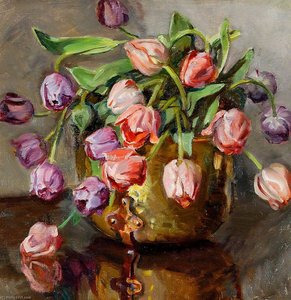
Tulips (1930) aut. Rose Mead

Tulips

1930 · Oil

A vase sits upon a table, heavy with the weight of purple tulips and pink blossoms. The arrangement is dense, a crowded gathering of stems that fills the vessel to the brim. Light catches the curve of the vase, creating a bright reflection that gives the object a sense of physical presence. Each petal holds a different shade, from the deep violet of the tulips to the softer pinks of…

4
Mrs Mead, Darning Socks (1910) aut. Rose Mead

Mrs Mead, Darning Socks

1910 · Oil On Canvas

In "Mrs Mead, Darning Socks" by Rose Mead, we find ourselves in a quiet, private moment from about 1910. The portrait focuses on an elderly woman seated in a chair, her attention entirely absorbed in the rhythmic, domestic task of knitting. Rose Mead employs a tightly cropped composition that draws the viewer into her immediate space, centering the focus on the subject's face and upper body. This close-up view creates…

5
Archdeacon George Hodges (1907) aut. Rose Mead

Archdeacon George Hodges

1907 · Oil On Canvas

The figure before us is Archdeacon George Hodges, captured in a moment of quiet dignity. This life-size oil portrait, painted by Rose Mead, presents the clergyman in his formal ecclesiastical attire. He carries the weight of his office with a steady presence, his gaze meeting the viewer from within the frame. The likeness is intimate, as if we have just stepped into his presence during a pause in his duties.

6
Arthur Mead, Reading (1910) aut. Rose Mead

Arthur Mead, Reading

1910 · Oil On Canvas

In the quiet stillness of 1910, Rose Mead captures a private moment of contemplation in her painting, Arthur Mead, Reading. The scene unfolds around a man absorbed in a book, his focus pulled entirely into the pages before him. This subject is Arthur Mead, the brother of the artist, appearing here in a moment of scholarly or perhaps professional concentration. He sits composed, a figure of stillness amidst the soft…

7
Self Portrait (1910) aut. Rose Mead

Self Portrait

1910 · Oil On Canvas

In this 1910 oil on canvas, Rose Mead turns her gaze inward to capture her own likeness. The painting, titled Self Portrait, presents a woman with brown hair who looks directly at the viewer. A red shirt provides a bold point of focus against her pensive expression. She occupies most of the frame, her presence filling the space with a quiet, steady intensity.

8
A Jug of Summer Flowers (1920) aut. Rose Mead

A Jug of Summer Flowers

1920 · Oil On Canvas

In A Jug of Summer Flowers, the artist Rose Mead presents a quiet study of botanical abundance. Painted about 1920, this work focuses on the inherent beauty of blossoms, captured in a moment of stillness. The subject matter centers around floral beauty, presenting a dense arrangement that fills the viewer's field of vision with organic forms.

9
A Cart with Barns (1930) aut. Rose Mead

A Cart with Barns

1930 · Oil

In the quiet light of a rural landscape, A Cart with Barns emerges from the brushstrokes of Rose Mead. This work, created about 1930, captures a specific moment in the life of the English countryside. The scene rests within the visual memory of a world shaped by agriculture and the steady rhythms of the land.

10
Mountainous Landscape and Stone Buildings (1930) aut. Rose Mead

Mountainous Landscape and Stone Buildings

1930 · Oil

The air feels thin and crisp in this 1930 scene, where the heavy weight of stone meets the ethereal lightness of snow. A rugged mountain range dominates the horizon, its peaks dusted with white that catches a pale, filtered light. Below these giants, a stone building sits firmly in the foreground, its solid presence anchoring the composition against the vastness of the sky. Clouds drift through the atmosphere, adding a…

Rose Mead tapiai, rangos nuo 11 iki 22

žymios Rose Mead tapiojamos, pagal laikotarpį

Temos, kurios domino Rose Mead

Ketverios temos, dažniausiai pasikrausto originaluose, kiekvienos su savo puikiausiu pavyzdžiu.

Rose Mead, po vieno ikoninio paveikslio kiekvienam dešimtmenės laikotarpiui

Darbai pagal dešimtmečius

Pasirinkite dešimtmetį, kad pamatytėte jį apibrėžusį originalą.

Rose Mead tapyiniai: galerijos atsakymai

Kuris Rose Mead paveikslas yra pats garsiausias iš visų?Atsakymas

Frank Mead (1910). Toliausiai eina Nasturtiums (1930) ir Tulips (1930).

Kiek metų buvo Rose Mead, kai sukūrė Frank Mead?Atsakymas

43 metų amžiaus: Frank Mead sukurta 1910 m. Nr. Rose Mead gimė 1867.

Kuriose yra 10 geriausių Rose Mead paveikslų?Atsakymas

Frank Mead, Nasturtiums, Tulips, Mrs Mead, Darning Socks, Archdeacon George Hodges, Arthur Mead, Reading, Self Portrait, A Jug of Summer Flowers, A Cart with Barns ir Mountainous Landscape and Stone Buildings. Viršuje esančioje reitingo sąraše nurodyta kiekvieno kūrinio metis ir muziejus.

Kiek kūrinių sukūrė Rose Mead?Atsakymas

Mūsų kataloge yra 22 Rose Mead darbų, skirtų laikotarpiui nuo 1907 iki 1940.

Kada Rose Mead sukūrė savo garsiausias paveikslus?Atsakymas

1930s laikotarpiu: 13 iš 22 šioje pusėje esančių darbų buvo sukurtos tada, iš jų Nasturtiums.

Kokie yra ankstyviausi ir vėliausi garsieji Rose Mead kūriniai?Atsakymas

Šioje pusėje seniausias darbas yra Archdeacon George Hodges (1907), o naujausias – Barbara Stone (1940).

Kurią temą Rose Mead kūrė dažniausiai?Atsakymas

Vase (8), Flowers (6) ir Portrait (5) iš 22 šioje pusėje esamų darbų.

Kurią techniką Rose Mead naudojo dažniausiai?Atsakymas

Oil, iš 22 šios puslapio darbų – 12.

Rose Mead: menininkas

Emma Rose Mead: A Life Painted in Suffolk’s Light

Born in Bury St Edmunds, England, in December 1867, Emma Rose Mead (later known as Rose Mead) emerged from a modest background to become a quietly significant figure in late Victorian and early Edwardian British art. Her life was inextricably linked to the landscape of Suffolk, a region she would repeatedly return to throughout her career, capturing its subtle beauty with an observant eye and a distinctive, almost melancholic, style. Unlike many artists of her era who sought grand narratives or dramatic subjects, Mead’s work focused on intimate scenes – portraits of ordinary people, still lifes brimming with domestic details, and evocative glimpses into the rural life of her beloved county. Her journey was one marked by resilience, personal sacrifice, and a dedication to her craft that ultimately yielded a body of work both understated and profoundly moving.

Mead’s early artistic training was unconventional for a woman of her time. She received little formal instruction initially, learning primarily through observation and self-study. A brief stint at the Lincoln School of Art provided a foundation, but it was her move to London and enrollment in the Westminster School of Art under Frederick Brown that proved pivotal. This period exposed her to established artistic principles while simultaneously challenging her to develop her own unique voice. Crucially, she spent time studying with Auguste Joseph Delécluse in Paris, an experience which broadened her technical skills and introduced her to new approaches to color and composition. However, personal circumstances – the death of her father and subsequent responsibilities as a caregiver for her mother – frequently interrupted her formal studies, forcing her to balance artistic pursuits with familial obligations.

Mead’s artistic output spanned various genres, though she is most recognized for her portraits. Her subjects were often drawn from the local community—farmers, shopkeepers, and women engaged in everyday activities. These weren't idealized representations; instead, they presented a realistic, almost unflinching, view of ordinary people, imbued with dignity and quiet strength. Her technique was characterized by a meticulous attention to detail, particularly in rendering fabrics and textures. She employed a muted palette—soft browns, greys, and blues—that perfectly complemented the atmospheric quality of her Suffolk scenes. Her paintings often evoke a sense of nostalgia and timelessness, as if capturing moments frozen in time. Notable works like “Mrs Mead, Darning Socks” (1910) exemplify this style – a poignant depiction of an elderly woman absorbed in her task, radiating both weariness and resilience. The painting’s realism is heightened by the artist's skillful use of light and shadow, creating a sense of intimacy and immediacy.

The Suffolk Connection: Landscape and Identity

While portraits constituted a significant portion of Mead’s oeuvre, her landscapes of Suffolk hold a particular fascination. These weren’t grand vistas or dramatic mountainscapes; rather, they were intimate studies of the county's rolling fields, hedgerows, and small villages. She captured the subtle shifts in light and color throughout the seasons, conveying a deep understanding of the land and its rhythms. Mead’s Suffolk paintings are not merely topographical representations; they are infused with a sense of place—a feeling for the region’s character and atmosphere. Her work reflects a growing interest in regional identity that was prevalent during the late Victorian period, as artists sought to celebrate the unique qualities of their local environments.

Mead's connection to Suffolk extended beyond mere artistic inspiration. She lived her entire adult life in Bury St Edmunds, returning there after brief periods in London and Paris. The landscape became a constant source of solace and renewal, providing a backdrop for her personal life and informing her artistic vision. Her paintings are imbued with a sense of belonging—a deep affection for the land and its people. The artist’s choice to remain rooted in this small town, despite opportunities elsewhere, speaks volumes about her priorities and values.

Royal Academy Recognition and Artistic Circles

Despite facing significant obstacles as a female artist in a male-dominated field, Rose Mead achieved considerable recognition during her lifetime. She was elected an Associate of the Royal Academy (RA) in 1925—a prestigious honor that acknowledged her artistic merit and established her within the highest echelons of British art. This achievement was particularly noteworthy considering the limited opportunities available to women artists at the time. Mead’s work was exhibited regularly at the Royal Academy summer exhibitions, providing a platform for her paintings to reach a wider audience.

Furthermore, she cultivated relationships with other prominent artists of her era, including Augustus John, whose portrait she painted and who, in turn, admired her talent. Her social circle included figures such as Ralph Tuck, the publisher of postcards featuring her work, and Frederick Pawsey, who commissioned her to create illustrations for a series of historical postcards celebrating Bury St Edmunds. These connections provided valuable support and encouragement throughout her career.

A Legacy of Quiet Observation

Rose Mead died in March 1946 at the age of 78, leaving behind a modest but significant body of work. Her paintings are now housed primarily in the Moyses Hall Museum in Bury St Edmunds, where they serve as a testament to her artistic skill and quiet determination. While she never achieved widespread fame during her lifetime, Mead’s work has gained increasing recognition in recent years, appreciated for its understated beauty, psychological depth, and intimate portrayal of everyday life. Her legacy lies not in grand pronouncements or revolutionary innovations, but in the quietly observant eye that captured the essence of Suffolk—a region and a way of life rendered with remarkable sensitivity and grace.