Robert Tatin portretas

Robert Tatin paveikslai: 100 garsiausi, galerijos akimis

Atnaujinta lapkritis 2026 · pagal mūsų populiarumumo koeficientą (paieškos, lankytojai ir užsakymai kiekvienam kūriniui) · 100 Robert Tatin darbai mūsų kataloge

Trumpai tariant

Galerijos akimais, garsiausias Robert Tatin paveikslas yra Maryvonne Fille de Lune. Les Mystères de la Femme ir Le Cirque užbaia trio, kurį atpažįsta kiekvienas ž)/\ Iš 100 Robert Tatin darbų mūsų kataloge, galerija žemiau pristato 100 garsiausius – kiekvienas yra originalus, su nurodytu metais, muziejumi bei unikaliu aprašymu.

1902 – 1983, Laval Expressionism

10 geriausių galerijos Robert Tatin paveikslų

1
Maryvonne Fille de Lune aut. Robert Tatin

Maryvonne Fille de Lune

Oil

This piece moves away from the depiction of a literal place, opting instead to map an internal experience. The circular motifs hint at cycles of life and the rhythmic nature of existence, turning a landscape into a visual expression of the psyche. It carries the energy of expressionism, focusing on subjective feeling rather than the external world. The colors and textures work together to create a sense of mystery, as…

2
Les Mystères de la Femme aut. Robert Tatin

Les Mystères de la Femme

Oil On Canvas

Les Mystères de la Femme presents a dense, surreal landscape characterized by an otherworldly atmosphere. The composition is dominated by an enormous, luminous circle at the center that radiates a soft glow across the scene. This central orb contains stylized figures and serves as the primary light source for the surrounding elements. Below this orb, the canvas is filled with a multitude of small, organic shapes, including circles, ovals, and…

3
Le Cirque aut. Robert Tatin

Le Cirque

Oil On Canvas

The scene erupts within a circular frame, a swirling vortex of energy that pulls the eye toward a central, dark figure. This rider, perched atop a horse, exists at the heart of a chaotic dance, surrounded by a flurry of abstract forms and faces that seem to spin outward. The composition feels enclosed, almost theatrical, as if the viewer is peering into a private, dreamlike arena where the laws of…

4
Arcane VI aut. Robert Tatin

Arcane VI

Acrylic On Canvas

is an abstract landscape characterized by a dense layering of swirling patterns and organic forms. The composition is complex and chaotic, utilizing a repetition of circular motifs and interconnected lines to create a sense of harmony. The color palette is exceptionally rich, featuring a wide range of hues including greens, blues, purples, yellows, oranges, pinks, and browns, which produce an almost iridescent effect.

Robert Tatin tapiai, rangos nuo 11 iki 100

11La Belle Epoque aut. Robert TatinLa Belle Epoque 12Arcane 7 aut. Robert TatinArcane 7 13Maüa aut. Robert TatinMaüa 14La Vache Bretonne aut. Robert TatinLa Vache Bretonne 15Homme au Camélia aut. Robert TatinHomme au Camélia 16Ile de la Cité aut. Robert TatinIle de la Cité 17Hommes aut. Robert TatinHommes 18Etude pour la toile Le Cirque aut. Robert TatinEtude pour la toile Le Cirque 19Portrait profil aut. Robert TatinPortrait profil 20Brésil 3 aut. Robert TatinBrésil 3 21Solange aut. Robert TatinSolange 22Les Hommes aut. Robert TatinLes Hommes 23Permanence des Sources aut. Robert TatinPermanence des Sources 24Paysan bigouden aut. Robert TatinPaysan bigouden 25Etude de Nus aut. Robert TatinEtude de Nus 26Naïssou de l'Eté aut. Robert TatinNaïssou de l'Eté 27Faubourg Saint Antoine aut. Robert TatinFaubourg Saint Antoine 28Itacolomi aut. Robert TatinItacolomi 29Têtes de Bretons aut. Robert TatinTêtes de Bretons 301976.2 Les Oiseaux aut. Robert Tatin1976.2 Les Oiseaux 31Croquis à l'Huile 2 aut. Robert TatinCroquis à l'Huile 2 32Guinguette aut. Robert TatinGuinguette 331976.1 Les Oiseaux et les Mains aut. Robert Tatin1976.1 Les Oiseaux et les Mains 34Lettre Fenêtre aut. Robert TatinLettre Fenêtre 35Time Square ou 14 Juillet aut. Robert TatinTime Square ou 14 Juillet 36Le Bateau aut. Robert TatinLe Bateau 37Christiane aut. Robert TatinChristiane 38Danses aut. Robert TatinDanses 39La Ville aut. Robert TatinLa Ville 4021 Juin 1972 aut. Robert Tatin21 Juin 1972 41Maryvonne ou le Blé aut. Robert TatinMaryvonne ou le Blé 42Vent aut. Robert TatinVent 43L'Oeil aut. Robert TatinL'Oeil 44La Vache au Piquet aut. Robert TatinLa Vache au Piquet 45La Frénouse aut. Robert TatinLa Frénouse 46Train de Maüa aut. Robert TatinTrain de Maüa 47Brésil N 2 aut. Robert TatinBrésil N 2 48Lune aut. Robert TatinLune 49Ma soeur Madeleine et le tonton Henri aut. Robert TatinMa soeur Madeleine et le tonton Henri 50Signes aut. Robert TatinSignes 51Nuit étoilée ou Initiation aut. Robert TatinNuit étoilée ou Initiation 52Racines aut. Robert TatinRacines 53Me et Dr Le Basser aut. Robert TatinMe et Dr Le Basser 54Chatou aut. Robert TatinChatou 55Sao Vincent Santos aut. Robert TatinSao Vincent Santos 56Coup de Tête aut. Robert TatinCoup de Tête 57Les Trois Pêches aut. Robert TatinLes Trois Pêches 58Men Dü aut. Robert TatinMen Dü 59Les Orangers de Maüa aut. Robert TatinLes Orangers de Maüa 60Etude pour la Toile Amida aut. Robert TatinEtude pour la Toile Amida 61Chacara Maüa Bresil aut. Robert TatinChacara Maüa Bresil 62Lunaison aut. Robert TatinLunaison 631970 1971 aut. Robert Tatin1970 1971 64Portrait n 2 ou Etude pour Les Trois Pêches aut. Robert TatinPortrait n 2 ou Etude pour Les Trois Pêches 65Rubis aut. Robert TatinRubis 66Macumba aut. Robert TatinMacumba 67Picasso aut. Robert TatinPicasso 68Etude pour la Toile Orphée aut. Robert TatinEtude pour la Toile Orphée 69Lettre X aut. Robert TatinLettre X 70Concours de Pêche à Nuillé sur Vicoin aut. Robert TatinConcours de Pêche à Nuillé sur Vicoin 71Saint Germain des Prés aut. Robert TatinSaint Germain des Prés 72Croquis à l'Huile 1 aut. Robert TatinCroquis à l'Huile 1 73Etude au Dindon aut. Robert TatinEtude au Dindon 74Les Pêchers aut. Robert TatinLes Pêchers 75Fleur de Lotus aut. Robert TatinFleur de Lotus 76Le Printemps en Mayenne aut. Robert TatinLe Printemps en Mayenne 77Sabots aut. Robert TatinSabots 78Jean Dubuffet aut. Robert TatinJean Dubuffet 79Quai de Bercy aut. Robert TatinQuai de Bercy 80La Lune bleue aut. Robert TatinLa Lune bleue 81Jardins du Luxembourg aut. Robert TatinJardins du Luxembourg 82Fleuve aut. Robert TatinFleuve 83Ca Voir aut. Robert TatinCa Voir 84Etude pour la Toile Fleur de Lotus aut. Robert TatinEtude pour la Toile Fleur de Lotus 85Bateau aut. Robert TatinBateau 86Les Peupliers d'Août aut. Robert TatinLes Peupliers d'Août 87Sinaï ou Fleur de Lys aut. Robert TatinSinaï ou Fleur de Lys 88Maüa ocres aut. Robert TatinMaüa ocres 89Rio aut. Robert TatinRio 90Eglise de Carapicuiba aut. Robert TatinEglise de Carapicuiba 91Saladier de Fruits aut. Robert TatinSaladier de Fruits 92Le Cri aut. Robert TatinLe Cri 93Jeu n 1 aut. Robert TatinJeu n 1 94Renoncules aut. Robert TatinRenoncules 95Favellas à Maüa aut. Robert TatinFavellas à Maüa 96Les Peupliers aut. Robert TatinLes Peupliers 97Maüa Cannes à sucre aut. Robert TatinMaüa Cannes à sucre 98Domador aut. Robert TatinDomador 99Maisons à Carapicuiba aut. Robert TatinMaisons à Carapicuiba 100Ebauche inachevée aut. Robert TatinEbauche inachevée

žymios Robert Tatin tapiojamos, pagal laikotarpį

Temos, kurios domino Robert Tatin

Ketverios temos, dažniausiai pasikrausto originaluose, kiekvienos su savo puikiausiu pavyzdžiu.

Robert Tatin tapyiniai: galerijos atsakymai

Kuris Robert Tatin paveikslas yra pats garsiausias iš visų?Atsakymas

Maryvonne Fille de Lune. Toliausiai eina Les Mystères de la Femme ir Le Cirque.

Kuriose yra 10 geriausių Robert Tatin paveikslų?Atsakymas

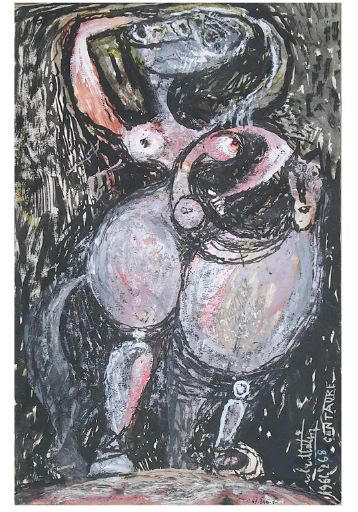
Maryvonne Fille de Lune, Les Mystères de la Femme, Le Cirque, Arcane VI, Centaure, St Jean de Luz Porte Roses, Silence, Autoportrait, Carnaval de Rio ir Café de Flore. Viršuje esančioje reitingo sąraše nurodyta kiekvieno kūrinio metis ir muziejus.

Kiek kūrinių sukūrė Robert Tatin?Atsakymas

Mūsų kataloge yra 100 darbų autoriaus Robert Tatin.

Kurią temą Robert Tatin kūrė dažniausiai?Atsakymas

Portraits (3), French countryside (3) ir Landscape (2) iš 100 šioje pusėje esamų darbų.

Kurią techniką Robert Tatin naudojo dažniausiai?Atsakymas

Oil On Canvas, iš 100 šios puslapio darbų – 2.

Su kokiu kierliu siejama Robert Tatin?Atsakymas

Expressionism, vadovaujantis šios puslapio originalais kūriniais.

Robert Tatin: menininkas

Robert Tatin: A Surrealist Vision of the Rural and the Primitive

Born in Laval, Mayenne, in 1902, Robert Tatin’s life was a remarkable confluence of seemingly disparate passions – construction, carpentry, ceramics, painting, sculpture, and architecture. He wasn't merely an artist; he was a builder of worlds, both tangible and imagined, driven by a profound desire to translate the rhythms of nature and the echoes of ancient myths into a singular, deeply personal visual language. His story is one of quiet revolution, a rejection of academic constraints in favor of intuitive creation, and ultimately, the establishment of a unique artistic sanctuary – his ‘Maison des Champs’ – that continues to bewilder and enchant visitors today.

Tatin's early years were shaped by a modest upbringing. His father was a Dreyfusard, deeply committed to his beliefs, while his mother practiced Catholicism. This duality—a tension between tradition and faith—likely fostered within him a sense of questioning and an independent spirit. He began his career as a house painter and carpenter, skills that would prove invaluable in the ambitious construction projects he undertook later in life. Crucially, he enrolled at the École des Beaux-Arts in Paris, immersing himself in classical techniques but quickly recognizing their limitations for expressing his own vision. This period laid the groundwork for his distinctive style – a blend of meticulous detail and dreamlike imagery.

The Years in South America: A Crucible of Creativity

A pivotal moment arrived in 1950 when Tatin, seeking inspiration and new techniques, embarked on an extended journey to Brazil and throughout South America. This period proved transformative. He spent years working alongside scientists at a ceramics research facility in Belo Horizonte, delving into the properties of cement and experimenting with innovative construction methods. He was deeply influenced by indigenous cultures, particularly their reverence for nature and their intricate symbolic systems. The vibrant colors, geometric patterns, and mythological narratives found in pre-Columbian art became integral to his own artistic vocabulary. It wasn’t simply observation; he actively engaged with these communities, learning from their traditions and incorporating them into his work.

Returning to France in 1955, Tatin settled in Vence on the French Riviera for a few years before ultimately returning to his native Mayenne. This move wasn’t about abandoning his artistic pursuits; rather, it was a homecoming—a desire to reconnect with his roots and create a space where he could fully realize his creative ambitions.

The Construction of ‘Maison des Champs’: A Personal Cosmology

In 1962, at the age of sixty, Tatin purchased an old farmhouse in Cossé-le-Vivien. What followed was not merely a renovation but a decades-long architectural and artistic undertaking – the creation of ‘Maison des Champs,’ a sprawling complex that defies easy categorization. He began by building a monumental stone structure resembling a temple, its entranceway shaped like a colossal dragon’s mouth, leading to a labyrinthine garden filled with sculptures, symbolic constructions, and painted walls. The house itself was expanded incrementally over twenty-one years, driven by Tatin's boundless imagination and his wife Lise’s unwavering support.

The ‘Maison des Champs’ is not simply a museum; it’s an immersive environment—a personal cosmology expressed through art. Each room is meticulously decorated with paintings depicting scenes of rural life, mythical figures, and abstract compositions. The sculptures are monumental, often exceeding eight feet in height, and imbued with symbolic meaning. The garden itself is a carefully orchestrated landscape, featuring twelve months represented by miniature structures, a central pond surrounded by symbolic elements, and a long, winding road lined with oversized statues of historical and artistic figures – a testament to Tatin’s fascination with the past.

A Legacy of Surrealism and Naive Art

Robert Tatin's work is often categorized as belonging to the realms of surrealism and naive art, though he resisted rigid labels. His paintings are characterized by their dreamlike quality, intricate detail, and symbolic imagery—a direct reflection of his experiences in South America and his deeply personal worldview. His sculptures, similarly, possess a raw, almost primitive energy, conveying a sense of timelessness and primal emotion. He was profoundly influenced by the work of artists like Paul Klee and Giorgio de Chirico, but he developed a unique style that is entirely his own.

Today, ‘Maison des Champs’ stands as a testament to Tatin's extraordinary vision—a surrealist sanctuary where art, architecture, and nature converge in a harmonious and unforgettable whole. It remains open to the public, offering visitors a rare glimpse into the mind of an artist who dared to create his own world, inviting us to contemplate the mysteries of life, myth, and the enduring power of imagination.