Robert Smithson portretas

Robert Smithson tapiai: 4 garsiausi πίναšiai, galerijos akimis

Atnaujinta lapkritis 2026 · pagal mūsų populiarumumo koeficientą (paieškos, lankytojai ir užsakymai kiekvienam kūriniui) · 6 Robert Smithson darbai mūsų kataloge

Trumpai tariant

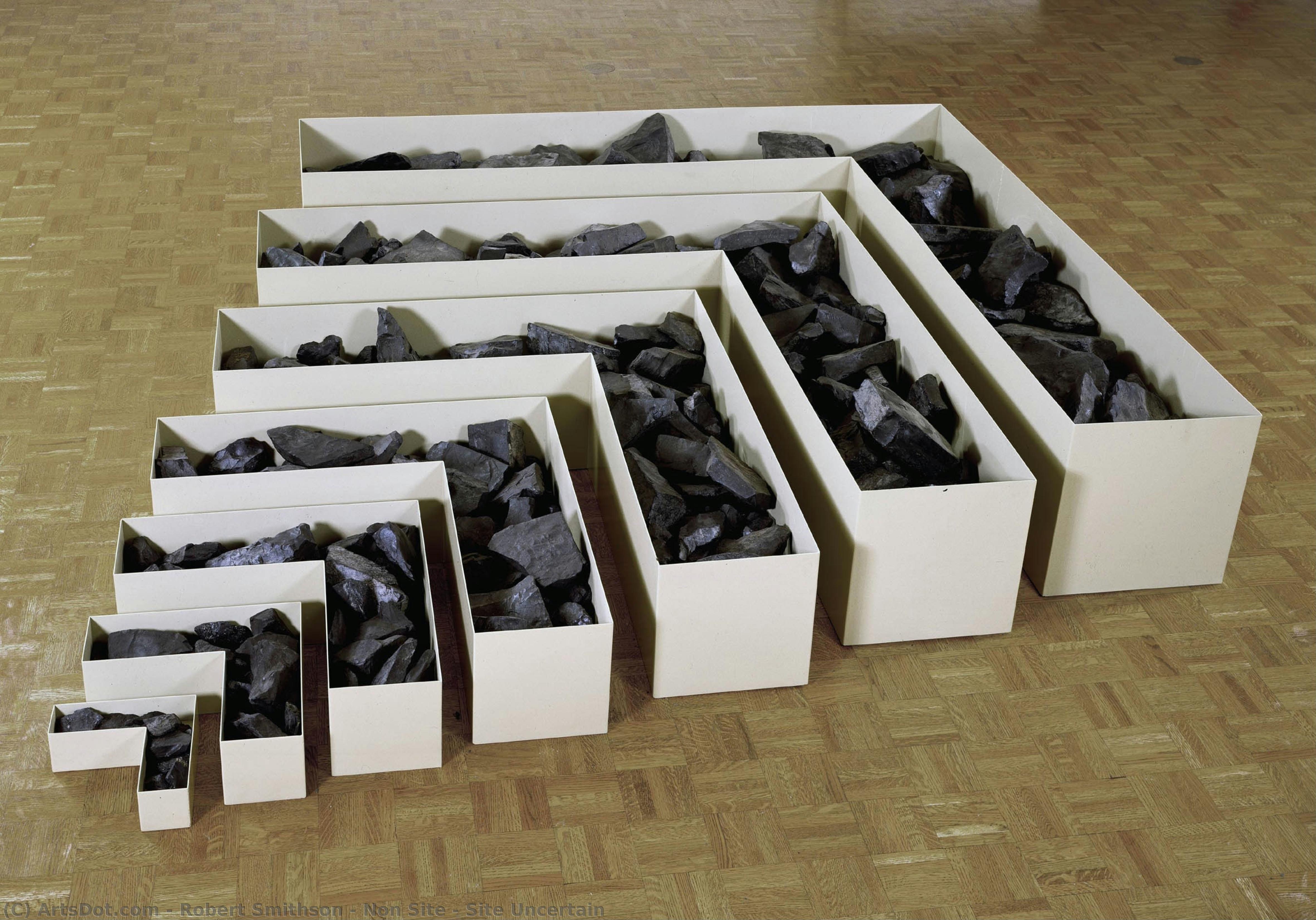
Galerijos akimais, garsiausias Robert Smithson tapas yra Non Site - Site Uncertain, kurio originalas eksponuojamas Detroito meno institutas, Detroitas. Three-Sided Vortex (1966) ir Ruin of Map of Hipparchus (100 B.C.) in Oswego Lake Quadrangle (1954 55) (1967) užbaia trio, kurį atpažįsta kiekvienas ž)/\ Iš 6 Robert Smithson darbų mūsų kataloge, galerija žemiau pristato 4 garsiausius – kiekvienas yra originalus, su nurodytu metais, muziejumi bei unikaliu aprašymu.

1938 – 1973, Passaic Daugiausia darbų: Detroito meno institutas

10 geriausių galerijos Robert Smithson paveikslų

Muziejai, kuriuose saugomi Robert Smithson originalūs darbai

2 muziejai, kuriuose saugoma daugiausia šioje pusėje esamų paveikslų.

Muzejaus Miestas Robert Smithson darbai Šiojo sąrašo paveikslai
Detroito meno institutas, DetroitasDetroito meno institutas Detroitas 1 Non Site - Site Uncertain
Chrysler Museum of Art, NorfolkasChrysler Museum of Art Norfolkas 1 Three-Sided Vortex

Robert Smithson, pagrindiniai kiekvienų metų paveiksliai

5 metų, nuo 1966 iki 1970, šiame puslapyje pristatoma visa Robert Smithson karjera: trumpa apžvalga, kurioje metinis chronologijos principu per žymiausius originalus atskleidžiama kūrybos istorija.

Darbai pagal metus

Pasirinkite metus, kad pamatytumėte originalus darbus.

Robert Smithson tapyiniai: galerijos atsakymai

Kuris Robert Smithson paveikslas yra pats garsiausias iš visų?Atsakymas

Non Site - Site Uncertain, Detroito meno institutas, Detroitas. Toliau seka Three-Sided Vortex (1966) ir Ruin of Map of Hipparchus (100 B.C.) in Oswego Lake Quadrangle (1954 55) (1967).

Kiek kūrinių sukūrė Robert Smithson?Atsakymas

Mūsų kataloge yra 6 Robert Smithson darbų, skirtų laikotarpiui nuo 1966 iki 1970.

Kur kabinami garsiausi Robert Smithson originalūs darbai?Atsakymas

Daugiausia – Detroito meno institutas (Detroitas) ir Chrysler Museum of Art (Norfolkas). Viršuje esančiame muziejų sąraše yra visi jie.

Kokie yra ankstyviausi ir vėliausi garsieji Robert Smithson kūriniai?Atsakymas

Šioje pusėje seniausias darbas yra Three-Sided Vortex (1966), o naujausias – Torn Photograph from the 2nd Stop (Rubble) (2nd Mountain of Six Stops on a Section) from Artists Photographs (1970).

Robert Smithson: menininkas

Early Life and Artistic Beginnings

  • Born: January 2, 1938, in Passaic, New Jersey
  • Early years spent in Rutherford and Clifton, New Jersey
  • Studied painting and drawing at the Art Students League of New York (1955-1956)
  • Early artwork explored collage influenced by homoerotic themes, science fiction, and pop art. Primarily identified as a painter during this period.
  • Influenced by William Carlos Williams, who was his pediatrician.

The Shift to Minimalism and Conceptual Art

  • After a three-year break from the art world, emerged in 1964 as a proponent of the minimalist movement.
  • Abandoned figurative work, focusing on glass sheet and neon lighting tubes exploring visual refraction and mirroring.
  • Developed interest in entropy (the second law of thermodynamics) – decay, renewal, chaos, order, non-sites, and earthworks. Saw entropy not as a disadvantage but as a form of transformation.
  • Associated with minimalist artists like Nancy Holt (his wife), Robert Morris, and Sol LeWitt.
  • Became a critic for *Arts Magazine* and *Artforum*, gaining recognition as a writer before his art.

Land Art and Earthworks: Spiral Jetty and Beyond

  • Fascination with industrial areas in New Jersey led to the development of "Non-Sites" – sculptures incorporating earth and rocks from specific locations, often combined with mirrors or glass.
  • Spiral Jetty (1970): His most famous work, a massive coil of basalt rock extending into the Great Salt Lake in Utah. A key example of land art, exploring themes of entropy, time, and geological processes.
  • Explored temporary sculptures using mirrors in the Yucatan Peninsula, documented in "Incidents of Mirror-Travel in the Yucatan."
  • Recovered 18th- and 19th-century conceptions of landscape architecture, influencing his later earthwork explorations.

Theoretical Writings and Landscape Perspectives

  • Wrote extensively on art theory, including "A Heap of Language," exploring how writing could become an artwork.
  • Examined Frederick Law Olmsted's design for Central Park in New York City, recovering issues of site specificity, human intervention, and the picturesque landscape.
  • His writings demonstrate a deep engagement with history, philosophy, geology, and cultural theory.

Legacy and Historical Significance

  • Died: July 20, 1973, in Tucson, Arizona (due to a heart attack while hiking).
  • Considered a pivotal figure in Land Art and Earthworks movements.
  • His work expanded the definition of art, blurring boundaries between sculpture, landscape, and natural processes.
  • Influenced generations of artists with his conceptual approach, exploration of entropy, and engagement with geological time scales.
  • The Holt/Smithson Foundation continues to preserve and promote his legacy.
