


1


Atnaujinta spalis 2026 · pagal mūsų populiarumumo koeficientą (paieškos, lankytojai ir užsakymai kiekvienam kūriniui) · 44 Robert Hope darbai mūsų kataloge
Trumpai tariant
Galerijos akimais, garsiausias Robert Hope paveikslas yra The Presentation by King James III and Queen Margaret of the Banner Known as the Blue Blanket to the Craftsmen in the Year 1482 (1912). Kilmeny ir Edinburgh from Craiglockhart užbaia trio, kurį atpažįsta kiekvienas ž)/\ Iš 44 Robert Hope darbų mūsų kataloge, galerija žemiau pristato 40 garsiausius – kiekvienas yra originalus, su nurodytu metais, muziejumi bei unikaliu aprašymu.


In the quiet intimacy of 1924, Robert Hope captured a scene of profound serenity that transcends the mere depiction of a person. Glints of Gold (Miss Dorothy Salvesen) is more than a portrait; it is an invitation into a private sanctuary of thought and repose. The painting presents a woman draped in a luminous yellow dress, reclining gracefully upon a bed with her head resting softly against a pillow. As…


 Portrait of a Lady with a Motoring Veil1915 · Harris Museum - Art Gallery
12
 A Victorian Debutante1922
13
 A Pageant of the Sea1929
14
 Alderman Eaton1944
15
 Lord Leverhulme and Alderman R. Williams, Mayor of Bebington1945
16
 Melrose
17
 Idle Hours
18
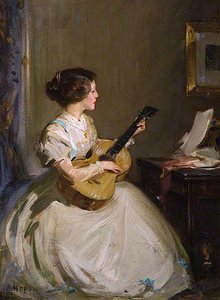 The Guitar Lesson
19
 The Fountain, Princes Street Gardens, EdinburghMcmanus: Dundee's Art Galleries And Museums
20
 A Quiet Pool, Evening
21
 Edinburgh from the ArboretumCity Art Centre
22
 Melrose
23
 The Guitar Lesson
24
 The Blue Veil
25
 Stream in Galloway
26
 An Old Herd
27
 No.8 Howard Place, Edinburgh, 1914
28
 Back of Standing Female NudeEdinburgh College of Art
29
 The Silken Gown
30
 The Glee Maiden
31
 Willows, East LintonJohn Muir House
32
 The Charm
33
 Before the Looking GlassThe Stirling Smith Art Gallery - Museum
34
 The Vanity GlassThe National Trust For Scotland
35
 The Return of the Sardine Fishers, Concarneau
36
 Swanston Cottage, Edinburgh
37
 The Green Door, CulrossThe Stewartry Museum
38
 The Remnant Stall
39
 Woman with BasketJohn Muir House
40
 Workers in a Hay FieldThe Stewartry Museum
Ketverios temos, dažniausiai pasikrausto originaluose, kiekvienos su savo puikiausiu pavyzdžiu.
8 muziejai, kuriuose saugoma daugiausia šioje pusėje esamų paveikslų.
| Muzejaus | Miestas | Robert Hope darbai | Šiojo sąrašo paveikslai |
|---|---|---|---|
 City Art Centre |
Edinburgh | 2 | Edinburgh from Craiglockhart, Edinburgh from the Arboretum |
 John Muir House |
Haddington | 2 | Willows, East Linton, Woman with Basket |
 The Stewartry Museum |
Cairns | 2 | The Green Door, Culross, Workers in a Hay Field |
 Borders Textile Townhouse |
Hawick | 1 | Kilmeny |
 Royal Scottish Academy of Art - Architecture |
Edinburgh | 1 | Glints of Gold (Miss Dorothy Salvesen) |
 Paisley Art Institute Collection |
Paisley | 1 | The Golden Apple |
 Harris Museum - Art Gallery |
Preston | 1 | Portrait of a Lady with a Motoring Veil |
 Mcmanus: Dundee's Art Galleries And Museums |
Dundee | 1 | The Fountain, Princes Street Gardens, Edinburgh |
Pasirinkite dešimtmetį, kad pamatytėte jį apibrėžusį originalą.
In the quiet intimacy of 1924, Robert Hope captured a scene of profound serenity that transcends the mere depiction of a person. Glints of Gold (Miss Dorothy Salvesen) is more than a portrait; it is an invitation into a private sanctuary of thought and repose. The painting presents a woman draped in a luminous yellow dress, reclining gracefully upon a bed with her head resting softly against a pillow. As…
The Presentation by King James III and Queen Margaret of the Banner Known as the Blue Blanket to the Craftsmen in the Year 1482 (1912). Toliausiai eina Kilmeny ir Edinburgh from Craiglockhart.
43 metų amžiaus: The Presentation by King James III and Queen Margaret of the Banner Known as the Blue Blanket to the Craftsmen in the Year 1482 sukurta 1912 m. Nr. Robert Hope gimė 1869.
The Presentation by King James III and Queen Margaret of the Banner Known as the Blue Blanket to the Craftsmen in the Year 1482, Kilmeny, Edinburgh from Craiglockhart, Glints of Gold (Miss Dorothy Salvesen), Inverkeithing, Inverkeithing, The Fountain, Princes Street Gardens, Edinburgh, The Glee Maiden, The Golden Apple ir Swanston Farm, Edinburgh. Viršuje esančioje reitingo sąraše nurodyta kiekvieno kūrinio metis ir muziejus.
Mūsų kataloge yra 44 Robert Hope darbų, skirtų laikotarpiui nuo 1905 iki 1929.
Daugiausia – City Art Centre (Edinburgh), John Muir House (Haddington) ir The Stewartry Museum (Cairns). Viršuje esančiame muziejų sąraše yra visi jie.
1910s laikotarpiu: 3 iš 40 šioje pusėje esančių darbų buvo sukurtos tada, iš jų The Presentation by King James III and Queen Margaret of the Banner Known as the Blue Blanket to the Craftsmen in the Year 1482.
Šioje pusėje seniausias darbas yra Inverkeithing (1905), o naujausias – A Pageant of the Sea (1929).
Elegant woman (3), Victorian era (3) ir Scottish landscape (2) iš 40 šioje pusėje esamų darbų.
Academic realism ir Impressionism, judging by the originals on this page.
Edinburgh from Craiglockhart ir Edinburgh from the Arboretum: City Art Centre, Edinburgh kolekcijoje yra 2 šioje pusėje esančių darbų.

