


1


Atnaujinta lapkritis 2026 · pagal mūsų populiarumumo koeficientą (paieškos, lankytojai ir užsakymai kiekvienam kūriniui) · 60 Peter Jacob Horemans darbai mūsų kataloge
Trumpai tariant
Iš visų paliktų originalų kūrinių Peter Jacob Horemans garsiausias yra Portrait of Frau Heigl (1738), esantis Bavarijos valstybinės paveikslų kolekcijos kolekcijoje, Miunchas. Tiesiog už jų seka Kitchen Still Life with Coffee Drinker (1765) ir Musical Still Life with Horn Player (1765). Mūsų kataloge yra 60 darbų autoriaus Peter Jacob Horemans; galerija išsaugojo 58 labiausiai pasaulyje žyminiausių kūrinių – kiekvienas jų pateikiamas su datos, muziejaus ir istorijos aprašymu.


 The Smoker1764 · Bavarijos valstybinės paveikslų kolekcijos
12
 Hunting Still Life with Hunter1765 · Bavarijos valstybinės paveikslų kolekcijos
13
 Hunting Still Life with Hunter1765 · Bavarijos valstybinės paveikslų kolekcijos
14
 Kitchen Interior with Beer Drinker1765 · Bavarijos valstybinės paveikslų kolekcijos
15
 Kitchen Still Life with Female Figure Counting Money and Parrot1760 · Bavarijos valstybinės paveikslų kolekcijos
16
 Still Life with Violinist1763 · Bavarijos valstybinės paveikslų kolekcijos
17
 The Tailor's Workshop1759
18
 Still life with a distinguished gentleman1762 · Bavarijos valstybinės paveikslų kolekcijos
19
 Fruit still life with a female figure drinking wine1764 · Bavarijos valstybinės paveikslų kolekcijos
20
 Kitchen still life with female figure and parrot (An allegory of feeling)1760 · Bavarijos valstybinės paveikslų kolekcijos
21
 Shoemakers-shop1759
22
 Still Life with Female Figure1770 · Bavarijos valstybinės paveikslų kolekcijos
23
 Kitchen Still Life with Female Figure and Parrot1771 · Bavarijos valstybinės paveikslų kolekcijos
24
 Court Musician Felix Reiner with Bassoon1774 · Bavarijos valstybinės paveikslų kolekcijos
25
 Court Musician with Violin (Johann Georg Holzbogen)1774 · Bavarijos valstybinės paveikslų kolekcijos
26
 Still Life "The Treasurer"1773 · Bavarijos valstybinės paveikslų kolekcijos
27
 Kitchen Still Life with Female Figure and Parrot1771 · Bavarijos valstybinės paveikslų kolekcijos
28
 Portrait of District Administrator Josef Heigl1768 · Bavarijos valstybinės paveikslų kolekcijos
29
 Spring (Johanna de Lasence Having Coffee in the Garden)1767 · Bavarijos valstybinės paveikslų kolekcijos
30
 Self-portrait in the artist's atelier1766 · Bavarijos valstybinės paveikslų kolekcijos
31
 Bildnis eines Silberdieners1772 · Bavarijos valstybinės paveikslų kolekcijos
32
 Portrait of court sculptor Roman Anton Boos (1730-1810) in his studio next to a bust of elector Maximilian III1766 · Bavarijos valstybinės paveikslų kolekcijos
33
 Hunting a wild boar1773 · Nacionalinis muziejus Varšuvoje
34
 Hunting with falcons1773 · Nacionalinis muziejus Varšuvoje
35
 Picnic in the park1776 · Lenbachhaus
36
 Concert in the garden1776 · Lenbachhaus
37
 Still Life with Plucked Chicken1764 · Bavarijos valstybinės paveikslų kolekcijos
38
 Still Life with Pork Knuckle and Squirrel1765 · Bavarijos valstybinės paveikslų kolekcijos
39
 Still Life with Dead Partridge1764 · Bavarijos valstybinės paveikslų kolekcijos
40
 Still Life with Fish1765 · Bavarijos valstybinės paveikslų kolekcijos
41
 Still Life with Pork Knuckle and Parrot1765 · Bavarijos valstybinės paveikslų kolekcijos
42
 Still Life with Fruit1765 · Bavarijos valstybinės paveikslų kolekcijos
43
 Still Life with Dead Lamb1765 · Bavarijos valstybinės paveikslų kolekcijos
44
 Still Life with Dead Hare1764 · Bavarijos valstybinės paveikslų kolekcijos
45
 Still Life with Fruit1765 · Bavarijos valstybinės paveikslų kolekcijos
46
 Still Life with Kitchen Utensils and Plucked Chicken1765 · Bavarijos valstybinės paveikslų kolekcijos
47
 Still Life with Kitchen Utensils and Dead Partridge1765 · Bavarijos valstybinės paveikslų kolekcijos
48
 Still Life with Lobster1765 · Bavarijos valstybinės paveikslų kolekcijos
49
 Still Life with Lobster1766 · Bavarijos valstybinės paveikslų kolekcijos
50
 Still Life with Grapes and Apples1768 · Bavarijos valstybinės paveikslų kolekcijos
51
 Fruit Still Life1770 · Bavarijos valstybinės paveikslų kolekcijos
52
 Still Life with Crabs1766 · Bavarijos valstybinės paveikslų kolekcijos
53
 Fruit Still Life1768 · Bavarijos valstybinės paveikslų kolekcijos
54
 Fruit Snack1770 · Bavarijos valstybinės paveikslų kolekcijos
55
 Still Life with Fruit and Dead Birds1771 · Bavarijos valstybinės paveikslų kolekcijos
56
 Still Life with Fruit and Dead Birds1771 · Bavarijos valstybinės paveikslų kolekcijos
57
 A Musical Gathering at the Court of the Elector Karl Albrecht of Bavaria1730 · Metropolitano meno muziejus
58
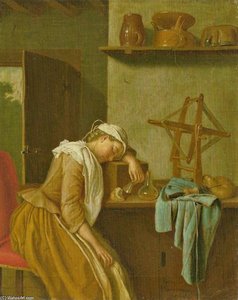 Schlafendes KüchenmädchenBavarijos valstybinės paveikslų kolekcijos
4 muziejai, kuriuose saugoma daugiausia šioje pusėje esamų paveikslų.
| Muzejaus | Miestas | Peter Jacob Horemans darbai | Šiojo sąrašo paveikslai |
|---|---|---|---|
 Bavarijos valstybinės paveikslų kolekcijos |
Miunchas | 51 | Portrait of Frau Heigl, Kitchen Still Life with Coffee Drinker, Musical Still Life with Horn Player |
 Nacionalinis muziejus Varšuvoje |
Varšuva | 2 | Hunting a wild boar, Hunting with falcons |
 Lenbachhaus |
Miunchenas | 2 | Picnic in the park, Concert in the garden |
 Metropolitano meno muziejus |
Niujorkas | 1 | A Musical Gathering at the Court of the Elector Karl Albrecht of Bavaria |
Pasirinkite dešimtmetį, kad pamatytėte jį apibrėžusį originalą.

Portrait of Frau Heigl (1738), Bavarijos valstybinės paveikslų kolekcijos, Miunchas. Toliau seka Kitchen Still Life with Coffee Drinker (1765) ir Musical Still Life with Horn Player (1765).
38 metų amžiaus: Portrait of Frau Heigl sukurta 1738 m. Nr. Peter Jacob Horemans gimė 1700.
Portrait of Frau Heigl, Kitchen Still Life with Coffee Drinker, Musical Still Life with Horn Player, Still Life with Female Figure with Flowers, Still Life with Elegant Lady, Still Life with Fruit and Female Figure, The Soup Eater, Still Life with Female Figure with Beer Glass, Still Life with Female Figure ir Musical Still Life with Male Figure. Viršuje esančioje reitingo sąraše nurodyta kiekvieno kūrinio metis ir muziejus.
Mūsų kataloge yra 60 Peter Jacob Horemans darbų, skirtų laikotarpiui nuo 1730 iki 1776.
Daugiausia – Bavarijos valstybinės paveikslų kolekcijos (Miunchas), Nacionalinis muziejus Varšuvoje (Varšuva) ir Lenbachhaus (Miunchenas). Viršuje esančiame muziejų sąraše yra visi jie.
1760s laikotarpiu: 36 iš 58 šioje pusėje esančių darbų buvo sukurtos tada, iš jų Kitchen Still Life with Coffee Drinker.
Šioje pusėje seniausias darbas yra A Musical Gathering at the Court of the Elector Karl Albrecht of Bavaria (1730), o naujausias – Picnic in the park (1776).
Portrait of Frau Heigl, Kitchen Still Life with Coffee Drinker ir Musical Still Life with Horn Player: Bavarijos valstybinės paveikslų kolekcijos, Miunchas kolekcijoje yra 51 šioje pusėje esančių darbų.