


1


Atnaujinta lapkritis 2026 · pagal mūsų populiarumumo koeficientą (paieškos, lankytojai ir užsakymai kiekvienam kūriniui) · 18 Percy Horton darbai mūsų kataloge
Trumpai tariant
Iš visų originalų, kuriuos paliko Percy Horton, garsiausias yra Unemployed Man (1929). Tiesiog už jų seka House on the Seine (1925) ir Flowerpiece (1929). Mūsų kataloge yra 18 darbų autoriaus Percy Horton; galerija išsaugojo 18 labiausiai pasaulyje žyminiausių kūrinių – kiekvienas jų pateikiamas su datos, muziejaus ir istorijos aprašymu.


 Blind Workers in a Birmingham Factory1942
12
 A Corner of Ambleside1943
13
 The Road to the Fells, Ambleside1943
14
 Storm over Loughrigg1943
15Helen Marion Wodehouse1942 · Girton College
16
 The Rugmaker1946 · The Ashmolean Museum of Art And Archaeology
17
 Sydney Robert Bell, Mayor of Andover (1939–1943)1944 · Andover Guildhall
18
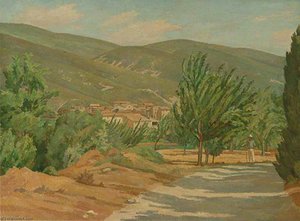 Village in Luberon, FranceTowner
Ketverios temos, dažniausiai pasikrausto originaluose, kiekvienos su savo puikiausiu pavyzdžiu.
4 muziejai, kuriuose saugoma daugiausia šioje pusėje esamų paveikslų.
| Muzejaus | Miestas | Percy Horton darbai | Šiojo sąrašo paveikslai |
|---|---|---|---|
 The Ashmolean Museum of Art And Archaeology |
Oksfordas | 2 | Flowerpiece, The Rugmaker |
 Girton College |
Cambridge | 1 | Helen Marion Wodehouse |
 Andover Guildhall |
Andover | 1 | Sydney Robert Bell, Mayor of Andover (1939–1943) |
 Towner |
Eastbourne | 1 | Village in Luberon, France |
Pasirinkite dešimtmetį, kad pamatytėte jį apibrėžusį originalą.
Unemployed Man (1929). Toliausiai eina House on the Seine (1925) ir Flowerpiece (1929).
32 metų amžiaus: Unemployed Man sukurta 1929 m. Nr. Percy Horton gimė 1897.
Unemployed Man, House on the Seine, Flowerpiece, Dulwich Trees, Coates Corner, Assington, Suffolk, Untitled A House at Ambleside, Lakeland Landscape, Portrait of the Artist's Mother, The Shepherd ir Mrs Simpson. Viršuje esančioje reitingo sąraše nurodyta kiekvieno kūrinio metis ir muziejus.
Mūsų kataloge yra 18 Percy Horton darbų, skirtų laikotarpiui nuo 1925 iki 1946.
Daugiausia – The Ashmolean Museum of Art And Archaeology (Oksfordas), Girton College (Cambridge) ir Andover Guildhall (Andover). Viršuje esančiame muziejų sąraše yra visi jie.
1940s laikotarpiu: 11 iš 18 šioje pusėje esančių darbų buvo sukurtos tada, iš jų Untitled A House at Ambleside.
Šioje pusėje seniausias darbas yra House on the Seine (1925), o naujausias – The Rugmaker (1946).
Vintage art (2), Rural landscape (2) ir Historical figure (2) iš 18 šioje pusėje esamų darbų.
Flowerpiece ir The Rugmaker: The Ashmolean Museum of Art And Archaeology, Oksfordas kolekcijoje yra 2 šioje pusėje esančių darbų.
Born in the coastal light of Brighton in 1897, Percy Frederick Horton emerged as a profound voice in the tapestry of twentieth-century British art. His journey was one defined by a deep-seated connection to the natural world and an unwavering commitment to the emotional truth found within observation. Growing up in a working-class family, Horton’s path was paved by talent and scholarship, leading him from the Brighton School of Art to the prestigious Royal College of Art. This formative period was not merely about technical mastery but about developing a soul that could converse with the landscape. His early years were marked by a significant moral stance; as a conscientious objector during the First World War, he faced imprisonment, an experience that undoubtedly deepened his introspective nature and perhaps fueled the psychological depth found in his later, more somber works.
Horton’s artistic evolution is a fascinating study of movement from the structured elegance of Academic Impressionism toward the raw, emotive power of Expressionism. Influenced by the monumental presence of Cézanne and the haunting psychological landscapes of Edvard Munch, he learned to use the brush not just to replicate reality, but to interpret it. His technique became a language of texture; through the deliberate use of impasto and bold, visible brushstrokes, he could convey the weight of a forest or the fleeting softness of a petal. This transition allowed him to move beyond mere depiction, capturing the very atmosphere—the moisture in the air, the brooding shadows of a woodland, and the quiet stillness of an English afternoon.
The breadth of Horton’s oeuvre reveals an artist capable of immense versatility, moving seamlessly between the grand scale of the English countryside and the intimate quietude of domestic life. His landscapes are perhaps his most enduring contribution to British art. In works such as ‘Lakeland Landscape’ (1943), one can feel the heavy, atmospheric tension of the Cumbrian forests, where the paint itself seems to hold the dampness of the mist. He possessed a rare ability to imbant a scene with a sense of time and place, whether it was the rugged beauty of the Lakes or the gentle, rolling hills of Suffolk, as seen in his evocative ‘Coates Corner’.
Yet, Horton was equally adept at finding the infinite within the small. His still lifes, such as the delicate ‘Flowerpiece’ (1929), demonstrate a masterful command of light and shadow. In these compositions, pink roses and weathered books are bathed in a soft, ethereal glow, inviting the viewer into a moment of profound tranquility. This duality—the ability to capture both the epic and the intimate—is what defines his unique artistic signature. His work often serves as a bridge between the Victorian sensibilities of his youth and the modern, fractured perspectives of the mid-twentieth century.
Beyond the canvas, Horton’s impact on the art world was cemented through his profound dedication to teaching. His career as an educator was as distinguished as his time as a painter. Serving as the Ruskin Master of Drawing at the University of Oxford from 1949 to 1964, he became a custodian of classical principles while encouraging the next generation to explore modern expression. He understood that true art required both a foundation in rigorous observation and the courage to experiment with form and emotion.
The legacy of Percy Frederick Horton resides not only in the museums that house his paintings but in the very way we perceive the British landscape. His life was a testament to the power of staying true to one's convictions, whether through political dissent or artistic innovation. Through his eyes, we continue to see the beauty of rural England—not as a static postcard, but as a living, breathing, and deeply emotional entity. His contributions to the Royal Society of British Artists and his lasting imprint on art education ensure that his vision remains an essential part of the historical narrative of British fine art.


