Michaelas Wolgemutas portretas

Michaelas Wolgemutas tapiai: 15 garsiausi πίναšiai, galerijos akimis

Atnaujinta lapkritis 2026 · pagal mūsų populiarumumo koeficientą (paieškos, lankytojai ir užsakymai kiekvienam kūriniui) · 15 Michaelas Wolgemutas darbai mūsų kataloge

Trumpai tariant

Galerijos akimais, garsiausias Michaelas Wolgemutas tapas yra Ursula Tucher portretas (1478), kurio originalas eksponuojamas Staatliche Museen, Kassel. Dance of Death (1493) ir A Young Man (1486) užbaia trio, kurį atpažįsta kiekvienas ž)/\ Iš 15 Michaelas Wolgemutas darbų mūsų kataloge, galerija žemiau pristato 15 garsiausius – kiekvienas yra originalus, su nurodytu metais, muziejumi bei unikaliu aprašymu.

1434 – 1519, Nurnbergas Northern renaissance Daugiausia darbų: Germanisches Nationalmuseum

10 geriausių galerijos Michaelas Wolgemutas paveikslų

1
Ursula Tucher portretas (1478) aut. Michaelas Wolgemutas

Ursula Tucher portretas

1478 · Aliejus · Staatliche Museen, Kassel

Michael Wolgemuto „Portretas Ursulos Tucherės“, kuriame naudojamas liminėlis, yra šlovingas įrodymas šiaurės rytų renesanso estetikai. Tai ne tik aristokratės Ursula Tucherin paveikslas – jos gyvenimo istorija; kūrinys išraiškina vertybes, kuriomis vadovaujosi Nėmbergė ir jos turtuomenės šeimos šį transformuojantį laikotarpį.

2
Dance of Death (1493) aut. Michaelas Wolgemutas

Dance of Death

1493 · Woodcut

A stark, monochromatic scene unfolds in this 1493 woodcut, where the boundary between life and mortality dissolves into rhythmic chaos. Several skeletons engage in a lively, unsettling dance, their bony limbs caught in exaggerated, swirling poses. At the center of this macabre movement, a figure lies prone upon the ground, seemingly caught in the momentum of the skeletal procession. The composition utilizes a circular arrangement to emphasize the cyclical nature…

3
A Young Man (1486) aut. Michaelas Wolgemutas

A Young Man

1486 · Oil On Panel · Detroito meno institutas, Detroitas

The portrait presents a bust-length view of a young man positioned slightly off-center, his gaze directed toward the right side of the frame. He wears a dark, somber headpiece and an outer garment of a similar deep black hue, which creates a sharp contrast against the pale, luminous skin of his face. Beneath the dark outer layer, a white undergarment with fine dark stripes is visible. His light brown hair…

4
Saint Lawrence and Archangel Michael with Sword and Scales (1459) aut. Michaelas Wolgemutas

Saint Lawrence and Archangel Michael with Sword and Scales

1459 · Woodcut

Saint Lawrence and Archangel Michael with Sword and Scales by Michael Wolgemut presents a vertical and crowded composition. On the right, the Archangel Michael is rendered in full plate armor, his large, feathered wings spreading behind him. He holds a sword aloft in his right hand while his left hand balances a pair of scales. Within these scales, small, nude human figures are being weighed. To the left, Saint Lawrence…

5
Portrait of the Nuremberg Apothecary Hans Perckmeister (1496) aut. Michaelas Wolgemutas

Portrait of the Nuremberg Apothecary Hans Perckmeister

1496 · Oil On Panel · Germanisches Nationalmuseum, Nurnbergas

The Portrait of the Nuremberg Apothecary Hans Perckmeister is a significant work by the German painter and printmaker Michael Wolgemut. Created in 1496, this portrait offers a direct encounter with a man of considerable civic standing in Nuremberg. The subject, Hans Perckmeister, was the son of the apothecary Conrad Perckmeister and inherited the family's professional legacy. He was a man deeply integrated into the social and political fabric of his…

6
Sermon of the Antichrist (1493) aut. Michaelas Wolgemutas

Sermon of the Antichrist

1493 · Woodcut

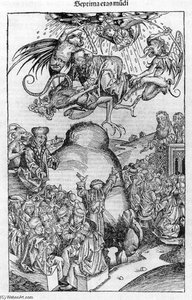
In this woodcut print from about 1493, Michael Wolgemut presents a scene of profound spiritual unrest. The work, titled Sermon of the Antichrist, depicts a religious and allegorical moment where the Antichrist delivers a sermon to a gathered audience. A large, ambiguous form dominates the middle ground, acting as a central mass around which the crowd is tightly packed. This central figure draws the eye, anchoring the chaotic energy of…

7
Circe and Ulysses (1493) aut. Michaelas Wolgemutas

Circe and Ulysses

1493 · Woodcut

In this woodcut from 1493, we find ourselves drawn into a quiet, tense moment of maritime drama. The scene captures the mythological intersection of Circe and Ulysses, set upon the deck of a large, detailed vessel. There is a certain stillness to the composition, despite the inherent tension of the narrative. The central figure of Circe occupies a prominent position, her presence commanding the space around her as figures interact…

8
The Virgin and Child with Saint Anne (1510) aut. Michaelas Wolgemutas

The Virgin and Child with Saint Anne

1510 · Oil On Panel · Germanisches Nationalmuseum, Nurnbergas

The composition settles into a vertical stillness, a ladder of holy figures rising toward the light. Saint Anne, the Virgin Mary, and the Christ Child occupy the center, their bodies forming a stable, sculptural pyramid. Deep reds and heavy blacks anchor the figures, while the soft pink of a drapery fold catches the light. Through the architectural pillars that frame the scene, a distant landscape unfolds in muted greens and…

9
Portrait of Levinus Memminger (1485) aut. Michaelas Wolgemutas

Portrait of Levinus Memminger

1485 · Oil On Panel · Thyssen-Bornemisza muziejus, Madridas

The year is 1485, and within the bustling workshop of Michael Wolgemut in Nuremberg, a portrait emerges – a meticulously rendered depiction of Levinus Memminger, a prominent figure in the city's civic life. More than simply a likeness, this painting offers a captivating glimpse into the artistic sensibilities and social dynamics of early Renaissance Germany. Wolgemut’s work isn’t merely a representation; it’s an invitation to contemplate status, wealth, and the…

10
Last Judgement (1500) aut. Michaelas Wolgemutas

Last Judgement

1500 · Germanisches Nationalmuseum, Nurnbergas

In the profound stillness of the late fifteenth century, Michael Wolgemut captured a moment of unparalleled cosmic significance. His Last Judgement is not merely a painting but a window into the medieval soul, a dramatic tableau where the temporal meets the eternal. The composition centers upon the majestic figure of Jesus Christ, serving as the ultimate arbiter of human destiny. Surrounding Him is a dense, emotive tapestry of humanity; men…

Michaelas Wolgemutas tapiai, rangos nuo 11 iki 15

Temos, kurios domino Michaelas Wolgemutas

Ketverios temos, dažniausiai pasikrausto originaluose, kiekvienos su savo puikiausiu pavyzdžiu.

Muziejai, kuriuose saugomi Michaelas Wolgemutas originalūs darbai

5 muziejai, kuriuose saugoma daugiausia šioje pusėje esamų paveikslų.

Muzejaus Miestas Michaelas Wolgemutas darbai Šiojo sąrašo paveikslai
Germanisches Nationalmuseum, NurnbergasGermanisches Nationalmuseum Nurnbergas 4 Portrait of the Nuremberg Apothecary Hans Perckmeister, The Virgin and Child with Saint Anne, Last Judgement
Staatliche Museen, KasselStaatliche Museen Kassel 1 Ursula Tucher portretas
Detroito meno institutas, DetroitasDetroito meno institutas Detroitas 1 A Young Man
Thyssen-Bornemisza muziejus, MadridasThyssen-Bornemisza muziejus Madridas 1 Portrait of Levinus Memminger
Brighton Museum & Art Gallery, Brighton and HoveBrighton Museum & Art Gallery Brighton and Hove 1 Triptych with the Nativity and Saints

Michaelas Wolgemutas, po vieno ikoninio paveikslio kiekvienam dešimtmenės laikotarpiui

Darbai pagal dešimtmečius

Pasirinkite dešimtmetį, kad pamatytėte jį apibrėžusį originalą.

Michaelas Wolgemutas tapyiniai: galerijos atsakymai

Kuris Michaelas Wolgemutas paveikslas yra pats garsiausias iš visų?Atsakymas

Ursula Tucher portretas (1478), Staatliche Museen, Kassel. Toliau seka Dance of Death (1493) ir A Young Man (1486).

Kiek metų buvo Michaelas Wolgemutas, kai sukūrė Ursula Tucher portretas?Atsakymas

44 metų amžiaus: Ursula Tucher portretas sukurta 1478 m. Nr. Michaelas Wolgemutas gimė 1434.

Kuriose yra 10 geriausių Michaelas Wolgemutas paveikslų?Atsakymas

Ursula Tucher portretas, Dance of Death, A Young Man, Saint Lawrence and Archangel Michael with Sword and Scales, Portrait of the Nuremberg Apothecary Hans Perckmeister, Sermon of the Antichrist, Circe and Ulysses, The Virgin and Child with Saint Anne, Portrait of Levinus Memminger ir Last Judgement. Viršuje esančioje reitingo sąraše nurodyta kiekvieno kūrinio metis ir muziejus.

Kiek kūrinių sukūrė Michaelas Wolgemutas?Atsakymas

Mūsų kataloge yra 15 Michaelas Wolgemutas darbų, skirtų laikotarpiui nuo 1459 iki 1510.

Kur kabinami garsiausi Michaelas Wolgemutas originalūs darbai?Atsakymas

Daugiausia – Germanisches Nationalmuseum (Nurnbergas), Staatliche Museen (Kassel) ir Detroito meno institutas (Detroitas). Viršuje esančiame muziejų sąraše yra visi jie.

Kada Michaelas Wolgemutas sukūrė savo garsiausias paveikslus?Atsakymas

1490s laikotarpiu: 4 iš 15 šioje pusėje esančių darbų buvo sukurtos tada, iš jų Dance of Death.

Kokie yra ankstyviausi ir vėliausi garsieji Michaelas Wolgemutas kūriniai?Atsakymas

Šioje pusėje seniausias darbas yra Saint Lawrence and Archangel Michael with Sword and Scales (1459), o naujausias – The Virgin and Child with Saint Anne (1510).

Kurią temą Michaelas Wolgemutas kūrė dažniausiai?Atsakymas

Man (3), Detail (2) ir Monochrome (2) iš 15 šioje pusėje esamų darbų.

Kurią techniką Michaelas Wolgemutas naudojo dažniausiai?Atsakymas

Woodcut, iš 15 šios puslapio darbų – 4.

Su kokiu kierliu siejama Michaelas Wolgemutas?Atsakymas

Northern renaissance, vadovaujantis šios puslapio originalais kūriniais.

Kurių Michaelas Wolgemutas originalų turi Germanisches Nationalmuseum?Atsakymas

Portrait of the Nuremberg Apothecary Hans Perckmeister, The Virgin and Child with Saint Anne ir Last Judgement: Germanisches Nationalmuseum, Nurnbergas kolekcijoje yra 4 šioje pusėje esančių darbų.

Michaelas Wolgemutas: menininkas

A Nuremberg Master: The Life and Legacy of Michael Wolgemut

Born around 1434 in the vibrant city of Nuremberg, Germany, Michael Wolgemut emerged as a pivotal figure in the transition from Late Gothic to Renaissance art. His name, sometimes rendered as Wohlgemuth or Wolgemuth, resonates through art history not only for his own artistic contributions but also—and perhaps more profoundly—for his role as mentor to one of the greatest masters of all time: Albrecht Dürer. Wolgemut’s journey began within a familial artistic tradition; he received his initial training from his father, Valentin Wolgemut, a painter himself. This foundation instilled in him an early appreciation for the craft and set the stage for a career that would span decades and leave an indelible mark on German art. He further honed his skills as an assistant to Hans Pleydenwurff, a prominent Nuremberg artist, gaining invaluable experience within a bustling workshop environment. A brief sojourn in Munich with Gabriel Malesskircher proved less fruitful, ending in a legal dispute, but it underscored Wolgemut’s ambition and willingness to seek opportunities beyond his native city.

Workshop Leadership and Artistic Development

A turning point arrived in 1472 when Wolgemut married Pleydenwurff's widow, Barbara, inheriting not only a life partner but also the established workshop of one of Nuremberg’s leading artists. This acquisition propelled him to the forefront of the city’s artistic scene. Wilhelm Pleydenwurff, Hans’ son, joined the workshop as an assistant and later became a partner, creating a dynamic collaborative environment. Under Wolgemut's direction, the workshop flourished, becoming renowned for its diverse output—from intricately carved and painted wood retables to exquisitely detailed altar pieces. His style reveals a clear influence from Flemish masters, suggesting possible travels within Flanders (modern Belgium and surrounding areas). This is evident in his meticulous attention to detail, rich color palettes, and realistic depictions of figures and textures. He wasn’t merely replicating the Flemish aesthetic; he was adapting it, infusing it with a distinctly German sensibility that would characterize much of Northern Renaissance art.

The Nuremberg Chronicle and the Rise of Woodcut

Wolgemut's legacy extends far beyond painting. He stands as a key figure in the revival of German woodcut artistry. His workshop became a prolific producer of woodcuts, often commissioned by publishers to illustrate books—a burgeoning market fueled by the recent invention of the printing press. These weren’t simply functional illustrations; they were works of art in their own right, demonstrating advancements in technique that allowed for more nuanced depictions of volume and shading. Frequently hand-colored after printing, these woodcuts brought visual narratives to a wider audience than ever before. However, his most monumental achievement remains his collaboration with Wilhelm Pleydenwurff on the illustrations for Hartmann Schedel’s *Liber Chronicarum*, published in 1493—better known as the Nuremberg Chronicle. This lavishly illustrated chronicle was a landmark publication, showcasing Wolgemut's mastery of woodcut design and meticulous planning. The project involved creating hundreds of intricate images depicting biblical scenes, historical events, and fantastical creatures, all meticulously laid out alongside Schedel’s text. The sheer scale and ambition of the Nuremberg Chronicle cemented Wolgemut’s reputation as a leading artist of his time.

A Teacher's Influence: Dürer and Beyond

Perhaps Michael Wolgemut’s most enduring legacy lies in his role as teacher to Albrecht Dürer, arguably Germany’s greatest artist. Dürer apprenticed with Wolgemut between 1486 and 1489, receiving a comprehensive artistic education that laid the foundation for his own groundbreaking career. While Dürer ultimately surpassed his mentor in fame and innovation, he consistently acknowledged Wolgemut's influence throughout his life. He learned not only technical skills—drawing, painting, woodcut techniques—but also the importance of meticulous observation, careful composition, and a dedication to craftsmanship. Wolgemut instilled in Dürer a deep appreciation for both artistic tradition and innovative experimentation. Beyond Dürer, Wolgemut’s workshop trained numerous other artists, contributing significantly to the flourishing artistic landscape of Nuremberg and beyond. His contribution to German art isn't solely defined by his individual works but also by the vibrant artistic ecosystem he fostered.

Lasting Significance

Michael Wolgemut died in 1519, leaving behind a rich artistic legacy that continues to resonate today. Major works such as the Retable of the High Altar at Zwickau (1479), the Great Retable for the Church of the Augustinian Friars in Nuremberg, and the Town Hall Decorations at Goslar demonstrate his versatility and skill. His portraits, known for their realistic depictions and meticulous detail—examples are held by institutions like the Royal Institution in Liverpool—reveal a keen eye for character and individuality. Wolgemut’s influence extended beyond his direct students; his innovative approach to woodcut design helped shape the development of German art in the late 15th century, impacting book production and artistic dissemination during the Renaissance. He successfully blended Flemish influences with local traditions, creating a unique style that paved the way for future generations of artists. He remains a vital link between the Late Gothic period and the burgeoning Renaissance, a testament to his enduring contribution to art history.