


1

Atnaujinta lapkritis 2026 · pagal mūsų populiarumumo koeficientą (paieškos, lankytojai ir užsakymai kiekvienam kūriniui) · 31 Kaff Gerrard darbai mūsų kataloge
Trumpai tariant
Galerijos akimais, garsiausias Kaff Gerrard tapas yra Autumn Landscape (1930), kurio originalas eksponuojamas Middlesbrough Institute of Modern Art, Middlesbrough. Swan Song (Flying Bomb) (1944) ir Portrait of a Man (1923) užbaia trio, kurį atpažįsta kiekvienas ž)/\ Iš 31 Kaff Gerrard darbų mūsų kataloge, galerija žemiau pristato 31 garsiausius – kiekvienas yra originalus, su nurodytu metais, muziejumi bei unikaliu aprašymu.


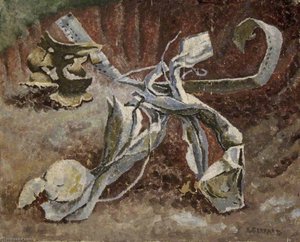
 Poppy in a Glass Jar
12
 Haysom's Quarry, Isle of Purbeck
13
 Still Life with a Pumpkin and a Green Jug
14
 In the Twilight, in the Evening
15
 Moonlight at Thetford Priory
16
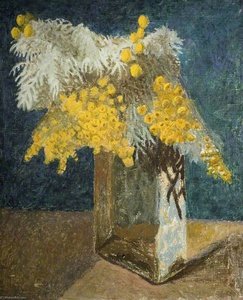 Artemisia in a Glass Vase
17
 Canterbury Bells (recto)Abbot Hall Art Gallery
18
 Large CornfieldAbbot Hall Art Gallery
19
 Vase of Paeonies on a WindowsillAbbot Hall Art Gallery
20
 The Cornfield by Moonlight
21
 Landscape with Pink Trees
22
 Still Life with Fruit and Mushrooms
23
 PoppiesMiddlesbrough Institute of Modern Art
24Twisted Metal in CraterFitzwilliam College
25
 Fungi and WoodlandFitzwilliam College
26
 Seascape with Cliffs
27
 Corn Stooks
28
 Small Fungus PaintingFitzwilliam College
29
 Large Sussex LandscapeThe Hepworth Wakefield
30
 Still Life with Fungi in BasketAbbot Hall Art Gallery
31
 Still LifeThe Hepworth Wakefield
5 muziejai, kuriuose saugoma daugiausia šioje pusėje esamų paveikslų.
| Muzejaus | Miestas | Kaff Gerrard darbai | Šiojo sąrašo paveikslai |
|---|---|---|---|
 Abbot Hall Art Gallery |
Kendal | 5 | Canterbury Bells (verso), Canterbury Bells (recto), Large Cornfield |
 Middlesbrough Institute of Modern Art |
Middlesbrough | 4 | Autumn Landscape, Wheatsheaves under the Sun, Moonlit Cornstocks |
 Fitzwilliam College |
Cambridge | 3 | Twisted Metal in Crater, Fungi and Woodland, Small Fungus Painting |
 The Hepworth Wakefield |
Wakefield | 2 | Large Sussex Landscape, Still Life |
 Government Art Collection |
Londonas | 1 | Swan Song (Flying Bomb) |
Pasirinkite dešimtmetį, kad pamatytėte jį apibrėžusį originalą.
Autumn Landscape (1930), Middlesbrough Institute of Modern Art, Middlesbrough. Toliau seka Swan Song (Flying Bomb) (1944) ir Portrait of a Man (1923).
36 metų amžiaus: Autumn Landscape sukurta 1930 m. Nr. Kaff Gerrard gimė 1894.
Autumn Landscape, Swan Song (Flying Bomb), Portrait of a Man, Wheatsheaves under the Sun, Moonlit Cornstocks, Bomb Fragments with Incendiaries, Twisted Metal and Doodlebug, Bomb Damage with Cows, The Big Wave ir Canterbury Bells (verso). Viršuje esančioje reitingo sąraše nurodyta kiekvieno kūrinio metis ir muziejus.
Mūsų kataloge yra 31 Kaff Gerrard darbų, skirtų laikotarpiui nuo 1923 iki 1950.
Daugiausia – Abbot Hall Art Gallery (Kendal), Middlesbrough Institute of Modern Art (Middlesbrough) ir Fitzwilliam College (Cambridge). Viršuje esančiame muziejų sąraše yra visi jie.
1940s laikotarpiu: 4 iš 31 šioje pusėje esančių darbų buvo sukurtos tada, iš jų Swan Song (Flying Bomb).
Šioje pusėje seniausias darbas yra Portrait of a Man (1923), o naujausias – The Big Wave (1950).
Impressionism, vadovaujantis šios puslapio originalais kūriniais.
Canterbury Bells (verso), Canterbury Bells (recto) ir Large Cornfield: Abbot Hall Art Gallery, Kendal kolekcijoje yra 5 šioje pusėje esančių darbų.
Kaff Gerrard, born Katherine Leigh-Pemberton in 1894, remains a compelling figure in British art history—not for prolific output during her lifetime, but for the remarkable story of her posthumous recognition. For decades, her evocative paintings and subtly powerful pottery lay largely unseen, known only within a small circle of friends and family. It wasn’t until 1991, with an exhibition at the Royal Museum & Art Gallery in Canterbury, that Gerrard's work began to capture the attention it deserved, leading to acquisitions by major national institutions like the Tate and the Imperial War Museum. Her journey is a testament to the enduring power of artistic vision and the sometimes-delayed nature of critical acclaim.
Gerrard’s formal training took place at the prestigious Slade School of Art from 1922 to 1924, where she quickly distinguished herself as a gifted student. She garnered several prizes, including first prize for painting from the cast in 1922 and accolades for both life and portrait painting the following year. This early success hinted at a promising career, but her path took an unexpected turn upon meeting Alfred Gerrard, who would become her husband and a prominent sculptor in his own right. Their marriage in 1933 marked a shift towards a more secluded artistic existence. The couple settled into an old farmhouse in Kent, where they cultivated both a home and a shared creative life.
While Alfred Gerrard focused on developing his teaching career at the Slade and fulfilling public commissions, Kaff Gerrard dedicated herself to painting, pottery, and sculpture. Her artistic focus centered around the landscapes of Sussex and the South Downs, which she explored almost daily. This immersion in nature wasn’t merely representational; it was a deeply spiritual engagement. Her paintings are characterized by a visionary quality, drawing comparisons to Paul Nash in their ability to imbue the natural world with symbolic weight. She didn't simply depict what she saw but sought to capture an underlying essence, a pantheistic connection between the land and something greater.
The outbreak of World War II profoundly impacted Gerrard’s work. She turned her attention to documenting the rural scenes transformed by conflict—crashed planes, bomb damage, and the quiet devastation left in war's wake. At least one of these poignant depictions was acquired by the War Artists' Advisory Committee, a testament to their emotional resonance and historical significance. However, even during this period, she didn’t abandon her more abstract explorations. Gerrard frequently incorporated heavily symbolic content into her paintings, often with Christian undertones, suggesting a complex inner life and a search for meaning amidst upheaval.
Despite her consistent artistic output, Kaff Gerrard remained largely outside the public eye during her lifetime. She had only one joint exhibition with Alfred at Colnaghi gallery in 1931, showcasing both their sculpture and pottery. This relative obscurity makes her rediscovery all the more remarkable. The 1991 Canterbury exhibition proved to be a watershed moment, prompting a reassessment of her work and revealing a unique artistic voice that had been overlooked for far too long.
The acquisition of her paintings by institutions like the Tate, the Imperial War Museum, and the Fitzwilliam Museum cemented Gerrard’s place in British art history. Her legacy lies not only in the beauty and evocative power of her work but also in its quiet resistance to easy categorization. She wasn't aligned with any particular school or movement; instead, she forged her own path, guided by a deeply personal vision and an unwavering commitment to exploring the landscapes—both external and internal—that shaped her artistic sensibility. Her story serves as a powerful reminder that true artistry often transcends immediate recognition, finding its audience and resonance in unexpected moments.