Džonas Martinas portretas

87 garsiausių Džonas Martinas paveikių rinkinys: galerijos išboru

Atnaujinta spalis 2026 · pagal mūsų populiarumumo koeficientą (paieškos, lankytojai ir užsakymai kiekvienam kūriniui) · 88 Džonas Martinas darbai mūsų kataloge

Trumpai tariant

Iš visų paliktų originalų kūrinių Džonas Martinas garsiausias yra Didžioji Jo pykčio diena (1851), esantis Tate Britain kolekcijoje, Londras. Tiesiog už jų seka The Destruction of Sodom And Gomorrah (1852) ir The Evening of the Deluge (1828). Mūsų kataloge yra 88 darbų autoriaus Džonas Martinas; galerija išsaugojo 87 labiausiai pasaulyje žyminiausių kūrinių – kiekvienas jų pateikiamas su datos, muziejaus ir istorijos aprašymu.

1789 – 1854, Heidon Bridžas Romanticism Daugiausia darbų: Yale Center for British Art

Džonas Martinas geriausios 10 paveikslų: galerijos pasirinkimas

1
Didžioji Jo pykčio diena (1851) aut. Džonas Martinas

Didžioji Jo pykčio diena

1851 · Aliejus ant drobės · Tate Britain, Londras

Devynioliktosios amžiaus šerduje nedarbingai galėjo sujaudinti viktorianės sielą tiek baimės ir nuostabos, kaip John Martin kūrinys "Didžioji Jo pykčio diena". Šis monumentalus dalykas ant pluošto nėra tik paveikslas; tai viskiškas aukštybių pojūčio, sublimumo patyrimas. Laikui bėgant žvelgiant per platų, turbulentišką krauniškį, žmogus nedelsনtai yra suhimlaudamas nuo didžiulės destrukcijos masto. Scena užfiksuoja tiksliką biblijinio apokalipsės momentą, kai dangus lūžta, o pati žemė atrodo ištirpstanti ugnies ir šešėlio kupinoje erdvėje. Martinas, melodramatinio…

2
The Destruction of Sodom And Gomorrah (1852) aut. Džonas Martinas

The Destruction of Sodom And Gomorrah

1852 · Oil On Canvas · Laing Art Gallery, Newcastle upon Tyne

The heavens do not merely darken; they fracture. A massive, swirling vortex of fiery clouds dominates the upper reaches of the canvas, a celestial furnace that seems to swallow the very air. Light does not fall from above in a gentle glow but erupts from the center of a cosmic explosion. It is a violent, directional radiance that carves the landscape into jagged silhouettes of deep black and shadowy blue.…

3
The Evening of the Deluge (1828) aut. Džonas Martinas

The Evening of the Deluge

1828 · Engraving · Victoria and Albert Museum, Londonas

To stand before John Martin's monumental vision, The Evening of the Deluge, is not merely to observe a painting; it is to be submerged within an epochal moment of divine wrath and human fragility. Created in 1828, this work transcends simple depiction, becoming instead a profound meditation on humanity’s place against the overwhelming power of nature. Martin, a master chronicler of the sublime, utilized his immense scale—a staggering 597 x…

4
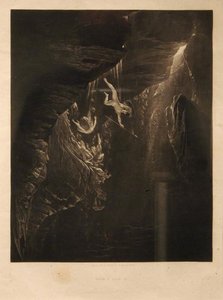
Eva (1827) aut. Džonas Martinas

Eva

1827 · Graviruotė · Te Papa, Velingtonas

In the engraving Eve, John Martin captures a moment of profound spiritual weight. Created about 1827, the print presents a scene of divine confrontation. Two angelic figures dominate the center of the frame. One angel clutches a sword with an expression of palpable distress, while the other holds the weapon aloft, a symbol of celestial authority. Below them, the human condition is laid bare through two men: one attempts to…

5
Great Day of His Wrath (1851) aut. Džonas Martinas

Great Day of His Wrath

1851 · Oil On Canvas · Tate Gallery, Londonas

The canvas bears the title Great Day of His Wrath. It is a work by the English romantic painter John Martin. Created in 1851, the painting captures a moment of profound upheaval. It exists as a single movement within a larger triptych of judgement pictures. This series draws its heavy inspiration from the Book of Revelation.

6
Destruction of Tyre (1840) aut. Džonas Martinas

Destruction of Tyre

1840 · Oil On Canvas · Toledo meno muziejus, Toledo

John Martin's "Destruction of Tyre," completed in 1840, is not merely a depiction of a historical event; it is a visceral embodiment of Romanticism’s fascination with the sublime – that overwhelming feeling of awe and terror inspired by nature’s power. Measuring an imposing 95 x 838 cm, this oil on canvas transports the viewer directly into the heart of apocalyptic chaos. The scene, based on the biblical account in 2…

7
Satan in Council aut. Džonas Martinas

Satan in Council

Engraving

The scene unfolds through the vision of Satan in Council, a dramatic work by the English romantic painter John Martin. This composition captures a moment of intense celestial and infernal tension, pulling the viewer into a realm of shadow and light. The work is also recognized by the title Satan presiding at the Infernal Council, a name that speaks to the heavy authority commanding the assembly. It exists as a…

8
Pandemonium (1841) aut. Džonas Martinas

Pandemonium

1841 · Oil On Canvas

The Sublime Terror of the Infernal Capital In the annals of Romanticism, few images command the eye with such overwhelming dread and grandeur as John Martin’s Pandemonium. Painted in 1841, this oil on canvas is not merely a depiction of a scene; it is an immersive descent into the heart of cosmic chaos. The viewer is immediately confronted by the sheer, terrifying scale of Hell’s capital, where the architecture of…

9
Fall of Babylon aut. Džonas Martinas

Fall of Babylon

The heavens fracture as the destruction of Babylon unfolds in this dramatic vision by John Martin. The scene captures a terrifying Old Testament biblical narrative, where the once-mighty city faces its ultimate end. Chaos reigns as the landscape is swallowed by upheaval, reflecting a moment of divine judgment that feels immediate and overwhelming. The scale of the catastrophe looms large, turning the sprawling cityscape into a site of profound human…

10
Belshazzar's Feast aut. Džonas Martinas

Belshazzar's Feast

Oil On Canvas · Carnavalet muziejus, Paris

The scene unfolds within a vast, architectural interior where a long dining table occupies the central space. Around this table, fourteen figures are positioned in various states of repose and movement. Some individuals sit in chairs, while others kneel or stand near the edges of the gathering. The table is laden with food and drink, set against a backdrop of grand, structural elements. Above the assembly, a clock hangs upon…

Džonas Martinas darba rinkinys tęsiamas, nuo 11 iki 87

11The Plains of Heaven aut. Džonas MartinasThe Plains of Heaven 12The Great Day of His Wrath aut. Džonas MartinasThe Great Day of His Wrath 13Satan Arousing the Fallen Angels, Book 1, line 314, from John Milton, Paradise Lost (1824) aut. Džonas MartinasSatan Arousing the Fallen Angels, Book 1, line 314, from John Milton, Paradise Lost1824 14The Last Man (1849) aut. Džonas MartinasThe Last Man1849 · Walker Art Gallery 15Landscape with a Castle (1815) aut. Džonas MartinasLandscape with a Castle1815 · Yale Center for British Art 16Plate from aut. Džonas MartinasPlate fromTate Britain 17Ancestor Worship (1964) aut. Džonas MartinasAncestor Worship1964 · Kanados Nacionalinė galerija 18Moonlight - Chepstow Castle (1815) aut. Džonas MartinasMoonlight - Chepstow Castle1815 · Art Gallery of South Australia 19Sadak in Search of the Waters of Oblivion aut. Džonas MartinasSadak in Search of the Waters of OblivionMuseum of Fine Arts 20Kensington Garden (1815) aut. Džonas MartinasKensington Garden1815 · Yale Center for British Art 21Kensington Garden (1815) aut. Džonas MartinasKensington Garden1815 · Yale Center for British Art 22Kensington Gardens (1815) aut. Džonas MartinasKensington Gardens1815 · Yale Center for British Art 23Landscape, Possibly the Isle of Wight or Richmond Hill (1815) aut. Džonas MartinasLandscape, Possibly the Isle of Wight or Richmond Hill1815 · Yale Center for British Art 24Hyde Park (1815) aut. Džonas MartinasHyde Park1815 · Yale Center for British Art 25The Court of God: Paradise Lost (Book 3, Line 365) (1824) aut. Džonas MartinasThe Court of God: Paradise Lost (Book 3, Line 365)1824 · Kanados Nacionalinė galerija 26Diogenes Throwing Away His Cup (1833) aut. Džonas MartinasDiogenes Throwing Away His Cup1833 27Alpheus and Arethusa (1832) aut. Džonas MartinasAlpheus and Arethusa1832 28The Deluge (1834) aut. Džonas MartinasThe Deluge1834 29Joshua Commanding the Sun to Stand Still (1840) aut. Džonas MartinasJoshua Commanding the Sun to Stand Still1840 · Yale Center for British Art 30The Assuaging of the Waters (1840) aut. Džonas MartinasThe Assuaging of the Waters1840 · Fine Arts Museums of San Francisco 31Twilight in the woodlands (1850) aut. Džonas MartinasTwilight in the woodlands1850 · Fitzwilliam Museum 32Landscape: View in Richmond Park (1850) aut. Džonas MartinasLandscape: View in Richmond Park1850 · Fitzwilliam Museum 33The Last Judgement (study) (1851) aut. Džonas MartinasThe Last Judgement (study)1851 · Yale Center for British Art 34Christ Stilleth the Tempest (1852) aut. Džonas MartinasChrist Stilleth the Tempest1852 · York Art Gallery 35F shaw brothers tannery maine aut. Džonas MartinasF shaw brothers tannery maineBavarijos valstybinės paveikslų kolekcijos 36Paradise Lost. Adam and Eve Driven out of Paradise aut. Džonas MartinasParadise Lost. Adam and Eve Driven out of Paradise 37Seventh Plague aut. Džonas MartinasSeventh Plague 38Gleaners in the Wheat Field aut. Džonas MartinasGleaners in the Wheat Field 39The Last Judgement aut. Džonas MartinasThe Last JudgementTate Britain 40The Isle of Man aut. Džonas MartinasThe Isle of Man 41The Destruction of Sodom and Gomorrah aut. Džonas MartinasThe Destruction of Sodom and Gomorrah 42The Valley of the Tyne, My Native Country, near Henshaw aut. Džonas MartinasThe Valley of the Tyne, My Native Country, near Henshaw 43Destruction of Pharaoh's Host aut. Džonas MartinasDestruction of Pharaoh's Host 44The Covenant aut. Džonas MartinasThe Covenant 45Figures Seated by a Lake in a Wooded Landscape aut. Džonas MartinasFigures Seated by a Lake in a Wooded Landscape 46Psalm CXXVII (by the Waters of Babylon) aut. Džonas MartinasPsalm CXXVII (by the Waters of Babylon) 47Moses Breaketh the Tables aut. Džonas MartinasMoses Breaketh the Tables 48A Man Playing a Harp with other Figures beside a Lake aut. Džonas MartinasA Man Playing a Harp with other Figures beside a Lake 49Ruins of an Ancient City aut. Džonas MartinasRuins of an Ancient CityCleveland Museum of Art 50Joshua Commanding the Sun to Stand Still upon Gibeon aut. Džonas MartinasJoshua Commanding the Sun to Stand Still upon Gibeon 51Landscape with a Ruined Castle aut. Džonas MartinasLandscape with a Ruined Castle 52Edwin and Angelina (also known as The Hermit) aut. Džonas MartinasEdwin and Angelina (also known as The Hermit) 53The Plains of Heaven (1851) aut. Džonas MartinasThe Plains of Heaven1851 · Tate Britain 54Repentance of Nineveh (1840) aut. Džonas MartinasRepentance of Nineveh1840 · Yale University Art Gallery 55Iguanodoje žemė (1837) aut. Džonas MartinasIguanodoje žemė1837 · Te Papa 56Plate from aut. Džonas MartinasPlate fromTate Britain 57Plate from aut. Džonas MartinasPlate fromTate Britain 58Fall of the Rebel Angels aut. Džonas MartinasFall of the Rebel AngelsHarvard Art Museums 59Paradise Lost. The Creation of Light aut. Džonas MartinasParadise Lost. The Creation of Light 60Flood at night aut. Džonas MartinasFlood at night 61David Spareth Saul at Hachilah aut. Džonas MartinasDavid Spareth Saul at Hachilah 62Fall of the Walls of Jericho aut. Džonas MartinasFall of the Walls of Jericho 63Fantastic Oriental Landscape aut. Džonas MartinasFantastic Oriental Landscape 64Fall of the Rebel Angels aut. Džonas MartinasFall of the Rebel Angels 65Christ's glorious coming aut. Džonas MartinasChrist's glorious coming 66The Assuaging of the Waters aut. Džonas MartinasThe Assuaging of the Waters 67Creation of Light aut. Džonas MartinasCreation of Light 68View on the River Wye, Looking towards Chepstow aut. Džonas MartinasView on the River Wye, Looking towards Chepstow 69Joshua commanding the Sun to stand still aut. Džonas MartinasJoshua commanding the Sun to stand still 70Eve's Dream - Satan aroused aut. Džonas MartinasEve's Dream - Satan aroused 71The Fallen Angels Entering Pandemonium, from Paradise Lost aut. Džonas MartinasThe Fallen Angels Entering Pandemonium, from Paradise LostTate Britain 72View of Dolbadern Castle, North Wales aut. Džonas MartinasView of Dolbadern Castle, North Wales 73A Country Graveyard, Possibly Bunhill Fields, Finsbury, A Wooded Landscape Beyond aut. Džonas MartinasA Country Graveyard, Possibly Bunhill Fields, Finsbury, A Wooded Landscape Beyond 74Belshazzar (1820) aut. Džonas MartinasBelshazzar1820 · Yale Center for British Art 75Manfred and the Alpine Witch (1837) aut. Džonas MartinasManfred and the Alpine Witch1837 · Whitworth Art Gallery 76Pandemonium - John Martin (2026) aut. Džonas MartinasPandemonium - John Martin2026 77Sadak in Search of the Waters of Oblivion (1812) aut. Džonas MartinasSadak in Search of the Waters of Oblivion1812 · Saint Louis Art Museum 78Seventh Plague of Egypt aut. Džonas MartinasSeventh Plague of EgyptMuseum of Fine Arts 79The Destruction of Pompeii and Herculaneum (1822) aut. Džonas MartinasThe Destruction of Pompeii and Herculaneum1822 80Joshua Commanding the Sun to Stand Still upon Gibeon (1816) aut. Džonas MartinasJoshua Commanding the Sun to Stand Still upon Gibeon1816 · National Gallery of Art 81The Eve of the Deluge (1840) aut. Džonas MartinasThe Eve of the Deluge1840 · Royal Collection 82Manfred on the Jungfrau (1837) aut. Džonas MartinasManfred on the Jungfrau1837 · Birmingham Museum and Art Gallery 83The Celestial City and the River of Bliss (1841) aut. Džonas MartinasThe Celestial City and the River of Bliss1841 84Macbeth aut. Džonas MartinasMacbeth 85The Coronation of Queen Victoria aut. Džonas MartinasThe Coronation of Queen VictoriaTate Britain 86The Bard (1817) aut. Džonas MartinasThe Bard1817 · Yale Center for British Art 87The Deluge (1834) aut. Džonas MartinasThe Deluge1834 · Yale Center for British Art

žymios Džonas Martinas tapiojamos, pagal laikotarpį

Temos, kurios domino Džonas Martinas

Ketverios temos, dažniausiai pasikrausto originaluose, kiekvienos su savo puikiausiu pavyzdžiu.

Muziejai, kuriuose saugomi Džonas Martinas originalūs darbai

8 muziejai, kuriuose saugoma daugiausia šioje pusėje esamų paveikslų.

Muzejaus Miestas Džonas Martinas darbai Šiojo sąrašo paveikslai
Yale Center for British Art, New HavenYale Center for British Art New Haven 11 Landscape with a Castle, Kensington Garden, Kensington Garden
Tate Britain, LondrasTate Britain Londras 8 Didžioji Jo pykčio diena, Plate from, The Last Judgement
Te Papa, VelingtonasTe Papa Velingtonas 2 Eva, Iguanodoje žemė
Kanados Nacionalinė galerija, OtavaKanados Nacionalinė galerija Otava 2 Ancestor Worship, The Court of God: Paradise Lost (Book 3, Line 365)
Museum of Fine Arts, BostonasMuseum of Fine Arts Bostonas 2 Sadak in Search of the Waters of Oblivion, Seventh Plague of Egypt
Fitzwilliam MuseumFitzwilliam Museum 2 Twilight in the woodlands, Landscape: View in Richmond Park
Laing Art Gallery, Newcastle upon TyneLaing Art Gallery Newcastle upon Tyne 1 The Destruction of Sodom And Gomorrah
Victoria and Albert Museum, LondonasVictoria and Albert Museum Londonas 1 The Evening of the Deluge

Džonas Martinas dešimtmetėms po dešimtmetės: originalus kūrinys, apibūdinantis kiekvieną iš jų

Darbai pagal dešimtmečius

Pasirinkite dešimtmetį, kad pamatytėte jį apibrėžusį originalą.

Kolekcjonerų klausimai apie Džonas Martinas paveikslus

Kuriu darbu Džonas Martinas yra labiausiai garsus?Atsakymas

Didžioji Jo pykčio diena (1851), Tate Britain, Londras. Toliau seka The Destruction of Sodom And Gomorrah (1852) ir The Evening of the Deluge (1828).

Kokia buvo Džonas Martinas amžius, kai buvo sukurtas Didžioji Jo pykčio diena?Atsakymas

62 metų amžiaus: Didžioji Jo pykčio diena sukurta 1851 m. Nr. Džonas Martinas gimė 1789.

Kokie yra 10 garsiausių Džonas Martinas paveikslų?Atsakymas

Didžioji Jo pykčio diena, The Destruction of Sodom And Gomorrah, The Evening of the Deluge, Eva, Great Day of His Wrath, Destruction of Tyre, Satan in Council, Pandemonium, Fall of Babylon ir Belshazzar's Feast. Viršuje esančioje reitingo sąraše nurodyta kiekvieno kūrinio metis ir muziejus.

Kiek paveikslų paliko Džonas Martinas?Atsakymas

Mūsų kataloge yra 88 Džonas Martinas darbų, skirtų laikotarpiui nuo 1812 iki 1852.

Kuriuose muziejuose eksponuojami Džonas Martinas šedevrai?Atsakymas

Daugiausia – Yale Center for British Art (New Haven), Tate Britain (Londras) ir Te Papa (Velingtonas). Viršuje esančiame muziejų sąraše yra visi jie.

Kuriomis metais Džonas Martinas tapo savo garsiausius kūrinius?Atsakymas

1810s laikotarpiu: 10 iš 87 šioje pusėje esančių darbų buvo sukurtos tada, iš jų Landscape with a Castle.

Kokie yra pirmasis ir paskutinis garsieji Džonas Martinas originalūs darbai?Atsakymas

Šioje pusėje seniausias darbas yra Sadak in Search of the Waters of Oblivion (1812), o naujausias – The Destruction of Sodom And Gomorrah (1852).

Kurią temą Džonas Martinas rinkosi dažniausiai?Atsakymas

People (12), Landscape (12) ir Biblical scene (7) iš 87 šioje pusėje esamų darbų.

Kurią techniką Džonas Martinas naudojo dažniausiai?Atsakymas

Oil On Canvas, iš 87 šios puslapio darbų – 15.

Kelią meno kryptį priklauso Džonas Martinas?Atsakymas

Romanticism, judging by the originals on this page.

Kurių Džonas Martinas darbai eksponuojami Yale Center for British Art?Atsakymas

Landscape with a Castle, Kensington Garden ir Kensington Garden: Yale Center for British Art, New Haven kolekcijoje yra 11 šioje pusėje esančių darbų.

Džonas Martinas: gyvenimas ir kūryba

John Martin: Melodramatinio romantizmo meistras

Johnas Martinas (1789–1854) buvo garsus anglų romantizmo paveikslų kūrėjas, gravuotojas ir iliustratorius, kurio dramatiškos kompozicijos sužavėjo viktorianių epochą. Gimęs 1789 m. liepos 19 d. Northumberland regione, Haydon Bridge mieste, jis iš skromios kilmės pakilė sėkmingai tapdamas vienu populiariausių savo laikų menininkų. Jis buvo garsėjantis savo milžiniškais peizažais, kuriuose traukiamos smulkios detalės ir traukios figūros, bei biblijomis įžengtomis ir fantastinėmis istorijomis, sukuriamomis naudojant galingą mastą ir emocijų jautį.

Pradiniai metai ir meninis vystymasis

Martino ankstyvojo gyvenimo metai buvo pasižyminti praktiniu darbu. Jis dirbo mokinio vagečių statytojui Newcastle upon Tyne mieste, kur išmokėjo herbinės dailė – įgudžio, kuris vėliau atsispindėjo jo itin kruopščiam dėmesiui detalėms. 1806 m. jis persikėlė į Londoną, suformino šeimą sulaukęs devyniolikos metų ir savo išgyvenimą užtikrino vedęs vaizdinimo pamokų bei užsakymų akvarelių, porcelano ir stiklinių dekoracijų kūrimo darbu. Šis laikotarpis padėtė tobulinti jo techninius įgūdžius ir leido tyrinėti įvairias menines medžiagas. Jo ankstyvieji darbai rodo augantį susidomėjimą dramatišku apšvietimu bei kompozicija, pranašaudami jo vėlesnįjį, unikalų stilių.

Meninis stilius ir iškilmingi darbai

Skirtingasis Martino stilius pasižymi didžiuoju mastu, melodramatine intensyvumu ir kruopščia detalėmis. Jis dažnai vaizdavo biblijinius motyvus, tokius kaip Sodomos ir Gomoros sunaikinimas bei Belšazaro puota, naudojdamas teatralinį žavesį, kuris giliai sujaudino žiūrovus. Jo peizažai, pavyzdžiui, Harnham bažnyčia šalia Salisbury, demonstravo gebėjimą įamžinti ramią kaimo gamtą, išlaikant didingumo pojūtį. Pagrindiniai jo meninės meistriškės pavyzdžiai apima:

  • Sodomos ir Gomoros sunaikinimas: Monumentali dievinimo atstūmo vaizda, rodanti Martino gebėjimą piešti chaosą ir destrukciją milžiniškame mastmečiui.
  • Belšazaro puota: Biblijos istorijos iliustracija su dramatišku apšvietimu ir sudėtingomis detalėmis, pabrėžiančia Babilono žlugimą.
  • Manfredas ir Alpių ragana: Įkvėptas Byrono poemos, šis darbas parodo Martino gebėjimą literatūrines istorijas paversti vizualiai stulbinančiomis kompozicijomis.
  • Šatanas kelia padegusius angelus (iš „Prarasto rojus“): Galingas Miltono epinės poemos interpretacijos vaizdas, demonstruojantis jo meistriškumą vaizduojant dramatiškas literatūros scenas.
  • Pandemoniumas: Fantastinis Čiešio kapitalės vaizdas, rodantis Martinas vaizduotės platum ir perspektyvos valdymą.
  • Iguanodonų šalis: Ankstyvas paleoartas pavyzdys, atspindintis augantį moksliškų atradimų susidomėjimą jo laikmečiu.

Atpažinimas ir palikimas

Johnas Martinas savo gyvenimo metu pasiekė didelį pripažinimą. 1821 m. Walteris Sickertas vadino jį „populiariausiu savo laikų paveiksluotoju“, o jis pats gavo auksinį medą iš Rusijos care Nikoja I. Jis taip pat buvo apdovanotas Leopaldo ordenu nuo kunigaikščio Leopoldo iš Saksonijos-Koburgo ir Gotos, tapdamas oficialiu kunigaikščio Leopoldo istoriniu paveiksluotoju. Jo darbai buvo eksponuojami tiek Nacionalinėje galerijoje, tiek Tate galerijoje, taip užtvirtindami jo vietą britų meno bendruomenėje.

Nors po mirties 1854 m. vasario 17 d. įvyko laikinas meninio vertinimo nuvalgiškumas, Martinas kūryba patyrė vertinimo atgimimą. Šiandien jo paveikslai yra pripažįstami dėl savo unikalaus romantizmo dramos, kruopščių detalių ir vaizduotės derinio. Jo įtaka juntama vėlesnių menininkų darbuose, įskaitant Jamesą Francisą Danby, kurį įkvėpė Martinas sukurti dramatiški peizažai. Johnas Martinas išlieka svarbi asmenybė britų meno istorijoje, šlovėje dėl savo gebėjimo žiūrovus nukelti į epinius pasaolius, kupinus tiek jaudinančio grožio, tiek siaubingo galios pajutos.