1


Atnaujinta lapkritis 2026 · pagal mūsų populiarumumo koeficientą (paieškos, lankytojai ir užsakymai kiekvienam kūriniui) · 14 Jock Macdonald darbai mūsų kataloge
Trumpai tariant
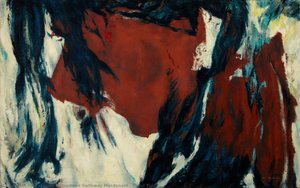
Galerijos akimais, garsiausias Jock Macdonald tapas yra Rust of Antiquity (1958), kurio originalas eksponuojamas The Robert McLaughlin Gallery, Oshawa. Pilgrimage (1937) ir Formative Colour Activity (1934) užbaia trio, kurį atpažįsta kiekvienas ž)/\ Iš 14 Jock Macdonald darbų mūsų kataloge, galerija žemiau pristato 13 garsiausius – kiekvienas yra originalus, su nurodytu metais, muziejumi bei unikaliu aprašymu.


A red circle with a yellow center anchors the composition, acting as a focal point amidst a field of shifting shapes. Surrounding this central form, various colors and dark, black elements create a sense of tension and contrast. The arrangement suggests a sudden release of energy, a visual pulse captured in 1955. The work moves away from literal representation, favoring a language of pure color and form to communicate movement…

In the captivating realm of James Williamson Galloway Macdonald, known affectionately as Jock Macdonald, the boundaries between reality and imagination dissolve into a vibrant tapestry of life. His 1946 masterpiece, Music Hour, serves as a profound testament to his ability to weave disparate elements into a singular, rhythmic composition. At first glance, the eye is immediately drawn to the central protagonist: a luminous yellow fish, its presence commanding and bold…


2 muziejai, kuriuose saugoma daugiausia šioje pusėje esamų paveikslų.
| Muzejaus | Miestas | Jock Macdonald darbai | Šiojo sąrašo paveikslai |
|---|---|---|---|
 The Robert McLaughlin Gallery |
Oshawa | 7 | Rust of Antiquity, Orange Impulse, Music Hour |
 Kanados Nacionalinė galerija |
Otava | 6 | Pilgrimage, Formative Colour Activity, Lytton Church, British Columbia |
Pasirinkite dešimtmetį, kad pamatytėte jį apibrėžusį originalą.
In the captivating realm of James Williamson Galloway Macdonald, known affectionately as Jock Macdonald, the boundaries between reality and imagination dissolve into a vibrant tapestry of life. His 1946 masterpiece, Music Hour, serves as a profound testament to his ability to weave disparate elements into a singular, rhythmic composition. At first glance, the eye is immediately drawn to the central protagonist: a luminous yellow fish, its presence commanding and bold…

Rust of Antiquity (1958), The Robert McLaughlin Gallery, Oshawa. Toliau seka Pilgrimage (1937) ir Formative Colour Activity (1934).
61 metų amžiaus: Rust of Antiquity sukurta 1958 m. Nr. Jock Macdonald gimė 1897.
Rust of Antiquity, Pilgrimage, Formative Colour Activity, Orange Impulse, Music Hour, Lytton Church, British Columbia, Rain, Thunder Clouds over Okanagan Lake, The Butterfly ir Birds Dreaming. Viršuje esančioje reitingo sąraše nurodyta kiekvieno kūrinio metis ir muziejus.
Mūsų kataloge yra 14 Jock Macdonald darbų, skirtų laikotarpiui nuo 1930 iki 1960.
Daugiausia – The Robert McLaughlin Gallery (Oshawa) ir Kanados Nacionalinė galerija (Otava). Viršuje esančiame muziejų sąraše yra visi jie.
1930s laikotarpiu: 4 iš 13 šioje pusėje esančių darbų buvo sukurtos tada, iš jų Pilgrimage.
Šioje pusėje seniausias darbas yra Lytton Church, British Columbia (1930), o naujausias – All Things Prevail (1960).
Rust of Antiquity, Orange Impulse ir Music Hour: The Robert McLaughlin Gallery, Oshawa kolekcijoje yra 7 šioje pusėje esančių darbų.
James Williamson Galloway Macdonald, known affectionately to the art world as Jock Macdonald, stands as a monumental figure in the evolution of Canadian modernism. Born in the rugged, atmospheric landscape of Thurso, Scotland, in 1897, his early life was steeped in the dramatic textures of his homeland. This foundational connection to nature would later become the heartbeat of his abstract explorations. After honing his technical prowess at the prestigious Glasgow School of Art, Macdonald embarked on a transformative journey across the Atlantic in 1926. Arriving in Canada, he did not merely join an existing art scene; he arrived to ignite a revolution, bringing with him a sophisticated understanding of European avant-garde movements such as Cubism and Surrealism that would eventually dismantle the boundaries of representational painting in North America.
As his career unfolded, Macdonald’s work underwent a profound metamorphosis, moving away from the literal depiction of the world toward a deeper, more spiritualized abstraction. He became a master of capturing the intangible, seeking to translate the very essence of movement, time, and cosmic energy onto the canvas. His palette was as diverse as his imagination, utilizing traditional oils and watercolors alongside experimental industrial materials like Duco and Lucite. This willingness to embrace new media allowed him to achieve a unique sense of depth and luminosity. In masterpieces such as Orange Impulse, one witnesses a vibrant explosion of red and yellow shapes that pulse with the dynamic energy of mid-century modernism, inviting the viewer into a realm where color itself becomes a language of pure emotion.
Macdonald’s contribution to art history extends far beyond his individual canvases; he was a pivotal educator and a catalyst for collective change. Through his influential teaching positions at the Vancouver School of Decorative and Applied Arts and the Ontario College of Art, he nurtured a new generation of Canadian artists, encouraging them to look inward and toward the abstract. As a prominent member of the Painters Eleven, he helped establish a movement that challenged the dominance of landscape painting in Canada, pushing the national identity toward a more universal, modernist dialogue.
His thematic preoccupations often revolved around the organic rhythms of life, frequently utilizing motifs such as birds and aquatic forms to explore the concept of space, time, and motion. Whether it is the whimsical, mid-century charm found in Music Hour, where a vibrant yellow fish serves as a captivating centerpiece, or the more somber, textured reflections in works like Rust of Antiquity, Macdonald’s oeuvre remains a testament to the power of abstraction to touch upon the profound. His ability to blend the organic with the geometric created a visual vocabulary that continues to resonate, ensuring his place as a pioneer who redefined the limits of Canadian art.