Jan Baptist Weenix portretas

78 garsiausių Jan Baptist Weenix paveikių rinkinys: galerijos išboru

Atnaujinta lapkritis 2026 · pagal mūsų populiarumumo koeficientą (paieškos, lankytojai ir užsakymai kiekvienam kūriniui) · 86 Jan Baptist Weenix darbai mūsų kataloge

Trumpai tariant

Iš visų paliktų originalų kūrinių Jan Baptist Weenix garsiausias yra Tobit, asleep under a vine, is blinded (1642), esantis Museum Boijmans Van Beuningen kolekcijoje, Roterdamas. Tiesiog už jų seka Italian landscape with shelter and antiques ruins (1658) ir Still Life with a Dead Swan (1651). Mūsų kataloge yra 86 darbų autoriaus Jan Baptist Weenix; galerija išsaugojo 78 labiausiai pasaulyje žyminiausių kūrinių – kiekvienas jų pateikiamas su datos, muziejaus ir istorijos aprašymu.

1621 – 1659, Amsterdamas Dutch golden age Daugiausia darbų: Bavarijos valstybinės paveikslų kolekcijos

Jan Baptist Weenix geriausios 10 paveikslų: galerijos pasirinkimas

1
Tobit, asleep under a vine, is blinded (1642) aut. Jan Baptist Weenix

Tobit, asleep under a vine, is blinded

1642 · Oil On Canvas · Museum Boijmans Van Beuningen, Roterdamas

A single man reclines in the heavy shade of a vine. He is Tobit, lost to a deep, unsuspecting sleep. The air around him feels thick, weighted by the muted tones of ochre and forest green. Sunlight does not flood this scene; instead, it pierces through the foliage in sharp, controlled beams, illuminating the textures of his slumped posture and the coarse fabric of his clothing. He rests amidst a…

2
Italian landscape with shelter and antiques ruins (1658) aut. Jan Baptist Weenix

Italian landscape with shelter and antiques ruins

1658 · Oil On Panel · Mauritshuis, Haga

The oil on panel painting titled Italian landscape with shelter and antiques ruins was executed by the artist Jan Baptist Weenix in 1658. This landscape painting depicts a specific pastoral setting within an Italianate environment. The scene is populated by a group of peasants and various livestock, including sheep and goats. These figures are situated near a rustic cottage and several ancient architectural ruins that occupy the landscape.

3
Still Life with a Dead Swan (1651) aut. Jan Baptist Weenix

Still Life with a Dead Swan

1651 · Oil On Canvas · Detroito meno institutas, Detroitas

The painting Still Life with a Dead Swan by Jan Baptist Weenix captures a heavy, silent moment of the hunt. Created about 1651, the work presents a collection of fallen game as a trophy of the chase. A white swan rests at the center, its pale plumage a stark contrast to the darker forms surrounding it. This central figure is accompanied by a turkey, two partridges, and a small finch,…

4
Tobit Sleeping Under the Vine (1641) aut. Jan Baptist Weenix

Tobit Sleeping Under the Vine

1641 · Oil · Museum Catharijneconvent, Utrechtas

In this work, titled Tobit Sleeping Under the Vine, we encounter a significant piece by the Dutch Golden Age painter Jan Baptist Weenix. Created around 1642, the painting belongs to the Baroque period, a time when the interplay of light and shadow began to define the dramatic tension of Northern European art. Weenix, born in Amsterdam, Netherlands, brought a disciplined approach to his subjects, often blending meticulous observation with a…

5
The Scissors Grinder (1641) aut. Jan Baptist Weenix

The Scissors Grinder

The air feels heavy with the scent of damp stone and the rhythmic, metallic scrape of steel against stone. Under a vast, expansive sky, a group of figures gathers within the skeletal remains of a classical ruin. A man leans into his work, operating a grinding wheel that cuts through the quietude of the scene. Beside him, a woman sits in repose, while a small child stands close by, watching…

6
Hunters Near Ruins (1648) aut. Jan Baptist Weenix

Hunters Near Ruins

1648 · Oil On Canvas · Cleveland Museum of Art, Klevlandas

Hunters Near Ruins is an oil on canvas painting by Jan Baptist Weenix. The work is dated 1648. This piece belongs to the Dutch Golden Age, a period during which the artist developed a specific approach to landscape and human figures.

7
Portrait of René Descartes (1647) aut. Jan Baptist Weenix

Portrait of René Descartes

1647 · Oil · Centraal Museum, Utrecht

In this 1647 oil painting, Jan Baptist Weenix captures the French philosopher René Descartes. The subject appears in a medium close-up, his presence defined by a heavy, somber stillness. He is an elderly man, his face marked by the weight of thought and the passage of years. A bright white collar cuts through the darkness of his attire, framing a pale countenance that emerges from a deep, umber shadow.

8
Monument at a Harbour (1648) aut. Jan Baptist Weenix

Monument at a Harbour

1648 · Oil · Statens Museum For Kunst, Kopenhaga

The composition relies on strong vertical elements, primarily through imposing columns and a central, highly ornate pedestal topped with a large urn. These structures anchor the scene, providing a sense of scale against the scattered human figures in the foreground and middle ground. Through a use of deep recession, the perspective draws the eye past a colonnade toward a distant, hazy horizon where the masts of ships are visible.

9
Harbour with Antique Ruins (1648) aut. Jan Baptist Weenix

Harbour with Antique Ruins

1648 · Oil On Canvas · Nationalmuseum, Stokholmas

The scene unfolds in 1648, a moment captured in the oil on canvas known as Harbour with Antique Ruins. This work belongs to the hand of Jan Baptist Weenix, an artist who brings the weight of history into a living, breathing maritime setting. The painting presents a world where the weathered stone of classical antiquity meets the constant, rhythmic movement of a working harbor. It is a vision of a…

10
The Angel Raphael Leaving Tobias's Family (1648) aut. Jan Baptist Weenix

The Angel Raphael Leaving Tobias's Family

1648 · Oil · Nationalmuseum, Stokholmas

In "The Angel Raphael Leaving Tobias's Family" by Jan Baptist Weenix, a divine departure unfolds with sudden, celestial energy. The scene captures the exact moment the Angel Raphael ascends toward the heavens, leaving the family below in a state of profound awe and reverence. A powerful diagonal movement pulls the eye from the lower left foreground upward toward the upper left, where the angelic figure climbs into a swirling formation…

Jan Baptist Weenix darba rinkinys tęsiamas, nuo 11 iki 78

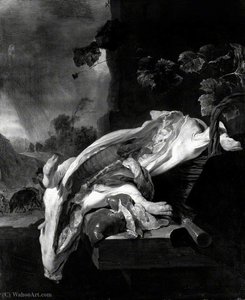
11vegetable-sellers at the house-door, 5 figures (1646) aut. Jan Baptist Weenixvegetable-sellers at the house-door, 5 figures1646 12caravane near the shore (1646) aut. Jan Baptist Weenixcaravane near the shore1646 13Mother and Child (1647) aut. Jan Baptist WeenixMother and Child1647 14Circumcision of Moses' son (1640) aut. Jan Baptist WeenixCircumcision of Moses' son1640 · Nacionalinis muziejus Varšuvoje 15Still Life with Game, Hunter and Two Dogs (1652) aut. Jan Baptist WeenixStill Life with Game, Hunter and Two Dogs1652 · Bavarijos valstybinės paveikslų kolekcijos 16Butterfly Dog and Dead Bird (1649) aut. Jan Baptist WeenixButterfly Dog and Dead Bird1649 · Museum Mayer van den Bergh 17Pleasure boating (1650) aut. Jan Baptist WeenixPleasure boating1650 18The Sleeping Shepherdess (1658) aut. Jan Baptist WeenixThe Sleeping Shepherdess1658 · National Gallery of Ireland 19Roman Tinker (1656) aut. Jan Baptist WeenixRoman Tinker1656 · Städel Museum 20The love letter (1650) aut. Jan Baptist WeenixThe love letter1650 · National Museum of Art, Architecture and Design 21Italian Harbour (1651) aut. Jan Baptist WeenixItalian Harbour1651 · Ermitažas 22Italian Peasants among Ruins (1650) aut. Jan Baptist WeenixItalian Peasants among Ruins1650 · Detroito meno institutas 23Sleeping girl (1656) aut. Jan Baptist WeenixSleeping girl1656 · Bavarijos valstybinės paveikslų kolekcijos 24Rest on the Flight into Egypt (1657) aut. Jan Baptist WeenixRest on the Flight into Egypt1657 · Museum Boijmans Van Beuningen 25Merry Company on a Ferry (1649) aut. Jan Baptist WeenixMerry Company on a Ferry1649 · Museum Gouda 26Battle at the foot of the mountain. (1650) aut. Jan Baptist WeenixBattle at the foot of the mountain.1650 · Nacionalinis muziejus Varšuvoje 27Christina Lepper de Kempenaer and Her Children (1653) aut. Jan Baptist WeenixChristina Lepper de Kempenaer and Her Children1653 28Italian port scene, 1649 (1649) aut. Jan Baptist WeenixItalian port scene, 16491649 · Centraal Museum 29Italian Landscape with Horsemen by a Spring (1657) aut. Jan Baptist WeenixItalian Landscape with Horsemen by a Spring1657 · Centraal Museum 30Before the walls of Rome (1650) aut. Jan Baptist WeenixBefore the walls of Rome1650 · National Museum in Wrocław 31Portrait of a man with a letter (1650) aut. Jan Baptist WeenixPortrait of a man with a letter1650 · Agnes Etherington Art Center 32A Landscape with a Ford (1660) aut. Jan Baptist WeenixA Landscape with a Ford1660 · Regionalinė galerija Liberece 33In the Campagna (1669) aut. Jan Baptist WeenixIn the Campagna1669 · National Gallery of Ireland 34Dead Fowl Being Eaten by a Cat (1653) aut. Jan Baptist WeenixDead Fowl Being Eaten by a Cat1653 · Städel Museum 35Departure of an Oriental Entourage (1647) aut. Jan Baptist WeenixDeparture of an Oriental Entourage1647 · Liuvro muziejus 36Display of Dead Game (1641) aut. Jan Baptist WeenixDisplay of Dead Game1641 · Petit Palais 37Dead Game (1641) aut. Jan Baptist WeenixDead Game1641 38River Landscape with a Ferry (1650) aut. Jan Baptist WeenixRiver Landscape with a Ferry1650 · Montrealio meno muziejus 39Still Life with Dead Game and Poultry (1656) aut. Jan Baptist WeenixStill Life with Dead Game and Poultry1656 · Centraal Museum 40Still Life with Fowl (1650) aut. Jan Baptist WeenixStill Life with Fowl1650 · Museum of Fine Arts Ghent (MSK) 41Marine with a Venetian Bucintoro (1650) aut. Jan Baptist WeenixMarine with a Venetian Bucintoro1650 · Staatliche Kunsthalle Karlsruhe 42The Dutch Ambassador on his Way to Isfahan, Jan Baptist Weenix, 1653 - 1659 (1659) aut. Jan Baptist WeenixThe Dutch Ambassador on his Way to Isfahan, Jan Baptist Weenix, 1653 - 16591659 · Rijksmuseum 43After the Hunt, Jan Baptist Weenix, c. 1656 (1656) aut. Jan Baptist WeenixAfter the Hunt, Jan Baptist Weenix, c. 16561656 · Rijksmuseum 44Still Life with White Mouse (1680) aut. Jan Baptist WeenixStill Life with White Mouse1680 · Ernest Zmeták Art Gallery 45Still Life with Game aut. Jan Baptist WeenixStill Life with GameHarvard Art Museums 46The Ford in the River (1647) aut. Jan Baptist WeenixThe Ford in the River1647 · Ermitažas 47Harbor View with Rider in Oriental Dress, aut. Jan Baptist WeenixHarbor View with Rider in Oriental Dress,Groninger Museum 48The Holy Women at the Tomb aut. Jan Baptist WeenixThe Holy Women at the TombNational Gallery of Ireland 49An Italian Seaport aut. Jan Baptist WeenixAn Italian SeaportAntverpio karališkasis gražiųjų menų muziejus 50Architectural interior with foreign shippers, ruins and a shipyard beyond aut. Jan Baptist WeenixArchitectural interior with foreign shippers, ruins and a shipyard beyond 51Study of a sheep aut. Jan Baptist WeenixStudy of a sheep 52A pig's carcase aut. Jan Baptist WeenixA pig's carcase 53The Tinker and His Dog aut. Jan Baptist WeenixThe Tinker and His Dog 54Landscape with Peasants and Animals aut. Jan Baptist WeenixLandscape with Peasants and Animals 55Dead Partridge (1650) aut. Jan Baptist WeenixDead Partridge1650 · Mauritshuis 56Goat Lying Down, Jan Baptist Weenix, 1645 - 1660 (1660) aut. Jan Baptist WeenixGoat Lying Down, Jan Baptist Weenix, 1645 - 16601660 · Rijksmuseum 57A Dog and a Cat near a partially disembowelled Deer, Jan Baptist Weenix, 1645 - 1660 (1660) aut. Jan Baptist WeenixA Dog and a Cat near a partially disembowelled Deer, Jan Baptist Weenix, 1645 - 16601660 · Rijksmuseum 58Still Life with Dead Poultry, Lidded Pitcher and Passglas aut. Jan Baptist WeenixStill Life with Dead Poultry, Lidded Pitcher and PassglasBavarijos valstybinės paveikslų kolekcijos 59Game-piece aut. Jan Baptist WeenixGame-pieceNational Gallery of Ireland 60Dead game and hunting tackle in landscape aut. Jan Baptist WeenixDead game and hunting tackle in landscape 61Hound with a Joint of Meat and a Cat Looking on aut. Jan Baptist WeenixHound with a Joint of Meat and a Cat Looking on 62Bouquet of flowers aut. Jan Baptist WeenixBouquet of flowersGemäldegalerie 63Shipping in Harbour aut. Jan Baptist WeenixShipping in Harbour 64Herons and Lapwings aut. Jan Baptist WeenixHerons and Lapwings 65Still Life of Dead Game in a Landscape with a Huntsman aut. Jan Baptist WeenixStill Life of Dead Game in a Landscape with a Huntsman 66An italian port scene aut. Jan Baptist WeenixAn italian port scene 67Shepherds and Flocks among Classical Ruins aut. Jan Baptist WeenixShepherds and Flocks among Classical Ruins 68A Coast Scene with Classical Ruins aut. Jan Baptist WeenixA Coast Scene with Classical RuinsWallace Collection 69Still Life with Dead Game aut. Jan Baptist WeenixStill Life with Dead Game 70Hounds and an Owl with Dead Birds and Sculptures in a Landscape aut. Jan Baptist WeenixHounds and an Owl with Dead Birds and Sculptures in a Landscape 71Still Life with Dead Birds aut. Jan Baptist WeenixStill Life with Dead Birds 72Family in a Mediterranean Seaport aut. Jan Baptist WeenixFamily in a Mediterranean Seaport 73Figures near a Seaport aut. Jan Baptist WeenixFigures near a SeaportŠkotijos Nacionalinė galerija 74A Huntsman cutting up a Dead Deer, with Two Deerhounds aut. Jan Baptist WeenixA Huntsman cutting up a Dead Deer, with Two DeerhoundsNational Gallery 75Ancient Ruins aut. Jan Baptist WeenixAncient RuinsSzépművészeti Múzeum 76Figures among ruins aut. Jan Baptist WeenixFigures among ruinsThe Kremer Collection 77Ancient Ruins (detail) aut. Jan Baptist WeenixAncient Ruins (detail)Szépművészeti Múzeum 78Girl as Shepherdess (1650) aut. Jan Baptist WeenixGirl as Shepherdess1650 · Musée de Picardie

žymios Jan Baptist Weenix tapiojamos, pagal laikotarpį

Temos, kurios domino Jan Baptist Weenix

Ketverios temos, dažniausiai pasikrausto originaluose, kiekvienos su savo puikiausiu pavyzdžiu.

Muziejai, kuriuose saugomi Jan Baptist Weenix originalūs darbai

8 muziejai, kuriuose saugoma daugiausia šioje pusėje esamų paveikslų.

Muzejaus Miestas Jan Baptist Weenix darbai Šiojo sąrašo paveikslai
Bavarijos valstybinės paveikslų kolekcijos, MiunchasBavarijos valstybinės paveikslų kolekcijos Miunchas 4 The Scissors Grinder, Still Life with Game, Hunter and Two Dogs, Sleeping girl
Centraal Museum, UtrechtCentraal Museum Utrecht 4 Portrait of René Descartes, Italian port scene, 1649, Italian Landscape with Horsemen by a Spring
National Gallery of Ireland, DublinNational Gallery of Ireland Dublin 4 The Sleeping Shepherdess, In the Campagna, The Holy Women at the Tomb
Rijksmuseum, AmsterdamasRijksmuseum Amsterdamas 4 The Dutch Ambassador on his Way to Isfahan, Jan Baptist Weenix, 1653 - 1659, After the Hunt, Jan Baptist Weenix, c. 1656, Goat Lying Down, Jan Baptist Weenix, 1645 - 1660
Museum Boijmans Van Beuningen, RoterdamasMuseum Boijmans Van Beuningen Roterdamas 2 Tobit, asleep under a vine, is blinded, Rest on the Flight into Egypt
Mauritshuis, HagaMauritshuis Haga 2 Italian landscape with shelter and antiques ruins, Dead Partridge
Detroito meno institutas, DetroitasDetroito meno institutas Detroitas 2 Still Life with a Dead Swan, Italian Peasants among Ruins
Nationalmuseum, StokholmasNationalmuseum Stokholmas 2 Harbour with Antique Ruins, The Angel Raphael Leaving Tobias's Family

Jan Baptist Weenix metai po metų: originalūs darbai, apibūdinantys kiekvieną iš jų

Nuo 1640 iki 1659, Jan Baptist Weenix kūrė 20 metų: šiame rinkinyje pristatoma ilga kūrybos kelionė, apimanti geriausius originalius darbus metus po metų.

Darbai pagal metus

Pasirinkite metus, kad pamatytumėte originalus darbus.

Kolekcjonerų klausimai apie Jan Baptist Weenix paveikslus

Kuriu darbu Jan Baptist Weenix yra labiausiai garsus?Atsakymas

Tobit, asleep under a vine, is blinded (1642), Museum Boijmans Van Beuningen, Roterdamas. Toliau seka Italian landscape with shelter and antiques ruins (1658) ir Still Life with a Dead Swan (1651).

Kokia buvo Jan Baptist Weenix amžius, kai buvo sukurtas Tobit, asleep under a vine, is blinded?Atsakymas

21 metų amžiaus: Tobit, asleep under a vine, is blinded sukurta 1642 m. Nr. Jan Baptist Weenix gimė 1621.

Kokie yra 10 garsiausių Jan Baptist Weenix paveikslų?Atsakymas

Tobit, asleep under a vine, is blinded, Italian landscape with shelter and antiques ruins, Still Life with a Dead Swan, Tobit Sleeping Under the Vine, The Scissors Grinder, Hunters Near Ruins, Portrait of René Descartes, Monument at a Harbour, Harbour with Antique Ruins ir The Angel Raphael Leaving Tobias's Family. Viršuje esančioje reitingo sąraše nurodyta kiekvieno kūrinio metis ir muziejus.

Kiek paveikslų paliko Jan Baptist Weenix?Atsakymas

Mūsų kataloge yra 86 Jan Baptist Weenix darbų, skirtų laikotarpiui nuo 1640 iki 1659.

Kuriuose muziejuose eksponuojami Jan Baptist Weenix šedevrai?Atsakymas

Daugiausia – Bavarijos valstybinės paveikslų kolekcijos (Miunchas), Centraal Museum (Utrecht) ir National Gallery of Ireland (Dublin). Viršuje esančiame muziejų sąraše yra visi jie.

Kuriomis metais Jan Baptist Weenix tapo savo garsiausius kūrinius?Atsakymas

1650 laikotarpiu: 11 iš 78 šioje pusėje esančių darbų buvo sukurtos tada, iš jų Pleasure boating.

Kokie yra pirmasis ir paskutinis garsieji Jan Baptist Weenix originalūs darbai?Atsakymas

Šioje pusėje seniausias darbas yra Circumcision of Moses' son (1640), o naujausias – The Dutch Ambassador on his Way to Isfahan, Jan Baptist Weenix, 1653 - 1659 (1659).

Kurią temą Jan Baptist Weenix rinkosi dažniausiai?Atsakymas

Landscape (18), Ruins (17) ir Sky (13) iš 78 šioje pusėje esamų darbų.

Kurią techniką Jan Baptist Weenix naudojo dažniausiai?Atsakymas

Oil On Canvas, iš 78 šios puslapio darbų – 30.

Kelią meno kryptį priklauso Jan Baptist Weenix?Atsakymas

Dutch golden age ir Baroque, vadovaujantis šios puslapio originalais kūriniais.

Kurių Jan Baptist Weenix darbai eksponuojami Bavarijos valstybinės paveikslų kolekcijos?Atsakymas

The Scissors Grinder, Still Life with Game, Hunter and Two Dogs ir Sleeping girl: Bavarijos valstybinės paveikslų kolekcijos, Miunchas kolekcijoje yra 4 šioje pusėje esančių darbų.

Jan Baptist Weenix: gyvenimas ir kūryba

Olandų Aukso amžiaus vizionierius

Jan Baptist Weenix išsiskiria kaip ypatinga figūra Olandų aukso amžiuje, tapęs garsėjantis savo išskirtiniu kruopštumo ir vaizdingos vizijos deriniu. Nors jo kūrybos apimtis buvo gana nedidelė lyginant su tokiais samtarpučių bendrontais kaip Rembrandtas ar Vermeeris, Weenix priskyrimas Olandų meno istorijai yra neabejingas – ypač jo novatoriškas Italijos kraštlandžių tyrimas, įpynintas į žmogaus figūras, sukūrė stilių, kuris keliausias kartas keliava per būsimas kartas. Gimęs 1621 metais Amsterdame, šalia vešlios uosto veiklos, Weenix kilė iš architektų šeimos – ši genealogija tikriausiai suformavo jo kūrybinį mątymą tarp intelektualaus ir struktūrinio to meto laikotarpio transformacijų.

Nepaisant asmeniškų iššūkių – pasakojimuose minima, kad dėl sveikatos problemų jis turėjo sunkumų kalbėti – Weenix turėjo aistringą meilę literatūrai ir menui, kurią puoselėjo motina, aktyviai organizuodama jo mokymąs pas Janą Mickerį, Rembrandtą susijusį su šeima. Šis ankstyvasis mokymasis įsidėmėjo jam disciplinuotu piešimo ir stebėjimo požiūlius, kurie tapo jo kūrybos žyminimo ženklais. Vėliau jis tobulino savo įgūdžius Utrechtuje, dirbdamas su Abrahamu Bloemaert, ir grįžo į Amsterdamą studijuoti pas Claes Corneliszoon Moeyaert, taip užtvirtindamas savo šaknis tarp pagrindinių Olandijos meno sročių.

Kelionė per šviesą ir kraštlandį

Weenix karjeros kryptis buvo iš esmės pakeista jo kelionėmis, ypač nuvykimu į Romą 1643 metais kartu su Nicolaes Pieterszoon Berchem. Ši išvyka leido jam prisitaikyti prie gyvos intelektualinės ir meninės Bentvuegilių gilvės, patirtis, kuri pasvarė jį link platesnio stiliaus spektrumo. Romoje jis priėmė italietiškojo stiliaus dvasią, pasižymintį šiltomis, auksinėmis šviesomis ir klasikiniais kraštlandžiais, kurie nuostabiai kontrastavo su šaltesniais, rimtesniais tradicinio olandų paveikslų tonais. Šis romiečių įtario laikotarpis leido jam meistriškai išmokti „italietiškojo kraštlandžio“ meną, kuriame pietų Europos drąsus grožis buvo perinterpretuojamas per šiaurės europietį akį.

Šio laikotarpio darbai dažnai sujungė klasikinės aplinkos didybę su intymiškais, žmogiškais elementais. Ar tai būtų uosto scenos, šnabždančios apie jūros prekybą, ar platus horizontas, keliantis amžinumo jausmą, Weenix turėjo unikalią gebėjimą įamžinti vietos atmosferą. Jo meistriškumas neapsiribojo tik plačiais horizontais; jis taip pat buvo lygiai meistriškas suimt skiltą, dažnai viską apimtą gyvenimo realybę per savo stilllifus. Jo metinė mga ir gyvūnų vaizdiniai pasižymėjo stingriau realizmu, kuriame kiekvienė tekstūra – nuo kietos medžioklinio šuns kailio iki delikat}$ šviesos plunksų – buvo atvaizduota kvapaudžiu tikslumu.

Realizmo ir meistriškumo palikimas

Jan Baptist Weenix reikšmė slypi jo gebėjime padaryti tiltą tarp grubaus olandų tradicijos realizmo ir idealizuoto italietiškojo judėjimo grožio. Jo universalumas leido jam naviguoti tarp įvairių temų – nuo dramatiško įtamtos, randamos tokiuose darbuose kaip Po medžioklės, iki tylios, beveik liūdna intensyvumo gyvūnų studijų. Per jo štrėbį žiūrovas pakvietiam į pasaulį, kuriame ribos tarp stebėto natūralaus pasaulio ir įsivaizduoto klasikinio praeities gražiai išblėsta.

Reflektuodami apie jo gyvenimą ir kūrybą, galime išskirti keletą pagrindinių elementų, apibrėžiančių jo neblėstantį svarbumą:

  • Stiliaus inovacija: Jis buvo pionierius integruojant italietiško kraštlandžio elementus į olandų tradiciją, sukuriant naują vizualinę kalbą savo samtarpučių žmonėms.
  • Techninis meistriškumas: Disciplinuotas mokymasis leido pasiekti neįtikėtiną detalumo lygį tiek dideliuose kraštlandžiuose, tiek intymiuose stilllifeuose.
  • Universalumas: Jo gebėjimas sklandžiai pereiti nuo uosto scenų ir medžioklės motyvų iki gyvūnų portretų demonstruoja retą talento platumą.
  • Istorinė įtaka: Kaip Bentvuegilių narys, jis padėjo puoselėti tarptautinį meninių idėjų mainą, kuris apibrėžė XVII amžiaus meno pasaulį.

Nors jo gyvenimas buvo gana trumpas ir pasibaigė 1661 metais, Jan Baptist Weenix paliktas pėdsakas išlieka matomas kraštlandžių tapimo evoliucijoje. Jis būsimas kartas išmokė, kaip žiūrėti į horizontą ne tik kaip į ribą, bet kaip į audinį šviesai, istorijai ir žmogaus emocijoms.