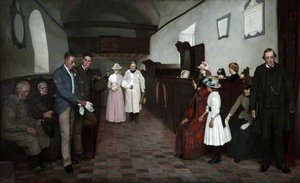
James Hayllar portretas

42 garsiausių James Hayllar paveikių – kiekvienas yra unikalus

Atnaujinta lapkritis 2026 · pagal mūsų populiarumumo koeficientą (paieškos, lankytojai ir užsakymai kiekvienam kūriniui) · 42 James Hayllar darbai mūsų kataloge

Trumpai tariant

Granville Sharp the Abolitionist Rescuing a Slave from the Hands of His Master (1864) yra James Hayllar paveikslas, kuriuo gausiausia žmonių žavisi. Po to akmuo patenka į All the world over ir Edward Wells, High Steward of Wallingford (1886). Iš 42 James Hayllar darbų mūsų kataloge šios 42 yra garsiausios – kiekvienas yra unikali originali dai̇lia, pateikta su jos metais, muziejumi ir priežastimi, kodėl ji išlieka per amžius.

1829 – 1920, Chichester Contemporary realism Daugiausia darbų: Kanados Nacionalinė galerija

10 geriausių James Hayllar paveikslų: galerijos akimais

1
Granville Sharp the Abolitionist Rescuing a Slave from the Hands of His Master (1864) aut. James Hayllar

Granville Sharp the Abolitionist Rescuing a Slave from the Hands of His Master

1864 · Oil On Canvas

The air in the room feels heavy, thick with the dust of legal parchment and the tension of a life hanging in the balance. A man in colonial attire stands with a steady, purposeful grace, his hand resting upon the shoulder of a figure caught in the grip of another. This is the moment of intervention. The setting is a courtroom, a space of rigid rules and wooden chairs, where…

2
All the world over aut. James Hayllar

All the world over

Oil On Canvas

All the world over is a work by James Hayllar. Born in 1829 in Chichester, United Kingdom, Hayllar established himself as a significant figure in the Victorian era. His practice focused on genre scenes and portraiture, often capturing the quietude of domestic life and the English landscape.

3
Edward Wells, High Steward of Wallingford (1886) aut. James Hayllar

Edward Wells, High Steward of Wallingford

1886 · Oil On Canvas

This formal portrait, titled Edward Wells, High Steward of Wallingford, was painted by James Hayllar about 1886. The canvas captures a man of significant local standing, a figure defined by the weight of his civic duties and his commercial influence. Wells was a banker and a brewer, a man whose life was woven into the economic fabric of his community. His presence in the portrait reflects the gravity of a…

žinomi James Hayllar paveikslai, nuo 11 iki 42 numerio

žymios James Hayllar tapiojamos, pagal laikotarpį

Temos, kurios domino James Hayllar

Ketverios temos, dažniausiai pasikrausto originaluose, kiekvienos su savo puikiausiu pavyzdžiu.

Muziejai, kuriuose saugomi James Hayllar originalūs darbai

4 muziejai, kuriuose saugoma daugiausia šioje pusėje esamų paveikslų.

Muzejaus Miestas James Hayllar darbai Šiojo sąrašo paveikslai
Kanados Nacionalinė galerija, OtavaKanados Nacionalinė galerija Otava 2 A Family Group, Going to the Ball
Nottingham City Museums And Galleries, NottinghamNottingham City Museums And Galleries Nottingham 1 The Invalid
Atkinson Art Gallery Collection, SouthportAtkinson Art Gallery Collection Southport 1 Happy Is the Bride
Bolton Museum And Art Gallery, BoltonBolton Museum And Art Gallery Bolton 1 Lunchtime

James Hayllar per dešimtmečius: vieniškas originalas kiekvienam

Darbai pagal dešimtmečius

Pasirinkite dešimtmetį, kad pamatytėte jį apibrėžusį originalą.

James Hayllar tapų klausimai galerijai

Koks yra garsiausias James Hayllar kūrinys?Atsakymas

Granville Sharp the Abolitionist Rescuing a Slave from the Hands of His Master (1864). Toliausiai eina All the world over ir Edward Wells, High Steward of Wallingford (1886).

Kuriuo amžiaus atσταση James Hayllar sukūrė Granville Sharp the Abolitionist Rescuing a Slave from the Hands of His Master?Atsakymas

35 metų amžiaus: Granville Sharp the Abolitionist Rescuing a Slave from the Hands of His Master sukurta 1864 m. Nr. James Hayllar gimė 1829.

Kurios James Hayllar dešimt paveikslų yra garsiausi?Atsakymas

Granville Sharp the Abolitionist Rescuing a Slave from the Hands of His Master, All the world over, Edward Wells, High Steward of Wallingford, The Invalid, Going to Court, A Family Group, Francis Bunting, Happy Is the Bride, At the Ball ir Going to the Ball. Viršuje esančioje reitingo sąraše nurodyta kiekvieno kūrinio metis ir muziejus.

Kiek žinoma James Hayllar darbų?Atsakymas

Mūsų kataloge yra 42 James Hayllar darbų, skirtų laikotarpiui nuo 1863 iki 1890.

Kur galima pamatyti garsiausių James Hayllar originalų?Atsakymas

Daugiausia – Kanados Nacionalinė galerija (Otava), Nottingham City Museums And Galleries (Nottingham) ir Atkinson Art Gallery Collection (Southport). Viršuje esančiame muziejų sąraše yra visi jie.

Kuriuo laikotarpiu James Hayllar sukūrė savo žymiausias paveikslus?Atsakymas

1860s laikotarpiu: 3 iš 42 šioje pusėje esančių darbų buvo sukurtos tada, iš jų Granville Sharp the Abolitionist Rescuing a Slave from the Hands of His Master.

Kuris iš garsių James Hayllar paveikslų yra pirmasis, o kuris – paskutinis?Atsakymas

Šioje pusėje seniausias darbas yra Going to Court (1863), o naujausias – Happy Is the Bride (1890).

Kokia temos James Hayllar mėgavosi?Atsakymas

Domestic scene (3), Man (2) ir Woman (2) iš 42 šioje pusėje esamų darbų.

Kuriomis medžiagomis James Hayllar tapė dažniausiai?Atsakymas

Oil On Canvas, iš 42 šios puslapio darbų – 3.

Kelią meno kryžkelę priklauso James Hayllar kūryba?Atsakymas

Contemporary realism ir Victorian genre painting, vadovaujantis šios puslapio originalais kūriniais.

Kurius James Hayllar originalius galėčiau pamatyti Kanados Nacionalinė galerija?Atsakymas

A Family Group ir Going to the Ball: Kanados Nacionalinė galerija, Otava kolekcijoje yra 2 šioje pusėje esančių darbų.

James Hayllar: meno kūrinys – autoportretas

A Legacy of Light and Domestic Grace

In the heart of the Victorian era, a period defined by both rigid social structures and a burgeoning romanticism for the pastoral, the works of James Hayllar offered a window into a world of profound tranquility. Born in 1829 in the historic setting of Chichester, Sussex, Hayllar emerged as a painter who could masterfully navigate the complexities of human character and the quiet beauty of the English landscape. His artistic journey began with rigorous formal training at Cary’s Art Academy in London—an institution that had famously nurtured masters like Millais and Rossetti—before he refined his technical command at the prestigious Royal Academy Schools. This foundation allowed him to develop a style that was both technically precise and emotionally resonant, capturing the subtle nuances of light and shadow that define the British genre tradition.

While Hayllar’s early career saw him gaining recognition as an accomplished portraitist, capable of rendering the dignity and individual essence of his subjects, it was his transition into genre painting that truly captured the Victorian imagination. He possessed a unique ability to transform everyday domesticity into something poetic and timeless. His canvases often featured charming young girls engaged in quiet, contemplative activities, set against backdrops of idyllic rural life. These scenes were more than mere depictions of habit; they were idealized reflections of a period seeking solace in the simplicity of family and the enduring charm of the countryside. Through his brush, the mundane became monumental, imbued with a sense of peace that offered an escape from the rapid industrialization of his age.

Artistic Lineage and Grand Ambitions

The Hayllar name was not merely one of individual achievement but part of a larger tapestry of familial creativity. James Hayllar fostered an environment where art was a shared language, passing his expertise down to his children. His daughters—Edith, Jessica, Mary, and Kate—all emerged as notable painters in their own right, each contributing to the rich artistic legacy of the family. This domestic workshop of talent ensured that the principles of fine art were woven into the very fabric of his household life, creating a lineage of excellence that extended far beyond his own personal triumphs.

One of the most significant milestones in Hayllar’s professional life occurred in 1887, a year of great national celebration. To commemorate the Golden Jubilee of Queen Victoria, Hayllar collaborated with the artist George Dunlop Leslie on a monumental portrait of the monarch. This ambitious undertaking was a profound testament to his technical prowess and his standing within the artistic establishment. The resulting masterpiece, which continues to reside in Wallingford Town Hall, serves as a lasting symbol of his ability to marry the intimate charm of genre painting with the grandeur required for royal commemoration.

Enduring Presence in the British Canon

Throughout his long and productive life, Hayllar was a constant presence in the most esteemed exhibition halls of Britain. From the Royal Academy and the British Institution to the Royal Society of British Artists, his work was frequently showcased to the public, earning him a reputation as an amiable man and a dedicated contributor to his local arts communities in Wallingford and Bournemouth. His influence can be traced through the many prestigious collections that now house his works, including:

As the nineteenth century gave way to the twentieth, Hayllar’s work remained a cornerstone of British genre art. He passed away in 1920, leaving behind a body of work that serves as a nostalgic and beautifully rendered chronicle of a bygone era. His paintings remain much more than historical artifacts; they are evocative explorations of innocence, domestic harmony, and the quiet majesty of the natural world, ensuring that his name remains etched in the annals of English art history.