Jacobas Lawrence portretas

100 garsiausių Jacobas Lawrence paveikių rinkinys: galerijos išboru

Atnaujinta lapkritis 2026 · pagal mūsų populiarumumo koeficientą (paieškos, lankytojai ir užsakymai kiekvienam kūriniui) · 157 Jacobas Lawrence darbai mūsų kataloge

Trumpai tariant

Iš visų paliktų originalų kūrinių Jacobas Lawrence garsiausias yra The Library (1960), esantis Smithsonian American Art Museum kolekcijoje, Vašingtonas. Tiesiog už jų seka Genesis Creation Sermon V: And God Created All the Fowls of the Air and Fishes of the Seas (1989) ir Bar and Grill (1941). Mūsų kataloge yra 157 darbų autoriaus Jacobas Lawrence; galerija išsaugojo 100 labiausiai pasaulyje žyminiausių kūrinių – kiekvienas jų pateikiamas su datos, muziejaus ir istorijos aprašymu.

1917 – 2000, Atlantik Sitis Daugiausia darbų: The Phillips Collection

Jacobas Lawrence geriausios 10 paveikslų: galerijos pasirinkimas

1
The Library (1960) aut. Jacobas Lawrence

The Library

1960 · Tempera · Smithsonian American Art Museum, Vašingtonas

In the vibrant tapestry of twentieth-century American art, few works capture the pulse of communal aspiration as poignantly as Jacob Lawrence’s “The Library.” Completed in 1960, this masterpiece serves as much more than a mere depiction of a reading room; it is a profound window into the enduring spirit of the Harlem Renaissance. As one gazes upon the canvas, they are immediately swept into a bustling sanctuary of knowledge, where…

2
Genesis Creation Sermon V: And God Created All the Fowls of the Air and Fishes of the Seas (1989) aut. Jacobas Lawrence

Genesis Creation Sermon V: And God Created All the Fowls of the Air and Fishes of the Seas

1989 · Painting · SCAD Museum of Art, Savannah

To stand before a piece from Jacob Lawrence’s Genesis Creation Sermon series is to be enveloped in a vibrant confluence of scripture, social history, and raw artistic energy. This particular panel, depicting "And God Created All the Fowls of the Air and Fishes of the Seas," transcends mere religious illustration; it is a monumental cultural document rendered in paint. Lawrence, whose life story was so deeply intertwined with the evolving…

3
Bar and Grill (1941) aut. Jacobas Lawrence

Bar and Grill

1941 · Painting · Smithsonian American Art Museum, Vašingtonas

Jacob Lawrence’s powerful 1941 work, "Bar and Grill," is far more than a mere depiction of an American social scene; it is a searing document etched in paint, capturing the suffocating reality of Jim Crow segregation. The painting plunges the viewer into the interior of a café, yet the atmosphere is anything but convivial. Lawrence masterfully uses composition to confront us with the visible, yet deeply ingrained, artificiality of racial…

4
Genesis Creation Sermon IV: And God Created the Day and the Night and God Creatied and Put Stars in the Skies (1989) aut. Jacobas Lawrence

Genesis Creation Sermon IV: And God Created the Day and the Night and God Creatied and Put Stars in the Skies

1989 · Painting · SCAD Museum of Art, Savannah

In the profound depths of Jacob Lawrence’s 1989 masterpiece, Genesis Creation Sermon IV: And God Created the Day and the Night and God Created and Put Stars in the Skies, we find a breathtaking intersection between the divine and the earthly. This work is not merely a depiction of a biblical event; it is a visceral, rhythmic experience that captures the very moment light pierces the darkness. Lawrence, a master…

6
Taboo (1963) aut. Jacobas Lawrence

Taboo

1963 · Painting · Philadelphia Museum of Art, Filadelfija

In 1963, Jacob Lawrence presented Taboo, a work that speaks with a clarity that belies its heavy subject matter. The painting captures two pairs of newlyweds, posed with the formal dignity of a traditional wedding portrait. On one side, a Black bride stands beside a white groom; on the other, the roles are reversed. They are dressed in full wedding regalia, their presence a calm assertion of existence in a…

7
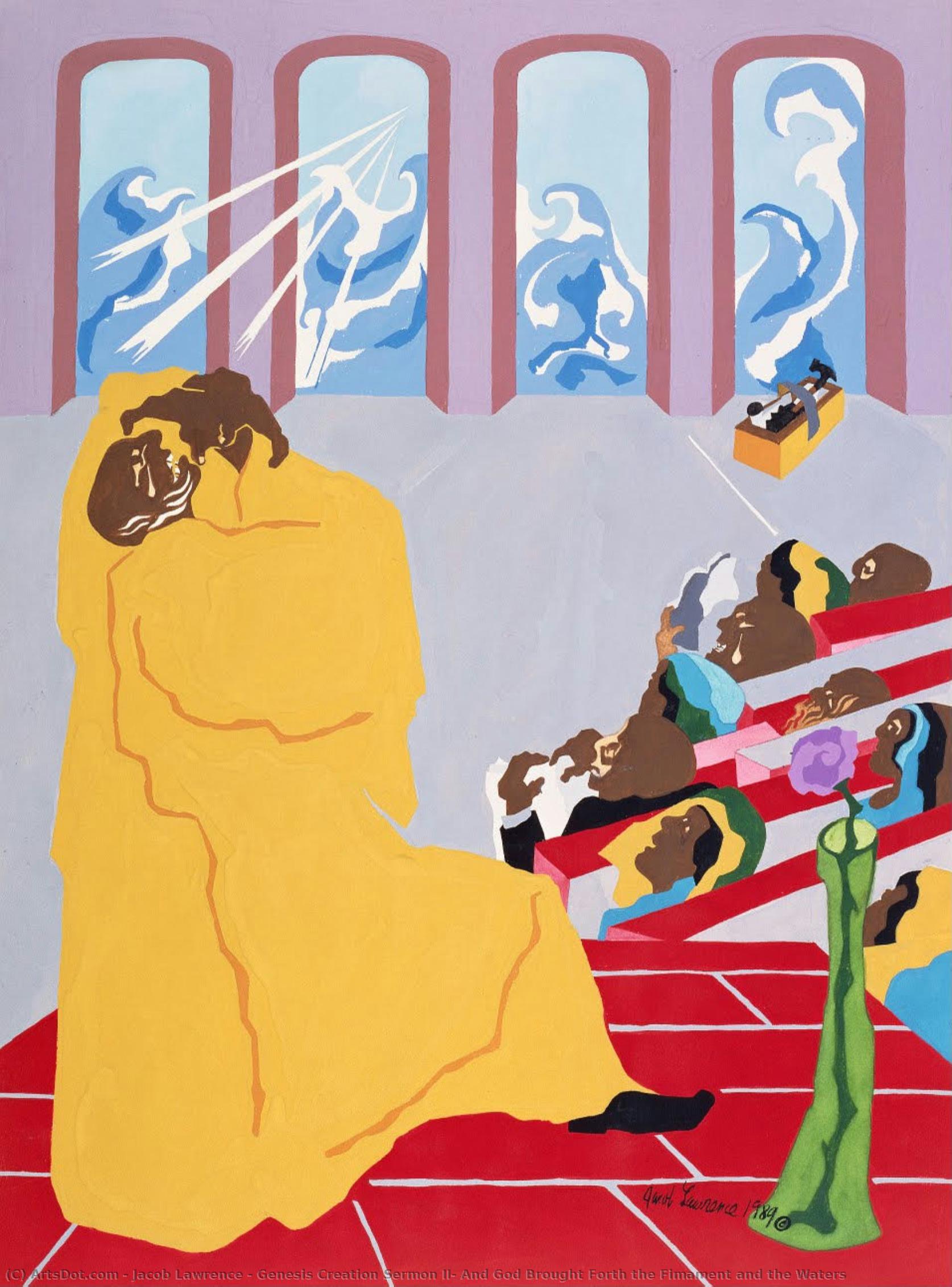
Genesis Creation Sermon II: And God Brought Forth the Fimament and the Waters (1989) aut. Jacobas Lawrence

Genesis Creation Sermon II: And God Brought Forth the Fimament and the Waters

1989 · Oil On Canvas · SCAD Museum of Art, Savannah

Jacob Lawrence’s Genesis Creation Sermon II: And God Brought Forth the Fimament and the Waters is far more than a depiction of biblical scripture; it is a vibrant, deeply personal sermon rendered in paint. Inspired by the powerful oratory of Rev. Adam Clayton Powell Sr., this work channels the electrifying energy of Harlem’s cultural heart into an epic moment of cosmic genesis. The scene pulses with divine activity, capturing that…

8
Tombstones (1942) aut. Jacobas Lawrence

Tombstones

1942 · Tempera · Whitney Amerikos meno muziejus, Niujorkas

In the somber, evocative landscape of Jacob Lawrence’s 1942 masterpiece, Tombstones, we are invited into a profound visual dialogue between life and death. Painted during the turbulent era following Pearl Harbor, this work serves as much more than a mere depiction of a graveyard; it is a soulful testament to the collective experience of African Americans in Harlem. Lawrence, a master of narrative storytelling, utilizes his signature dynamic cubism to…

9
War Series: The Letter (1946) aut. Jacobas Lawrence

War Series: The Letter

1946 · Acrylic On Canvas · Whitney Amerikos meno muziejus, Niujorkas

Jacob Lawrence’s “The Letter,” part of his monumental “War Series” created in 1946, is not merely a depiction of sorrow; it’s an embodiment of profound human experience distilled into its most potent form. This work, rendered with the artist's signature flattened planes and stark geometry, immediately commands attention with its emotionally charged atmosphere. The central figure, hunched and isolated within a confined space, speaks volumes about the devastating impact of…

10
Migration Series No.57: The female workers were the last to arrive north (1941) aut. Jacobas Lawrence

Migration Series No.57: The female workers were the last to arrive north

1941 · Tempera On Panel · The Phillips Collection, Vašingtonas

A single, vertical line of reddish-brown cuts through the center of the frame, acting as a steady axis for the scene. Around this pole, the world feels flattened and heavy, composed of large, overlapping geometric planes that strip away unnecessary detail to reveal the essence of a moment. A figure, draped in a white cloth that obscures the face, leans into the work. Only dark hands are visible, gripping the…

Jacobas Lawrence darba rinkinys tęsiamas, nuo 11 iki 100

11Genesis Creation Sermon VIII: And Creation Was Done and All Was Well (1989) aut. Jacobas LawrenceGenesis Creation Sermon VIII: And Creation Was Done and All Was Well1989 · SCAD Museum of Art 12Migration Series No.39: Railroad platforms were piled high with luggage (1941) aut. Jacobas LawrenceMigration Series No.39: Railroad platforms were piled high with luggage1941 · The Phillips Collection 13Genesis Creation Sermon I: In the Beginning All Was Void (1989) aut. Jacobas LawrenceGenesis Creation Sermon I: In the Beginning All Was Void1989 · SCAD Museum of Art 14Genesis Creation Sermon VI: And God Created All the Beasts of the Earth (1989) aut. Jacobas LawrenceGenesis Creation Sermon VI: And God Created All the Beasts of the Earth1989 · SCAD Museum of Art 15Genesis Creation Sermon VII: And God Created Man and Woman (1989) aut. Jacobas LawrenceGenesis Creation Sermon VII: And God Created Man and Woman1989 · SCAD Museum of Art 16Migration Series No.23: The migration spread (1941) aut. Jacobas LawrenceMigration Series No.23: The migration spread1941 · The Phillips Collection 17Migration Series No.31: The migrants found improved housing when they arrived north (1941) aut. Jacobas LawrenceMigration Series No.31: The migrants found improved housing when they arrived north1941 · The Phillips Collection 18Migration Series No.37: Many migrants found work in the steel industry (1941) aut. Jacobas LawrenceMigration Series No.37: Many migrants found work in the steel industry1941 · The Phillips Collection 19Migration Series No.59: In the North they had the freedom to vote (1941) aut. Jacobas LawrenceMigration Series No.59: In the North they had the freedom to vote1941 · The Phillips Collection 20The Migration Series, Panel no. 13: The crops were left to dry and rot.  There was no one to tend them. aut. Jacobas LawrenceThe Migration Series, Panel no. 13: The crops were left to dry and rot. There was no one to tend them.The Phillips Collection 21Genesis Creation Sermon III: And God Said (1989) aut. Jacobas LawrenceGenesis Creation Sermon III: And God Said1989 · SCAD Museum of Art 22The Migration Series, Panel no. 57: The female workers were the last to arrive north. aut. Jacobas LawrenceThe Migration Series, Panel no. 57: The female workers were the last to arrive north.The Phillips Collection 23The Migration Series, Panel no. 43: In a few sections of the South leaders of both Black and White communities met to discuss ways of making the South a good place to live. aut. Jacobas LawrenceThe Migration Series, Panel no. 43: In a few sections of the South leaders of both Black and White communities met to discuss ways of making the South a good place to live.The Phillips Collection 24The Card Game (1953) aut. Jacobas LawrenceThe Card Game1953 · SCAD Museum of Art 25The Wedding (1948) aut. Jacobas LawrenceThe Wedding1948 · Art Institute of Chicago 26Migration Series No.49: They found discrimination in the North. It was a different kind (1941) aut. Jacobas LawrenceMigration Series No.49: They found discrimination in the North. It was a different kind1941 27Migration Series No.45: The migrants arrived in Pittsburgh, one of the great industrial centers of the North (1941) aut. Jacobas LawrenceMigration Series No.45: The migrants arrived in Pittsburgh, one of the great industrial centers of the North1941 28Migration Series No.43: In a few sections of the South leaders of both Black and White communities met to discuss ways of making the South a good place to live (1941) aut. Jacobas LawrenceMigration Series No.43: In a few sections of the South leaders of both Black and White communities met to discuss ways of making the South a good place to live1941 29Migration Series No.35: They left the South in great numbers. They arrived in the North in great numbers (1941) aut. Jacobas LawrenceMigration Series No.35: They left the South in great numbers. They arrived in the North in great numbers1941 30Migration Series No.33: Letters from relatives in the North told of the better life there (1941) aut. Jacobas LawrenceMigration Series No.33: Letters from relatives in the North told of the better life there1941 31Migration Series No.29: The labor agent recruited unsuspecting laborers as strike breakers for northern industries (1941) aut. Jacobas LawrenceMigration Series No.29: The labor agent recruited unsuspecting laborers as strike breakers for northern industries1941 32Migration Series No.28: The labor agent sent south by northern industry was a familiar presence in the Black communities (1941) aut. Jacobas LawrenceMigration Series No.28: The labor agent sent south by northern industry was a familiar presence in the Black communities1941 33Migration Series No.17: Tenant farmers received harsh treatment at the hands of the planter (1941) aut. Jacobas LawrenceMigration Series No.17: Tenant farmers received harsh treatment at the hands of the planter1941 34Migration Series No.14: For African Americans there was no justice in the southern courts (1941) aut. Jacobas LawrenceMigration Series No.14: For African Americans there was no justice in the southern courts1941 35Painting the Bilges (1944) aut. Jacobas LawrencePainting the Bilges1944 36Watchmaker (1946) aut. Jacobas LawrenceWatchmaker1946 37Cabinet Makers (1946) aut. Jacobas LawrenceCabinet Makers1946 38Sedation (1950) aut. Jacobas LawrenceSedation1950 39Vaudeville (1951) aut. Jacobas LawrenceVaudeville1951 40...if we fail, let us fail like men, and expire together in one common strugge... -Henry Clay, 1813 (1956) aut. Jacobas Lawrence...if we fail, let us fail like men, and expire together in one common strugge... -Henry Clay, 18131956 41The Cue and the Ball (1956) aut. Jacobas LawrenceThe Cue and the Ball1956 42Pool (1954) aut. Jacobas LawrencePool1954 43Street Shadows (1959) aut. Jacobas LawrenceStreet Shadows1959 44Through Forest, Through Rivers, Up Mountains (1967) aut. Jacobas LawrenceThrough Forest, Through Rivers, Up Mountains1967 45Struggle Series - No. 10: Washington Crossing the Delaware (1954) aut. Jacobas LawrenceStruggle Series - No. 10: Washington Crossing the Delaware1954 · Metropolitano meno muziejus 46...is life so dear or peace so sweet as to be purchased at the prices of chains and slavery? Patrick Henry-1775 (1955) aut. Jacobas Lawrence...is life so dear or peace so sweet as to be purchased at the prices of chains and slavery? Patrick Henry-17751955 47The Migration Series, Panel no. 53: African American, long-time residents of northern cities met the migrants with aloofness and disdain. aut. Jacobas LawrenceThe Migration Series, Panel no. 53: African American, long-time residents of northern cities met the migrants with aloofness and disdain.The Phillips Collection 48The Migration Series, Panel no. 27: Many men stayed behind until they could take their families north with them. aut. Jacobas LawrenceThe Migration Series, Panel no. 27: Many men stayed behind until they could take their families north with them.The Phillips Collection 49The Migration Series, Panel no. 21: Families arrived at the station very early.  They did not wish to miss their trains north. aut. Jacobas LawrenceThe Migration Series, Panel no. 21: Families arrived at the station very early. They did not wish to miss their trains north.The Phillips Collection 50Frederick Douglass listened to William Lloyd Garrison denounce slavery aut. Jacobas LawrenceFrederick Douglass listened to William Lloyd Garrison denounce slavery 51Race riots were very numerous all over the North because of the antagonism that was caused between the Negro and white workers aut. Jacobas LawrenceRace riots were very numerous all over the North because of the antagonism that was caused between the Negro and white workers 52Migration Series No.58: In the North the African American had more educational opportunities (1941) aut. Jacobas LawrenceMigration Series No.58: In the North the African American had more educational opportunities1941 53Migration Series No.55: The migrants, having moved suddenly into a crowded and unhealthy environment, soon contracted tuberculosis. The death rate rose (1941) aut. Jacobas LawrenceMigration Series No.55: The migrants, having moved suddenly into a crowded and unhealthy environment, soon contracted tuberculosis. The death rate rose1941 54Migration Series No.54: For the migrants, the church was the center of life (1941) aut. Jacobas LawrenceMigration Series No.54: For the migrants, the church was the center of life1941 55Migration Series No.53: African Americans, long-time residents of northern cities, met the migrants with aloofness and disdain (1941) aut. Jacobas LawrenceMigration Series No.53: African Americans, long-time residents of northern cities, met the migrants with aloofness and disdain1941 56Migration Series No.51: African Americans seeking to find better housing attempted to move into new areas. This resulted in the bombing of their new homes (1941) aut. Jacobas LawrenceMigration Series No.51: African Americans seeking to find better housing attempted to move into new areas. This resulted in the bombing of their new homes1941 57Migration Series No.47: As the migrant population grew, good housing became scarce. Workers were forced to live in overcrowded and dilapidated tenement houses (1941) aut. Jacobas LawrenceMigration Series No.47: As the migrant population grew, good housing became scarce. Workers were forced to live in overcrowded and dilapidated tenement houses1941 58Migration Series No.46: Industries boarded their workers in unhealthy quarters. Labor camps were numerous (1941) aut. Jacobas LawrenceMigration Series No.46: Industries boarded their workers in unhealthy quarters. Labor camps were numerous1941 59Migration Series No.44: But living conditions were better in the North (1941) aut. Jacobas LawrenceMigration Series No.44: But living conditions were better in the North1941 60Migration Series No.42: To make it difficult for the migrants to leave, they were arrested en masse. They often missed their trains (1941) aut. Jacobas LawrenceMigration Series No.42: To make it difficult for the migrants to leave, they were arrested en masse. They often missed their trains1941 61Migration Series No.41: The South was desperate to keep its cheap labor. Northern labor agents were jailed or forced to operate in secrecy (1941) aut. Jacobas LawrenceMigration Series No.41: The South was desperate to keep its cheap labor. Northern labor agents were jailed or forced to operate in secrecy1941 62Migration Series No.30: In every southern home people met to decide whether or not to go north (1941) aut. Jacobas LawrenceMigration Series No.30: In every southern home people met to decide whether or not to go north1941 63Migration Series No.27: Many men stayed behind until they could take their families north with them (1941) aut. Jacobas LawrenceMigration Series No.27: Many men stayed behind until they could take their families north with them1941 64Migration Series No.25: They left their homes. Soon some communities were left almost empty (1941) aut. Jacobas LawrenceMigration Series No.25: They left their homes. Soon some communities were left almost empty1941 65Migration Series No.22: Migrants left. They did not feel safe. It was not wise to be found on the streets late at night. They were arrested on the slightest provocation (1941) aut. Jacobas LawrenceMigration Series No.22: Migrants left. They did not feel safe. It was not wise to be found on the streets late at night. They were arrested on the slightest provocation1941 66Migration Series No.21: Families arrived at the station very early. They did not wish to miss their trains north (1941) aut. Jacobas LawrenceMigration Series No.21: Families arrived at the station very early. They did not wish to miss their trains north1941 67Migration Series No.19: There had always been discrimination (1941) aut. Jacobas LawrenceMigration Series No.19: There had always been discrimination1941 · The Phillips Collection 68Migration Series No.15: There were lynchings (1941) aut. Jacobas LawrenceMigration Series No.15: There were lynchings1941 · The Phillips Collection 69Migration Series No.13: The crops were left to dry and rot. There was no one to tend them (1941) aut. Jacobas LawrenceMigration Series No.13: The crops were left to dry and rot. There was no one to tend them1941 70Migration Series No.9: They left because the boll weevil had ravaged the cotton crop (1941) aut. Jacobas LawrenceMigration Series No.9: They left because the boll weevil had ravaged the cotton crop1941 · The Phillips Collection 71Migration Series No.7: The migrant, whose life had been rural and nurtured by the earth, was now moving to urban life dependent on industrial machinery (1941) aut. Jacobas LawrenceMigration Series No.7: The migrant, whose life had been rural and nurtured by the earth, was now moving to urban life dependent on industrial machinery1941 72Migration Series No.5: Migrants were advanced passage on the railroads, paid for by northern industry. Northern industry was to be repaid by the migrants out of their future wages (1941) aut. Jacobas LawrenceMigration Series No.5: Migrants were advanced passage on the railroads, paid for by northern industry. Northern industry was to be repaid by the migrants out of their future wages1941 73Migration Series No.3: From every southern town migrants left by the hundreds to travel north (1941) aut. Jacobas LawrenceMigration Series No.3: From every southern town migrants left by the hundreds to travel north1941 74Migration Series No.1: During World War I there was a great migration north by southern African Americans (1941) aut. Jacobas LawrenceMigration Series No.1: During World War I there was a great migration north by southern African Americans1941 75Bar and Grill (1941) aut. Jacobas LawrenceBar and Grill1941 · Smithsonian American Art Museum 76Harriet Tubman Series (Panel -4) (1940) aut. Jacobas LawrenceHarriet Tubman Series (Panel -4)1940 · Hampton University Museum 77When It Is Warm the Parks Are Filled with People (1943) aut. Jacobas LawrenceWhen It Is Warm the Parks Are Filled with People1943 78This is Harlem (1943) aut. Jacobas LawrenceThis is Harlem1943 79Captain Skinner (1944) aut. Jacobas LawrenceCaptain Skinner1944 80War Series: Shipping Out (1947) aut. Jacobas LawrenceWar Series: Shipping Out1947 · Whitney Amerikos meno muziejus 81War Series: Prayer (1947) aut. Jacobas LawrenceWar Series: Prayer1947 · Whitney Amerikos meno muziejus 82African Gold Miners (1946) aut. Jacobas LawrenceAfrican Gold Miners1946 83Defeat (1954) aut. Jacobas LawrenceDefeat1954 84I alarmed almost every house till I got to Lexington-Paul Revere (1954) aut. Jacobas LawrenceI alarmed almost every house till I got to Lexington-Paul Revere1954 85Trappers (1956) aut. Jacobas LawrenceTrappers1956 86Victory and Defeat (1955) aut. Jacobas LawrenceVictory and Defeat1955 87We, the people of the United States, in order to form a more perfect Union, establish justice, insure domestic tranquility (1955) aut. Jacobas LawrenceWe, the people of the United States, in order to form a more perfect Union, establish justice, insure domestic tranquility1955 88...for freedom we want and will have, for we have served this cruel land long enuff... -a Georgia slave, 1810 (1956) aut. Jacobas Lawrence...for freedom we want and will have, for we have served this cruel land long enuff... -a Georgia slave, 18101956 89I cannot speak sufficiently in praise of the firmness and deliberation with which my whole line received their approach... -Andrew Jackson, New Orleans, 1815 (1956) aut. Jacobas LawrenceI cannot speak sufficiently in praise of the firmness and deliberation with which my whole line received their approach... -Andrew Jackson, New Orleans, 18151956 90Untitled (D2X9VM) (1955) aut. Jacobas LawrenceUntitled (D2X9VM)1955 91Thousands of American citizens have been torn from their country and from everying dear to them: they have been dragged on board ships of ward of a foreign nation. -Madison, 1 June 1812 (1956) aut. Jacobas LawrenceThousands of American citizens have been torn from their country and from everying dear to them: they have been dragged on board ships of ward of a foreign nation. -Madison, 1 June 18121956 92120.9.14.286.9.33-ton 290.9.27 be at 153.9.28.110.8.17.255.9.29 evening 178.9.8... -an informer's coded message (1955) aut. Jacobas Lawrence120.9.14.286.9.33-ton 290.9.27 be at 153.9.28.110.8.17.255.9.29 evening 178.9.8... -an informer's coded message1955 93Listen, Father! The Americans have not yet defeated us by land; neither are we sure they have done so by water--we therefore wish to remain here and fight our enemy... Tecumseh to the British, Tippecanoe, 1811 (1956) aut. Jacobas LawrenceListen, Father! The Americans have not yet defeated us by land; neither are we sure they have done so by water--we therefore wish to remain here and fight our enemy... Tecumseh to the British, Tippecanoe, 18111956 94Fulton and Nostrand (1958) aut. Jacobas LawrenceFulton and Nostrand1958 · Cleveland Museum of Art 95Fruits and Vegetables (1959) aut. Jacobas LawrenceFruits and Vegetables1959 · Cincinnati Art Museum 96The Visitors (1959) aut. Jacobas LawrenceThe Visitors1959 · Dallas Museum of Art 97Magic Man (1958) aut. Jacobas LawrenceMagic Man1958 98Parade (1960) aut. Jacobas LawrenceParade1960 99Pool Parlor (1942) aut. Jacobas LawrencePool Parlor1942 100Firewood 55 (1942) aut. Jacobas LawrenceFirewood 551942

žymios Jacobas Lawrence tapiojamos, pagal laikotarpį

Temos, kurios domino Jacobas Lawrence

Ketverios temos, dažniausiai pasikrausto originaluose, kiekvienos su savo puikiausiu pavyzdžiu.

Muziejai, kuriuose saugomi Jacobas Lawrence originalūs darbai

8 muziejai, kuriuose saugoma daugiausia šioje pusėje esamų paveikslų.

Muzejaus Miestas Jacobas Lawrence darbai Šiojo sąrašo paveikslai
The Phillips Collection, VašingtonasThe Phillips Collection Vašingtonas 35 Migration Series No.11: Food had doubled in price because of the war, Migration Series No.57: The female workers were the last to arrive north, Migration Series No.39: Railroad platforms were piled high with luggage
SCAD Museum of Art, SavannahSCAD Museum of Art Savannah 10 Genesis Creation Sermon V: And God Created All the Fowls of the Air and Fishes of the Seas, Genesis Creation Sermon IV: And God Created the Day and the Night and God Creatied and Put Stars in the Skies, Genesis Creation Sermon II: And God Brought Forth the Fimament and the Waters
Whitney Amerikos meno muziejus, NiujorkasWhitney Amerikos meno muziejus Niujorkas 4 Tombstones, War Series: The Letter, War Series: Shipping Out
Smithsonian American Art Museum, VašingtonasSmithsonian American Art Museum Vašingtonas 3 The Library, Bar and Grill, Bar and Grill
Philadelphia Museum of Art, FiladelfijaPhiladelphia Museum of Art Filadelfija 1 Taboo
Art Institute of Chicago, ČikagosArt Institute of Chicago Čikagos 1 The Wedding
Metropolitano meno muziejus, NiujorkasMetropolitano meno muziejus Niujorkas 1 Struggle Series - No. 10: Washington Crossing the Delaware
Hampton University Museum, HamptonHampton University Museum Hampton 1 Harriet Tubman Series (Panel -4)

Jacobas Lawrence dešimtmetėms po dešimtmetės: originalus kūrinys, apibūdinantis kiekvieną iš jų

Darbai pagal dešimtmečius

Pasirinkite dešimtmetį, kad pamatytėte jį apibrėžusį originalą.

Kolekcjonerų klausimai apie Jacobas Lawrence paveikslus

Kuriu darbu Jacobas Lawrence yra labiausiai garsus?Atsakymas

The Library (1960), Smithsonian American Art Museum, Vašingtonas. Toliau seka Genesis Creation Sermon V: And God Created All the Fowls of the Air and Fishes of the Seas (1989) ir Bar and Grill (1941).

Kokia buvo Jacobas Lawrence amžius, kai buvo sukurtas The Library?Atsakymas

43 metų amžiaus: The Library sukurta 1960 m. Nr. Jacobas Lawrence gimė 1917.

Kokie yra 10 garsiausių Jacobas Lawrence paveikslų?Atsakymas

The Library, Genesis Creation Sermon V: And God Created All the Fowls of the Air and Fishes of the Seas, Bar and Grill, Genesis Creation Sermon IV: And God Created the Day and the Night and God Creatied and Put Stars in the Skies, Migration Series No.11: Food had doubled in price because of the war, Taboo, Genesis Creation Sermon II: And God Brought Forth the Fimament and the Waters, Tombstones, War Series: The Letter ir Migration Series No.57: The female workers were the last to arrive north. Viršuje esančioje reitingo sąraše nurodyta kiekvieno kūrinio metis ir muziejus.

Kiek paveikslų paliko Jacobas Lawrence?Atsakymas

Mūsų kataloge yra 157 Jacobas Lawrence darbų, skirtų laikotarpiui nuo 1940 iki 1989.

Kuriuose muziejuose eksponuojami Jacobas Lawrence šedevrai?Atsakymas

Daugiausia – The Phillips Collection (Vašingtonas), SCAD Museum of Art (Savannah) ir Whitney Amerikos meno muziejus (Niujorkas). Viršuje esančiame muziejų sąraše yra visi jie.

Kuriomis metais Jacobas Lawrence tapo savo garsiausius kūrinius?Atsakymas

1940s laikotarpiu: 56 iš 100 šioje pusėje esančių darbų buvo sukurtos tada, iš jų Bar and Grill.

Kokie yra pirmasis ir paskutinis garsieji Jacobas Lawrence originalūs darbai?Atsakymas

Šioje pusėje seniausias darbas yra Harriet Tubman Series (Panel -4) (1940), o naujausias – Genesis Creation Sermon V: And God Created All the Fowls of the Air and Fishes of the Seas (1989).

Kurią temą Jacobas Lawrence rinkosi dažniausiai?Atsakymas

People (8), Harlem renaissance (6) ir Figures (6) iš 100 šioje pusėje esamų darbų.

Kurią techniką Jacobas Lawrence naudojo dažniausiai?Atsakymas

Painting, iš 100 šios puslapio darbų – 10.

Kurių Jacobas Lawrence darbai eksponuojami The Phillips Collection?Atsakymas

Migration Series No.11: Food had doubled in price because of the war, Migration Series No.57: The female workers were the last to arrive north ir Migration Series No.39: Railroad platforms were piled high with luggage: The Phillips Collection, Vašingtonas kolekcijoje yra 16 šioje pusėje esančių darbų.

Jacobas Lawrence: gyvenimas ir kūryba

Istorija, išbraukta ant drobės: Jacob Lawrence pasaulis

Jacob Armstead Lawrence, gimęs 1917 m. Atlantic City, New Jersey, tapo vienu ryškiausių XX amžiaus Amerikos menininkų. Jo gyvenimo istorija yra neatsiejama nuo jo kūrybos – tai galingas pasakojimas, sukurtas iš afroamerikiečių realybės tuo derinio socialinių pokyčių laikotarpiu. Po tėvų skyrimo 1924 m., Lawrence vaikystę pažino per judėjimą ir prisitaikymą: praleido laiką globos institucijose Filadelfijoje, kol galiausiai rado namus su motina Harleme, gyvendamas gyvybingųjų Harlem Renaissance metų sarmatizmui. Šis pas डूबimas į kultūrinį afroamerikiečių Amerikos širdį tapo jo meninės vizijos šaltiniu. Būtent triuščios Harlem gatvėse ir bendruomenės dvasio aplinkoje Lawrence pirmą kartą susipažino su menu, lankydamas „Utopia Children’s House“ klases, o vėliau mokydamasis Charles Alston prie Harlem Art Workshop – tai buvo formavimo patirtis, nukreipusi jį į neįtikėtino gylio vizualaus istorijos pasakotojo kelią.

Dinamiškasis kubizmas: iš patirties gimęs stilius

Lawrence ne tiesiog priėmė menines stilius; jis sukūrė savo prisimenu, apibūdindamas jį kaip „dinamiškąjį kubizmą“. Tai nebuvo Europos avangardo imitacija, o tikra modernizmo principų ir savo bendruomenės patirtų įvyki vengimo sintezė. Įkvėstas drastiškų spalvų bei plokščių formų afro afrikiečių skulptūros ir Meksikos muralistų – menininkų, kurie prioritetą teikė naratyvui ir socialiniam komentarui – Lawrence išрабоjo vizualinę kalbą, kuri buvo tiek stebinti moderni, tiek giliai į šaknis įsišaknijusi afroamerikiečių kultūroje. Jo paveikslai pasižymi stipriomis, supaprastintomis formomis, ryškiomis spalvų paletėmis ir tyčia atsisakymu nuo tradicinės perspektyvos. Šis požiūris nebuvo tik estetinį; jis tarnavo pabrėžti temų emocinį svorį bei sukurti tiesioginio pajutimo ir prieinamumo pojūtį. Jis siekė ne atkartoti realybės, o išgryninti jos esmę, su nešališka nuomone įamžindamas tautos dvasią ir jų istoriją.

Istorijos ir kasdienio gyvenimo kronika

Lawrence kūrybinė plėtra stebina savo platumu ir teminiu vientisumu. Jis nesikoncentruojo į izoliuotus portretus ar peizažus; priešgi reverse, jis kūrę platias serijas, kurios nagrinėjo monumentalius istorinius įvykią bei kasdienio afroamerikiečių gyvenimo niuansus. Jo proveržis įvyko su Migracijos serialu (The Migration Series) – galingu šešiasdebimų panelės sekimu, vaizduojančiu Didžiąją migraciją – masinį afroamerikiečių judėjimą iš kaimyninės Pietų sritis į pramoninę Šimtą, ieškant galimybių ir bėgiant nuo Jim Crow segregacijos. Šis darbas, pradėtas 1940–1941 m., Lawrence paskatino į nacionalinį pripažinimą, užtikrinant jam vietą kaip pirmaujančios balsui Amerikos mene, tačiau Migracijos serialas buvo tik pradžia. Jis tęsė kurti taip pat įtraukiančias serijas, skirtas tokiems veikėjams kaip Toussaint L’Ouverture, Frederick Douglass ir Harriet Tubman – transformuodamas istorinius naratyvus į lengvai suprantamų vizualinių istorijų formą. Be šių didingų istorinių ciklų, Lawrence grožį ir prasmę rado ir papraštai: barberių salonų, kavinės veiklos ir buitinio gyvenimo scenos tapo drovėmis, tyrinėjančiomis bendruomenės, atsparumo ir identybės temas. Jo paveikslas Bar and Grill, griežtai vaizduojantis segregaciją New Orleans kavinėje, parodo jo gebėjimą sudaryti sudėtingas socialines realyjas į stiprias vizualines išvadas. Panašiai ir Victory and Defeat, su savo įtampą keliančia sukių sieną, įamžina svarbius Yorktown apsilankymą, teikdamas subtilią refleksiją apie Amerikos istoriją.

Palikimas ir neblėstantis įtampas

Jacob Lawrence poveikis išsiekia daug toli už jo įspūdingos kūrybos. Jis buvo ne tik menininkas, bet ir atsidavęs pedagogas, šešiolika metų mokydamas tokiuose institutuose kaip Black Mountain College ir Vašingtono universitetas. Per savo mokymą jis puoselėjo menininkų kartas, skatindamas juos rasti savo balsus ir tyrinėti savo patirtims svarbias temas. Lawrence atvėrę pavedė kelią nesuskaičiuojamiems sekmantiems afroamerikiečių menininkams, iššūkdamas prevailingius standartus ir plečiant Amerikos meno ribas. Jo darbai ir šiandien kelia rezonansą, skatindami kritines diskusijas apie rasę, istoriją ir socialinį teisingumą. Rodomi tokiuose žymiuose muziejuose kaip Smithsonian American Art Museum ir Vašingtono universiteto kolekcijoje, jo paveikslai tarnauja kaip neblėstantys įrodymai apie meno galią apšviesti žmogaus būseną ir įkvėpti pokyčių. Jis paliko paveldą ne tik kaip gražius paveikslus, bet kaip drąsų istorijų pasakojimą – vizualią tautos kelionės kroniką link laisvės ir savivardo.