Ilja Repinas portretas

100 garsiausių Ilja Repinas paveikių – kiekvienas yra unikalus

Atnaujinta spalis 2026 · pagal mūsų populiarumumo koeficientą (paieškos, lankytojai ir užsakymai kiekvienam kūriniui) · 672 Ilja Repinas darbai mūsų kataloge

Trumpai tariant

Ivanas Keistutys ir jo sūnus Ivanas 1885 m. lapkričio 16 d. (1885) yra viena矚 most žiūrėlių pritraukiančių Ilja Repinas tapierių; originalas saugomas Tretyakov galerija, Maskva. Po to akmuo patenka į Zaporoziečių kazakų atsakymas sultonui Mahmūdoviui IV (1878) ir Bargos traukėjai prie Volgos (1873). Iš 672 Ilja Repinas darbų mūsų kataloge šios 100 yra garsiausios – kiekvienas yra unikali originali dai̇lia, pateikta su jos metais, muziejumi ir priežastimi, kodėl ji išlieka per amžius.

1844 – 1930, Čuhujivas Realist expressionism Daugiausia darbų: Tretyakov galerija

10 geriausių Ilja Repinas paveikslų: galerijos akimais

1
Ivanas Keistutys ir jo sūnus Ivanas 1885 m. lapkričio 16 d. (1885) aut. Ilja Repinas

Ivanas Keistutys ir jo sūnus Ivanas 1885 m. lapkričio 16 d.

1885 · Aliejus ant drobės · Tretyakov galerija, Maskva

Dailininkas Iliaus Repino dalyje sukurtas kaitinis paveikslas „Ivanas Keistutys ir jo sūnus Ivanas 1885 m. lapkričio 16 d.“ yra vienas ryškiausių rusų realizmo pavyzdžių. Šis mokslinis ir emocinis darbas buvo sukurtas 1883–1885 metais. Kompozicija skoncentruota į dramatišką istoristinį momentą, kuriame dalyvauja Rusijos caras Ivanas Keistutys ir jo sūnus, caravičius Ivanas Ivanovičius. Scena vaizduoja carą, glaudžiantį savo mirštantį sūnų po to, kai tėvas pykčio valos metu padavė jam mirtiną smūgį į…

2
Zaporoziečių kazakų atsakymas sultonui Mahmūdoviui IV (1878) aut. Ilja Repinas

Zaporoziečių kazakų atsakymas sultonui Mahmūdoviui IV

1878 · Aliejus ant drobės · Valstybinis Rusijos muziejus, Sankt Peterburgas

"Zaporozhės kazakų atsakymas sultonui Mahmūdoviui IV": Nepagarbaus maišto ir ukrainietiškojo charakterio atspindys Ilija Repino monumentalus kūrinys "Zaporozhės kazakų atsakymas sultonui Mahmūdoviui IV" – tai ne tik istorinis vaizdas, bet ir giliai įsišaknijusi ukrainietiškojo maišto dvasia bei nepaprastas realizmo meistriškumas. Sukurtas 1878–1891 metais, šis paveikslas tapo Rusijos meno simboliu, atspindintis kazokų laisvės siekį ir neprilygstamą humorą. Žiūrint į drobę, jaučiasi tarsi perkeliantis į XVII amžiaus Zaporozhės žemę, kur vyko šis legendinis…

3
Bargos traukėjai prie Volgos (1873) aut. Ilja Repinas

Bargos traukėjai prie Volgos

1873 · Aliejus ant drobės · Valstybinis Rusijos muziejus, Sankt Peterburgas

In the vast landscape of nineteenth-century Russian Realism, few canvases command the viewer's attention with such raw, unyielding power as Ilya Yefimovich Repin’s Barge Haulers on the Volga. Painted between 1870 and 1873, this monumental work is far more than a mere depiction of manual labor; it is a profound psychological study of the human spirit under the weight of systemic hardship. As one gazes upon the scene, the heavy…

4
Netikėtas grįžimas (1884) aut. Ilja Repinas

Netikėtas grįžimas

1884 · Aliejus ant drobės · Tretyakov galerija, Maskva

Platrioje rusų realizmo gausoje nedarbingai sukurti darbai geba atskleisti tokį gilią įtampą tarp privatumo intymumo ir viešųjų permainų kaip Ilja Jefimovičiaus Repino Netikėtas grįžimas. Šis 1884 m. sukurtas šedevras yra kur kas daugiau nei paprasta kasdienė šeimos scena; tai psichologinė studija momento, sustingusio laiko erdvėje, kur šeimos svėtakos staiga pažeidžiamos istorijos našumo. Scena vaizduoja revoliocinio tremtinio atvykęs vyronį – žmogų, kurio pati tykėjimas į rusų namų ramybę atneša turbulentiškus narodnikų…

5
Sadko (1876) aut. Ilja Repinas

Sadko

1876 · Aliejus ant drobės · Valstybinis Rusijos muziejus, Sankt Peterburgas

1876 metais baigtas Ilja Repino kūrinys „Sadko“ nėra tik fantastinio pasakojimo vaizdas; tai pasinėrimas į pasaulį, kuriame mitas ir realybė susipina. Šis monumentalus, 323 x 230 cm nedimensijos, płatinas perteikia rusų folklo esmę – legendą apie Volgos burtingą Sadko, kuris savo turtą išmainė į tris gražias dukras su Jūros karaliumi. Scena atsivelo kaip gyvybingas, beveik prigradinantis nimfų tableau, kurioje pagrindinė vykčio figūra puošiama prabangiomis aprangomis, o aplinkos aplinką užpildo magija…

6
Krestny Khod (Religinis procesija) Kursk gubernijoje (1883) aut. Ilja Repinas

Krestny Khod (Religinis procesija) Kursk gubernijoje

1883 · Aliejus ant drobės · Tretyakov galerija, Maskva

Šis paveikslas pasižymi dideliu žmonių grupe, einančia gatve, kurioje kai kurie važiavo arkliais, o kiti keliavo vežine. Lange galima pastebėti bent 14 asmenų, iš kurių kiekvienas yra sukita tradiciniu aprantu, tinkamu šiam renginiui. Ši scena puikiai perteikia religinės procesijos esmę, demonstruodama dalyvių atsidavimą ir vieningumą, kai jie keliauja per miestą. Žmonės yra išskirstyti per visą kompoziciją: kai kurie yra arčiau žiūrovų, o kiti – toliau, taip sukuriant gylį ir perspektyvą…

7
Portrait of Chuguev resident S.L. Lyubitskaya (1877) aut. Ilja Repinas

Portrait of Chuguev resident S.L. Lyubitskaya

1877 · Oil On Canvas

To stand before Ilya Yefimovich Repin's Portrait of Chuguev resident S.L. Lyubitskaya is to encounter a moment suspended in time, a quiet dialogue between the subject and the viewer. Painted in 1877, this oil on canvas transcends a mere likeness; it is a profound study in human introspection. Repin, the master chronicler of Russian life, captures here not just the features of S.L. Lyubitskaya, but the very essence of her…

8
Portrait of the Poet Voinov (1926) aut. Ilja Repinas

Portrait of the Poet Voinov

1926 · Oil On Canvas

The poet Voinov sits in a space where time seems to slow, caught in a moment of poised contemplation. He leans slightly against a solid, vertical column, a gesture that lends a sense of structural stability to his relaxed posture. His gaze is direct, meeting the viewer with an intelligence that feels both immediate and deeply personal. There is a quiet confidence in his eyes, a sense of a mind…

9
The Vice-President of the Academy of Arts, I.I. Tolstoy (1899) aut. Ilja Repinas

The Vice-President of the Academy of Arts, I.I. Tolstoy

1899 · Oil On Canvas · Valstybinis Rusijos muziejus, Sankt Peterburgas

To gaze upon Ilya Yefimovich Repin's depiction of The Vice-President of the Academy of Arts, I.I. Tolstoy, is to step into a moment suspended in time—a sanctuary of quiet thought amidst the grandeur of late 19th-century Russian intellectual life. This portrait transcends a mere likeness; it captures the very essence of contemplation. The subject, seated with an air of distinguished gravity, holds a book as if it were both a…

10
Portrait of the Composer Mikhail Glinka (1887) aut. Ilja Repinas

Portrait of the Composer Mikhail Glinka

1887 · Oil On Canvas · Tretyakov galerija, Maskva

To gaze upon this portrait is to step directly into the quiet, contemplative chambers of a musical mind. Ilya Repin has captured not merely the likeness of Mikhail Glinka, but the very essence of creative introspection. Seated with an air of profound thoughtfulness, the composer seems suspended in that magical space between inspiration and execution—the moment before the perfect note is struck. The composition draws the viewer immediately to Glinka’s…

žinomi Ilja Repinas paveikslai, nuo 11 iki 100 numerio

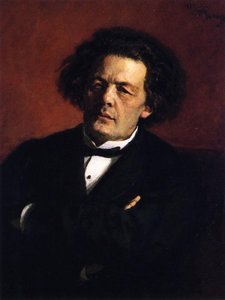
11Portrait of Dmitry Mendeleev (1885) aut. Ilja RepinasPortrait of Dmitry Mendeleev1885 12Portrait of Pavel Tretyakov, Founder of the Tretyakov Gallery. (1883) aut. Ilja RepinasPortrait of Pavel Tretyakov, Founder of the Tretyakov Gallery.1883 · Tretyakov galerija 13Self-Portrait. (1887) aut. Ilja RepinasSelf-Portrait.1887 · Tretyakov galerija 14The Surgeon E. Pavlov in the Operating Theater. (1888) aut. Ilja RepinasThe Surgeon E. Pavlov in the Operating Theater.1888 · Tretyakov galerija 15Portrait of Emperor Nicholas II (1895) aut. Ilja RepinasPortrait of Emperor Nicholas II1895 · Ermitažas 16Portrait of the Actress Pelageya Strepetova (1882) aut. Ilja RepinasPortrait of the Actress Pelageya Strepetova1882 · Tretyakov galerija 17Portrait of the Composer Modest Musorgsky. (1881) aut. Ilja RepinasPortrait of the Composer Modest Musorgsky.1881 · Tretyakov galerija 18Portrait of Professor Ivanov (1882) aut. Ilja RepinasPortrait of Professor Ivanov1882 · Finnish National Gallery 19Sadko in the Underwater Kingdom (1875) aut. Ilja RepinasSadko in the Underwater Kingdom1875 · Tretyakov galerija 20Portrait of the Lawyer Vladimir Spasovitch. (1891) aut. Ilja RepinasPortrait of the Lawyer Vladimir Spasovitch.1891 21Portrait of Composer Cesar Antonovich Cui (1890) aut. Ilja RepinasPortrait of Composer Cesar Antonovich Cui1890 22Portretas Nikolajui Remizovui (1917) aut. Ilja RepinasPortretas Nikolajui Remizovui1917 23Portrait of Bella Gorskaya (1910) aut. Ilja RepinasPortrait of Bella Gorskaya1910 · The State Museum of Fine Arts of Tatarstan Republic 24Portrait of writer Yevgeny Nikolayevich Chirikov (1906) aut. Ilja RepinasPortrait of writer Yevgeny Nikolayevich Chirikov1906 25Portrait of the Surgeon Nikolay Pirogov (1881) aut. Ilja RepinasPortrait of the Surgeon Nikolay Pirogov1881 26Portrait of actor and dramatist Grigory Grigorievich Ghe (1895) aut. Ilja RepinasPortrait of actor and dramatist Grigory Grigorievich Ghe1895 · Nizhniy Tagil State Museum of Fine Arts 27Portrait of the Lawyer Vladimir Spasovitch (1891) aut. Ilja RepinasPortrait of the Lawyer Vladimir Spasovitch1891 28Portrait of actress Eleonora Duse (1891) aut. Ilja RepinasPortrait of actress Eleonora Duse1891 29Portrait of K.B. Boleslavova (1913) aut. Ilja RepinasPortrait of K.B. Boleslavova1913 30Boris Godunov with Ivan the Terrible (1890) aut. Ilja RepinasBoris Godunov with Ivan the Terrible1890 · Art Gallery of Tver 31Portrait of the Author Leonid Andreev. (1904) aut. Ilja RepinasPortrait of the Author Leonid Andreev.1904 32Portrait of the physiologist Ivan Petrovich Pavlov. (1924) aut. Ilja RepinasPortrait of the physiologist Ivan Petrovich Pavlov.1924 · Tretyakov galerija 33Portrait of Nadya Repina (1881) aut. Ilja RepinasPortrait of Nadya Repina1881 34Portrait of the Art Critic Vladimir Stasov (1889) aut. Ilja RepinasPortrait of the Art Critic Vladimir Stasov1889 35Young ladys walk among herd of cow aut. Ilja RepinasYoung ladys walk among herd of cowTereschenko muziejus 36Golgotha aut. Ilja RepinasGolgotha 37Portrait of painter and sculptor Mikhail Osipovich Mikeshin. (1888) aut. Ilja RepinasPortrait of painter and sculptor Mikhail Osipovich Mikeshin.1888 · Tretyakov galerija 38Interior (etude). (1883) aut. Ilja RepinasInterior (etude).1883 · Tretyakov galerija 39Ivan the Terrible and His Son Ivan on November 16, 1581. (1885) aut. Ilja RepinasIvan the Terrible and His Son Ivan on November 16, 1581.1885 · Tretyakov galerija 40On a Turf Bench. (1876) aut. Ilja RepinasOn a Turf Bench.1876 41Unexpected Visitors (1888) aut. Ilja RepinasUnexpected Visitors1888 42Haulers on the Volga. (1870) aut. Ilja RepinasHaulers on the Volga.1870 43On a Bridge in Abramtsevo. (1879) aut. Ilja RepinasOn a Bridge in Abramtsevo.1879 · Pushkinio valstybinis dailės muziejus 44Vladimir Vladimirovich Mayakovsky aut. Ilja RepinasVladimir Vladimirovich Mayakovsky 45Rest. Portrait of Vera Repina, Artist's Wife. (1882) aut. Ilja RepinasRest. Portrait of Vera Repina, Artist's Wife.1882 · Tretyakov galerija 46Portrait of Yuria Repina, the Artist's son. (1882) aut. Ilja RepinasPortrait of Yuria Repina, the Artist's son.1882 · Tretyakov galerija 47Portrait of the Composer Mikhail Glinka. (1887) aut. Ilja RepinasPortrait of the Composer Mikhail Glinka.1887 · Tretyakov galerija 48Portrait of Tatyana Repina, the Artist's Mother. (1867) aut. Ilja RepinasPortrait of Tatyana Repina, the Artist's Mother.1867 · Prahos nacionalinė dailės galerija 49Portrait of the Composer Anton Rubinstein. (1881) aut. Ilja RepinasPortrait of the Composer Anton Rubinstein.1881 · Tretyakov galerija 50Sergejė Vitečio portretas (1903) aut. Ilja RepinasSergejė Vitečio portretas1903 51Portrait of Nadezhda Repina, the Artist's Daughter. (1900) aut. Ilja RepinasPortrait of Nadezhda Repina, the Artist's Daughter.1900 · Tretyakov galerija 52Judas (1885) aut. Ilja RepinasJudas1885 53Dragon-Fly. Portrait of Vera Repina, the Artist's Daughter. (1884) aut. Ilja RepinasDragon-Fly. Portrait of Vera Repina, the Artist's Daughter.1884 · Tretyakov galerija 54Portrait of the Art Critic Vladimir Stasov. (1889) aut. Ilja RepinasPortrait of the Art Critic Vladimir Stasov.1889 · Tretyakov galerija 55Portrait of the artist daughter Nadezhda (1898) aut. Ilja RepinasPortrait of the artist daughter Nadezhda1898 56Portrait of the Artist Ilya Repin by Valentin Serov. (1901) aut. Ilja RepinasPortrait of the Artist Ilya Repin by Valentin Serov.1901 · Tretyakov galerija 57Portrait of the Author Vladimir Korolemko. (1912) aut. Ilja RepinasPortrait of the Author Vladimir Korolemko.1912 · Tretyakov galerija 58Portrait of S.F. Mamontova (1879) aut. Ilja RepinasPortrait of S.F. Mamontova1879 59Zaporozhets aut. Ilja RepinasZaporozhetsVitebsko šiuolaikinio meno muziejus 60The road from Montmartre in Paris (1876) aut. Ilja RepinasThe road from Montmartre in Paris1876 61The Procurator (1912) aut. Ilja RepinasThe Procurator1912 · Finnish National Gallery 62A Shy Peasant (1877) aut. Ilja RepinasA Shy Peasant1877 63Cry of prophet Jeremiah on the Ruins of Jerusalem (on a Bible subject) (1870) aut. Ilja RepinasCry of prophet Jeremiah on the Ruins of Jerusalem (on a Bible subject)1870 · Tretyakov galerija 64Religious Procession (1877) aut. Ilja RepinasReligious Procession1877 · Valstybinis Rusijos muziejus 65Old Man and Raven (1885) aut. Ilja RepinasOld Man and Raven1885 · Alte Nationalgalerie 66Tramps. Homeless. (1894) aut. Ilja RepinasTramps. Homeless.1894 67Portrait of Vladimir Aleksandrovich (1910) aut. Ilja RepinasPortrait of Vladimir Aleksandrovich1910 68A woman in a cap aut. Ilja RepinasA woman in a capVitebsko šiuolaikinio meno muziejus 69Portrait of the Art Critic Vladimir Stasov (1873) aut. Ilja RepinasPortrait of the Art Critic Vladimir Stasov1873 70A Parisian Cafe (1875) aut. Ilja RepinasA Parisian Cafe1875 71The Surgeon E. Pavlov in the Operating Theater (1888) aut. Ilja RepinasThe Surgeon E. Pavlov in the Operating Theater1888 · Tretyakov galerija 72Portrait of Leo Tolstoy as a Ploughman on a Field (1887) aut. Ilja RepinasPortrait of Leo Tolstoy as a Ploughman on a Field1887 · Tretyakov galerija 73Portrait of the Chello-Player Alexander Verzhbilovich. (1895) aut. Ilja RepinasPortrait of the Chello-Player Alexander Verzhbilovich.1895 74Portrait of Polixena Stasova. (1879) aut. Ilja RepinasPortrait of Polixena Stasova.1879 75The Self immolation of Gogol (1909) aut. Ilja RepinasThe Self immolation of Gogol1909 · Tretyakov galerija 76Portrait of Tevashova aut. Ilja RepinasPortrait of Tevashova 77Diogenes and the boy (1867) aut. Ilja RepinasDiogenes and the boy1867 78Portrait of A. Bocharova, artist's aunts (1859) aut. Ilja RepinasPortrait of A. Bocharova, artist's aunts1859 79Barge Haulers Pulling on the Strap (1870) aut. Ilja RepinasBarge Haulers Pulling on the Strap1870 80Portrait of P.P. Chistyakov (1870) aut. Ilja RepinasPortrait of P.P. Chistyakov1870 81Portrait of sculptor Mark Matveevich Antokolski (1866) aut. Ilja RepinasPortrait of sculptor Mark Matveevich Antokolski1866 82Portrait of a kalmyk (1871) aut. Ilja RepinasPortrait of a kalmyk1871 83Portrait of A.I. Shevtsov (1869) aut. Ilja RepinasPortrait of A.I. Shevtsov1869 84Academic keeper Efimov (1870) aut. Ilja RepinasAcademic keeper Efimov1870 85Crucession in Oak wood (1877) aut. Ilja RepinasCrucession in Oak wood1877 86Study of a peasant in the grass. (1875) aut. Ilja RepinasStudy of a peasant in the grass.1875 · Nacionalinis muziejus Varšuvoje 87The Scytheman (1876) aut. Ilja RepinasThe Scytheman1876 · Finnish National Gallery 88Portrait de Mykola Ivanovich Murashko (1877) aut. Ilja RepinasPortrait de Mykola Ivanovich Murashko1877 · Ukrainos nacionalinis meno muziejus 89Under guard. On a dirty road (1876) aut. Ilja RepinasUnder guard. On a dirty road1876 · Tretyakov galerija 90Death of Fedor Chizhov (1877) aut. Ilja RepinasDeath of Fedor Chizhov1877 91Reading Aloud (1878) aut. Ilja RepinasReading Aloud1878 92Two woman (1878) aut. Ilja RepinasTwo woman1878 93To his homeland. The hero of the last war (1878) aut. Ilja RepinasTo his homeland. The hero of the last war1878 94Death of Fedor Chizhov (1877) aut. Ilja RepinasDeath of Fedor Chizhov1877 95Portrait of the artist R. S. Levitsky (1878) aut. Ilja RepinasPortrait of the artist R. S. Levitsky1878 · Finnish National Gallery 96Portrait of V. Repin, musician, brother of the artist (1876) aut. Ilja RepinasPortrait of V. Repin, musician, brother of the artist1876 97A Newspaper Seller in Paris (1873) aut. Ilja RepinasA Newspaper Seller in Paris1873 98Portrait of poet and slavophile Ivan Sergeyevich Aksakov (1878) aut. Ilja RepinasPortrait of poet and slavophile Ivan Sergeyevich Aksakov1878 99Girl at a Table (1883) aut. Ilja RepinasGirl at a Table1883 · Finnish National Gallery 100At the boundary (1879) aut. Ilja RepinasAt the boundary1879 · Tretyakov galerija

žymios Ilja Repinas tapiojamos, pagal laikotarpį

Temos, kurios domino Ilja Repinas

Ketverios temos, dažniausiai pasikrausto originaluose, kiekvienos su savo puikiausiu pavyzdžiu.

Muziejai, kuriuose saugomi Ilja Repinas originalūs darbai

8 muziejai, kuriuose saugoma daugiausia šioje pusėje esamų paveikslų.

Muzejaus Miestas Ilja Repinas darbai Šiojo sąrašo paveikslai
Tretyakov galerija, MaskvaTretyakov galerija Maskva 59 Ivanas Keistutys ir jo sūnus Ivanas 1885 m. lapkričio 16 d., Netikėtas grįžimas, Krestny Khod (Religinis procesija) Kursk gubernijoje
Finnish National Gallery, HelsinkisFinnish National Gallery Helsinkis 29 Portrait of Professor Ivanov, The Procurator, The Scytheman
Valstybinis Rusijos muziejus, Sankt PeterburgasValstybinis Rusijos muziejus Sankt Peterburgas 27 Zaporoziečių kazakų atsakymas sultonui Mahmūdoviui IV, Bargos traukėjai prie Volgos, Sadko
Vitebsko šiuolaikinio meno muziejus, VitebskasVitebsko šiuolaikinio meno muziejus Vitebskas 2 Zaporozhets, A woman in a cap
The State Museum of Fine Arts of Tatarstan Republic, KazanThe State Museum of Fine Arts of Tatarstan Republic Kazan 2 Portrait of Bella Gorskaya
Nizhniy Tagil State Museum of Fine Arts, Nizhny TagilNizhniy Tagil State Museum of Fine Arts Nizhny Tagil 2 Portrait of actor and dramatist Grigory Grigorievich Ghe
Nacionalinis muziejus Varšuvoje, VaršuvaNacionalinis muziejus Varšuvoje Varšuva 2 Study of a peasant in the grass.
Ermitažas, Šv. PeterburgasErmitažas Šv. Peterburgas 1 Portrait of Emperor Nicholas II

Ilja Repinas per dešimtmečius: vieniškas originalas kiekvienam

Darbai pagal dešimtmečius

Pasirinkite dešimtmetį, kad pamatytėte jį apibrėžusį originalą.

Ilja Repinas tapų klausimai galerijai

Koks yra garsiausias Ilja Repinas kūrinys?Atsakymas

Ivanas Keistutys ir jo sūnus Ivanas 1885 m. lapkričio 16 d. (1885), Tretyakov galerija, Maskva. Toliau seka Zaporoziečių kazakų atsakymas sultonui Mahmūdoviui IV (1878) ir Bargos traukėjai prie Volgos (1873).

Kuriuo amžiaus atσταση Ilja Repinas sukūrė Ivanas Keistutys ir jo sūnus Ivanas 1885 m. lapkričio 16 d.?Atsakymas

41 metų amžiaus: Ivanas Keistutys ir jo sūnus Ivanas 1885 m. lapkričio 16 d. sukurta 1885 m. Nr. Ilja Repinas gimė 1844.

Kurios Ilja Repinas dešimt paveikslų yra garsiausi?Atsakymas

Ivanas Keistutys ir jo sūnus Ivanas 1885 m. lapkričio 16 d., Zaporoziečių kazakų atsakymas sultonui Mahmūdoviui IV, Bargos traukėjai prie Volgos, Netikėtas grįžimas, Sadko, Krestny Khod (Religinis procesija) Kursk gubernijoje, Portrait of Chuguev resident S.L. Lyubitskaya, Portrait of the Poet Voinov, The Vice-President of the Academy of Arts, I.I. Tolstoy ir Portrait of the Composer Mikhail Glinka. Viršuje esančioje reitingo sąraše nurodyta kiekvieno kūrinio metis ir muziejus.

Kiek žinoma Ilja Repinas darbų?Atsakymas

Mūsų kataloge yra 672 Ilja Repinas darbų, skirtų laikotarpiui nuo 1859 iki 1926.

Kur galima pamatyti garsiausių Ilja Repinas originalų?Atsakymas

Daugiausia – Tretyakov galerija (Maskva), Finnish National Gallery (Helsinkis) ir Valstybinis Rusijos muziejus (Sankt Peterburgas). Viršuje esančiame muziejų sąraše yra visi jie.

Kuriuo laikotarpiu Ilja Repinas sukūrė savo žymiausias paveikslus?Atsakymas

1870s laikotarpiu: 35 iš 100 šioje pusėje esančių darbų buvo sukurtos tada, iš jų Zaporoziečių kazakų atsakymas sultonui Mahmūdoviui IV.

Kuris iš garsių Ilja Repinas paveikslų yra pirmasis, o kuris – paskutinis?Atsakymas

Šioje pusėje seniausias darbas yra Portrait of A. Bocharova, artist's aunts (1859), o naujausias – Portrait of the Poet Voinov (1926).

Kokia temos Ilja Repinas mėgavosi?Atsakymas

Portrait (36), Russian art (28) ir Repin (17) iš 100 šioje pusėje esamų darbų.

Kuriomis medžiagomis Ilja Repinas tapė dažniausiai?Atsakymas

Oil On Canvas, iš 100 šios puslapio darbų – 50.

Kelią meno kryžkelę priklauso Ilja Repinas kūryba?Atsakymas

Realist expressionism, judging by the originals on this page.

Kurius Ilja Repinas originalius galėčiau pamatyti Tretyakov galerija?Atsakymas

Ivanas Keistutys ir jo sūnus Ivanas 1885 m. lapkričio 16 d., Netikėtas grįžimas ir Krestny Khod (Religinis procesija) Kursk gubernijoje: Tretyakov galerija, Maskva kolekcijoje yra 29 šioje pusėje esančių darbų.

Ilja Repinas: meno kūrinys – autoportretas

Early Life, Family and Training

Ilya Yefimovich Repin entered the world on August 5, 1844, in Chuguev, located within the Kharkov Governorate of the Russian Empire. His upbringing was shaped by the practicalities of a modest household; his father, Yefim Vasilyevich Repin, was a military settler who later worked as an itinerant merchant. This background provided a connection to the movement of people and the realities of provincial life that would later inform his perspective. His early years were defined by the quiet discipline of a small town, far from the formal academies that would eventually define his professional life.

The seeds of his technical skill were sown through a traditional apprenticeship. At the age of sixteen, he began the meticulous work of painting icons, learning the craft under the guidance of local icon painters. This period of training required a precise hand and an understanding of religious composition. It was a rigorous introduction to the visual language of his surroundings, teaching him to observe the nuances of form and light before he ever stepped foot in a major metropolitan center.

In 1863, driven by an ambition to refine his talent, he traveled to Saint Petersburg. He did not enter the Imperial Academy of Arts through the standard channels at first, but instead audited courses, absorbing the atmosphere and instruction of the institution. This period of self-directed study allowed him to bridge the gap between his provincial training and the formal academic standards of the capital. He was a man of persistence, navigating the transition from a student of religious imagery to a serious practitioner of secular art.

The Rise of a Realist Master

The transition from a student to a central figure in Russian art was marked by rapid academic success. After navigating the challenges of his early training, he secured his first prizes at the Imperial Academy of Arts in 1869 and 1871. These accolades signaled a shift toward a more direct engagement with the world around him. His growing reputation led to a significant commission from Grand Duke Vladimir Alexandrovich for The Barge Haulers on the Volga, a work that would define his early career and establish his commitment to depicting the realities of labor.

Between 1873 and 1876, his perspective expanded through two years spent in Paris and Normandy. This period allowed him to observe the techniques of painting in the open air, which he would later integrate into his own approach to light and form. He did not merely replicate the styles he encountered; instead, he refined a method of capturing the human condition with a specific, unvarnished clarity. This period of travel provided the technical breadth necessary to move beyond simple representation into a more profound psychological realism.

By 1894, his influence had become institutionalized when he was appointed a professor of historical painting at the St. Petersburg Academy. He had moved from the periphery of the art world to its very center, teaching the next generation how to navigate the tension between academic tradition and the demand for social truth. His career had come full circle, from a student auditing classes to a master shaping the direction of national art.

Key Works and Masterpieces

Repin’s ascent was marked by a profound ability to translate the struggles of the common man into monumental visual narratives. In 1873, he produced Barge Haulers on the Volga, a work that captured the brutal physical toil of laborers dragging boats along the river. This painting moved beyond simple observation, offering a searing indictment of social injustice through the exhaustion and resolve of its subjects. It established him as a painter deeply attuned to the human condition and the socio-political tensions of his era.

His interest in the complexities of the Russian soul led him to explore both religious and historical themes with intense psychological depth. Between 1880 and 1883, he painted Religious Procession in Kursk Province, a nuanced study of faith and social hierarchy. This period also saw the development of Reply of the Zaporozhian Cossacks, a work created between 1880 and 1891 that captured a defiant spirit of resistance. His brushwork often balanced the joy of folk motifs with the darker, more heavy aspects of history.

The capacity for drama reached a peak in 1885 with Ivan the Terrible and His Son Ivan. This depiction of a moment of horrific violence and remorse remains one of his most striking explorations of power and guilt. Through these varied subjects, Repin moved from the grit of the riverbanks to the heavy shadows of the Kremlin, always maintaining a focus on the internal struggles of his figures.

Technique and Artistic Style

Repin established himself as the foremost exponent of the Russian Realist style, a movement that sought to strip away academic idealization in favor of the unvarnished truth of contemporary life. His artistic language was defined by a profound sense of plasticity, a quality that allowed him to render the human form and its surroundings with a tangible, three-dimensional presence. This technical command enabled him to move beyond mere likeness, capturing the physical weight of a laborer or the subtle tension in a historical scene. He was a master of genre painting, finding profound meaning in the everyday activities of the common people and the complex social hierarchies of his era.

His approach was not static, however. During his time in France and Italy, he encountered the burgeoning Impressionist movement, and the influence of French plein-air techniques became evident in his later work. He began to integrate these observations into his rigorous realist foundation, utilizing light and brushwork to suggest atmosphere and movement rather than relying solely on rigid, polished finishes. This synthesis allowed him to depict the psychological depth of his subjects through a more fluid, observational lens. He used the human face as a landscape of emotion, often focusing on the internal struggles of his sitters.

Later Years and Death

The final chapter of Repin’s life was marked by a quiet withdrawal from the turbulent currents of history. Following the February Revolution of 1917, he found himself increasingly disillusioned by the violence and terror unleashed by the Bolsheviks. This profound sense of unease prompted a retreat from the center of Russian life toward the more tranquil surroundings of his estate, Penates. Located in Kuokkala, Finland, this sanctuary provided a refuge from the political upheaval that had reshaped his homeland.

In this secluded setting, he continued to paint, finding a sense of peace away from the social transformations occurring in the cities. His focus shifted toward more personal and introspective subjects, often drawing from his immediate surroundings and the people closest to him. He remained active in his craft until his final days, maintaining a connection to the art that had defined his existence. He died on 29 September 1930 in Kuokkala. He is buried at The Penates.

Legacy and Enduring Influence

The influence of Ilya Yefimovich Repin extended far beyond the borders of the Russian Empire, reaching into the very foundations of modern painting. By defining the parameters of Russian realism, he established a visual language that would later inform the development of Socialist Realism. His ability to merge technical academic precision with a sharp social conscience allowed his work to function as a mirror to a changing society. This commitment to portraying the human condition with honesty ensured that his impact would be felt by generations of artists who followed in his footsteps.

His reputation was recognized on the international stage, far from the provincial towns of his youth. In 1900, he served as a jury member of the Paris World Fair, a position that reflected his standing among the global artistic elite. This recognition was further solidified when he was awarded the Legion of Honour, an honor that underscored his importance to the European art world. He moved between the rigorous traditions of the Academy and the evolving techniques of plein-air painting, leaving behind a body of work that bridged the gap between the old world and the new.

Where to See the Works Today

The physical presence of Repin's oeuvre is scattered across several major institutions, reflecting the breadth of his influence. The Tretyakov Gallery in Moscow remains the most significant repository, housing 26 of his works. Within this collection, one can find his portrait of the composer Modest Musorgsky, dated 1881, alongside the portrait of Pavel Tretyakov from 1883. These pieces offer a direct encounter with the psychological depth he brought to his subjects.

Beyond Moscow, his canvases have traveled to various corners of Europe and the former Soviet territories. The Vitebsk Museum of Modern Art holds two of his works, while the Pushkin State Museum in Moscow preserves a single piece. In Prague, the National Gallery maintains one of his paintings, ensuring his visual language remains accessible to international audiences. These specific locations provide a fragmented but significant map of his artistic output.