Henri Biva portretas

16 garsiausių Henri Biva paveikių rinkinys: galerijos išboru

Atnaujinta lapkritis 2026 · pagal mūsų populiarumumo koeficientą (paieškos, lankytojai ir užsakymai kiekvienam kūriniui) · 16 Henri Biva darbai mūsų kataloge

Trumpai tariant

Iš visų originalų, kuriuos paliko Henri Biva, garsiausias yra Looking out onto a lake on a summer day. Tiesiog už jų seka Flowers near a well ir By The River. Mūsų kataloge yra 16 darbų autoriaus Henri Biva; galerija išsaugojo 16 labiausiai pasaulyje žyminiausių kūrinių – kiekvienas jų pateikiamas su datos, muziejaus ir istorijos aprašymu.

1848 – 1929, Montmartras

Henri Biva geriausios 10 paveikslų: galerijos pasirinkimas

1
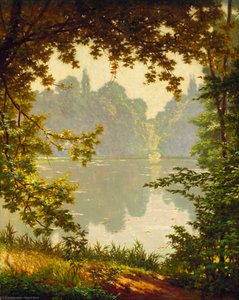
Looking out onto a lake on a summer day aut. Henri Biva

Looking out onto a lake on a summer day

Oil On Canvas

Looking out onto a lake on a summer day is a painting by the French artist Henri Biva. The canvas captures a quiet moment where a small, unoccupied boat rests near the center of a calm body of water. Trees frame the scene, their leaves occasionally drifting onto the surface of the lake. The water acts as a mirror, reflecting the stillness of the surrounding landscape.

2
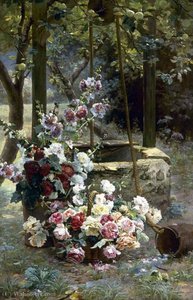
Flowers near a well aut. Henri Biva

Flowers near a well

Oil On Canvas

We are looking at Flowers near a well, an oil on canvas by Henri Biva. This particular work carries a significant presence, measuring 71.2 in (180.9 cm) in height and 46.5 in (118.1 cm) in width. It is a piece that reflects the artist's deep connection to the French landscape and his ability to capture the quietude of the natural world.

5
Chrysanthemums and roses in a vase on a salver aut. Henri Biva

Chrysanthemums and roses in a vase on a salver

Oil

The painting titled Chrysanthemums and roses in a vase on a salver is a work by the artist Henri Biva. This still life features a bouquet of flowers placed within a blue vase. The arrangement contains at least 12 different flowers, including roses and daisies, which are positioned both at the top of the cluster and scattered throughout the composition. The vase rests upon a plate, which is situated on…

6
Woodland interior with brook aut. Henri Biva

Woodland interior with brook

Oil On Canvas

In the quiet heart of a dense forest, the painting Woodland interior with brook by Henri Biva captures a moment of profound stillness. The scene unfolds around a small waterfall that breaks the silence of the woods, its waters cascading through a landscape of mossy rocks and thick foliage. Sunlight filters through the canopy, catching the spray of the brook as it moves through the shadows of the trees.

7
Bord De Rivière Ensoleillé aut. Henri Biva

Bord De Rivière Ensoleillé

Oil On Canvas

Bord De Rivière Ensoleillé is an oil on canvas by the French artist Henri Biva. This work measures 53.3 x 59.7 cm. It captures a sunlit riverbank where the light settles upon detailed grasses and shimmering water.

8
A Quiet Stretch Of The River aut. Henri Biva

A Quiet Stretch Of The River

Oil

A Quiet Stretch Of The River is a painting by the French artist Henri Biva. The work depicts a tranquil landscape centered on a meandering river that flows through the foreground. Lush vegetation and various shades of green line the banks, while a dense collection of trees forms the background under an overcast sky. The composition uses a variety of color temperatures, with cooler tones situated in the distance and…

9
Les nenuphar aut. Henri Biva

Les nenuphar

Oil

Les nenuphar is a painting by the French artist Henri Biva. The work captures a quiet forest scene where a river flows through a dense grove. Within the water, lily pads float upon the surface, resting near the shadows of trees. A single person stands near the center of the composition, a silent witness to the stillness of the riverbank.

10
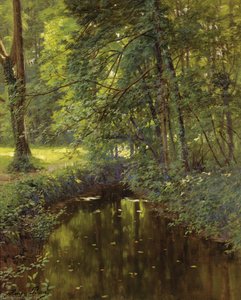
The river aut. Henri Biva

The river

Oil

The river is a painting by the French artist Henri Biva. It captures a forest scene where a small stream winds through the greenery. A single person stands near the water, a quiet presence amidst the lushness of the trees and scattered bushes. The scene holds the stillness of a woodland path.

Henri Biva darba rinkinys tęsiamas, nuo 11 iki 16

Temos, kurios domino Henri Biva

Ketverios temos, dažniausiai pasikrausto originaluose, kiekvienos su savo puikiausiu pavyzdžiu.

Henri Biva metai po metų: originalūs darbai, apibūdinantys kiekvieną iš jų

1905 yra kiekvieno aprašyto datomis Henri Biva kūrinio šioje rinktinėje: štai jie, išvardyti pagal šlovę.

Darbai pagal metus

Pasirinkite metus, kad pamatytumėte originalus darbus.

Kolekcjonerų klausimai apie Henri Biva paveikslus

Kuriu darbu Henri Biva yra labiausiai garsus?Atsakymas

Looking out onto a lake on a summer day. Toliausiai eina Flowers near a well ir By The River.

Kokie yra 10 garsiausių Henri Biva paveikslų?Atsakymas

Looking out onto a lake on a summer day, Flowers near a well, By The River, Market At Jaffa, Chrysanthemums and roses in a vase on a salver, Woodland interior with brook, Bord De Rivière Ensoleillé, A Quiet Stretch Of The River, Les nenuphar ir The river. Viršuje esančioje reitingo sąraše nurodyta kiekvieno kūrinio metis ir muziejus.

Kiek paveikslų paliko Henri Biva?Atsakymas

Mūsų kataloge yra 16 darbų autoriaus Henri Biva.

Kurią temą Henri Biva rinkosi dažniausiai?Atsakymas

Trees (9), Water (8) ir River (7) iš 16 šioje pusėje esamų darbų.

Kurią techniką Henri Biva naudojo dažniausiai?Atsakymas

Oil On Canvas, iš 16 šios puslapio darbų – 7.

Henri Biva: gyvenimas ir kūryba

The Luminous Legacy of Henri Biva

Born amidst the vibrant, bohemian pulse of Montmartre in January 1848, Henri Biva emerged as a master of the French landscape, a painter whose brush captured the very soul of the Parisian countryside. Growing up in an environment steeped in artistic tradition, Biva was destined for the canvas; his creative lineage was furthered by his brother, Paul Biva, and later by his son, Lucien Biva. His early years in Paris provided more than just a backdrop; they offered a profound connection to the natural world that would become the cornerstone of his oeuvre. As he matured, Biva developed a singular ability to bridge the gap between the meticulous precision of Realism and the emotive, light-drenched spontaneity of Impressionism, creating works that feel both timelessly grounded and ethereally fleeting.

The technical foundation of Biva’s artistry was forged in the prestigious halls of the École des Beaux-Arts and the rigorous Académie Julian. Under the watchful eyes of masters such as Léon Tanzi and Alexandre Nozal, he learned to navigate the delicate balance between academic discipline and the burgeoning avant-garde movements of his era. His studies with legendary figures like William-Adolphe Bouguereau and Jules Joseph Lefebvre instilled in him a respect for form and structure, yet it was his devotion to the plein air tradition that truly liberated his style. By stepping out of the studio and into the western suburbs of Paris, Biva began to experiment with the interplay of shadow and sun, learning to translate the warmth of a summer afternoon or the quiet stillness of a backwater into a language of pure color and intricate brushwork.

A Mastery of Light and Nature

Biva’s work is often celebrated for its profound Naturalist sentiment, characterized by an almost tactile intimacy with his subjects. He possessed a rare, unparalleled skill in capturing the ephemeral magic of the seasons, particularly the way light dances across a garden or settles upon a tranquil pond. His compositions frequently invite the viewer into a serene, idealized version of the French landscape—places where sunlight feels tangible and the atmosphere is heavy with the scent of summer blooms. This mastery was not merely about visual accuracy but about emotional resonance; through his use of a pure, vibrant palette, he could evoke a sense of peace and nostalgia that transcends the mere depiction of scenery.

Beyond his sweeping landscapes, Biva also demonstrated a remarkable talent for still life painting. In these works, the same attention to light and texture found in his outdoors scenes is applied to the intimate details of the natural world—the velvety petal of a chrysanthemum or the rustic charm of a wicker basket. This versatility allowed him to command respect across different genres, proving that his true subject was not just the landscape itself, but the very essence of light as it interacts with all forms of life.

Recognition and Historical Significance

The trajectory of Biva’s career was marked by significant professional triumphs that cemented his status within the French art establishment. His frequent exhibitions at the Salon des Artistes Français garnered critical acclaim, leading to a series of prestigious accolades that reflected his rising importance in the late 19th and early 20th centuries:

  • Medal Honors: He was awarded a third-class medal in 1895, followed by a second-class medal in 1896, and a bronze medal in 1900.
  • Knighthood: In recognition of his immense contribution to French culture, he was bestowed the title of Chevalier de la Légion d'honneur.
  • Societal Standing: His membership in the Société des Artistes Français placed him among the elite circle of painters defining the era.

Today, Henri Biva remains a significant figure for collectors and historians alike. He stands as a vital link in the evolution of French painting, representing a period where the rigid boundaries of academic tradition began to dissolve into the luminous freedom of modernism. His ability to harmonize the structural integrity of Realism with the atmospheric brilliance of Post-Impressionism ensures that his landscapes continue to offer a window into a beautifully captured, sun-drenched past.