Gunnar Berndtsonas portretas

Gunnar Berndtsonas tapiai: 42 garsiausi πίναšiai, galerijos akimis

Atnaujinta lapkritis 2026 · pagal mūsų populiarumumo koeficientą (paieškos, lankytojai ir užsakymai kiekvienam kūriniui) · 42 Gunnar Berndtsonas darbai mūsų kataloge

Trumpai tariant

Galerijos akimais, garsiausias Gunnar Berndtsonas tapas yra Portrait of a Jewish Man (1873), kurio originalas eksponuojamas Finnish National Gallery, Helsinkis. Self-Portrait in 17th-Century Costume (1884) ir Nude Female Model (1883) užbaia trio, kurį atpažįsta kiekvienas ž)/\ Iš 42 Gunnar Berndtsonas darbų mūsų kataloge, galerija žemiau pristato 42 garsiausius – kiekvienas yra originalus, su nurodytu metais, muziejumi bei unikaliu aprašymu.

1854 – 1895, Helsinkas Realism Daugiausia darbų: Finnish National Gallery

10 geriausių galerijos Gunnar Berndtsonas paveikslų

2
Self-Portrait in 17th-Century Costume (1884) aut. Gunnar Berndtsonas

Self-Portrait in 17th-Century Costume

1884 · Oil · Finnish National Gallery, Helsinkis

In this intimate oil painting, titled Self-Portrait in 17th-Century Costume, the artist Gunnar Berndtson gazes back from the canvas. He captures his own likeness, presenting himself through a lens of historical character. The work functions as a self-portrait, a moment where the creator and the subject become one. He appears dressed in the fashion of a bygone era, a choice that shifts the viewer's focus toward the persona he inhabits…

3
Nude Female Model (1883) aut. Gunnar Berndtsonas

Nude Female Model

1883 · Pastel · Finnish National Gallery, Helsinkis

In the 1883 pastel portrait titled Nude Female Model, the artist Gunnar Berndtson presents a classical nude study. The subject is a female model positioned in a seated, reclining pose. She is turned slightly toward the viewer's left, creating a sense of quiet contemplation. The figure is draped in satin-like fabric that cascades in fluid folds around her form. This blue drapery provides a cool-toned backdrop that contrasts with the…

4
Woman with a Bird at the Castle of Maison Laffitte (1882) aut. Gunnar Berndtsonas

Woman with a Bird at the Castle of Maison Laffitte

1882 · Oil · Finnish National Gallery, Helsinkis

The air in the grand room feels still, held in a delicate balance between the heavy architecture and the soft presence of the woman. She sits amidst the opulence of the Castle of Maison Laffitte, her figure framed by the rhythmic geometry of doorways and columns that pull the eye deep into the shadowy recesses of the castle. A soft light, perhaps filtering from an unseen window to the left,…

7
The Mirror ; The Toilet (1889) aut. Gunnar Berndtsonas

The Mirror ; The Toilet

1889 · Oil · Finnish National Gallery, Helsinkis

The air in the room feels heavy with the scent of expensive powders and the soft rustle of silk. A woman sits in profile, her silhouette a graceful curve against the muted backdrop of a private chamber. She is draped in a gown of luminous green satin that catches the light from an unseen window, the fabric shimmering with a liquid quality that suggests the cool touch of high-quality silk.…

8
Portrait of Counsellor of State Maria von Wahlberg (b. Sinebrychoff) (1892) aut. Gunnar Berndtsonas

Portrait of Counsellor of State Maria von Wahlberg (b. Sinebrychoff)

1892 · Oil On Panel · Finnish National Gallery, Helsinkis

The gaze of Maria von Wahlberg meets the viewer in the Portrait of Counsellor of State Maria von Wahlberg (b. Sinebrychoff). Painted in 1892 by the Finnish artist Gunnar Berndtson, this oil on panel captures a woman of significant presence. She is depicted as Mrs Maria von Wahlberg, born into the Sinebrychoff family, a lineage that carries a quiet weight within the frame. The portrait exists now within the Finnish…

9
Head of a Girl, Study for the Family Portrait of Baron Magnus von Born (1890) aut. Gunnar Berndtsonas

Head of a Girl, Study for the Family Portrait of Baron Magnus von Born

1890 · Oil · Finnish National Gallery, Helsinkis

In Head of a Girl, Study for the Family Portrait of Baron Magnus von Born, Gunnar Berndtson employs a close-up composition that focuses on the subject's face and upper shoulders. The figure is positioned slightly off-center, creating a sense of movement as she gazes toward the right. This orientation, combined with an eye-level perspective, establishes a direct connection between the subject and the viewer.

10
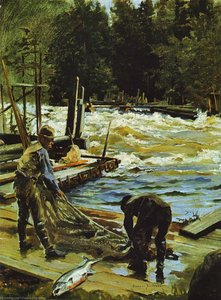
Salmon Fishers at the Langinkoski Rapid (1892) aut. Gunnar Berndtsonas

Salmon Fishers at the Langinkoski Rapid

1892 · Oil

In Salmon Fishers at the Langinkoski Rapid, the artist Gunnar Berndtson captures a moment of strenuous manual labor set against the wild, rushing waters of a natural river. Painted about 1892, the scene pulls the viewer directly onto a wooden dock where the air feels heavy with the spray of the rapids. Two fishermen work in unison, their bodies engaged in the heavy task of managing a large net amidst…

Gunnar Berndtsonas tapiai, rangos nuo 11 iki 42

žymios Gunnar Berndtsonas tapiojamos, pagal laikotarpį

Temos, kurios domino Gunnar Berndtsonas

Ketverios temos, dažniausiai pasikrausto originaluose, kiekvienos su savo puikiausiu pavyzdžiu.

Muziejai, kuriuose saugomi Gunnar Berndtsonas originalūs darbai

5 muziejai, kuriuose saugoma daugiausia šioje pusėje esamų paveikslų.

Muzejaus Miestas Gunnar Berndtsonas darbai Šiojo sąrašo paveikslai
Finnish National Gallery, HelsinkisFinnish National Gallery Helsinkis 17 Portrait of a Jewish Man, Self-Portrait in 17th-Century Costume, Nude Female Model
Turku meno muziejus, TurkuTurku meno muziejus Turku 2 Kesä, Self-portrait
Ateneum meno muziejus, HelsinkisAteneum meno muziejus Helsinkis 2 Almée, an Egyptian Dancer, The Bride
Serlachius Manor, Mänttä-VilppulaSerlachius Manor Mänttä-Vilppula 2 Taiteentuntijoita Louvressa, Sakkia
National Portrait Gallery of Sweden, SträngnäsNational Portrait Gallery of Sweden Strängnäs 1 Gustaf Cederström, 1845-1933

Gunnar Berndtsonas, po vieno ikoninio paveikslio kiekvienam dešimtmenės laikotarpiui

Darbai pagal dešimtmečius

Pasirinkite dešimtmetį, kad pamatytėte jį apibrėžusį originalą.

Gunnar Berndtsonas tapyiniai: galerijos atsakymai

Kuris Gunnar Berndtsonas paveikslas yra pats garsiausias iš visų?Atsakymas

Portrait of a Jewish Man (1873), Finnish National Gallery, Helsinkis. Toliau seka Self-Portrait in 17th-Century Costume (1884) ir Nude Female Model (1883).

Kiek metų buvo Gunnar Berndtsonas, kai sukūrė Portrait of a Jewish Man?Atsakymas

19 metų amžiaus: Portrait of a Jewish Man sukurta 1873 m. Nr. Gunnar Berndtsonas gimė 1854.

Kuriose yra 10 geriausių Gunnar Berndtsonas paveikslų?Atsakymas

Portrait of a Jewish Man, Self-Portrait in 17th-Century Costume, Nude Female Model, Woman with a Bird at the Castle of Maison Laffitte, Portrait of Zacharias Topelius, Portrait of Baron Delort de Gléon, The Mirror ; The Toilet, Portrait of Counsellor of State Maria von Wahlberg (b. Sinebrychoff), Head of a Girl, Study for the Family Portrait of Baron Magnus von Born ir Salmon Fishers at the Langinkoski Rapid. Viršuje esančioje reitingo sąraše nurodyta kiekvieno kūrinio metis ir muziejus.

Kiek kūrinių sukūrė Gunnar Berndtsonas?Atsakymas

Mūsų kataloge yra 42 Gunnar Berndtsonas darbų, skirtų laikotarpiui nuo 1873 iki 1894.

Kur kabinami garsiausi Gunnar Berndtsonas originalūs darbai?Atsakymas

Daugiausia – Finnish National Gallery (Helsinkis), Turku meno muziejus (Turku) ir Ateneum meno muziejus (Helsinkis). Viršuje esančiame muziejų sąraše yra visi jie.

Kada Gunnar Berndtsonas sukūrė savo garsiausias paveikslus?Atsakymas

1880s laikotarpiu: 8 iš 42 šioje pusėje esančių darbų buvo sukurtos tada, iš jų Self-Portrait in 17th-Century Costume.

Kokie yra ankstyviausi ir vėliausi garsieji Gunnar Berndtsonas kūriniai?Atsakymas

Šioje pusėje seniausias darbas yra Portrait of a Jewish Man (1873), o naujausias – Miniature Portrait of Baroness Delort de Gléon the Younger (1894).

Kurią temą Gunnar Berndtsonas kūrė dažniausiai?Atsakymas

Portraits (7), Woman (6) ir Man (5) iš 42 šioje pusėje esamų darbų.

Kurią techniką Gunnar Berndtsonas naudojo dažniausiai?Atsakymas

Oil, iš 42 šios puslapio darbų – 8.

Su kokiu kierliu siejama Gunnar Berndtsonas?Atsakymas

Realism, vadovaujantis šios puslapio originalais kūriniais.

Kurių Gunnar Berndtsonas originalų turi Finnish National Gallery?Atsakymas

Portrait of a Jewish Man, Self-Portrait in 17th-Century Costume ir Nude Female Model: Finnish National Gallery, Helsinkis kolekcijoje yra 17 šioje pusėje esančių darbų.

Gunnar Berndtsonas: menininkas

Gunnar Berndtson: A Finnish Master of Realistic Portraiture

Gunnar Fredrik Berndtson (1854-1895) stands as a significant, yet often overlooked, figure in the history of Finnish art. Born into an intellectual family – his father was the renowned author, journalist, and poet Fredrik Berndtson – Gunnar’s artistic journey began with formal studies at the Polytechnic Institute in Helsinki, later transitioning to auditing classes at the University of Helsinki under esteemed instructors like Erik Johan Löfgren. However, by 1876, he decisively chose a path as an artist, embarking on a transformative period in Paris where he enrolled at the École des Beaux-Arts and studied under the influential Jean-Léon Gérôme. This Parisian sojourn proved pivotal, exposing him to the Salon style of painting and fostering connections with artists like Albert Edelfelt, a relationship that would profoundly shape his artistic sensibilities.

Early Influences and the Salon Style

Berndtson’s early work demonstrates a clear absorption of the Salon’s emphasis on historical subjects and idealized beauty. His initial exhibits at the Salon in 1878 showcased this influence, characterized by meticulous detail and a polished aesthetic. Yet, he wasn't merely a mimic; his time with Edelfelt introduced him to a more nuanced approach – one that retained realism while subtly incorporating elements of Finnish identity and a burgeoning sense of modernism. The Salon’s popularity provided Berndtson with crucial exposure and established a foundation for his subsequent career.

Egypt and the Dawn of a New Vision

A pivotal chapter in Berndtson's artistic development unfolded between 1882 and 1883 when he traveled to Egypt as a guest of Alphonse, Baron Delort de Gléon, a French mining engineer. This experience proved profoundly influential, shifting his focus towards portraiture and documentary illustration for *Le Monde Illustré*. The stark light, vibrant colors, and diverse subjects of Egypt ignited a new passion within him, moving beyond the formal constraints of the Salon and laying the groundwork for a more personal and expressive style. He captured the essence of Egyptian life with remarkable accuracy and sensitivity, documenting both its grandeur and its everyday realities.

Return to Finland and Artistic Recognition

Upon his return to Finland in 1883, Berndtson established himself as a respected portrait painter, quickly gaining recognition for his ability to capture the character and dignity of his subjects. He received considerable acclaim, culminating in the State Prize for Portrait Painting in 1889 – a testament to his growing reputation. His portraits were not merely likenesses; they possessed an undeniable psychological depth, revealing subtle nuances of emotion and personality. He continued to exhibit at the Salon throughout the 1890s, maintaining a consistent level of success and solidifying his position as one of Finland’s leading artists.

Legacy and Artistic Significance

Gunnar Berndtson's legacy extends beyond his individual works; he played a role in shaping the development of Finnish art. He served as a teacher at the Academy of Fine Arts from 1890 to 1892, mentoring talented students like Magnus Enckell and Ellen Thesleff, who would go on to make significant contributions to the artistic landscape. His untimely death in 1895, attributed to a “degenerative ailment” (possibly syphilis), cut short a promising career but left behind a body of work characterized by meticulous realism, psychological insight, and a subtle yet unmistakable Finnish sensibility. Works such as *The Bride’s Song* (1881), *Portrait of Dentistry Professor Matti Äyräpää* (1889), *His Name* (1890) and *Almée, an Egyptian Dancer* (1883) offer poignant glimpses into the fin-de-siècle world he inhabited – a world grappling with modernity while retaining deep roots in tradition. Berndtson’s art continues to be studied and appreciated for its technical skill, emotional resonance, and its contribution to the rich tapestry of Finnish artistic history.