George Hand Wright portretas

12 garsiausių George Hand Wright paveikių rinkinys: galerijos išboru

Atnaujinta spalis 2026 · pagal mūsų populiarumumo koeficientą (paieškos, lankytojai ir užsakymai kiekvienam kūriniui) · 12 George Hand Wright darbai mūsų kataloge

Trumpai tariant

Iš visų originalų, kuriuos paliko George Hand Wright, garsiausias yra Washington at Valley Forge (from the portfolio The Bicentennial Pageant of George Washington ) (1932). Tiesiog už jų seka The royal mail crossing a bridge ir Fresh Rolls (1882). Mūsų kataloge yra 12 darbų autoriaus George Hand Wright; galerija išsaugojo 12 labiausiai pasaulyje žyminiausių kūrinių – kiekvienas jų pateikiamas su datos, muziejaus ir istorijos aprašymu.

1872 – 1951, Fox Chase

George Hand Wright geriausios 10 paveikslų: galerijos pasirinkimas

1
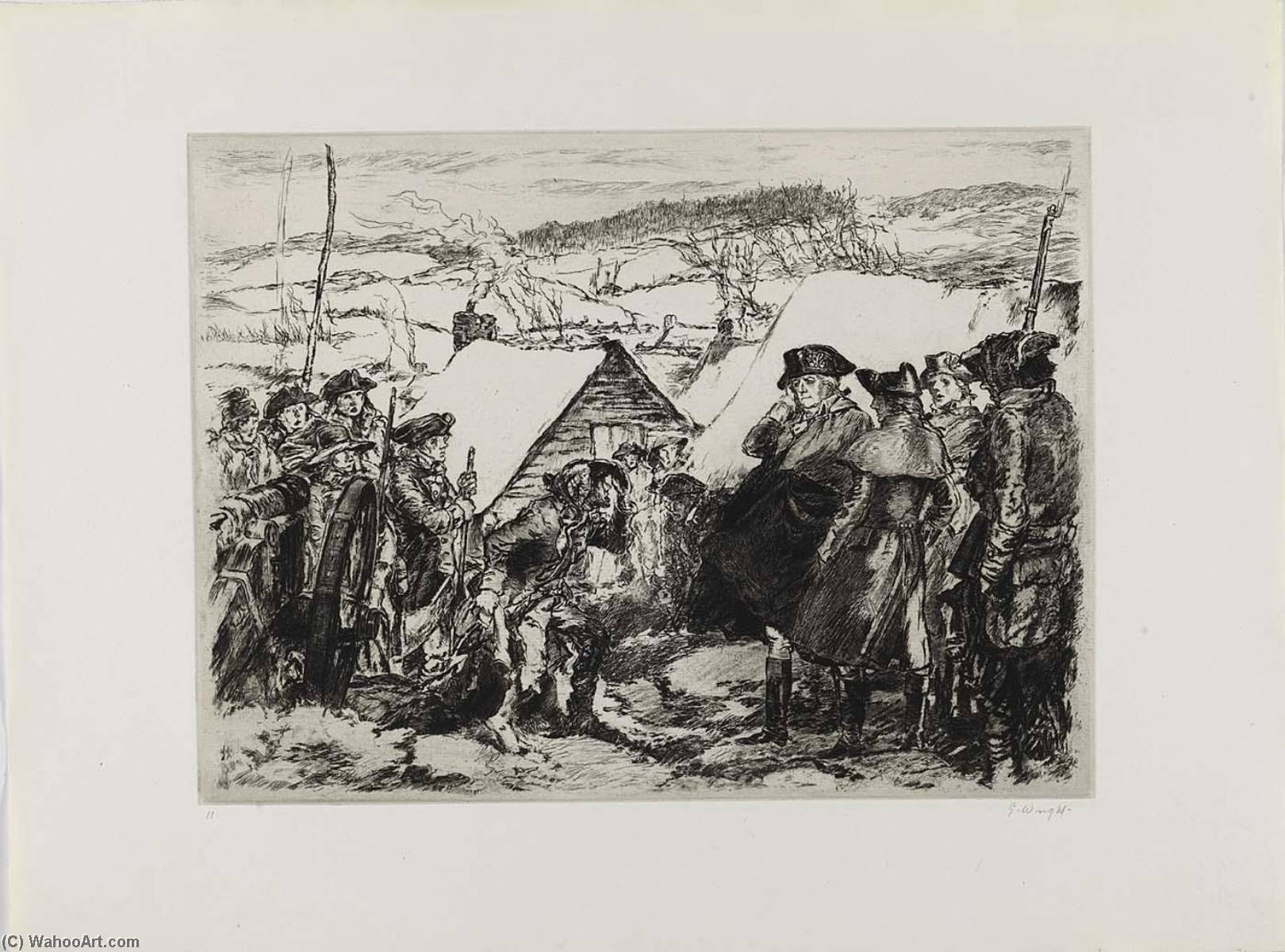
Washington at Valley Forge (from the portfolio The Bicentennial Pageant of George Washington ) (1932) aut. George Hand Wright

Washington at Valley Forge (from the portfolio The Bicentennial Pageant of George Washington )

1932 · Etching

In this black and white etching, we find ourselves amidst the quiet, heavy stillness of Valley Forge. The scene is composed around a central tent, a modest structure that acts as the anchor for a gathering of thirteen figures. These men, draped in heavy coats and hats, are caught in a moment of quietude. Some are lost in conversation, while others simply observe the surroundings, their presence felt through the…

George Hand Wright darba rinkinys tęsiamas, nuo 11 iki 12

George Hand Wright metai po metų: originalūs darbai, apibūdinantys kiekvieną iš jų

Nuo 1882 iki 1932, George Hand Wright kūrė 51 metų: šiame rinkinyje pristatoma ilga kūrybos kelionė, apimanti geriausius originalius darbus metus po metų.

Darbai pagal metus

Pasirinkite metus, kad pamatytumėte originalus darbus.

Kolekcjonerų klausimai apie George Hand Wright paveikslus

Kuriu darbu George Hand Wright yra labiausiai garsus?Atsakymas

Washington at Valley Forge (from the portfolio The Bicentennial Pageant of George Washington ) (1932). Toliausiai eina The royal mail crossing a bridge ir Fresh Rolls (1882).

Kokia buvo George Hand Wright amžius, kai buvo sukurtas Washington at Valley Forge (from the portfolio The Bicentennial Pageant of George Washington )?Atsakymas

60 metų amžiaus: Washington at Valley Forge (from the portfolio The Bicentennial Pageant of George Washington ) sukurta 1932 m. Nr. George Hand Wright gimė 1872.

Kokie yra 10 garsiausių George Hand Wright paveikslų?Atsakymas

Washington at Valley Forge (from the portfolio The Bicentennial Pageant of George Washington ), The royal mail crossing a bridge, Fresh Rolls, A Monopolise, A coach and four on the open road, Washington at Valley Forge, Washington at Valley Forge (cancelled plate from the portfolio The Bicentennial Pageant of George Washington ), A fresh team, The lost scent ir Homewards. Viršuje esančioje reitingo sąraše nurodyta kiekvieno kūrinio metis ir muziejus.

Kiek paveikslų paliko George Hand Wright?Atsakymas

Mūsų kataloge yra 12 George Hand Wright darbų, skirtų laikotarpiui nuo 1882 iki 1932.

Kuriomis metais George Hand Wright tapo savo garsiausius kūrinius?Atsakymas

1932 laikotarpiu: 2 iš 12 šioje pusėje esančių darbų buvo sukurtos tada, iš jų Washington at Valley Forge (from the portfolio The Bicentennial Pageant of George Washington ).

Kokie yra pirmasis ir paskutinis garsieji George Hand Wright originalūs darbai?Atsakymas

Šioje pusėje seniausias darbas yra Fresh Rolls (1882), o naujausias – Washington at Valley Forge (from the portfolio The Bicentennial Pageant of George Washington ) (1932).

George Hand Wright: gyvenimas ir kūryba

A Life Forged in Ink and Light

Born in the Fox Chase section of Philadelphia, Pennsylvania, George Hand Wright carried within him a profound sympathy for the rustic and the hardworking, a sentiment likely inherited from his father, a blacksmith. His journey into the world of fine art began with technical discipline at the Spring Garden Institute, where he was apprenticed to a lithographer. This early immersion in the mechanics of printmaking would later inform the precision and soul found in his diverse body of work. Seeking deeper artistic expression, he moved to the prestigious Pennsylvania Academy of the Fine Arts, studying under Robert Vonnoh alongside luminaries such as Robert Henri, John Sloan, and William Glackens. These formative years placed him at the heart of a vibrant American artistic evolution.

In 1893, Wright’s career took a significant turn when his first illustration appeared in Scribner's Magazine. This marked the beginning of a prolific era as an illustrator, where his keen eye for detail and reportorial instinct allowed him to capture the essence of contemporary life. His work became a regular fixture in legendary publications including Harper's, Collier's, and The Saturday Evening Post. Wright did not merely draw; he researched his subjects with the rigor of a reporter, filling sketchbooks with on-the-spot observations that breathed life into his finished pieces. This unique approach allowed him to bridge the gap between commercial illustration and fine art, treating a magazine commission with the same reverence as a gallery print.

Evolution of Style and Artistic Legacy

As his career matured, Wright underwent a beautiful metamorphosis, transitioning from the demanding world of commercial illustration toward more personal, expressive mediums. He turned his focus to watercolors, pastels, and etchings, finding in these delicate forms a way to explore light and atmosphere with greater intimacy. His later years were marked by a dedication to the fine arts, where he explored the nuances of landscape and coastal scenes through evocative black and white etchings and serene oil paintings. Whether capturing the nostalgic beauty of a coach on an open road or the quiet majesty of a beach at Baie, St. Paul, his work remained anchored in a deep respect for his subjects.

Wright’s contributions to the American art community were both creative and leadership-oriented. He was a foundational figure in the artistic community of Westport, Connecticut, where he settled with his wife, Anne Boylan. His professional accolades were numerous, including serving as president of the Society of Illustrators in 1926 and 1927, and being elected to the National Academy of Design in 1939. His legacy is preserved through his membership in prestigious groups like the Salmagundi Club and the Society of American Etchers, and through collections such as those held by the Smithsonian American Art Museum and the Library of Congress. Through his versatile hand, Wright left an indelible mark on the visual narrative of early twentieth-century America.