François Bonvin portretas

68 garsiausių François Bonvin paveikių – kiekvienas yra unikalus

Atnaujinta lapkritis 2026 · pagal mūsų populiarumumo koeficientą (paieškos, lankytojai ir užsakymai kiekvienam kūriniui) · 70 François Bonvin darbai mūsų kataloge

Trumpai tariant

Woman Ironing (1858) yra viena矚 most žiūrėlių pritraukiančių François Bonvin tapierių; originalas saugomas Philadelphia Museum of Art, Filadelfija. Po to akmuo patenka į Sophie Unternährer at her easel (1848) ir Woman Playing Games (1853). Iš 70 François Bonvin darbų mūsų kataloge šios 68 yra garsiausios – kiekvienas yra unikali originali dai̇lia, pateikta su jos metais, muziejumi ir priežastimi, kodėl ji išlieka per amžius.

1817 – 1887, Parisas Realism Daugiausia darbų: Burrell Collection

10 geriausių François Bonvin paveikslų: galerijos akimais

1
Woman Ironing (1858) aut. François Bonvin

Woman Ironing

1858 · Oil · Philadelphia Museum of Art, Filadelfija

A single woman leans into her labor. The scene is tight, a quiet corner of a room where the air feels heavy with the scent of heated fabric. She is bent over her task, her body forming a soft curve against the stark, bright white of the linens. The light does not flood the room; it strikes only what is necessary. It catches the ridge of her shoulder, the pale…

2
Sophie Unternährer at her easel (1848) aut. François Bonvin

Sophie Unternährer at her easel

1848 · Oil

The studio is swallowed by shadow, leaving only a single, concentrated pool of light to illuminate the scene. Within this luminous circle, Sophie Unternährer leans toward her canvas, her entire being pulled into the act of making. She is a figure of intense focus, caught in a private stillness that feels almost sacred. The light, spilling from the upper left, catches the heavy, creamy folds of her voluminous white dress,…

3
Woman Playing Games (1853) aut. François Bonvin

Woman Playing Games

1853 · Oil On Panel · Centraal Museum, Utrecht

The oil painting titled Woman Playing Games captures a singular, quiet moment of domesticity. Created by the French artist François Bonvin, the work belongs to the genre art tradition. It focuses on the private, unadorned rhythms of daily life, finding weight in the stillness of a single figure.

5
The Embroideress (La Brodeuse) (1857) aut. François Bonvin

The Embroideress (La Brodeuse)

1857 · Oil · Museum Gouda, Gouda

The Embroideress (La Brodeuse) is a realist oil painting from 1857 that captures a solitary woman immersed in the quiet task of embroidery. The composition is centered on the seated figure, creating an atmosphere of domestic devotion and stillness. The scene is characterized by a dark, muted color palette of deep blacks and browns, which serves to highlight the stark white of the woman's collar and the warm, reddish-orange hue…

6
Drawing Water (1858) aut. François Bonvin

Drawing Water

1858 · Oil On Canvas · Walters Art Museum, Baltimore

In "Drawing Water" by François Bonvin, a quiet moment of domestic labor unfolds within a vertically oriented space. The scene captures a solitary woman engaged in her daily chore, positioned slightly to the right of center. She leans toward a water dispenser, her form defined by the steady rhythm of her task. In the immediate foreground, a bucket sits waiting, grounding the viewer in this intimate, private sphere. The perspective…

7
Ave Maria : interior of the  Aramont convent (1870) aut. François Bonvin

Ave Maria : interior of the Aramont convent

1870 · Oil On Canvas · Musée d'Orsay, Paris

The scene unfolds within the quietude of Ave Maria : interior of the Aramont convent, a work that captures a moment of stillness through the eyes of François Bonvin. This painting emerges from the year 1870, offering a glimpse into a world of devotion and architectural weight. The atmosphere feels heavy with the presence of the past, as if the very air within the convent holds its breath.

8
Woman in White (1865) aut. François Bonvin

Woman in White

1865 · Oil On Canvas · Musée des Beaux-Arts, Reims

In Woman in White, François Bonvin captures a moment of quietude through a vertically oriented composition. The subject is positioned slightly off-center, a profile of a woman seen from the side. She gazes downward, her eyes cast toward an unseen point below. This posture creates a sense of stillness against a dark, indistinct background that offers no distraction from her form. The space around her feels heavy and silent.

10
Interior of a Tavern (1867) aut. François Bonvin

Interior of a Tavern

1867 · Oil On Canvas · Walters Art Museum, Baltimore

In Interior of a Tavern by François Bonvin, we find ourselves within a quiet, somber moment of 19th-century life. The scene is anchored by a woman in a red bodice and white apron, who occupies the center of the composition. To her left, a man sits quietly at a wooden table, while to her right, a standing man wearing a red vest and a dark hat directs his gaze toward…

žinomi François Bonvin paveikslai, nuo 11 iki 68 numerio

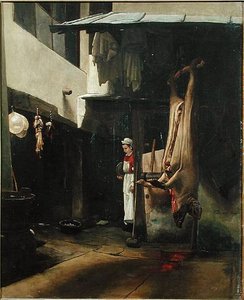
11Young Woman with a Mandolin, Portrait of Louison Köhler (1873) aut. François BonvinYoung Woman with a Mandolin, Portrait of Louison Köhler1873 · Cleveland Museum of Art 12The Scrubber (1887) aut. François BonvinThe Scrubber1887 · Musée des Beaux-Arts 13La Servante indiscrete (1871) aut. François BonvinLa Servante indiscrete1871 · Art Gallery of Hamilton 14Still Life with Oyster (1860) aut. François BonvinStill Life with Oyster1860 · Yale University Art Gallery 15Still Life with Asparagus (1867) aut. François BonvinStill Life with Asparagus1867 · Kröller-Müller muziejus 16Attributes of Music (1863) aut. François BonvinAttributes of Music1863 · Cleveland Museum of Art 17Still Life (1858) aut. François BonvinStill Life1858 · Houston meno muziejus 18Landscape with Barn (1869) aut. François BonvinLandscape with Barn1869 · Museum Gouda 19Still Life with Oysters (1865) aut. François BonvinStill Life with Oysters1865 · National Gallery of Ireland 20Still life with cherries. (1865) aut. François BonvinStill life with cherries.1865 · Šv. Jono Pauliaus II kolekcijos muziejus 21The Candlestick (Still Life with Candle) (1878) aut. François BonvinThe Candlestick (Still Life with Candle)1878 · Museum Gouda 22Still Life with Grapes (1877) aut. François BonvinStill Life with Grapes1877 · Museum Gouda 23Still Life with Clogs (1875) aut. François BonvinStill Life with Clogs1875 · Museum Gouda 24Port-Marly (1872) aut. François BonvinPort-Marly1872 · Musée d'Orsay 25The Trio (1880) aut. François BonvinThe Trio1880 · Centraal Museum 26Still Life with Vegetables (1880) aut. François BonvinStill Life with Vegetables1880 · Museum Gouda 27Still Life With Brass Kettle (1883) aut. François BonvinStill Life With Brass Kettle1883 · Museum Boijmans Van Beuningen 28Still life, two glazed earthenware pots. (1887) aut. François BonvinStill life, two glazed earthenware pots.1887 · Musée des Beaux-Arts de Rouen 29Femme lisant aut. François BonvinFemme lisantMusée Fabre 30'Miss' aut. François Bonvin'Miss'Burrell Collection 31The Butcher aut. François BonvinThe Butcher 32A woman ironing aut. François BonvinA woman ironingNational Museum Cardiff 33Two countrywomen aut. François BonvinTwo countrywomenBowes Museum 34The winder aut. François BonvinThe winder 35The Blacksmiths, Memory of Treport aut. François BonvinThe Blacksmiths, Memory of Treport 36Still life, François Bonvin, 1871 (1871) aut. François BonvinStill life, François Bonvin, 18711871 · Rijksmuseum 37Stilleven met vier vruchten, glas en aardewerk, François Bonvin, 1827 - 1887 (1887) aut. François BonvinStilleven met vier vruchten, glas en aardewerk, François Bonvin, 1827 - 18871887 · Rijksmuseum 38Still Life aut. François BonvinStill LifeMusée des Beaux-Arts 39Still life aut. François BonvinStill lifeYork Art Gallery 40Still Life with Jar of Cherries aut. François BonvinStill Life with Jar of Cherries 41Woman at a Spinet aut. François BonvinWoman at a SpinetBurrell Collection 42The crow aut. François BonvinThe crowBurrell Collection 43Interior of a Tavern aut. François BonvinInterior of a Tavern 44Grandmamma's breakfast aut. François BonvinGrandmamma's breakfastBowes Museum 45Still Life with a Copper Pot aut. François BonvinStill Life with a Copper PotBurrell Collection 46The violin aut. François BonvinThe violinBurrell Collection 47The meadow aut. François BonvinThe meadowNational Gallery 48The young housewife aut. François BonvinThe young housewifeNational Museum Cardiff 49The Letter of Recommendation aut. François BonvinThe Letter of Recommendation 50Housemaid At The Wasserholen aut. François BonvinHousemaid At The WasserholenMusée d'Orsay 51Oysters aut. François BonvinOystersBurrell Collection 52Interior aut. François BonvinInteriorFitzwilliam Museum 53Charity aut. François BonvinCharity 54Still Life with Game aut. François BonvinStill Life with GameBurrell Collection 55Still Life with Oysters, a Wine Bottle and a Glass of Wine aut. François BonvinStill Life with Oysters, a Wine Bottle and a Glass of WineBurrell Collection 56Peasant knitting aut. François BonvinPeasant knitting 57Still Life with Book, Papers and Inkwell aut. François BonvinStill Life with Book, Papers and InkwellNational Gallery 58Still Life with Apples and a Silver Goblet aut. François BonvinStill Life with Apples and a Silver GobletKelvingrove Art Gallery and Museum 59Interior with an Old Woman Kneeling aut. François BonvinInterior with an Old Woman Kneeling 60The Attributes of Painting aut. François BonvinThe Attributes of PaintingBarber Institute of Fine Arts 61Nature morte aut. François BonvinNature morteBerwick Museum and Art Gallery 62Still Life with a Tobacco Pot and a Pipe aut. François BonvinStill Life with a Tobacco Pot and a PipeBurrell Collection 63Still Life with a Jug, Cheese, Onions, Fish and a Knife aut. François BonvinStill Life with a Jug, Cheese, Onions, Fish and a KnifeBurrell Collection 64Still Life with a Glass, Pears and a Knife aut. François BonvinStill Life with a Glass, Pears and a KnifeBurrell Collection 65Still Life with Asparagus aut. François BonvinStill Life with AsparagusŠkotijos Nacionalinė galerija 66Still Life with a Book and an Ink Well aut. François BonvinStill Life with a Book and an Ink WellBurrell Collection 67Still Life with Vegetables and Cooking Utensils aut. François BonvinStill Life with Vegetables and Cooking UtensilsBurrell Collection 68Self portrait aut. François BonvinSelf portraitBowes Museum

Temos, kurios domino François Bonvin

Ketverios temos, dažniausiai pasikrausto originaluose, kiekvienos su savo puikiausiu pavyzdžiu.

Muziejai, kuriuose saugomi François Bonvin originalūs darbai

8 muziejai, kuriuose saugoma daugiausia šioje pusėje esamų paveikslų.

Muzejaus Miestas François Bonvin darbai Šiojo sąrašo paveikslai
Burrell Collection, GlavasBurrell Collection Glavas 13 'Miss', Woman at a Spinet, The crow
Museum Gouda, GoudaMuseum Gouda Gouda 6 The Embroideress (La Brodeuse), Landscape with Barn, The Candlestick (Still Life with Candle)
Musée d'Orsay, ParisMusée d'Orsay Paris 3 Ave Maria : interior of the Aramont convent, Port-Marly, Housemaid At The Wasserholen
Bowes Museum, Barnard CastleBowes Museum Barnard Castle 3 Two countrywomen, Grandmamma's breakfast, Self portrait
Centraal Museum, UtrechtCentraal Museum Utrecht 2 Woman Playing Games, The Trio
Walters Art Museum, BaltimoreWalters Art Museum Baltimore 2 Drawing Water, Interior of a Tavern
Musée des Beaux-Arts, ReimsMusée des Beaux-Arts Reims 2 Woman in White, The Scrubber
Cleveland Museum of Art, KlevlandasCleveland Museum of Art Klevlandas 2 Young Woman with a Mandolin, Portrait of Louison Köhler, Attributes of Music

François Bonvin per dešimtmečius: vieniškas originalas kiekvienam

Darbai pagal dešimtmečius

Pasirinkite dešimtmetį, kad pamatytėte jį apibrėžusį originalą.

François Bonvin tapų klausimai galerijai

Koks yra garsiausias François Bonvin kūrinys?Atsakymas

Woman Ironing (1858), Philadelphia Museum of Art, Filadelfija. Toliau seka Sophie Unternährer at her easel (1848) ir Woman Playing Games (1853).

Kuriuo amžiaus atσταση François Bonvin sukūrė Woman Ironing?Atsakymas

41 metų amžiaus: Woman Ironing sukurta 1858 m. Nr. François Bonvin gimė 1817.

Kurios François Bonvin dešimt paveikslų yra garsiausi?Atsakymas

Woman Ironing, Sophie Unternährer at her easel, Woman Playing Games, The Guitar Player, The Embroideress (La Brodeuse), Drawing Water, Ave Maria : interior of the Aramont convent, Woman in White, Portrait of a Seated Woman ir Interior of a Tavern. Viršuje esančioje reitingo sąraše nurodyta kiekvieno kūrinio metis ir muziejus.

Kiek žinoma François Bonvin darbų?Atsakymas

Mūsų kataloge yra 70 François Bonvin darbų, skirtų laikotarpiui nuo 1848 iki 1887.

Kur galima pamatyti garsiausių François Bonvin originalų?Atsakymas

Daugiausia – Burrell Collection (Glavas), Museum Gouda (Gouda) ir Musée d'Orsay (Paris). Viršuje esančiame muziejų sąraše yra visi jie.

Kuriuo laikotarpiu François Bonvin sukūrė savo žymiausias paveikslus?Atsakymas

1870s laikotarpiu: 9 iš 68 šioje pusėje esančių darbų buvo sukurtos tada, iš jų Ave Maria : interior of the Aramont convent.

Kuris iš garsių François Bonvin paveikslų yra pirmasis, o kuris – paskutinis?Atsakymas

Šioje pusėje seniausias darbas yra Sophie Unternährer at her easel (1848), o naujausias – The Scrubber (1887).

Kokia temos François Bonvin mėgavosi?Atsakymas

Woman (12), Life (12) ir Table (5) iš 68 šioje pusėje esamų darbų.

Kuriomis medžiagomis François Bonvin tapė dažniausiai?Atsakymas

Oil On Canvas, iš 68 šios puslapio darbų – 10.

Kelią meno kryžkelę priklauso François Bonvin kūryba?Atsakymas

Realism ir Contemporary realism, vadovaujantis šios puslapio originalais kūriniais.

Kurius François Bonvin originalius galėčiau pamatyti Burrell Collection?Atsakymas

'Miss', Woman at a Spinet ir The crow: Burrell Collection, Glavas kolekcijoje yra 13 šioje pusėje esančių darbų.

François Bonvin: meno kūrinys – autoportretas

Ramžusio stebėtojo gyvenimas ir palikimas: François Bonvin

Šūkioje, transformuojamo XIX amžiaus Paryžiaus peizaže, kur pramonės revoliucijos šešėliai pradėjo slėptis ant miesto akmens grindinio gatvių, gyveno dailininkas, rado gilią grožį pati egzistencijos paprasčiausiose kampinėse. François Bonvin (1817–1887) nebuvo didžiųjų istorinių mūšių ar mitologinių eposų kronikierius; jis buvo intymumo meistras, realistas, kurio šerpusiai perteikė tylią kasdienybės orumą. Jo gyvenimas, žymėtas ankstyvuosiuose sunklaiviuose ir tvirtu proteliu, atspindėjo pačias temas, kurias jis tapo vaizduoti – neapdirštas, sąžiningas ir giliai žmogiškas.

Gedęs skliausčiuose, kaip policininko ir siuvėjos sūnus, François Bonvin vaikystė buvo toli nuo romantiškos Paryžiaus gyvenimo versijos, dažnai aprašomos literatūroje. Motinos mirtis nuo tuberkulio, kai jam buvo tik keturi metai, paliko jį vargų ir neglectingumo pasaulyje. Augindamas prėsčiame šeimynos kruopčiame namuose su daugybe brolių ir seserų, susidūręs su neglaistomis neaprėminto vaikystės realybe, šie ankstyvieji sunkumai įsidiegsė jame gilią empatiją prieš aplinkinių nuobliausių žmonių gerbiamumą. Būtent ši jautribė vėliau apibrėžė jo meninę viziją, leisdama jam matyti poetišką svorį paprasto vaisių krepšelio ar tylaus namų darbininkės darbo rankose.

Kelionė šviesos ir šešėlio pasaulyje

François Bonvin kelias į meną buvo tiek pat pagrįstas ištveriškumu, kiek ir talento. Nors jo oficialus išsilavinimas prasidėjo École de dessin mokykloje, remiamas šeimos draugo malonumo, didžioji dalis jo tikrojo tobulėjimo įvyko per vienatvę ir savamegkį mokymąsi. Darbas spausdinimo magistrale suteikė jam disciplinuotą žvalgymo regimą, tačiau būtent dažnos kelionės į Leninistinį muziejų (Louvre) tikrai išskulptavo jo sielą. Ten, tarp praėties šedevrų, jis rado savo dvasinius protėvius. Jis tapo giliai uždraugęs olandų senajų meistrų kūrybai, ypač dramatiškam chiaroscuro stiliui, kurį sukūrė Rembrandt, bei gyvybingam brushwork'ui, kurį pristatė Frans Hals.

Šis susidomėjimas šia šiaip septintikos ir septinties šalies tradicijomis leisdami François Bonvin išvystyti unikalią techniką – prancūzišką tikslumą ir olandų toninę galybę. Jis išmoko meistriškai perteikti šviesą, kai ji padeda ant įvairių tekstūrų: šaltą metalinio puodo blizgėsį, minkštą stiprinančių braškės tekstūrą ar sunkų, organišką anšlies šrelos svorį. Jo darbuose dažnai dominuoja nuolydis, žemėta paleta, kuri vengia šiuolaikinių tendencijų vaizdingumo, rinkdamasi subtilų tonų nuolydį, sukuriantį juntamą atmosferą ir ramybę.

Kasdienybės menas

François Bonvin kūrybos reikšmė slypi jos gebėjime pakelti kasdienybę į monumentalo lygmenį. Jo paveikslai dažnai veikia kaip langai į privatią, buitinę XIX amžiaus Prancūzijos sferą. Ar tai būtų stilles gyvenimas su keturiais vaisiais, ar jautri scena A Motuoja, visur jaučiamas neįtikėtinai stiprus buvimo pojūdis ir pagarba tai, kas vaizduojama. Jis neieškojo realybės papuošimo, o siekė ją pagarbDinti.

Jo indėlis į Realizmo judėjimą galima apibūdinti per keletą pagrindinių meninių bruožų:

  • Tekstūros meistriškumas: Nuostabus gebėjimas perteikti maisto, keramikos ir audinio taktilinius savybes.
  • Chiaroscuro įtaka: Dramatiškas šviesos ir šešėlio naudojimas gylio ir emocinio rezonanso kūrimui.
  • Empatiškas Realizmas: Orientacija į paprasto gyvenimo orumą ir grožį, aptikamą kasdienybėje.
  • Toniškas niuansas: Sofistikuotas požiūris į spalvą, teikiantis pirmenybę subtiliems, atmosferiniams perėjimams, o ne ryškiems pigmentams.

Nors jis galėjo nepasiekti tokios plačios šlovės kaip jo samtvairiai Courbet, François Bonvin išlieka esminė figūra tiems, kurie ieško sielos paprostoje. Jo palikimas yra kiekviename brushstroke, kuris štai tylą, pamirštą ir amžiną mūsų bendros žmogiškos patirties grožį.