Francesco Botticini portretas

43 garsiausių Francesco Botticini paveikių – kiekvienas yra unikalus

Atnaujinta lapkritis 2026 · pagal mūsų populiarumumo koeficientą (paieškos, lankytojai ir užsakymai kiekvienam kūriniui) · 44 Francesco Botticini darbai mūsų kataloge

Trumpai tariant

Madonna and Child Enthroned with Saints and Angels (1481) yra viena矚 most žiūrėlių pritraukiančių Francesco Botticini tapierių; originalas saugomas Metropolitano meno muziejus, Niujorkas. Po to akmuo patenka į Saints Anna and Joachim (1460) ir Incoronation of Mary (1460). Iš 44 Francesco Botticini darbų mūsų kataloge šios 43 yra garsiausios – kiekvienas yra unikali originali dai̇lia, pateikta su jos metais, muziejumi ir priežastimi, kodėl ji išlieka per amžius.

1446 – 1498, Firena Early renaissance Daugiausia darbų: Gemäldegalerie

10 geriausių Francesco Botticini paveikslų: galerijos akimais

1
Madonna and Child Enthroned with Saints and Angels (1481) aut. Francesco Botticini

Madonna and Child Enthroned with Saints and Angels

1481 · Tempera On Panel · Metropolitano meno muziejus, Niujorkas

The painting presents a central, elevated throne holding the Virgin Mary and the Christ Child. Mary is positioned in a frontal view, wearing a deep ultramarine blue mantle over a crimson red garment. The infant Jesus rests in her arms, his form rendered with anatomical clarity. Flanking the central throne, two angels are depicted in motion, while four saints occupy the foreground. These saints are identified by specific attributes, including…

2
Saints Anna and Joachim (1460) aut. Francesco Botticini

Saints Anna and Joachim

1460 · Tempera On Panel · Brooklyn Museum, Brooklyn

This Renaissance-era tempera painting presents a serene and devotional scene featuring two holy figures, likely Saints Anna and Joachim, depicted in profile. The composition is intimate and vertical, with the subjects positioned slightly to the right of the center. They are set against a background consisting of a blue sky and a reddish-brown crenelated wall.

3
Incoronation of Mary (1460) aut. Francesco Botticini

Incoronation of Mary

1460 · Tempera On Panel · Gemäldegalerie, Berlynas

Incoronation of Mary by Francesco Botticini unfolds as a profound moment of divine recognition. This panel, dating to about 1460, captures a celestial event frozen in time. The scene centers on the kneeling Virgin Mary as she receives her crown, a moment of profound spiritual weight that bridges the gap between the heavens and the earth. Every figure in this assembly seems to hold its breath, caught in the stillness…

4
Madonna and Child with Tobias and the Angel Raphael (1470) aut. Francesco Botticini

Madonna and Child with Tobias and the Angel Raphael

1470 · Tempera On Panel · Cleveland Museum of Art, Klevlandas

In this work, Madonna and Child with Tobias and the Angel Raphael, Francesco Botticini organizes the sacred narrative within a vertically oriented composition, contained by an arched frame. At the center, the Madonna is captured in a moment of quiet prayer, kneeling before the Christ Child who rests upon the ground. To the left, the artist has placed a smaller, secondary scene depicting the figures of Tobias and the Angel…

5
Madonna and Child (1475) aut. Francesco Botticini

Madonna and Child

1475 · Tempera On Panel · Cleveland Museum of Art, Klevlandas

The Virgin Mary sits in a vertical stillness, her form defined by the soft pink of a pleated tunic. She holds the infant Jesus against a landscape that recedes into pale blue skies and earthy greens. A translucent veil rests upon her hair, its fine pattern catching a light that seems to emanate from within the skin of the figures. The child is a pale, luminous weight in her arms.…

6
Noli Me Tangere (1485) aut. Francesco Botticini

Noli Me Tangere

1485 · Tempera On Panel · Yale University Art Gallery, Niū Hevenas

The air in the enclosed garden feels still, held in a suspension of shock and divine presence. On the left, a male figure emerges from the shadows of the resurrection, his form draped in a long, flowing blue robe that catches the soft, diffused light. He holds a staff, a quiet marker of his transition from the tomb to the living world. Facing him, a woman kneels upon the green…
7
The Resurrection (1485) aut. Francesco Botticini

The Resurrection

1485 · Tempera On Panel · Yale University Art Gallery, Niū Hevenas

In this tempera on wood panel from 1485, we find a scene of profound spiritual transition. Christ rises from a stone sarcophagus, his form luminous against the earthy greens of a rolling Florentine landscape. He holds a white banner marked with a red cross, a symbol of victory over death, while his skin possesses a pale, translucent quality that suggests an inner light. Below, the earthly realm remains in a…

8
Way to Calvary (1475) aut. Francesco Botticini

Way to Calvary

1475 · Tempera On Panel · Yale University Art Gallery, Niū Hevenas

In this religious art painting, titled Way to Calvary, we encounter a significant work by the Florentine artist Francesco Botticini. Created around 1475, the piece belongs to the Early Renaissance period. It is a tempera painting on wood, a medium that allows for a specific kind of clarity in its depiction of sacred narratives.

9
Agony in the Garden (1485) aut. Francesco Botticini

Agony in the Garden

1485 · Tempera On Panel · Yale University Art Gallery, Niū Hevenas

In this tempera on wood panel from 1485, we find ourselves in a quiet, somber landscape where the weight of a divine burden is felt through stillness. The composition is divided into two distinct narrative zones, creating a tension between the spiritual and the earthly. On the left, a solitary figure of Christ kneels in prayer, his form defined by soft, contour-driven lines that suggest a profound sense of isolation.…

10
Madonna and Child with a Breviary (1475) aut. Francesco Botticini

Madonna and Child with a Breviary

1475 · Tempera On Panel · Cincinnati Art Museum, Sinciatiati

The air feels still, as if the very light of the Florentine morning has paused to watch this intimate encounter. Within the soft, circular boundary of the tondo, the Virgin Mary sits in a moment of profound stillness, her presence anchoring the entire composition. She is draped in a mantle of deep ultramarine blue that flows around her, contrasting sharply with the rich vermilion red of her tunic. On her…

žinomi Francesco Botticini paveikslai, nuo 11 iki 43 numerio

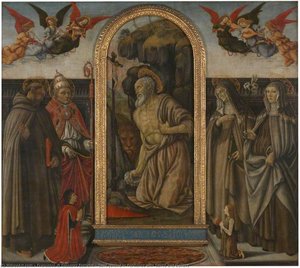
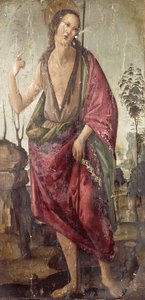
11Madonna and Child with St. Mary Magdalene, St. Bernard, Angels, Cherubim and Seraphim (1485) aut. Francesco BotticiniMadonna and Child with St. Mary Magdalene, St. Bernard, Angels, Cherubim and Seraphim1485 12Madonna Adoring the Christ Child (1470) aut. Francesco BotticiniMadonna Adoring the Christ Child1470 · Birmingham art muziejus 13Crucifixion with Saints Vincent Ferrer, Peter Martyr, Stephen, Catherine of Siena and the Blessed Antonius at the Foot of the Cross (1474) aut. Francesco BotticiniCrucifixion with Saints Vincent Ferrer, Peter Martyr, Stephen, Catherine of Siena and the Blessed Antonius at the Foot of the Cross1474 · Courtauld Gallery 14Mary with the Child, the Boy John Adoring the Child, and Two Saints (1480) aut. Francesco BotticiniMary with the Child, the Boy John Adoring the Child, and Two Saints1480 · Gemäldegalerie 15Christ on the Cross and Four Saints (1475) aut. Francesco BotticiniChrist on the Cross and Four Saints1475 · Gemäldegalerie 16Virgin and Child with the Infant Saint John the Baptist (1472) aut. Francesco BotticiniVirgin and Child with the Infant Saint John the Baptist1472 · Isabella Stewart Gardner Museum 17The three archangels with the little Tobias (1491) aut. Francesco BotticiniThe three archangels with the little Tobias1491 · Bavarijos valstybinės paveikslų kolekcijos 18Madonna Adoring the Christ Child with St. John the Baptist and Two Angels (1487) aut. Francesco BotticiniMadonna Adoring the Christ Child with St. John the Baptist and Two Angels1487 19Mary and John Adoring the Child (1490) aut. Francesco BotticiniMary and John Adoring the Child1490 · Gemäldegalerie 20Virgin and Child (1475) aut. Francesco BotticiniVirgin and Child1475 21Madonna and Child in a Landscape with the Infant St. John the Baptist (1487) aut. Francesco BotticiniMadonna and Child in a Landscape with the Infant St. John the Baptist1487 22Scenes from the Life of Saint Jerome Predella (1490) aut. Francesco BotticiniScenes from the Life of Saint Jerome Predella1490 23Saint Jerome in Penitence with Saints and Donors (1490) aut. Francesco BotticiniSaint Jerome in Penitence with Saints and Donors1490 24Madonna with Child, St John the Baptist, and Angels (1490) aut. Francesco BotticiniMadonna with Child, St John the Baptist, and Angels1490 25Virgin and Child Enthroned (1495) aut. Francesco BotticiniVirgin and Child Enthroned1495 · Škotijos nacionalinė galerija 26St. Nicolas and Sts. Catherine, Lucy, Margaret and Apollonia aut. Francesco BotticiniSt. Nicolas and Sts. Catherine, Lucy, Margaret and ApolloniaNacionalinis Vakarų meno muziejus 27Virgin Adoring the Child aut. Francesco BotticiniVirgin Adoring the ChildFitzwilliam Museum 28Portrait of a Young Man aut. Francesco BotticiniPortrait of a Young Man 29TRIPTYQUE, LA VIERGE ET L'ENFANT aut. Francesco BotticiniTRIPTYQUE, LA VIERGE ET L'ENFANT 30Saint Cecilia Between Saint Valerian and Saint Tiburtius with a Donor aut. Francesco BotticiniSaint Cecilia Between Saint Valerian and Saint Tiburtius with a DonorThyssen-Bornemisza muziejus 31John the Baptist aut. Francesco BotticiniJohn the BaptistRijksmuseum 32Scenes from the Life of Saint Jerome - Predella aut. Francesco BotticiniScenes from the Life of Saint Jerome - Predella 33La Vierge adorant l'enfant entourée de saint Jean Baptiste enfant et de deux anges aut. Francesco BotticiniLa Vierge adorant l'enfant entourée de saint Jean Baptiste enfant et de deux angesLiuvro muziejus 34LA VIERGE ET L'ENFANT EN GLOIRE ENTOURES D'ANGES, DE SAINTE MARIE MADELEINE ET DE SAINT BERNARD aut. Francesco BotticiniLA VIERGE ET L'ENFANT EN GLOIRE ENTOURES D'ANGES, DE SAINTE MARIE MADELEINE ET DE SAINT BERNARDLiuvro muziejus 35Saint Sebastian aut. Francesco BotticiniSaint Sebastian 36Saint Nicholas of Tolentino aut. Francesco BotticiniSaint Nicholas of Tolentino 37Saint Jerome in Penitence with Saints and Donors aut. Francesco BotticiniSaint Jerome in Penitence with Saints and DonorsNational Gallery 38S. gerolamo altarpiece aut. Francesco BotticiniS. gerolamo altarpieceNational Gallery 39The Assumption of the Virgin aut. Francesco BotticiniThe Assumption of the VirginNational Gallery 40Madonna and Child with the Infant St. John the Baptist (1487) aut. Francesco BotticiniMadonna and Child with the Infant St. John the Baptist1487 41The Three Archangels with Tobias (1470) aut. Francesco BotticiniThe Three Archangels with Tobias1470 · Galleria degli Uffizi 42Madonna with child St. John and Angel (1470) aut. Francesco BotticiniMadonna with child St. John and Angel1470 · Musée Des Beaux 43Saint Sebastian aut. Francesco BotticiniSaint SebastianMetropolitano meno muziejus

žymios Francesco Botticini tapiojamos, pagal laikotarpį

Temos, kurios domino Francesco Botticini

Ketverios temos, dažniausiai pasikrausto originaluose, kiekvienos su savo puikiausiu pavyzdžiu.

Muziejai, kuriuose saugomi Francesco Botticini originalūs darbai

8 muziejai, kuriuose saugoma daugiausia šioje pusėje esamų paveikslų.

Muzejaus Miestas Francesco Botticini darbai Šiojo sąrašo paveikslai
Gemäldegalerie, BerlynasGemäldegalerie Berlynas 4 Incoronation of Mary, Mary with the Child, the Boy John Adoring the Child, and Two Saints, Christ on the Cross and Four Saints
Yale University Art Gallery, Niū HevenasYale University Art Gallery Niū Hevenas 4 Noli Me Tangere, The Resurrection, Way to Calvary
National Gallery, LondonasNational Gallery Londonas 3 Saint Jerome in Penitence with Saints and Donors, S. gerolamo altarpiece, The Assumption of the Virgin
Metropolitano meno muziejus, NiujorkasMetropolitano meno muziejus Niujorkas 2 Madonna and Child Enthroned with Saints and Angels, Saint Sebastian
Cleveland Museum of Art, KlevlandasCleveland Museum of Art Klevlandas 2 Madonna and Child with Tobias and the Angel Raphael, Madonna and Child
Liuvro muziejus, ParyžiusLiuvro muziejus Paryžius 2 La Vierge adorant l'enfant entourée de saint Jean Baptiste enfant et de deux anges, LA VIERGE ET L'ENFANT EN GLOIRE ENTOURES D'ANGES, DE SAINTE MARIE MADELEINE ET DE SAINT BERNARD
Brooklyn Museum, BrooklynBrooklyn Museum Brooklyn 1 Saints Anna and Joachim
Cincinnati Art Museum, SinciatiatiCincinnati Art Museum Sinciatiati 1 Madonna and Child with a Breviary

Francesco Botticini per dešimtmečius: vieniškas originalas kiekvienam

Darbai pagal dešimtmečius

Pasirinkite dešimtmetį, kad pamatytėte jį apibrėžusį originalą.

Francesco Botticini tapų klausimai galerijai

Koks yra garsiausias Francesco Botticini kūrinys?Atsakymas

Madonna and Child Enthroned with Saints and Angels (1481), Metropolitano meno muziejus, Niujorkas. Toliau seka Saints Anna and Joachim (1460) ir Incoronation of Mary (1460).

Kuriuo amžiaus atσταση Francesco Botticini sukūrė Madonna and Child Enthroned with Saints and Angels?Atsakymas

35 metų amžiaus: Madonna and Child Enthroned with Saints and Angels sukurta 1481 m. Nr. Francesco Botticini gimė 1446.

Kurios Francesco Botticini dešimt paveikslų yra garsiausi?Atsakymas

Madonna and Child Enthroned with Saints and Angels, Saints Anna and Joachim, Incoronation of Mary, Madonna and Child with Tobias and the Angel Raphael, Madonna and Child, Noli Me Tangere, The Resurrection, Way to Calvary, Agony in the Garden ir Madonna and Child with a Breviary. Viršuje esančioje reitingo sąraše nurodyta kiekvieno kūrinio metis ir muziejus.

Kiek žinoma Francesco Botticini darbų?Atsakymas

Mūsų kataloge yra 44 Francesco Botticini darbų, skirtų laikotarpiui nuo 1460 iki 1495.

Kur galima pamatyti garsiausių Francesco Botticini originalų?Atsakymas

Daugiausia – Gemäldegalerie (Berlynas), Yale University Art Gallery (Niū Hevenas) ir National Gallery (Londonas). Viršuje esančiame muziejų sąraše yra visi jie.

Kuriuo laikotarpiu Francesco Botticini sukūrė savo žymiausias paveikslus?Atsakymas

1470s laikotarpiu: 11 iš 43 šioje pusėje esančių darbų buvo sukurtos tada, iš jų Madonna and Child with Tobias and the Angel Raphael.

Kuris iš garsių Francesco Botticini paveikslų yra pirmasis, o kuris – paskutinis?Atsakymas

Šioje pusėje seniausias darbas yra Saints Anna and Joachim (1460), o naujausias – Virgin and Child Enthroned (1495).

Kokia temos Francesco Botticini mėgavosi?Atsakymas

Woman (14), Child (13) ir Landscape (9) iš 43 šioje pusėje esamų darbų.

Kuriomis medžiagomis Francesco Botticini tapė dažniausiai?Atsakymas

Tempera On Panel, iš 43 šios puslapio darbų – 23.

Kelią meno kryžkelę priklauso Francesco Botticini kūryba?Atsakymas

Early renaissance, vadovaujantis šios puslapio originalais kūriniais.

Kurius Francesco Botticini originalius galėčiau pamatyti Gemäldegalerie?Atsakymas

Incoronation of Mary, Mary with the Child, the Boy John Adoring the Child, and Two Saints ir Christ on the Cross and Four Saints: Gemäldegalerie, Berlynas kolekcijoje yra 4 šioje pusėje esančių darbų.

Francesco Botticini: meno kūrinys – autoportretas

The Florentine Master: The Life and Legacy of Francesco Botticini

In the vibrant, sun-drenched streets of 15th-century Florence, amidst the burgeoning intellect of the Early Renaissance, lived a painter whose brush captured the profound spiritual essence of an era. Francesco di Giovanni Botticini, born around 1446, was far more than a mere contemporary to the giants of his age; he was a vital thread in the rich tapestry of Florentine art. While history often casts the spotlight on the monumental shadows of Leonardo da Vinci or Michelangelo, Botticini’s work offers a window into a period of exquisite transition, where the rigid structures of medieval devotion began to melt into the humanistic grace of the Renaissance.

Botticini’s journey into the heart of artistry was predestined by his lineage. Born into a family steeped in the traditions of the craft, he was the son of Giovanni di Domenico di Piero, a skilled painter of playing cards. This early exposure to the meticulous demands of pigment and design laid the groundwork for a career defined by precision and devotion. His formal education began in the prestigious workshop of Neri di Bicci, where, as an apprentice in 1459, he absorbed the foundational principles of fresco and the collaborative spirit of the Florentine studio system. However, it was his subsequent immersion in the atelier of the legendary Andrea del Verrocchio that truly transformed his vision. Within Verrocchio’s workshop—the same crucible that nurtured Leonardo da Vinci—Botticini learned to marry the sculptural depth of three-dimensional form with the ethereal beauty of tempera painting.

A Symphony of Devotion and Technique

The oeuvre of Botticini is a testament to his ability to evoke the divine through the tangible. His style, heavily influenced by the lyrical elegance of Botticelli and the structural clarity of Filippino Lippi, often centered on religious narratives that invited deep contemplation. One cannot discuss his mastery without reflecting on his monumental achievement, "The Assumption of the Virgin." This large-scale tempera on wood panel, now housed in the National Gallery in London, serves as a breathtaking display of his technical prowess. In this work, the heavens open to reveal a celestial hierarchy of angels, while the earthly realm is populated by disciples and donors, all rendered with a delicate balance of movement and stillness.

Botticini’s talent extended beyond grand altarpieces into the intimate realm of small-scale religious panels and portraits. His ability to manipulate light and shadow allowed him to create scenes of profound intimacy, such as his "Virgin and Child Enthroned," where the boundaries between the sacred and the human seem to dissolve. His technique often utilized the traditional medium of tempera, which lent a luminous, almost translucent quality to the skin of his holy figures, making them appear as though they were radiating an inner, spiritual light. Whether depicting the scholarly weight of Saint Jerome or the tender grace of the Madonna, Botticini possessed a unique gift for capturing the emotional gravity of his subjects.

Historical Significance and Rediscovery

The historical trajectory of Francesco Botticini is as poignant as the art he produced. For centuries, much of his contribution was obscured by the overwhelming legacies of his more famous peers. Many of his works were once attributed to other masters, lost in the shifting tides of art historical attribution. It is only through the meticulous efforts of modern scholars—reconstructing his oeuvre through stylistic analysis and archival research—that Botticini has been reclaimed as a significant voice of the Quattrocento.

Today, we recognize Botticini not merely as a student of Verrocchio or a follower of the Florentine tradition, but as an artist who contributed a distinct sense of serenity and spiritual depth to the Renaissance. His legacy resides in:

  • The integration of sculptural form: Bringing a sense of weight and presence to religious figures through his training under Verrocchio.
  • Mastery of the Florentine style: Contributing to the aesthetic language of grace, line, and luminosity that defined the era.
  • Spiritual storytelling: Creating works that served as both educational tools for the faithful and profound objects of meditation.

As we gaze upon his surviving panels, we see more than just paint on wood; we see the enduring spirit of a master who, though he lived in the shadow of giants, left an indelible mark upon the soul of Florence.