Floris Verster portretas

Floris Verster tapiai: 53 garsiausi πίναšiai, galerijos akimis

Atnaujinta lapkritis 2026 · pagal mūsų populiarumumo koeficientą (paieškos, lankytojai ir užsakymai kiekvienam kūriniui) · 63 Floris Verster darbai mūsų kataloge

Trumpai tariant

Galerijos akimais, garsiausias Floris Verster tapas yra Portrait of H.H. van Dam A. Czn. (1921), kurio originalas eksponuojamas Museum Boijmans Van Beuningen, Roterdamas. Flowers and Leaves (1888) ir Study Of Roses užbaia trio, kurį atpažįsta kiekvienas ž)/\ Iš 63 Floris Verster darbų mūsų kataloge, galerija žemiau pristato 53 garsiausius – kiekvienas yra originalus, su nurodytu metais, muziejumi bei unikaliu aprašymu.

1861 – 1927, Leidenas Impressionism Daugiausia darbų: Groninger Museum

10 geriausių galerijos Floris Verster paveikslų

2
Flowers and Leaves (1888) aut. Floris Verster

Flowers and Leaves

1888 · Oil On Canvas · Rijksmuseum, Amsterdamas

A vertical composition centers a vase holding a collection of wilted foliage and sparse blossoms. The arrangement is dominated by large, decaying leaves that droop with a heavy, organic irregularity. Deep greens, ochre, and muddy browns define the palette, set against a near-black background that swallows the shadows. Light enters from the left, catching the tattered edges of the leaves and the cylindrical surface of the vase, creating a stark…

3
Study Of Roses aut. Floris Verster

Study Of Roses

Oil

In this intimate study, the viewer is invited to observe a bouquet of roses captured in a moment of quiet transition. The composition focuses on the organic architecture of the blooms, presenting them in various stages of life. Some petals are tightly furled in youthful buds, while others have opened fully, revealing the complex, layered depth of the flower's heart. There is a palpable sense of weight to the petals,…

4
painting (1889) aut. Floris Verster

painting

1889 · Oil · Museum Boijmans Van Beuningen, Roterdamas

In this 1889 oil painting, we find ourselves in a dim, rustic interior where the weight of daily existence is felt through shadow and substance. A solitary woman is the central focus, her body bent in a posture of focused labor over a vessel. The scene is quiet, almost heavy with the stillness of a private moment. There is a certain dignity in her movement, a rhythmic quality to the…

5
Self-Portrait (1921) aut. Floris Verster

Self-Portrait

1921 · Oil · Museum Boijmans Van Beuningen, Roterdamas

The artwork titled Self-Portrait, known in Dutch as Zelfportret, is an oil painting by the Dutch artist Floris Verster. This work was produced about 1921. The subject is a single male figure, presented in a close-up composition that focuses on the head and upper shoulders. The figure is positioned slightly off-center, looking directly forward as if observing a mirror.

Floris Verster tapiai, rangos nuo 11 iki 53

Temos, kurios domino Floris Verster

Ketverios temos, dažniausiai pasikrausto originaluose, kiekvienos su savo puikiausiu pavyzdžiu.

Muziejai, kuriuose saugomi Floris Verster originalūs darbai

8 muziejai, kuriuose saugoma daugiausia šioje pusėje esamų paveikslų.

Muzejaus Miestas Floris Verster darbai Šiojo sąrašo paveikslai
Groninger Museum, HroningenGroninger Museum Hroningen 8 Flower Still Life with Anemones, Flower Still Life with Begonias and East Indian Cherry, Moon Roses After the Feast
Museum Boijmans Van Beuningen, RoterdamasMuseum Boijmans Van Beuningen Roterdamas 6 Portrait of H.H. van Dam A. Czn., painting, Self-Portrait
Dordrechts Museum, DordrechtDordrechts Museum Dordrecht 6 Artist's Garden at Rapenburg 40, Leiden, Beardman Jugs, Flower Study (Roses)
Rijksmuseum, AmsterdamasRijksmuseum Amsterdamas 3 Flowers and Leaves, Anemones, Stillife With Zinnias In A Ginger Pot
Centraal Museum, UtrechtCentraal Museum Utrecht 3 Portrait of George Willem van Heukelom, Portrait Of Henriëtte Van Heukelom-van Den Brandeler, Ginger Jar With Tulips
Museum Gouda, GoudaMuseum Gouda Gouda 1 Onions (on blue background)
Museum de Lakenhal, LeidenasMuseum de Lakenhal Leidenas 1 Flox I
The Phillips Collection, VašingtonasThe Phillips Collection Vašingtonas 1 Londen

Floris Verster, po vieno ikoninio paveikslio kiekvienam dešimtmenės laikotarpiui

Darbai pagal dešimtmečius

Pasirinkite dešimtmetį, kad pamatytėte jį apibrėžusį originalą.

Floris Verster tapyiniai: galerijos atsakymai

Kuris Floris Verster paveikslas yra pats garsiausias iš visų?Atsakymas

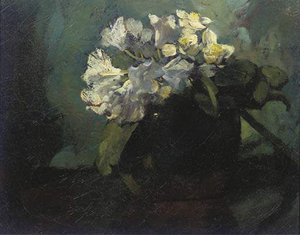
Portrait of H.H. van Dam A. Czn. (1921), Museum Boijmans Van Beuningen, Roterdamas. Toliau seka Flowers and Leaves (1888) ir Study Of Roses.

Kiek metų buvo Floris Verster, kai sukūrė Portrait of H.H. van Dam A. Czn.?Atsakymas

60 metų amžiaus: Portrait of H.H. van Dam A. Czn. sukurta 1921 m. Nr. Floris Verster gimė 1861.

Kuriose yra 10 geriausių Floris Verster paveikslų?Atsakymas

Portrait of H.H. van Dam A. Czn., Flowers and Leaves, Study Of Roses, painting, Self-Portrait, Artist's Garden at Rapenburg 40, Leiden, Onions (on blue background), Flower Still Life with Anemones, Dead Swan ir Flower Still Life with Begonias and East Indian Cherry. Viršuje esančioje reitingo sąraše nurodyta kiekvieno kūrinio metis ir muziejus.

Kiek kūrinių sukūrė Floris Verster?Atsakymas

Mūsų kataloge yra 63 Floris Verster darbų, skirtų laikotarpiui nuo 1881 iki 1921.

Kur kabinami garsiausi Floris Verster originalūs darbai?Atsakymas

Daugiausia – Groninger Museum (Hroningen), Museum Boijmans Van Beuningen (Roterdamas) ir Dordrechts Museum (Dordrecht). Viršuje esančiame muziejų sąraše yra visi jie.

Kada Floris Verster sukūrė savo garsiausias paveikslus?Atsakymas

1880s laikotarpiu: 6 iš 53 šioje pusėje esančių darbų buvo sukurtos tada, iš jų Flowers and Leaves.

Kokie yra ankstyviausi ir vėliausi garsieji Floris Verster kūriniai?Atsakymas

Šioje pusėje seniausias darbas yra Artist's Garden at Rapenburg 40, Leiden (1881), o naujausias – Portrait of H.H. van Dam A. Czn. (1921).

Kurią temą Floris Verster kūrė dažniausiai?Atsakymas

Flowers (6), Leaves (3) ir Vase (3) iš 53 šioje pusėje esamų darbų.

Kurią techniką Floris Verster naudojo dažniausiai?Atsakymas

Oil On Canvas, iš 53 šios puslapio darbų – 3.

Su kokiu kierliu siejama Floris Verster?Atsakymas

Impressionism, vadovaujantis šios puslapio originalais kūriniais.

Kurių Floris Verster originalų turi Groninger Museum?Atsakymas

Flower Still Life with Anemones, Flower Still Life with Begonias and East Indian Cherry ir Moon Roses After the Feast: Groninger Museum, Hroningen kolekcijoje yra 8 šioje pusėje esančių darbų.

Floris Verster: menininkas

The Luminous Transition: The Life and Art of Floris Verster

Born into a world steeped in artistic heritage, Floris Hendrik Verster emerged from the historic city of Leiden as a transformative force in Dutch painting. His lineage was one of profound connection to nature and art; his father, Abraham Florentius Verster van Wulverhorst, was a distinguished scholar and painter of birds, providing a foundation of meticulous observation that would later define Floris's own mastery. Growing up in an environment where the delicate details of the natural world were celebrated, Verster developed an early sensitivity to light and form. His formal education at the Leiden Academy of Fine Arts under Willem van Haeckens provided him with a disciplined academic rigor, yet his spirit was far too restless to be confined by the somber traditions of the past.

As he moved toward the Royal Academy of Art in The Hague, Verster found himself amidst a generation of burgeoning talent, studying alongside luminaries such as George Hendrik Breitner and Isaac Israëls. This period was crucial in shaping his artistic trajectory. Initially, his work adhered to the stylistic hallmarks of the Hague School, characterized by a muted palette and a focus on the quiet, often melancholic realism of everyday Dutch life. However, Verster possessed an innate hunger for color that the subdued tones of his contemporaries could not satisfy. He began to look beyond the borders of the Netherlands, finding inspiration in the vibrant energy of Brussels and the avant-garde spirit of the group Les Vingt. This exposure to French influences, including the works of Antoine Vollon and Théodule Ribot, acted as a catalyst, pushing him away from heavy, darkened tones toward a more expressive, luminous approach.

A Symphony of Color and Texture

The true magic of Verster’s oeuvre lies in his ability to bridge the gap between classical precision and modern impressionistic freedom. His evolution was not merely a change in subject matter but a profound metamorphosis of technique. During a period of intense experimentation, he moved away from smooth finishes toward a more tactile, energetic application of paint. He became a master of colorism, utilizing layered glazes to create surfaces that seem to shimmer with an internal light. When one gazes upon his floral still lifes, the experience is almost sensory; one can almost feel the velvety weight of a rose petal or the cool, damp surface of a clay pot. He did not simply paint flowers; he captured the very essence of their vitality.

This mastery extended seamlessly into his landscapes, where he captured the fleeting atmospheric nuances of the Dutch countryside. Unlike the static landscapes of the previous era, Verster’s vistas feel alive with movement and light. His brushstrokes, often rough and vigorous, serve to convey the transient nature of sunlight filtering through clouds or the rustle of leaves in a gentle breeze. This stylistic shift allowed him to achieve an emotional resonance that spoke to the changing sensibilities of the turn of the century, making his work a vital link between the realism of the 19th century and the burgeoning modernism of the 20th.

Legacy and Artistic Significance

Throughout his career, Verster’s ability to reinvent himself remained his greatest strength. From his early days of academic training to his period of serene crayon drawings, and finally to his celebrated status as a master of vibrant oil painting, he never ceased to explore the boundaries of his medium. His contributions to Dutch art are marked by several key achievements:

  • Innovation in Color: He broke free from the monochromatic constraints of the Hague School, introducing a brilliant, light-filled palette that redefined Dutch landscape and still life painting.
  • Technical Versatility: His ability to manipulate texture—from delicate glazes to impasto-like strokes—allowed him to capture both the fragility of nature and its raw power.
  • Cultural Bridge: He served as a pivotal figure in transitioning Dutch art from traditional realism toward the expressive freedom of modern Impressionism.

Today, the works of Floris Verster reside in prestigious collections such as the Kröller-Müller Museum, serving as enduring testaments to his vision. He remains an artist who understood that to truly honor nature, one must not only observe it with precision but also celebrate it with passion. His legacy is found in every luminous petal and sun-drenched field he left behind, reminding us of a time when art was finding its voice in the dance between light and shadow.