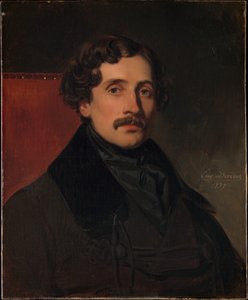
Eugène Devéria portretas

33 garsiausių Eugène Devéria paveikių – kiekvienas yra unikalus

Atnaujinta lapkritis 2026 · pagal mūsų populiarumumo koeficientą (paieškos, lankytojai ir užsakymai kiekvienam kūriniui) · 33 Eugène Devéria darbai mūsų kataloge

Trumpai tariant

Portrait of Monsieur Couche (1824) yra viena矚 most žiūrėlių pritraukiančių Eugène Devéria tapierių; originalas saugomas Detroito meno institutas, Detroitas. Po to akmuo patenka į Young Women Sitting (1827) ir The Assassination (1828). Iš 33 Eugène Devéria darbų mūsų kataloge šios 33 yra garsiausios – kiekvienas yra unikali originali dai̇lia, pateikta su jos metais, muziejumi ir priežastimi, kodėl ji išlieka per amžius.

1805 – 1865, Parisas Daugiausia darbų: Musée des Beaux-Arts de Pau

10 geriausių Eugène Devéria paveikslų: galerijos akimais

2
Young Women Sitting (1827) aut. Eugène Devéria

Young Women Sitting

1827 · Oil On Canvas

In the oil painting Young Women Sitting by Eugène Devéria, the composition is centered on a woman seated upon a large, gilded yellow chaise longue. To the left, a second woman reclines, her form partially obscured by heavy red drapery. The scene is set within an opulent interior where the color palette is dominated by deep reds, golds, and creams. This arrangement creates a shallow perspective that directs the viewer's…

3
The Assassination (1828) aut. Eugène Devéria

The Assassination

1828 · Oil On Canvas · Reading Public Museum, Reading

We find ourselves before The Assassination, a significant work by the French painter Eugène Devéria. This piece was executed about 1828, a period when the artist was beginning to establish his presence within the Parisian art scene. Devéria, who was born in Paris, France, in 1805, brought a specific sense of historical gravity to his compositions, a quality that is palpable in this particular canvas.

4
Portrait of General Joseph-Léopold Sigisbert Hugo (1835) aut. Eugène Devéria

Portrait of General Joseph-Léopold Sigisbert Hugo

1835 · Oil On Canvas · Musée Victor Hugo, Paris

The subject is captured in a moment of quiet authority, positioned centrally against a somber, atmospheric landscape. He wears a dark blue military tunic, heavily detailed with gold braided aiguillettes, epaulettes, and medals that catch a sharp, directional light. This illumination, striking from the upper left, defines the contours of his face and the metallic textures of his uniform while casting the background into deep shadow. A sense of monumental…

5
Puget Presenting His Statue of Milon de Crotone to Louis XIV, in the Gardens of Versailles (1832) aut. Eugène Devéria

Puget Presenting His Statue of Milon de Crotone to Louis XIV, in the Gardens of Versailles

1832 · Oil On Canvas

In this 1832 oil on canvas, we find ourselves within the formal, structured elegance of the Gardens of Versailles. The scene captures a specific historical intersection: the presentation of a sculpture by Puget to the French monarchy. At the heart of the composition, a large, muscular statue of Milon de Crotone commands the viewer's attention. The figure is rendered with a sense of physical weight, its pale, marble-like surface contrasting…

6
Puget Presenting His Statue of Milo of Croton to Louis XIV, in the Gardens of Versailles (1832) aut. Eugène Devéria

Puget Presenting His Statue of Milo of Croton to Louis XIV, in the Gardens of Versailles

1832 · Oil On Canvas

The scene unfolds in the grand, manicured expanse of the Gardens of Versailles, where the air feels heavy with the weight of ceremony. Here, the artist Eugène Devéria captures a moment of profound historical significance. In this work, titled Puget Presenting His Statue of Milo of Croton to Louis XIV, in the Gardens of Versailles, the viewer finds themselves amidst a gathering of the French elite. The composition centers on…

7
Portrait of the Artist and His Brother Achille (1836) aut. Eugène Devéria

Portrait of the Artist and His Brother Achille

1836 · Terracotta · Opera House, Versalio

The gaze settles upon Portrait of the Artist and His Brother Achille, a work that brings together two figures bound by blood and art. This piece is the creation of Eugène Devéria, a man whose life began in Paris, France, in 1805. He carries the weight of a long creative life until his passing in 1865. Within this frame, the artist captures a personal connection, presenting himself alongside his brother,…

8
Breton Family Praying Before a Country Oratory (1838) aut. Eugène Devéria

Breton Family Praying Before a Country Oratory

1838 · Oil · Musée des Beaux-Arts de Quimper, Kampė

In Breton Family Praying Before a Country Oratory, Eugène Devéria arranges a quiet, intimate scene of religious devotion. The composition is centered on a group of five figures—two men, one woman, and two children—who are gathered in a moment of shared prayer. They are positioned in a triangular formation, a structural choice that provides a sense of stability and familial unity. This geometric arrangement naturally directs the viewer's eye toward…

9
Sketch for the church Notre-Dame-de-Lorette: Apotheosis of Saint Genevieve (1835) aut. Eugène Devéria

Sketch for the church Notre-Dame-de-Lorette: Apotheosis of Saint Genevieve

1835 · Oil On Canvas · Petit Palais, Paris

The artwork titled Sketch for the church Notre-Dame-de-Lorette: Apotheosis of Saint Genevieve is a religious study by the French painter Eugène Devéria. Created about 1835, this oil on canvas work functions as a preliminary sketch for a larger painting intended for the church Notre-Dame-de-Lorette. The composition focuses on the subject matter of the Apotheosis of Saint Genevieve, depicting the saint's transition toward a celestial state.

10
Apotheosis of Saint Genevieve, sketch for the painting of the church Notre-Dame-de-Lorette (1835) aut. Eugène Devéria

Apotheosis of Saint Genevieve, sketch for the painting of the church Notre-Dame-de-Lorette

1835 · Drawing · Carnavalet muziejus, Paris

This vertical sketch, dated 1835, captures a moment of religious exaltation centered on the figure of Saint Genevieve. The composition is organized around a strong upward movement, drawing the eye from the lower grouping of figures toward a concentrated burst of white and yellow light at the top of the frame. Saint Genevieve is positioned in the midground, her arms reaching toward the celestial light, her white garments providing a…

žinomi Eugène Devéria paveikslai, nuo 11 iki 33 numerio

žymios Eugène Devéria tapiojamos, pagal laikotarpį

Temos, kurios domino Eugène Devéria

Ketverios temos, dažniausiai pasikrausto originaluose, kiekvienos su savo puikiausiu pavyzdžiu.

Muziejai, kuriuose saugomi Eugène Devéria originalūs darbai

8 muziejai, kuriuose saugoma daugiausia šioje pusėje esamų paveikslų.

Muzejaus Miestas Eugène Devéria darbai Šiojo sąrašo paveikslai
Musée des Beaux-Arts de Pau, PauMusée des Beaux-Arts de Pau Pau 3 Portrait of Octavie Courcier, née Devéria (1804-1887), Portrait of Philippe-Adolphe Courcier, husband of Octavie Devéria, Christopher Columbus at the Court of Ferdinand and Isabella
Detroito meno institutas, DetroitasDetroito meno institutas Detroitas 1 Portrait of Monsieur Couche
Reading Public Museum, ReadingReading Public Museum Reading 1 The Assassination
Musée Victor Hugo, ParisMusée Victor Hugo Paris 1 Portrait of General Joseph-Léopold Sigisbert Hugo
Opera House, VersalioOpera House Versalio 1 Portrait of the Artist and His Brother Achille
Musée des Beaux-Arts de Quimper, KampėMusée des Beaux-Arts de Quimper Kampė 1 Breton Family Praying Before a Country Oratory
Petit Palais, ParisPetit Palais Paris 1 Sketch for the church Notre-Dame-de-Lorette: Apotheosis of Saint Genevieve
Carnavalet muziejus, ParisCarnavalet muziejus Paris 1 Apotheosis of Saint Genevieve, sketch for the painting of the church Notre-Dame-de-Lorette

Eugène Devéria per dešimtmečius: vieniškas originalas kiekvienam

Darbai pagal dešimtmečius

Pasirinkite dešimtmetį, kad pamatytėte jį apibrėžusį originalą.

Eugène Devéria tapų klausimai galerijai

Koks yra garsiausias Eugène Devéria kūrinys?Atsakymas

Portrait of Monsieur Couche (1824), Detroito meno institutas, Detroitas. Toliau seka Young Women Sitting (1827) ir The Assassination (1828).

Kuriuo amžiaus atσταση Eugène Devéria sukūrė Portrait of Monsieur Couche?Atsakymas

19 metų amžiaus: Portrait of Monsieur Couche sukurta 1824 m. Nr. Eugène Devéria gimė 1805.

Kurios Eugène Devéria dešimt paveikslų yra garsiausi?Atsakymas

Portrait of Monsieur Couche, Young Women Sitting, The Assassination, Portrait of General Joseph-Léopold Sigisbert Hugo, Puget Presenting His Statue of Milon de Crotone to Louis XIV, in the Gardens of Versailles, Puget Presenting His Statue of Milo of Croton to Louis XIV, in the Gardens of Versailles, Portrait of the Artist and His Brother Achille, Breton Family Praying Before a Country Oratory, Sketch for the church Notre-Dame-de-Lorette: Apotheosis of Saint Genevieve ir Apotheosis of Saint Genevieve, sketch for the painting of the church Notre-Dame-de-Lorette. Viršuje esančioje reitingo sąraše nurodyta kiekvieno kūrinio metis ir muziejus.

Kiek žinoma Eugène Devéria darbų?Atsakymas

Mūsų kataloge yra 33 Eugène Devéria darbų, skirtų laikotarpiui nuo 1824 iki 1864.

Kur galima pamatyti garsiausių Eugène Devéria originalų?Atsakymas

Daugiausia – Musée des Beaux-Arts de Pau (Pau), Detroito meno institutas (Detroitas) ir Reading Public Museum (Reading). Viršuje esančiame muziejų sąraše yra visi jie.

Kuriuo laikotarpiu Eugène Devéria sukūrė savo žymiausias paveikslus?Atsakymas

1830s laikotarpiu: 10 iš 33 šioje pusėje esančių darbų buvo sukurtos tada, iš jų Portrait of General Joseph-Léopold Sigisbert Hugo.

Kuris iš garsių Eugène Devéria paveikslų yra pirmasis, o kuris – paskutinis?Atsakymas

Šioje pusėje seniausias darbas yra Portrait of Monsieur Couche (1824), o naujausias – Charles-Théodule Devéria (1831-1871) (1864).

Kokia temos Eugène Devéria mėgavosi?Atsakymas

Man (11), Woman (9) ir People (6) iš 33 šioje pusėje esamų darbų.

Kuriomis medžiagomis Eugène Devéria tapė dažniausiai?Atsakymas

Oil On Canvas, iš 33 šios puslapio darbų – 10.

Kurius Eugène Devéria originalius galėčiau pamatyti Musée des Beaux-Arts de Pau?Atsakymas

Portrait of Octavie Courcier, née Devéria (1804-1887), Portrait of Philippe-Adolphe Courcier, husband of Octavie Devéria ir Christopher Columbus at the Court of Ferdinand and Isabella: Musée des Beaux-Arts de Pau, Pau kolekcijoje yra 3 šioje pusėje esančių darbų.

Eugène Devéria: meno kūrinys – autoportretas

Eugène Devéria: Bridging History and Observation

Eugène François Marie Joseph Devéria (1805 – 1865) was a French painter whose distinctive style combined meticulous realism with an expressive handling of color, establishing him as one of the foremost chroniclers of his era. Born in Paris to a family steeped in artistic tradition—his father was a sculptor—Devéria’s early life foreshadowed his future vocation, immersing him in the vibrant cultural landscape of Restoration France. While biographical details remain somewhat sparse, scholarly research suggests he honed his skills under Jean-Baptiste Camille Corot and Alexandre Cabanel, absorbing the Impressionist spirit alongside the academic rigor of the École Supérieure des Beaux-Arts.
  • Early Influences & Training: Devéria’s formative years coincided with a period of artistic revival following Napoleon's reign. The Romantic movement profoundly impacted his sensibilities, fostering an appreciation for dramatic landscapes and emotionally charged narratives. However, he skillfully balanced these influences with the meticulous observation championed by Corot and Cabanel—artists who prioritized capturing natural light and texture with unparalleled accuracy.
  • A Painter of Scenes & Portraits: Devéria’s oeuvre is remarkably diverse, encompassing both monumental historical paintings and intimate portraits. He gained considerable renown for his depictions of Scottish clansmen, meticulously rendered in oils that convey not only physical likeness but also psychological depth—a testament to his ability to distill complex emotions onto canvas.

Notable Works & Artistic Style

Devéria’s artistic style is characterized by a remarkable blend of realism and tonal subtlety. He eschewed the flamboyant brushstrokes favored by some contemporaries, opting instead for smooth, blended surfaces that achieved an astonishing degree of luminosity. This technique—particularly evident in his celebrated canvases depicting Christopher Columbus' arrival in America and The Woodpigeon—allowed him to convey atmospheric conditions with breathtaking precision. Furthermore, Devéria’s palette was restrained yet expressive, utilizing muted hues to create a sense of mood and atmosphere that resonated deeply with viewers.
  • Historical Narratives: His monumental canvases like “The Reception Of Christopher Columbus” exemplify his commitment to portraying historical events with unflinching detail. Devéria’s compositions are carefully constructed, guiding the eye across expansive landscapes and capturing fleeting expressions of human emotion—reflecting a humanist sensibility that distinguished him from many artists of his time.
  • Portraiture: Devéria's portraits were equally noteworthy for their psychological insight. He skillfully captured the essence of his subjects’ personalities, conveying not merely physical appearance but also inner character through subtle gestures and facial expressions.

Legacy & Historical Significance

Eugène Devéria’s contribution to French art history extends beyond his individual masterpieces. He helped solidify the École Supérieure des Beaux-Arts' reputation for excellence, nurturing a generation of artists who embraced both academic tradition and Impressionist innovation. His paintings continue to inspire admiration for their technical virtuosity and emotional resonance—serving as enduring reminders of a pivotal moment in European artistic culture. Devéria’s meticulous observation and tonal mastery cemented his place among the most influential painters of the mid-19th century, ensuring that his work would be studied and appreciated for decades to come.