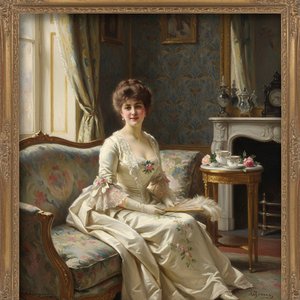
1846 - 1933

Esminiai duomenys

  • Top 3 works:
    • Portrait of Madame Judic during Act II of "Niniche"
    • Scholar at the Table
    • The Levite of Ephraim and the old man of Gibeah
  • Art period: 19th Century
  • Died: 1933
  • Lifespan: 87 years
  • Works on this site: 7
  • Mediums: oil on canvas
  • Born: 1846, Brussels metropolitan area, Belgium
  • Typical colors: earthy

A Life in Color and History

Emile Wauters was a Belgian painter born in the Brussels metropolitan area. A student of Jean-François Portaels and Jean-Léon Gérôme, he gained early recognition with his 1868 work, The Battle of Hastings: The Finding of the Body of Harold by Edith. His career was marked by significant historical compositions, such as Mary of Burgundy entreating the Sheriffs of Ghent to pardon the Councillors Hugonet and Humbercourt, which caused a sensation in 1870. Other notable large-scale works include The Madness of Hugo van der Goes, Sobieski and his Staff before Besieged Vienna, and the vast panorama Cairo and the Banks of the Nile.

His artistic journey included travels to Italy and Egypt, the latter of which inspired works like The Great Mosque and Serpent Charmers of Sokko. Wauters was also a highly accomplished portraitist, creating over two hundred likenesses of prominent figures from Belgium, France, and America. His portraiture evolved from a sober style to a brilliant, forceful palette, eventually embracing pastel for life-size portraits of ladies.

Accolades and Recognition

Throughout his career, Wauters received numerous prestigious distinctions. His achievements include:

He held honorary memberships in the academies of Vienna, Berlin, and Munich, and served as a corresponding member of the Institut de France and the Madrid academy. His technical execution and ability to capture character and vitality placed him at the front rank of his profession.

Viktorina

Kiekviename klausime yra tik vienas teisingas atsakymas.

Klausimas 1:
In which city was Emile Wauters born?
Klausimas 2:
Which artist was one of Emile Wauters' teachers?
Klausimas 3:
What was the subject of Wauters' 1872 painting exhibited in the Brussels Museum?
Klausimas 4:
Which large panorama did Wauters execute in six months and exhibit in Brussels, Munich, and The Hague?
Klausimas 5:
In which year did Wauters exhibit his historical picture of Mary of Burgundy entreating the Sheriffs of Ghent?

Klausimai ir atsakymai

Kuriame mieste ir šalyje gimė Emile Wauters?

Emile Wauters gimė Brussels metropolitan area, Belgium šalyje.

Kur galiu pamatyti Emile Wauters kūrybą 3D galerijoje?

Emile Wauters 3D galerija yra puslapis, kuriame kūriniai rodomi virtualioje trimensione galerijoje.

Ar yra Emile Wauters kūrybos istorijos chronologija?

Chronologinė Emile Wauters kūrybos apžvalga galima rasti puslapio Karieros istorija puslapio, kuriame kūriniai pateikiami pagal jų kūrimo tvarką, skirstant į skyrius.

Kokie kiti Emile Wauters vardai yra žinomi?

Emile Wauters taip pat žinomas (žinoma) kaip Emile-Charles Wauters, E. Wauters, Wauter, Wauters, エミール・ワウタース.

Kaip rasti Emile Wauters darbus konkrečia spalvų paletė?

Pagrinti pagal spalvų paletę puslapio darbai Emile Wauters kūryboje suskirstyti pagal jų spalvų paletę.

Kokia Emile Wauters kūryba yra populiari?

Statistika apie Emile Wauters kūrybinį veiklą galima rasti puslapyje Statistika.

Ar galiu peržiūrėti Emile Wauters kūrybą pagal meno kryptis?

Meno kryptis, kuriomis dirbo Emile Wauters, galima rasti puslapio Visi meno kryptys, kuriame kūriniai sugrupuoti pagal meno kryptis.

Ar yra Emile Wauters kūrybos laiko linija?

Emile Wauters kūrybos laiko linija Kūrybos chronologija pateikia Emile Wauters darbus chronologine tvarka, metus po metų.

Ar yra apžvalga visų temų, kurias vaizdavo Emile Wauters?

Emile Wauters kūrybą temomis galima tyrinėti puslapio Tematų katalogas temų kataloge.