A Life Painted in Light: The Story of Edward Cucuel
Edward Alfred Cucuel, born in San Francisco in 1875, embarked on a journey that would lead him far from his Californian roots and establish him as a notable figure within the American
Impressionist movement. Though he began his artistic life immersed in the practical world of newspaper illustration, Cucuel’s spirit yearned for something more—a deeper engagement with color, light, and the fleeting beauty of
everyday life. His father, a newspaper publisher, initially guided his early steps, providing him with foundational training at the San Francisco School of Design. However, it was the allure of Europe that truly ignited his artistic passion. At just seventeen years old, Cucuel bravely crossed the Atlantic, seeking tutelage in Paris at the prestigious Académie Julian and later the École des Beaux-Arts. There, under the guidance of masters like Benjamin Jean-Joseph Constant, William Bouguereau, and Jean Leon Gérôme, he honed his skills and began to develop a style that would become distinctly his own.
From Paris to Munich: A European Apprenticeship
Cucuel’s artistic path wasn't linear. He returned briefly to the United States in 1896, working as an illustrator in
New York for approximately six months before once again succumbing to the magnetic pull of Europe. This time, his travels extended beyond Paris, taking him through France and Italy as he sought inspiration from the old masters. It was in Berlin that a pivotal moment occurred—he met Clara Lotte von Marcard, who would become his wife and artistic companion. In 1907, Cucuel settled in Munich, a city that would profoundly shape his artistic development. He fell under the influence of
Leo Putz, whose emphasis on
plein-air painting and warm, impasto brushwork resonated deeply with Cucuel’s own sensibilities. This period marked a turning point, as he began to fully embrace
Impressionism, focusing on idyllic scenes of women in European landscapes—a subject matter that would define his career.
The Essence of Leisure: Themes and Techniques
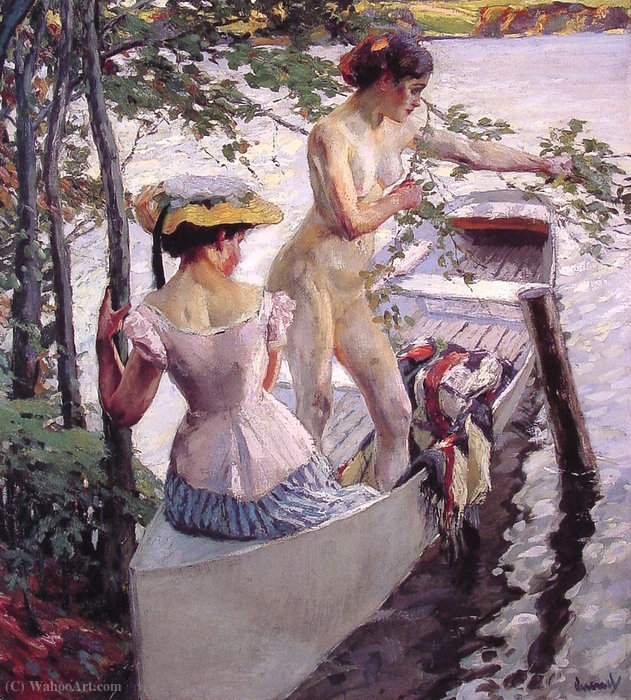
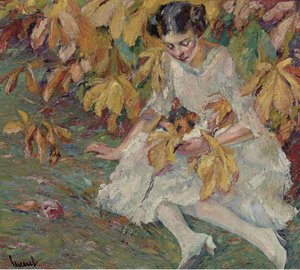
Cucuel's paintings are often described as serene and evocative, capturing moments of quiet leisure and feminine beauty. He possessed a remarkable ability to depict the interplay of
light and shadow, creating an atmosphere of warmth and tranquility. His canvases frequently feature women—often reclining by lakes or enjoying peaceful afternoons in sun-dappled gardens—immersed in nature. These weren’t grand historical narratives or dramatic allegories; instead, Cucuel found beauty in the ordinary, elevating
everyday scenes to a level of poetic grace. He masterfully employed a palette of soft pastels and rich impasto, building up layers of paint to create texture and depth. The influence of
German Expressionism is subtly present in his work, particularly in his use of color and composition, though he never fully abandoned the Impressionist principles that guided his artistic vision. His paintings are not merely representations of reality; they are emotional landscapes—expressions of a particular mood or feeling.
Recognition and Legacy
Throughout his career, Cucuel garnered increasing recognition for his distinctive style. His work was exhibited in prestigious Parisian salons, and he received a silver medal at the 1915 Panama-Pacific International Exposition in San Francisco—a testament to his growing reputation. While he maintained a strong presence in Europe for over four decades, World War II forced him to return to California in 1939, where he lived until his death in Pasadena in 1954. Today, Edward Cucuel’s paintings are held in museums and private collections across the United States, France, and Germany. He is remembered as an artist who successfully bridged the gap between American illustration and European
Impressionism, creating a body of work that continues to captivate viewers with its beauty, tranquility, and
emotional depth. His ability to capture the essence of leisure—the simple joys of life—remains powerfully resonant in our modern world.
Major Achievements
- Early Training & European Studies: Formal art education at Académie Julian and École des Beaux-Arts, Paris.
- Development of a Unique Style: Blending Impressionist techniques with subtle Expressionist influences.
- Recognition in Salons & Exhibitions: Consistent exhibition presence in Parisian salons and the 1915 Panama-Pacific International Exposition.
- Influence on Contemporary Artists: Involvement with the “Scholle” group led by Leo Putz, Munich.
- Lasting Artistic Legacy: Paintings held in major museum collections internationally and continued appreciation for his serene landscapes.